
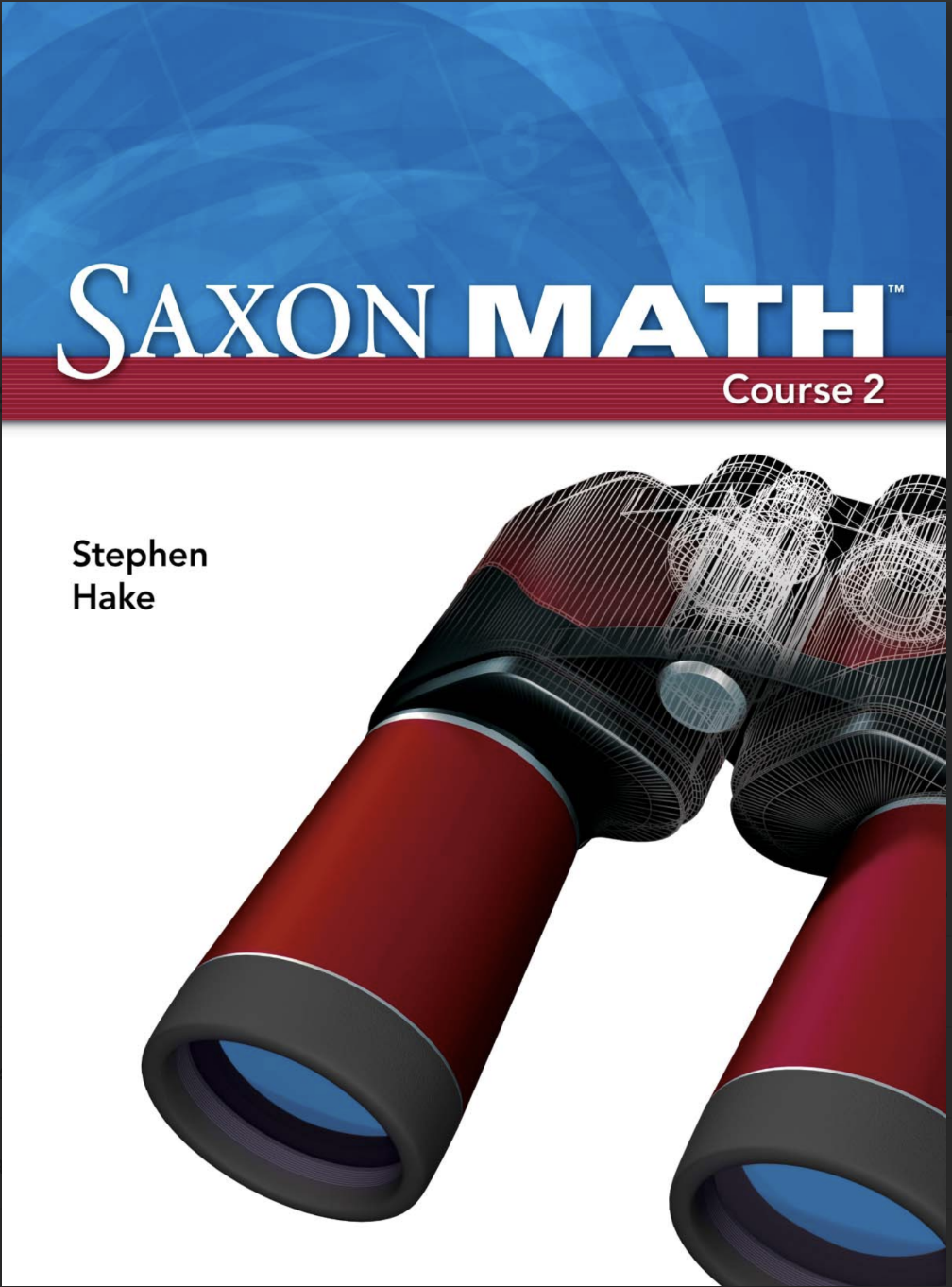
Saxon Math, Course 2
Saxon Math, Course 2, published by Saxon Publishers, is a Grade 7 mathematics textbook designed around Saxon's signature incremental approach, delivering instruction across 120 lessons and 12 hands-on investigations. The course covers a broad range of topics including fractions, decimals, and percents, integers and rational numbers, ratios and proportions, introductory algebra and equations, basic geometry, data analysis, probability, and problem-solving strategies. Each lesson builds systematically on prior concepts, with continuous mixed practice throughout all 12 chapters to reinforce long-term mastery and prepare students for pre-algebra and beyond.
Chapters & Lessons
Chapter 1: Lessons 1-10, Investigation 1
11 lessonsIn this Grade 7 Saxon Math Course 2 lesson, students review the four fundamental operations of arithmetic — addition, subtraction, multiplication, and division — applied to whole numbers and money amounts. Students practice key vocabulary including addends, sum, minuend, subtrahend, and difference while learning to correctly align decimal points and use dollar and cent notation. The lesson also introduces sequences and pattern recognition using triangular numbers as a problem-solving warm-up.
In this Grade 7 Saxon Math Course 2 lesson, students explore key properties of operations, including the Commutative Property of Addition and Multiplication, the Identity Properties of Addition and Multiplication, the Property of Zero for Multiplication, and inverse operations with fact families. Students also learn how parentheses group numbers in binary operations and are introduced to the Associative Property through examples showing that changing the grouping of addends or factors does not change the result. The lesson builds foundational algebraic reasoning skills using variables to express these properties in equation form.
In this Grade 7 Saxon Math Course 2 lesson, students learn how to find unknown numbers represented by variables in addition, subtraction, multiplication, and division equations using inverse operations. The lesson covers identifying unknown sums, addends, minuends, subtrahends, and differences, and teaches students to check their solutions by substituting answers back into the original equation. Part of Chapter 1, it builds foundational algebra skills essential for working with equations throughout the course.
In this Grade 7 Saxon Math Course 2 lesson, students learn to use the number line to identify and order integers, positive and negative numbers, and the origin, while applying comparison symbols (greater than, less than, equal to) to compare values. Students also practice representing addition and subtraction on the number line using directional arrows. The lesson introduces sequences and foundational integer concepts central to Chapter 1.
In this Grade 7 Saxon Math Course 2 lesson, students learn to identify place values from the ones place through the hundred trillions place and practice writing large whole numbers in expanded notation. The lesson also covers how to read and write multi-digit numbers as words, including proper use of commas to separate trillions, billions, millions, and thousands periods. Problem-solving with missing digits in subtraction reinforces place value understanding through regrouping.
In this Grade 7 Saxon Math Course 2 lesson, students learn to identify factors and factor pairs, find the greatest common factor (GCF) of two numbers, and apply divisibility rules for 2, 3, 4, 5, 6, 8, 9, and 10. The lesson covers how to determine whether one whole number is divisible by another without dividing, using digit-based tests such as checking the sum of digits or the last one to three digits. These foundational number theory skills prepare students for simplifying fractions and working with multiples in later chapters.
In Saxon Math Course 2 Lesson 7, Grade 7 students learn the foundational geometry concepts of points, lines, rays, line segments, angles, and planes, including how to identify and name each using proper symbols and notation. Students practice distinguishing between these one-, two-, and three-dimensional figures and apply segment addition to find missing lengths.
In Saxon Math Course 2 Lesson 8, Grade 7 students learn to represent parts of a whole using fractions and percents, including how to convert between the two by dividing 100% by the denominator. The lesson covers key vocabulary such as numerator, denominator, and mixed numbers, and extends to percents greater than 100% and identifying fractional mixed numbers on a number line.
In this Grade 7 Saxon Math Course 2 lesson, students learn how to add, subtract, and multiply fractions with common denominators, including mixed numbers and percentages. The lesson also introduces reciprocals and the Inverse Property of Multiplication, showing that a number multiplied by its reciprocal always equals 1. These foundational fraction skills are practiced through real-world examples such as measuring lengths and calculating money amounts.
In this Grade 7 Saxon Math Course 2 lesson, students learn how to express division remainders as mixed numbers by placing the remainder over the divisor as a fraction. The lesson also introduces improper fractions, showing students how to convert them to whole numbers or mixed numbers using division, and how to rewrite mixed numbers that contain improper fractions with proper fractions. These skills are applied across contexts including percent calculations and fraction addition and multiplication.
In this Grade 7 Saxon Math Course 2 investigation, students use hands-on fraction manipulatives — including halves, thirds, fourths, sixths, eighths, and twelfths — to explore equivalent fractions, mixed numbers, improper fractions, and fraction addition and subtraction. Students also convert common fractions such as one-half, two-thirds, and three-fourths to percents, and connect fraction representations to their decimal equivalents. The activity builds conceptual understanding of fraction relationships through group problem-solving and visual modeling.
Chapter 2: Lessons 11-20, Investigation 2
11 lessonsIn this Grade 7 Saxon Math Course 2 lesson, students learn to solve one-step word problems by identifying two common plot types — combining and separating — and writing equations using the formulas s + m = t and b − a = r. They practice the four-step problem-solving process to set up and solve for unknown addends or remainders in real-world contexts. This lesson builds algebraic thinking skills essential for translating word problems into equations.
In this Grade 7 Saxon Math Course 2 lesson, students learn to solve two types of word problems: comparison problems using the greater-minus-lesser-equals-difference formula (g - l = d), and elapsed-time problems using the later-minus-earlier-equals-difference formula (l - e = d). Students practice identifying key phrases like "how much greater" or "how much less" to set up subtraction equations, then apply the same logic to calculate elapsed time between historical dates and life events.
In this Grade 7 Saxon Math Course 2 lesson, students learn to solve word problems about equal groups using the formula n × g = t (number of groups times number in each group equals total). They practice applying a four-step problem-solving method to find either an unknown total by multiplying or an unknown factor by dividing, using real-world contexts like counting marbles, ticket sales, and cars on trucks.
In this Grade 7 Saxon Math Course 2 lesson, students learn to solve problems about parts of a whole using the addition pattern part + part = whole, working with fractions and percents to find missing quantities. Students also explore simple probability, using the formula P(Event) = favorable outcomes ÷ total possible outcomes to express the likelihood of an event as a fraction, decimal, or percent on a scale from 0 (impossible) to 1 (certain).
In this Grade 7 Saxon Math Course 2 lesson, students learn how to create equivalent fractions by multiplying a fraction by a form of 1, and how to reduce fractions to lowest terms by dividing both terms by their greatest common factor. The lesson covers key vocabulary including equivalent fractions, the terms of a fraction, and what it means to reduce a fraction, with worked examples such as reducing 18/24 using the greatest common factor of 6.
In this Grade 7 Saxon Math Course 2 lesson, students learn the units and equivalent measures of the U.S. Customary System, including weight (ounces, pounds, tons), length (inches, feet, yards, miles), liquid measure (cups, pints, quarts, gallons), and Fahrenheit temperature benchmarks. Students also explore function tables, using input-output rules to convert between units and solve real-world problems such as converting pounds to ounces or yards to inches.
Grade 7 students learn how to measure angles in degrees using a protractor, including how to correctly align the tool at a vertex and choose between the two scales based on whether an angle is acute or obtuse. The lesson also covers the degree measures associated with acute, right, obtuse, and straight angles and includes practice drawing angles of a specified measure. This content is from Lesson 17 of Chapter 2 in Saxon Math, Course 2.
Grade 7 students in Saxon Math Course 2 learn to identify and name polygons by their number of sides, distinguish between regular and irregular polygons, and understand the concepts of similar and congruent figures. The lesson covers polygon vocabulary including vertices, naming conventions using vertex letters, and how similar figures share the same shape while congruent figures share both the same shape and size.
In this Grade 7 Saxon Math Course 2 lesson, students learn how to calculate the perimeter of polygons by adding the lengths of all sides, including rectangles, regular polygons such as hexagons and octagons, and irregular polygons with right angles where some side lengths must be determined before solving. Students also practice working backwards from a known perimeter to find unknown side lengths, and develop general perimeter formulas using variables for triangles, rectangles, and squares.
In this Grade 7 Saxon Math Course 2 lesson, students learn to work with exponents by identifying the base and exponent in exponential expressions, evaluating powers such as 4² and 2³, and applying exponent rules to multiply and divide expressions with the same base. The lesson also introduces rectangular area, explaining how multiplying linear dimensions produces square units like ft², and how to calculate area by counting unit squares or multiplying length by width.
In this Grade 7 Saxon Math Course 2 investigation, students learn to use a compass and straightedge to draw concentric circles and inscribe a regular hexagon and regular triangle in a circle. The lesson introduces key geometric vocabulary including arc, radius, pivot point, inscribed polygon, inscribed angle, chord, and diameter. Students practice hands-on construction techniques while exploring properties of regular polygons and circle geometry.
Chapter 3: Lessons 21-30, Investigation 3
11 lessonsIn this Grade 7 Saxon Math Course 2 lesson from Chapter 3, students learn to distinguish between prime numbers and composite numbers by identifying factors, and practice finding prime factorization of whole numbers. Students apply the definition that a prime number has exactly two factors — 1 and itself — while composite numbers have three or more factors, using factor pairs and factor trees to break numbers down into their prime components. The lesson builds foundational number theory skills essential for working with fractions, greatest common factors, and least common multiples.
In this Grade 7 Saxon Math Course 2 lesson, students learn to solve multi-step problems involving a fraction of a group by using rectangle diagrams divided into equal parts. They practice finding fractional parts of a whole number, such as determining how many students out of a class wore sneakers or how many pages of a book were read, and also work with converting percents to fractions before solving. The lesson builds on prior knowledge of equal groups and parts of a whole to tackle real-world problems requiring two or more steps.
In this Grade 7 Saxon Math Course 2 lesson, students learn how to subtract mixed numbers with regrouping by renaming the minuend so that its fractional part is large enough to subtract from. The lesson covers cases where the fraction in the subtrahend is greater than the fraction in the minuend, requiring students to exchange one whole for an equivalent fraction based on the denominator, such as rewriting 3 1/5 as 2 6/5. Students also apply regrouping to subtract mixed number percentages and to subtract a mixed number from a whole number.
In this Grade 7 Saxon Math Course 2 lesson, students learn to reduce fractions using prime factorization and to find the greatest common factor of two numbers. The lesson also introduces canceling, a technique for reducing fractions before multiplying by pairing any numerator with any denominator across two or more fractions. These methods are applied to increasingly complex fraction multiplication problems to simplify calculations efficiently.
In this Grade 7 Saxon Math Course 2 lesson, students learn how to divide fractions by multiplying the dividend by the reciprocal of the divisor. The lesson builds conceptual understanding using fraction manipulatives before formalizing the "multiply by the reciprocal" rule, with examples covering whole number ÷ fraction, fraction ÷ fraction, and mixed number contexts.
In this Grade 7 Saxon Math Course 2 lesson (Chapter 3, Lesson 26), students learn how to multiply and divide mixed numbers by first converting them to improper fractions, then applying standard fraction multiplication or multiplying by the reciprocal of the divisor. The lesson covers squaring mixed numbers, finding areas of rectangles and squares with fractional side lengths, and simplifying results. Real-world word problems involving ribbon lengths, biscuit recipes, and geometric area reinforce these skills throughout the lesson.
In this Grade 7 Saxon Math Course 2 lesson, students learn to identify multiples and common multiples, find the least common multiple (LCM) of two or more numbers using list comparison and prime factorization, and solve equivalent division problems by multiplying or dividing both the dividend and divisor by the same number. Part of Chapter 3, the lesson builds number sense through practical examples and connects LCM concepts to the identity property of multiplication.
In Saxon Math Course 2, Grade 7 Lesson 28 introduces students to solving two-step word problems and calculating averages (also called the mean). Students learn to identify and combine problem-solving themes such as equal groups and separating, then apply a two-step process to find the mean by summing a set of numbers and dividing by the count of numbers. This lesson builds foundational skills in multi-step reasoning using real-world contexts like money, scores, and group sizes.
In this Grade 7 Saxon Math Course 2 lesson, students learn how to round whole numbers to a specified place value using both number line placement and the 4-5 split strategy, and how to round mixed numbers to the nearest whole number by comparing the fraction part to one-half. Students also apply these rounding skills to estimate answers in arithmetic problems. The lesson is part of Chapter 3 and builds foundational number sense for practical calculation and problem solving.
In this Grade 7 Saxon Math Course 2 lesson, students learn how to find common denominators and the least common denominator (LCD) using the least common multiple (LCM) of two denominators. They practice renaming fractions by multiplying by a fraction equal to 1, then use common denominators to compare, order, and add or subtract fractions with unlike denominators. The lesson builds essential fraction fluency needed for more advanced operations throughout the course.
In this Grade 7 Saxon Math Course 2 investigation, students explore the coordinate plane by learning to identify and graph ordered pairs using the x-axis, y-axis, origin, and four quadrants. Students practice reading coordinates, plotting points in all four quadrants including negative values, and applying coordinate graphing to find perimeters and areas of rectangles and squares. The investigation builds foundational skills for working with geometric figures on a coordinate grid.
Chapter 4: Lessons 31-40, Investigation 4
11 lessonsIn Saxon Math Course 2, Grade 7 students learn to read and write decimal numbers by understanding decimal fractions, place value positions from tenths through millionths, and the relationship between decimal notation and equivalent common fractions. The lesson covers how to interpret the number of decimal places as the denominator, name specific place values such as thousandths and ten-thousandths, and correctly read multi-part decimal numbers using "and" to represent the decimal point. Students also practice converting between word form, fraction form, and decimal notation for numbers like seventy-five thousandths and one hundred twenty-three thousandths.
In this Grade 7 lesson from Saxon Math, Course 2, students learn the structure of the metric system, including the base units of length (meter), capacity (liter), and mass (kilogram), along with how prefixes such as kilo-, centi-, and milli- indicate powers of 10. Students practice converting between metric units — such as kilometers to meters and centimeters to milliliters — and compare metric measurements to U.S. Customary equivalents. The lesson builds foundational skills for working with decimal-based unit conversions across real-world measurement contexts.
Grade 7 students in Saxon Math Course 2 learn how to compare decimal numbers by aligning decimal points and examining digits place by place, using terminal zeros to equalize decimal places for accurate comparison. The lesson also covers rounding decimals to a specified place value, applying the same underline-and-circle method used for whole numbers and removing unnecessary terminal zeros from the result.
In this Grade 7 Saxon Math Course 2 lesson, students learn to locate and name decimal numbers on a number line by dividing the intervals between whole numbers into 10 or 100 equal units, connecting place value concepts like tenths and hundredths to physical measurement. The lesson uses centimeter rulers and metersticks to practice expressing the same length in millimeters, centimeters, and meters using one- and two-place decimals. Students also practice arranging decimal numbers in order from least to greatest by identifying their positions on a number line.
In this Grade 7 Saxon Math Course 2 lesson, students learn how to add, subtract, multiply, and divide decimal numbers by aligning decimal points for addition and subtraction and counting combined decimal places to position the decimal point in products. The lesson uses real-world contexts such as finding perimeter and area of rectangles and converting inches to centimeters to reinforce each operation. This is Lesson 35 in Chapter 4 of the course.
In Saxon Math Course 2, Grade 7 students learn how to write and interpret ratios in multiple forms — including fractions, decimals, and colon notation — and apply ratio relationships to find missing parts or totals. The lesson also introduces sample space as a tool for counting outcomes in probability experiments, connecting probability to the concept of part-total ratios.
In this Grade 7 Saxon Math Course 2 lesson, students learn how to calculate the area of a triangle using the formula A = ½bh, understanding that a triangle's area is always half that of a rectangle with the same base and height. The lesson covers identifying the base and perpendicular height (altitude) for right, acute, and obtuse triangles, including cases where the height falls outside the triangle. Students apply the formula through hands-on activities and worked examples involving real measurements in square centimeters.
In this Grade 7 Saxon Math Course 2 lesson, students learn to interpret and extract quantitative information from four types of graphs: pictographs, bar graphs, line graphs, and circle graphs. Students practice reading graph scales, using keys, identifying trends, and comparing data across different visual formats. The lesson is part of Chapter 4 and builds foundational data literacy skills essential for understanding real-world mathematical representations.
In Saxon Math Course 2, Grade 7 students learn what a proportion is and how to solve for missing terms using cross products. The lesson teaches the two-step process of setting equal cross products and then dividing the known product by the known factor to find the unknown variable. Students apply this skill to real-world rate problems and practice solving proportions that include whole numbers and decimals.
In this Grade 7 Saxon Math Course 2 lesson, students learn that the interior angles of any triangle always sum to 180 degrees and practice finding unknown angle measures using that relationship. The lesson also introduces angle pairs formed by intersecting lines, building foundational geometry vocabulary and reasoning skills. Students apply these concepts through hands-on folding activities and algebraic equations to solve for missing angles.
Grade 7 students in Saxon Math Course 2 learn how to organize and analyze data using stem-and-leaf plots and box-and-whisker plots. The lesson covers key statistical measures including mode, range, median, and quartiles, showing students how to identify lower and upper quartiles by dividing a data set into four equal parts. Students then use these five key values — the two extremes, lower quartile, median, and upper quartile — to construct a box-and-whisker plot that displays the distribution of scores along a number line.
Chapter 5: Lessons 41-50, Investigation 5
11 lessonsGrade 7 students in Saxon Math Course 2 learn how to substitute values into formulas such as A = lw and p = 2(l + w) to calculate area and perimeter of rectangles. The lesson also introduces the Distributive Property of Multiplication Over Addition, showing that a(b + c) = ab + ac, and applies it to simplify algebraic expressions like 2(3 + n) + 4.
In this Grade 7 lesson from Saxon Math Course 2, students learn to identify and write repeating decimals using bar notation over the repetend, distinguishing them from terminating decimals. Students practice converting division problems into repeating decimal form, rounding repeating decimals to a specified number of decimal places, and comparing repeating decimals with terminating decimals. The lesson also introduces how calculators handle repeating decimals through truncation or rounding.
In this Grade 7 Saxon Math Course 2 lesson, students learn how to convert decimals to fractions by using place value to identify the denominator and then reducing, convert fractions to decimals by performing long division, and recognize the difference between terminating and repeating decimals. The lesson also covers writing mixed numbers as decimals and converting percents to decimals. These interchangeable representations of rational numbers build foundational fluency for algebraic reasoning throughout the course.
In this Grade 7 Saxon Math Course 2 lesson, students learn to express division answers in multiple forms, including with a remainder, as a mixed number, and as a decimal. The lesson also covers repeating decimals, rounding quotients to a specified decimal place, and interpreting remainders in real-world contexts such as grouping problems. Students practice selecting the most appropriate form of a division answer based on the situation.
In this Grade 7 Saxon Math Course 2 lesson, students learn how to divide by a decimal number by converting the problem into an equivalent division by a whole number — moving the decimal point in both the divisor and dividend the same number of places to the right. The lesson explains why multiplying the dividend and divisor by the same power of 10 produces an equivalent quotient, and walks through examples such as 3.35 ÷ 0.05 and 0.144 ÷ 0.8 using the standard division algorithm.
In this Grade 7 Saxon Math Course 2 lesson, students learn what a rate is and how to calculate common rates including speed using the formula r = d/t, mileage rates, pay rates, and unit prices by dividing two related measures. Through worked examples, students practice expressing rates as fractions with a denominator of 1 and applying rates by multiplying or dividing to solve real-world problems.
In this Grade 7 Saxon Math Course 2 lesson, students learn the three rules of exponents — multiplying, dividing, and raising a power to a power — using powers of 10 as the primary model. Students also practice writing numbers in expanded notation with powers of 10 and apply decimal point shifting to multiply and divide decimal numbers by positive powers of 10. The lesson connects exponent rules to place value and real-world large numbers expressed in standard form.
In this Grade 7 Saxon Math Course 2 lesson, students learn how to convert between fractions, decimals, and percents by multiplying by 100% or by equivalent forms of 1. The lesson covers writing fractions such as 2/3 as a percent, converting decimals like 0.8 to percent form, and completing conversion tables that include mixed numbers and values greater than 1. Students practice recognizing that fractions, decimals, and percents are three equivalent ways to represent the same part of a whole.
In this Grade 7 Saxon Math Course 2 lesson, students learn how to add and subtract mixed measures — measurements that combine different units from the same category, such as yards, feet, and inches or hours, minutes, and seconds. The lesson covers aligning like units, simplifying results by converting between units, and borrowing across units when subtracting requires regrouping.
In this Grade 7 Saxon Math Course 2 lesson, students learn how to use unit multipliers — fractions equal to 1 that contain equivalent measures — to convert between units of measurement such as inches to feet or feet to yards. Students practice setting up conversion problems by selecting the correct unit multiplier so that unwanted units cancel, leaving only the desired unit in the answer. This lesson connects fraction canceling and the Identity Property of Multiplication to real-world unit conversion within Chapter 5.
In this Grade 7 Saxon Math Course 2 investigation, students learn to create and interpret histograms, double-line graphs, and circle graphs using real data sets. Students explore how scale choices can create misleading visual effects in bar graphs and practice calculating central angles to construct accurate pie chart sectors. The lesson builds graph literacy by connecting stem-and-leaf plots to histograms and comparing multiple graph types for representing data effectively.
Chapter 6: Lessons 51-60, Investigation 6
11 lessonsGrade 7 students in Saxon Math Course 2 learn how to write large numbers using scientific notation, expressing them as a product of a decimal number and a power of 10. The lesson covers converting between scientific notation and standard form by shifting the decimal point based on the exponent, as well as comparing values written in scientific notation.
Grade 7 students in Saxon Math Course 2 learn the order of operations (PEMDAS) in Lesson 52, covering how to simplify expressions by working through parentheses and other symbols of inclusion, exponents and roots, multiplication and division, and addition and subtraction in the correct sequence. The lesson also applies these rules to evaluating algebraic expressions with variable substitution, using examples with fractions, exponents, and multi-step calculations.
In Saxon Math Course 2 for Grade 7, Lesson 53 teaches students how to solve ratio word problems using proportions and ratio boxes. Students learn to organize given ratio numbers and actual count numbers into a two-column table, then set up and solve a proportion to find an unknown quantity. This skill builds a foundation for applying proportional reasoning to more complex problems in later lessons.
In Saxon Math Course 2, Grade 7 students learn how to solve rate word problems using proportions and ratio boxes, applying unit rates involving distance, time, fuel efficiency, and wages. The lesson extends the proportion-based method from Lesson 53 to set up and solve equations with rates such as miles per hour or dollars per hour. Students practice finding unknown quantities by organizing rate and actual measure values into a structured ratio box and cross-multiplying to solve.
In this Grade 7 Saxon Math Course 2 lesson, students learn how to use the relationship between average, sum, and quantity to solve multi-step average and rate problems. Key skills include finding a missing number in a data set when the average is known, calculating unit price to compare costs, and determining average rate of pay across multiple pay rates. The lesson emphasizes organizing multi-step solutions clearly to reach a final answer efficiently.
In this Grade 7 Saxon Math Course 2 lesson, students learn to write function rules as equations using x and y variables, complete function tables, and plot input-output pairs as coordinates on a coordinate plane. The lesson covers how some functions produce discrete unconnected points while others, like y = 2x, form a continuous line when all values are graphed. Students also practice working backward from plotted points to determine the underlying function rule.
In this Grade 7 Saxon Math Course 2 lesson, students learn how negative exponents work using the rule a⁻ⁿ = 1/aⁿ and how to simplify expressions like 3⁻² and 10⁻³. Students also extend their understanding of scientific notation to small numbers, practicing how to convert between scientific notation with negative exponents and standard decimal form by shifting the decimal point to the left.
In this Grade 7 Saxon Math Course 2 lesson, students explore reflective symmetry and rotational symmetry in two-dimensional figures, learning to identify lines of symmetry and determine the order of rotational symmetry for polygons and letters. Students practice drawing lines of symmetry for regular polygons such as squares and triangles, and analyze figures on a coordinate plane where the y-axis serves as a line of symmetry. The lesson builds spatial reasoning skills through hands-on cutting activities and connects symmetry concepts to real-world shapes and objects.
In this Grade 7 Saxon Math Course 2 lesson, students learn to add positive and negative integers using a number line, representing each integer as a directed arrow pointing left or right. The lesson also introduces absolute value, explaining it as a number's distance from zero, and reinforces the concept that the sum of two opposites always equals zero. Students apply these skills to real-world contexts such as debt and elevation problems.
In this Grade 7 Saxon Math Course 2 lesson, students learn how to find a fractional part of a number and a percent of a number by translating word problems into equations, replacing "is" with an equals sign and "of" with multiplication. Students practice converting percentages to either fractions or decimals to solve real-world problems involving profit, sales commission, and sales tax. The lesson builds fluency in choosing the most efficient form — fraction or decimal — when calculating percent of a quantity.
In this Grade 7 lesson from Saxon Math Course 2, students learn to classify quadrilaterals by analyzing properties such as parallel sides, equal side lengths, and right angles, distinguishing between parallelograms, trapezoids, trapeziums, rectangles, rhombuses, and kites. Students use Venn diagrams to explore the hierarchical relationships among these shapes, including how a square is simultaneously a rectangle, a rhombus, and a parallelogram. The investigation also covers lines of symmetry for special quadrilaterals and compares perimeter and area when a rectangle is transformed into a parallelogram.
Chapter 7: Lessons 61-70, Investigation 7
11 lessonsIn this Grade 7 Saxon Math Course 2 lesson, students learn how to calculate the area of a parallelogram using the formula A = bh, understanding that the height is perpendicular to the base and distinct from the slanted side. The lesson also explores the angle relationships in a parallelogram, showing that opposite angles are equal and adjacent angles are supplementary. Students apply these concepts through hands-on activities and practice finding both perimeter and area of real-world parallelogram shapes.
In this Grade 7 Saxon Math Course 2 lesson, students learn to classify triangles by their angles as acute, right, or obtuse, and by their sides as equilateral, isosceles, or scalene. The lesson also covers the relationship between side lengths and opposite angle measures, including how to order sides from shortest to longest based on their corresponding angles. These concepts build foundational geometry vocabulary and reasoning skills essential for more advanced geometric proofs and problem solving.
In this Grade 7 Saxon Math Course 2 lesson, students learn how to solve ratio problems that involve totals by setting up a ratio box with a third row for the total and writing a proportion to find an unknown quantity. The lesson covers how to add the parts of a ratio to get the total ratio number, then use cross-multiplication to solve for actual counts. Students practice applying this method to real-world scenarios such as groups of people, mixed collections, and assorted objects.
In Saxon Math Course 2, Grade 7 Lesson 67 introduces students to geometric solids, including spheres, cylinders, cones, prisms, and pyramids. Students learn to distinguish polyhedrons from solids with curved surfaces and identify the faces, edges, and vertices of figures like cubes and triangular prisms. The lesson also covers how three-dimensional figures are formed by moving two-dimensional shapes through space and how nets represent unfolded solids.
In this Grade 7 lesson from Saxon Math Course 2, students learn the concept of algebraic addition, using it to simplify expressions involving subtraction of positive and negative numbers by rewriting them as addition problems. The lesson introduces opposites and explains how subtracting a number is equivalent to adding its opposite, including cases like simplifying expressions with double negatives such as negative of a negative. Students practice applying algebraic addition to integers, fractions, and decimals across a variety of multi-term expressions.
In this Grade 7 Saxon Math Course 2 lesson, students learn how to convert numbers into proper scientific notation when the coefficient is not already between 1 and 10, such as expressions like 4600 × 10⁵ or 0.25 × 10⁴. The lesson teaches a two-step process: first rewriting the coefficient in scientific notation, then combining the resulting powers of 10 using their place-value meanings to produce a single exponent. Students practice applying this method to both positive and negative exponents through guided examples and a written practice set.
In this Grade 7 Saxon Math Course 2 investigation, students learn to solve one-variable equations by isolating the variable — applying inverse operations such as subtraction and division equally to both sides of an equation to maintain balance. Using a balance-scale model, students work through equations like x + 12 = 33 and 2x = 132, practicing the two-step process of selecting the correct operation and performing it on both sides. Students also verify solutions by substituting the value of x back into the original equation.
Chapter 8: Lessons 71-80, Investigation 8
11 lessonsIn this Grade 7 Saxon Math Course 2 lesson, students learn how to find the whole group when a fraction and its corresponding part are known, using both diagram models and algebraic equations. The lesson teaches students to divide the known quantity by the numerator to find the unit fraction value, then multiply by the denominator to determine the total. Students also practice solving related fraction equations such as three-eighths P equals 51 by multiplying both sides by the reciprocal.
In this Grade 7 lesson from Saxon Math, Course 2, students learn how to solve implied ratio problems by setting up proportions using a case 1–case 2 ratio box. They practice writing and solving proportions with cross multiplication across real-world contexts such as unit pricing, rates, and equivalent ratios. The lesson builds students' ability to recognize constant ratios between two quantities and apply proportional reasoning to find unknown values.
In this Grade 7 Saxon Math Course 2 lesson, students learn the rules for multiplying and dividing positive and negative numbers, discovering that two numbers with the same sign produce a positive result while two numbers with different signs produce a negative result. The lesson builds understanding by connecting multiplication to repeated addition and uses the concept of opposites to explain why a negative times a negative equals a positive. Students apply these signed number rules across integers, decimals, and fractions in both practice and written exercises.
In Saxon Math Course 2, Grade 7 Lesson 74 builds on earlier fraction work by teaching students to solve fractional-part-of-a-number problems where either the fraction or the total is the unknown quantity. Students learn to translate word problems into equations by substituting multiplication for "of" and an equal sign for "is," then solve using division or multiplication by the reciprocal. The lesson also covers equivalent approaches using decimals in place of fractions.
In this Grade 7 Saxon Math Course 2 lesson, students learn to find the area of complex figures by dividing them into rectangles and triangles, then adding or subtracting the component areas. The lesson also introduces the trapezoid area formula A = ½(b₁ + b₂)h, explaining how multiplying the average of the two parallel bases by the height gives the correct area.
In this Grade 7 Saxon Math Course 2 lesson, students learn to identify and simplify complex fractions — fractions that contain one or more fractions in the numerator or denominator. Two methods are taught: multiplying by a reciprocal-based name for 1 to make the denominator equal 1, and rewriting the complex fraction as a division problem using the invert-and-multiply rule. Students also apply these skills to convert mixed-number percents such as 83⅓% into simplified fractions.
In this Grade 7 Saxon Math Course 2 lesson, students learn to solve percent problems by translating word problems into equations to find an unknown percent or an unknown whole number, including cases where the percent exceeds 100%. Building on Lesson 74's fractional-part problems, students practice converting between fractions, decimals, and percents as part of the solution process. The lesson covers all three forms of the percent equation: finding what percent one number is of another, finding a missing whole when a percent and part are given, and working with percents greater than 100%.
In this Grade 7 Saxon Math Course 2 lesson, students learn to graph inequalities on a number line using the symbols greater than, less than, greater than or equal to, and less than or equal to. They distinguish between open circles (for strict inequalities like x > 4) and filled dots (for inequalities like x ≤ 4), and understand that a shaded ray represents the infinite set of values satisfying an inequality. This lesson builds foundational algebra skills for representing and interpreting solution sets of one-variable inequalities.
In this Grade 7 Saxon Math Course 2 lesson, students learn how to estimate the area of irregular shapes by tracing their outlines onto a square grid, counting whole squares and half squares to approximate total area. The lesson applies this grid-counting method to real-world problems, such as calculating pounds per square inch by dividing weight by the estimated contact area of a shoe print or circular castor.
In Saxon Math Course 2, Grade 7 students learn about the three types of geometric transformations — reflection, translation, and rotation — and how to perform each on figures plotted on a coordinate plane. The lesson covers how flipping a shape across the x- or y-axis produces a reflection, sliding it to a new position creates a translation, and turning it around a center of rotation results in a rotation. Students practice identifying and drawing transformed figures using ordered pairs and prime notation for image vertices.
In this Grade 7 Saxon Math Course 2 investigation, students explore probability and odds, learning to express the likelihood of events as fractions, decimals, and percents while distinguishing between favorable outcomes and their complements. Students then extend this understanding to compound events, using multiplication to find the probability of two or more independent events occurring together. The investigation also introduces experimental probability, contrasting it with theoretical probability through hands-on trials and data analysis.
Frequently Asked Questions
- Is Saxon Math Course 2 the right math program for my 7th grader?
- Saxon Math Course 2 is an excellent choice for 7th graders who benefit from consistent, incremental practice and thorough review. Saxon's signature approach introduces new concepts in small steps and continuously revisits prior material through mixed practice, which works especially well for students who need to solidify foundations before moving forward. The course covers fractions, decimals, percents, integers, ratios, proportions, introductory algebra, geometry, data analysis, and probability. It is a strong traditional program. If your child thrives on conceptual exploration and open-ended problem solving, a curriculum like Illustrative Mathematics might be a better complement.
- Which lessons or topics in Saxon Math Course 2 tend to be the hardest?
- Integer operations with signed numbers typically cause the most trouble when they appear in the early-to-mid chapters. The transition to equation solving with variables in the algebra lessons around Chapters 4-7 is challenging for students who have not internalized inverse operation logic. Ratio and proportion word problems, especially those requiring multi-step setup, are another common sticking point. The good news about Saxon is that these topics keep reappearing in the mixed practice sets, so students get many chances to improve. But early confusion compounds quickly if not addressed promptly.
- My child struggles with fractions — where should they start in Course 2?
- Start with Chapter 1 Lessons 8 through 10, which cover fractions and percents, adding and subtracting fractions with common denominators, and writing division answers as mixed numbers. Then work through Chapter 2 Lesson 15 on Equivalent Fractions and Reducing Fractions along with Investigation 1, the hands-on fraction manipulative activity that builds concrete visual understanding. Do not skip the Investigation sessions. Once those foundations are solid, fraction skills will carry naturally into ratio and proportion work later in the course.
- What should my child study after finishing Saxon Math Course 2?
- After completing Saxon Math Course 2, the natural next step is Saxon Math Course 3, the 8th-grade pre-algebra course covering more advanced algebra, geometry, and data analysis. Students who complete Course 3 are well-positioned for Algebra 1 in high school. If your child performed strongly in Course 2, some families move directly to Saxon Algebra 1/2, a pre-algebra bridge course, or a standard Algebra 1 course depending on how thoroughly the Chapters 10-12 algebra lessons were mastered. Discuss placement with your child's teacher before skipping Course 3.
- How can Pengi help my child with Saxon Math Course 2?
- Pengi is very useful for Saxon because the 120 lessons and continuous mixed practice mean there is always a lot to review. When your child encounters an older concept in the mixed practice sets, say a ratio problem from Chapter 4 appearing in Chapter 9, Pengi can quickly re-explain that concept and generate a few targeted practice problems. For the algebra equation lessons in the middle chapters, Pengi can walk through inverse operation logic step by step. Pengi can also help your child work through the Investigation activities by explaining hands-on concepts through guided questions when physical manipulatives are not available.
Ready to start learning?
Jump into your first lesson for Saxon Math, Course 2. Free, no account required.
Start Learning