
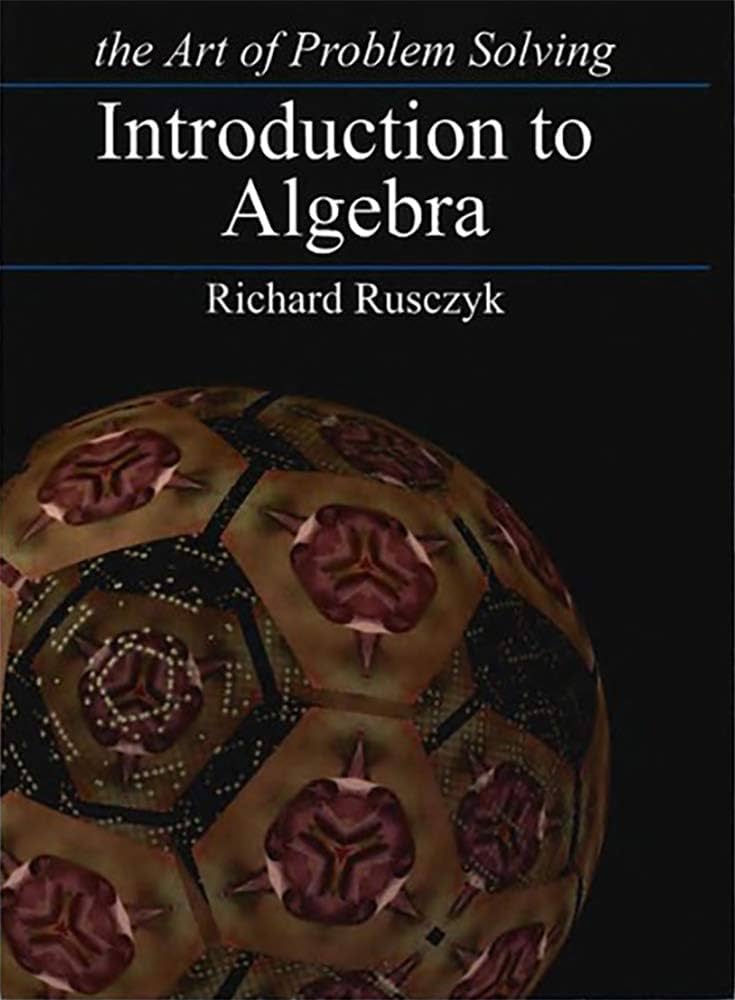
AoPS: Introduction to Algebra (AMC 8 & 10)
AoPS: Introduction to Algebra, published by AoPS Incorporated, is a rigorous math enrichment textbook designed for advanced learners preparing for competitions such as AMC 8 and AMC 10, typically used by highly motivated students around Grade 4 and beyond. The book provides a thorough foundation in algebra, covering topics from one- and multi-variable linear equations, ratios, proportions, and graphing lines to more advanced concepts including quadratic equations, complex numbers, polynomials, exponents, logarithms, sequences and series, and functions. With its problem-solving-focused approach, it challenges students to develop deep mathematical reasoning and the skills needed to excel in competitive mathematics.
Chapters & Lessons
Chapter 1: Follow the Rules
8 lessonsIn this Grade 4 AMC Math lesson from AoPS Introduction to Algebra, students explore the classification of numbers, including integers, rational numbers, irrational numbers, and real numbers. The lesson introduces key distinctions such as positive versus negative integers, why zero is neither positive nor negative, and how numbers like the square root of 2 cannot be expressed as a ratio of integers. It lays the foundational vocabulary students need for algebraic reasoning throughout the AoPS curriculum.
In this Grade 4 lesson from AoPS: Introduction to Algebra, students learn the order of operations — the standard rules for evaluating expressions that combine parentheses, exponentiation, multiplication, division, addition, and subtraction. The lesson covers why a consistent sequence (PEMDAS) is necessary and walks through step-by-step examples showing how changing the placement of parentheses changes the result. Students then practice applying these rules to multi-operation expressions, including those with nested brackets and exponents.
Grade 4 students explore the commutative and associative properties of addition and multiplication in this lesson from AoPS Introduction to Algebra. Students learn why order matters for subtraction and division but not for addition and multiplication, using variables to express general rules like a + b = b + a. The lesson also shows how applying these properties together can simplify complex calculations involving multiple numbers.
In this Grade 4 lesson from AoPS: Introduction to Algebra, students learn the distributive property — how multiplying a number by a sum equals the sum of individual products, such as 4 × (5 + 7) = 4 × 5 + 4 × 7 — and its reverse process called factoring. Through real-world problems involving animals, fish, and dot grids, students practice applying distribution and factoring with whole numbers, negative numbers, and subtraction. This lesson builds foundational algebraic reasoning skills aligned with AMC 8 and AMC 10 competition math.
In this Grade 4 AoPS Introduction to Algebra lesson, students learn the definition of an equation and key properties of equality, including the symmetric property, transitive property, and how to perform valid operations on both sides of an equation. Using a balance scale model as a visual foundation, students explore how adding, subtracting, multiplying, or dividing both sides by the same value keeps an equation balanced. This lesson is part of Chapter 1 and builds the foundational reasoning skills needed for AMC 8 and AMC 10 problem solving.
Grade 4 students in the AoPS Introduction to Algebra course learn how exponents work as shorthand for repeated multiplication, covering key terms like base and exponent and discovering the core laws of exponents including the product rule, power of a power rule, and negative and zero exponents. The lesson uses problems from Chapter 1 to build understanding of expressions like 3 to the 6th power and why rules such as a to the b times a to the c equals a to the b plus c hold true. Students also explore important distinctions like the difference between negative 2 to the 4th power and the quantity negative 2 to the 4th power, developing the careful reasoning needed for AMC 8 and AMC 10 competition math.
Grade 4 students in the AoPS Introduction to Algebra course learn how to interpret and evaluate fractional exponents, including expressions like x to the 1/2, x to the 1/3, and a to the n/m, by extending the integer exponent laws from the previous section. The lesson covers how to simplify fractional exponent expressions using prime factorization and the power of a power rule, with worked examples such as evaluating 25 to the 3/2 and 100 to the 5/2. Part of Chapter 1 in the AMC 8 and 10 preparation curriculum, this lesson also addresses the important distinction that even-root fractional exponents like x to the 1/2 are defined as nonnegative values.
In this Grade 4 AMC Math lesson from AoPS: Introduction to Algebra, students learn how to work with radicals, including evaluating square roots, cube roots, and higher-order roots using radical notation and fractional exponents. Students practice simplifying expressions like the square root of 12 into simplified form using prime factorization and the laws of exponents. The lesson also covers the general rule that the square root of a nonnegative number is always nonnegative, and introduces the identity x to the m/n power equals the nth root of x to the m.
Chapter 2: x Marks the Spot
4 lessonsIn this Grade 4 lesson from AoPS: Introduction to Algebra, students learn how to build and evaluate mathematical expressions by working with variables, constants, coefficients, and terms. The lesson introduces the concept of a variable as a placeholder that can take different values, contrasted with constants, and covers how to write products using coefficient notation such as 6x. Students also practice substituting specific values into expressions and applying the order of operations to evaluate them.
In this Grade 4 lesson from AoPS Introduction to Algebra, students learn to evaluate algebraic expressions by substituting values for variables, combine like terms such as 5x and 3x, and simplify expressions involving exponents and radicals. The lesson also covers critical rules for working with fractions and powers, including when canceling common factors is and is not valid. Part of Chapter 2 in the AMC 8 and 10 preparation curriculum, this lesson builds foundational skills in arithmetic with expressions that support more advanced algebraic reasoning.
In this Grade 4 lesson from AoPS: Introduction to Algebra (AMC 8 & 10), students apply the distributive property and factoring to algebraic expressions containing variables. They practice expanding products like 2(x + 7), subtracting polynomial expressions by distributing negative signs, and factoring out common terms from expressions such as 2a³ + 16a² − 8a. The lesson also emphasizes combining like terms correctly and recognizing when terms cannot be combined due to different variable expressions.
In this Grade 4 lesson from AoPS Introduction to Algebra, students learn how to simplify fractions involving variable expressions by factoring numerators and denominators to cancel common factors. The lesson also covers adding and subtracting algebraic fractions by finding a common denominator, including cases where denominators contain polynomial expressions like s+2. These skills are developed through AMC-style problems drawn from Chapter 2 of the AoPS curriculum.
Chapter 3: One-Variable Linear Equations
4 lessonsIn this Grade 4 lesson from AoPS: Introduction to Algebra, students learn how to solve one-variable linear equations by isolating the variable using equation manipulations such as adding or subtracting the same value from both sides. The lesson covers key concepts including what makes an equation "linear," the role of coefficients, and how to apply algebraic, logical, and visual approaches to find solutions. Part of Chapter 3 in the AMC 8 and 10 curriculum, it builds foundational algebra skills through worked examples involving integers, fractions, and decimals.
In this Grade 4 lesson from AoPS: Introduction to Algebra, students learn to solve multi-step one-variable linear equations by combining like terms, moving variable terms to one side, and isolating the variable using inverse operations. The lesson covers techniques such as eliminating fractions by multiplying by the least common denominator and identifying equations with no solution or infinitely many solutions. Part of Chapter 3 in the AMC 8 and 10 curriculum, it also introduces translating word problems into algebraic equations and verifying solutions by substitution.
In this Grade 4 AMC math lesson from AoPS: Introduction to Algebra, students learn how to translate word problems into one-variable linear equations by assigning variables to unknown quantities and building equations from verbal phrases. Using problems drawn from Chapter 3, students practice solving equations through algebraic manipulation and verifying solutions against the original problem conditions. The lesson emphasizes a systematic approach — define the variable, write the equation, solve, and check — as the core strategy for tackling real-world problem contexts.
In this Grade 4 AoPS Introduction to Algebra lesson, students learn to recognize and solve equations that are linear equations in disguise, including equations with square roots and variables in denominators. Using substitution and isolation techniques, students practice transforming complex expressions like 3√x − 2 = 30 − √x into standard one-variable linear equations they can solve step by step. The lesson also covers how to identify and check for extraneous solutions when variables appear under radicals or in denominators.
Chapter 4: More Variables
5 lessonsIn this Grade 4 lesson from AoPS: Introduction to Algebra, students learn how to evaluate multi-variable expressions by substituting given values for each variable and simplifying the result. Working through expressions involving operations such as exponents, fractions, and square roots with two or three variables like r, s, x, y, a, b, and c, students build fluency with substitution across a range of algebraic forms. This lesson is part of the AMC 8 and 10 preparation curriculum in Chapter 4: More Variables.
In this Grade 4 lesson from AoPS: Introduction to Algebra, students learn how to simplify algebraic expressions with multiple variables by combining like terms, grouping matching variable expressions such as x terms, y terms, and constants. The lesson extends these skills to multiplication and division of multi-variable expressions, including working with exponents, products like (3rs²)(2rs³), and cube roots of expressions such as ∛(27a⁶b³).
In this Grade 4 lesson from AoPS: Introduction to Algebra, students learn how to apply the distributive property and factoring with multiple variables, extending the same techniques used with single variables and constants. Through real-world problems involving baseball and football team rosters, students practice expanding expressions like 7(2x + 4y) = 14x + 28y and simplifying multi-variable expressions by distributing subtraction across parentheses. This lesson builds fluency with core algebraic manipulation skills essential for AMC 8 and AMC 10 competition math.
In this Grade 4 lesson from AoPS: Introduction to Algebra (AMC 8 & 10), students learn how to add and subtract algebraic fractions with multiple variables by finding a least common denominator. The lesson covers simplifying fractions through factoring and canceling common factors before combining them. Students practice these skills with variable expressions such as combining fractions with denominators like rs, 6x²y, and 2ab(a-1).
In this Grade 4 lesson from AoPS: Introduction to Algebra, students learn how to solve multi-variable equations by isolating one variable in terms of others, using techniques such as subtracting terms from both sides, dividing by coefficients, and factoring. The lesson covers solving general forms like ax + b = c and more complex equations involving multiple variables and squared terms. Part of Chapter 4: More Variables, this lesson builds on earlier equation-solving skills to prepare students for AMC 8 and AMC 10 competition math.
Chapter 5: Multi-Variable Linear Equations
6 lessonsIn this Grade 4 AoPS Introduction to Algebra lesson, students learn what two-variable linear equations are and how to identify and generate their solutions as ordered pairs. Working with equations like 2x − 3y = 7, students practice substitution and discover patterns that reveal why these equations have infinitely many solutions. This lesson builds foundational skills in solving for one variable in terms of another, preparing students for AMC 8 and AMC 10 problem-solving.
In this Grade 4 AMC Math lesson from AoPS: Introduction to Algebra, students learn the substitution method for solving systems of two-variable linear equations. They practice isolating one variable in one equation and substituting that expression into the second equation to produce a solvable one-variable linear equation. The lesson covers applying substitution to systems involving fractions and decimals, and verifying solutions by checking them in both original equations.
In this Grade 4 AoPS Introduction to Algebra lesson, students learn the elimination method for solving systems of two-variable linear equations by adding or subtracting equations to cancel out one variable. The lesson covers multiplying one or both equations by constants to set up elimination, and explores why a system can have no solution, exactly one solution, or infinitely many solutions. It is part of Chapter 5 on Multi-Variable Linear Equations, aligned with AMC 8 and AMC 10 preparation.
In this Grade 4 AMC Math lesson from AoPS Introduction to Algebra, students learn to recognize and solve systems of two-variable equations in disguise, where non-linear equations involving square roots or reciprocals can be transformed into standard linear systems using substitution and elimination. Working through problems like finding values where the sum of square roots equals 37 or solving systems with fractional terms, students practice the key strategy of substituting a new variable for an unfamiliar expression to reveal the underlying linear structure. The lesson emphasizes experimentation and flexible problem-solving, showing that most systems can be approached multiple ways once students identify the hidden linear form.
In this Grade 4 AMC Math lesson from AoPS: Introduction to Algebra, students learn how to solve systems of three-variable linear equations using substitution and elimination to reduce them to simpler two-variable systems. Working through problems like solving for x, y, and z simultaneously, students apply techniques such as multiplying equations to match coefficients and strategically eliminating variables step by step. This lesson is part of Chapter 5 on Multi-Variable Linear Equations and also introduces setting up multi-variable equations from word problems involving unknown quantities.
Chapter 6: Ratios and Percents
5 lessonsIn this Grade 4 lesson from AoPS: Introduction to Algebra, students learn how to interpret and apply basic ratios, including writing ratios as fractions or in colon notation and converting part-to-part ratios into part-to-whole ratios. Using problems aligned with AMC 8 and AMC 10 competition math, students practice setting up equations and solving for unknown quantities when given ratio and total information. This lesson builds foundational skills in proportional reasoning that are essential for more advanced algebra and competition problem-solving.
In this Grade 4 lesson from AoPS Introduction to Algebra, students work through advanced ratio problems by learning to distinguish between part-to-whole and part-to-part ratios and setting up correct algebraic equations. Using problems from MATHCOUNTS and AMC competitions, students practice cross-multiplying, solving two-variable linear equations, and finding ratios like x/y from complex expressions. The lesson emphasizes checking answers and recognizing when ratios apply even in problems that don't initially appear ratio-based.
In this Grade 4 lesson from AoPS: Introduction to Algebra, students learn how to use conversion factors — ratios equal to 1 — to convert between different units of measurement by canceling units in the numerator and denominator. The lesson covers setting up and applying conversion factors correctly, including choosing the proper orientation of the ratio so that unwanted units cancel out. Practice problems involve converting inches to feet and pounds to grams, building foundational skills for AMC 8 and AMC 10 problem solving.
In this Grade 4 AMC Math lesson from AoPS: Introduction to Algebra, students learn the definition of percent as a ratio per hundred and apply the equation a/b = x/100 to solve problems involving finding a percent of a number, determining what percent one number is of another, and working backwards from a percentage. Students also practice converting between fractions, decimals, and percents to simplify calculations, and explore how to increase or decrease a number by a given percentage using the expressions x(1 + k/100) and x(1 - k/100).
In this Grade 4 AMC Math lesson from AoPS Introduction to Algebra, students tackle percentage problems including percent increase and decrease using the formulas x(1 + k/100) and x(1 - k/100). The lesson covers converting between percents, decimals, and fractions, and emphasizes a critical concept: successive percentage changes multiply rather than add. Students also practice choosing convenient values for unknown quantities to simplify ratio and percent calculations.
Chapter 7: Proportion
4 lessonsIn this Grade 4 AoPS Introduction to Algebra lesson, students learn the concept of direct proportion, including how to identify the constant of proportionality and use the relationship x/y = k to solve for unknown values. The lesson covers practical applications such as using shadow lengths to calculate the height of objects and scaling medicine dosages by weight. It draws on students' prior ratio skills to build fluency with both algebraic and arithmetic approaches to proportion problems, in preparation for AMC 8 and AMC 10 competition math.
In this Grade 4 AoPS Introduction to Algebra lesson, students learn the concept of inverse proportion, where two quantities have a constant product rather than a constant quotient. Using worked problems from Chapter 7, students practice finding unknown values when quantities are inversely proportional, including cases involving higher powers like w² and z³, and real-world scenarios such as workers and time. The lesson also introduces a proof connecting inverse and direct proportion, building algebraic reasoning skills aligned with AMC 8 and AMC 10 preparation.
In this Grade 4 AoPS Introduction to Algebra lesson, students explore joint proportion — relationships in which more than two varying quantities are related through direct and inverse proportionality. Using the Ideal Gas Law (PV = nRT) as a central example, students practice isolating variables, identifying constant ratios, and solving multi-variable proportion problems. The lesson builds on earlier proportion concepts from Chapter 7 to prepare students for AMC 8 and AMC 10 competition problem-solving.
In this Grade 4 AoPS Introduction to Algebra lesson, students apply the rate-time-distance relationship (rate × time = distance) and its work equivalent (rate of work × time worked = amount of work done) to solve real-world proportion problems. Learners practice converting units, using inverse proportionality when distance or total work is constant, and accounting for relative motion and moving mediums. The lesson draws on Chapter 7's study of joint proportions to build problem-solving strategies for AMC 8 and AMC 10 style rate problems.
Chapter 8: Graphing Lines
6 lessonsIn this Grade 4 AoPS Introduction to Algebra lesson, students explore the foundations of analytic geometry by learning how to use the number line, including concepts of absolute value and magnitude, and how René Descartes extended it into the Cartesian plane. Students practice plotting points using ordered pairs and identifying x-coordinates and y-coordinates relative to the origin. This lesson from Chapter 8 sets the stage for graphing two-variable linear equations in preparation for AMC 8 and AMC 10 competition math.
In this Grade 4 lesson from AoPS Introduction to Algebra, students learn how to graph two-variable linear equations of the form Ax + By = C on the Cartesian plane and discover why these equations produce straight lines. The lesson introduces slope using the formula m = (y₂ - y₁) / (x₂ - x₁), covering positive, negative, zero, and undefined slope and what each means geometrically. Aligned with AMC 8 and AMC 10 preparation, this lesson builds foundational graphing skills within Chapter 8's study of linear equations.
In this Grade 4 AoPS Introduction to Algebra lesson, students apply slope to solve real problems, including graphing a line from a single point and a given slope, and determining whether sets of coordinate points are collinear by comparing slopes. Students also learn the midpoint of a segment and practice the correct order of coordinates when computing slope using the formula (y₂ − y₁) / (x₂ − x₁). The lesson is part of Chapter 8 on Graphing Lines and builds the skills needed for AMC 8 and AMC 10 competition problems.
In this Grade 4 AoPS Introduction to Algebra lesson, students learn how to find the equation of a line given its graph or key information, working with point-slope form and standard form (Ax + By = C). Students practice calculating slope between two points and rearranging equations into standard form with integer coefficients. The lesson is part of Chapter 8 on Graphing Lines and aligns with AMC 8 and AMC 10 competition math preparation.
In this Grade 4 AoPS Introduction to Algebra lesson, students learn how to identify x-intercepts and y-intercepts, and explore slope-intercept form (y = mx + b) to determine a line's slope and y-intercept directly from its equation. The lesson also covers finding the slope from standard form (Ax + By = C) and introduces parameterization as a technique for relating multiple quantities through a single variable. Part of Chapter 8 on Graphing Lines, this lesson builds AMC 8 and AMC 10 problem-solving skills through worked examples and graphing practice.
In this Grade 4 lesson from AoPS Introduction to Algebra, students learn to identify and compare parallel and perpendicular lines by analyzing slope relationships, including the rule that lines with equal slopes are parallel and lines with slopes whose product is negative one are perpendicular. The lesson also covers systems of two-variable linear equations and the three possible solution outcomes: no solution, one solution, or infinitely many solutions, depending on how the lines relate graphically. Students practice graphing systems on the Cartesian plane and verifying intersection points algebraically using slope-intercept form.
Chapter 9: Introduction to Inequalities
5 lessonsIn this Grade 4 AMC math lesson from AoPS: Introduction to Algebra, students learn the fundamental rules for manipulating inequalities, including the transitive property, addition and subtraction properties, and how multiplying or dividing by a negative number reverses the inequality sign. The lesson also covers how exponents and roots apply to inequalities and introduces inequality chains. These concepts build directly on students' prior work with equations in preparation for AMC 8 and AMC 10 competition problem solving.
In this Grade 4 AoPS Introduction to Algebra lesson from Chapter 9, students learn how to compare non-integer quantities such as nested radicals and large exponential expressions by applying inequality manipulation techniques like squaring both sides, taking roots, and multiplying or dividing by positive quantities. The lesson emphasizes that valid inequality operations preserve the direction of the inequality sign, enabling students to simplify complex comparisons into straightforward arithmetic. Students also explore strategies such as comparing fractions to 1 and taking common roots to order numbers like 2 to the 300th power versus 3 to the 200th power without a calculator.
In this Grade 4 lesson from AoPS: Introduction to Algebra, students learn to solve and graph linear inequalities with one variable, such as isolating x in expressions like 3x − 7 ≥ 8 − 2x using addition, subtraction, and division. The lesson introduces number line graphs with open and closed circles to distinguish strict and nonstrict inequalities, and teaches interval notation using brackets, parentheses, and the infinity symbol to express solution sets. This foundational AMC 8 and 10 topic builds algebraic reasoning skills essential for competition math.
In this Grade 4 AoPS Introduction to Algebra lesson, students learn how to graph two-variable linear inequalities on a coordinate plane by plotting a boundary line and shading the solution region. The lesson covers key techniques such as using a test point like the origin to determine which side to shade, distinguishing between solid and dashed boundary lines for nonstrict versus strict inequalities, and finding the intersection region that satisfies two simultaneous linear inequalities. This chapter from the Introduction to Inequalities unit builds the foundational graphing skills needed for AMC 8 and AMC 10 competition problems.
In this Grade 4 AoPS Introduction to Algebra lesson, students learn how to solve optimization problems by finding the maximum or minimum value of a quantity using inequalities and graphical methods. Working through problems from Chapter 9, they practice setting up and solving rational inequalities, maximizing expressions with integer constraints, and using coordinate plane graphs to identify the largest possible value of a linear expression over a feasible region. This lesson draws on AMC 8 and AMC 10 competition problems to build strategic problem-solving skills alongside core inequality concepts.
Chapter 10: Quadratic Equations - Part 1
5 lessonsIn this AoPS Introduction to Algebra lesson, Grade 4 students are introduced to quadratic equations in the standard form ax² + bx + c = 0, learning to identify the quadratic term, linear term, constant term, and coefficients. Students practice solving quadratics by taking square roots with the ± rule, factoring expressions as products of binomials, and applying the zero-product property. The lesson builds directly on prior work with linear equations and prepares students for AMC 8 and AMC 10 problem-solving strategies.
In this Grade 4 AoPS Introduction to Algebra lesson, students learn how to factor quadratic expressions of the form x² + bx + c by finding two numbers r and s such that r + s equals the linear coefficient and rs equals the constant term. The lesson covers identifying roots and zeros of a quadratic equation by rewriting it as a product of binomials and applying the zero-product property. Part of Chapter 10 on Quadratic Equations, this lesson builds problem-solving strategies for AMC 8 and AMC 10 competition math.
In this Grade 4 AMC Math lesson from AoPS: Introduction to Algebra, students learn how to factor quadratic expressions of the form ax² + bx + c where the leading coefficient a is not equal to 1. Building on binomial multiplication, students apply number sense strategies including parity analysis and coefficient magnitude to systematically identify the correct binomial factorizations. The lesson covers key techniques for matching factors of a and c using the linear term b as a guide, with worked examples such as factoring 5x² − 36x + 7 and 8x² + 23x + 15.
In this lesson from AoPS: Introduction to Algebra, Grade 4 students learn how to use Vieta's formulas to find the sum and product of the roots of a quadratic equation ax² + bx + c = 0, where the sum of the roots equals −b/a and the product equals c/a. The lesson derives these relationships by expanding the factored form a(x − r)(x − s) and equating coefficients, then applies them to solve problems involving unknown coefficients. Students practice multiple solution strategies, including substitution, factored-form construction, and direct use of the root-coefficient relationships.
In this Grade 4 AoPS Introduction to Algebra lesson, students apply quadratic factoring techniques to complex rational equations, learning to identify and eliminate extraneous solutions caused by zero denominators. The lesson also covers treating multi-variable equations as quadratics in a single variable and using substitution to simplify complicated expressions. Problems are drawn from AMC 10 competition contexts, extending core quadratic skills to advanced applications.
Chapter 11: Special Factorizations
5 lessonsIn this Grade 4 AMC Math lesson from AoPS: Introduction to Algebra, students learn how to expand and factor squares of binomials using the identity (a + b)² = a² + 2ab + b². The lesson covers recognizing perfect square trinomials, applying the pattern to both positive and negative terms, and factoring expressions back into binomial squares. Students practice identifying whether a quadratic expression fits the perfect square form across a range of problems, including those with fractions and two variables.
In this Grade 4 AMC math lesson from AoPS: Introduction to Algebra, students learn the difference of squares factorization — the identity a² − b² = (a − b)(a + b) — and practice applying it to expressions like 4t² − 121 and z⁴ − 1. The lesson extends this technique to solving Diophantine equations by factoring expressions such as (m − n)(m + n) = 105 to find all integer solution pairs. Part of Chapter 11: Special Factorizations, this lesson builds algebraic reasoning skills essential for AMC 8 and AMC 10 competition preparation.
In this Grade 4 AoPS Introduction to Algebra lesson from Chapter 11, students learn how to factor the sum and difference of cubes using the identities x³ − y³ = (x − y)(x² + xy + y²) and x³ + y³ = (x + y)(x² − xy + y²). The lesson guides students through deriving these factorizations by recognizing patterns in expanded products, then applying logical reasoning to construct the correct quadratic factors. Special attention is given to understanding why each identity works rather than simply memorizing the formulas, helping students avoid common errors when applying these special factorizations.
In this Grade 4 AoPS Introduction to Algebra lesson from Chapter 11, students learn how to rationalize the denominator of fractions by eliminating irrational expressions such as square roots and cube roots from the denominator. The lesson covers multiplying numerator and denominator by an appropriate radical factor, including using conjugate expressions like a√b − c√d to clear binomial irrational denominators. Students practice these techniques through AMC-style problems drawn from the chapter's special factorizations.
In this Grade 4 AoPS Introduction to Algebra lesson, students learn Simon's Favorite Factoring Trick, a technique for factoring expressions that contain the product of two variables along with linear terms in each variable, such as mn + m + n or bc − 7b + 3c, by strategically adding a constant to rewrite the expression in the form (a + x)(b + y). The lesson applies this factorization method to Diophantine equations, guiding students to find all integer or positive integer solution pairs by reducing the problem to finding factor pairs of a constant. Part of Chapter 11's Special Factorizations unit, the lesson also reinforces awareness of solution constraints, such as restricting answers to positive integers only.
Chapter 12: Complex Numbers
3 lessonsIn this lesson from AoPS Introduction to Algebra, Grade 4 students explore the historical development of number systems, learning to distinguish between rational numbers (ratios of integers) and irrational numbers such as the square root of 2. The lesson introduces proof by contradiction through Hippasus's classical proof that the square root of 2 cannot be expressed as a ratio of two integers, laying the foundation for understanding complex numbers in Chapter 12.
In this Grade 4 AMC Math lesson from AoPS: Introduction to Algebra, students explore imaginary numbers by learning how the unit imaginary number i is defined through the equation i² = -1. Students practice evaluating expressions like (3i)² and (ai)², solve equations such as x² = -16 by expressing solutions in the form ±bi, and discover the repeating four-cycle pattern of powers of i. The lesson builds foundational understanding of imaginary numbers as distinct from real numbers on the number line.
In this Grade 4 AMC Math lesson from AoPS: Introduction to Algebra, students learn to define and work with complex numbers, identifying the real part and imaginary part of expressions such as 3 + 2i. Students practice adding and subtracting complex numbers by combining like parts, and multiply complex number binomials using the property that i² = -1. The lesson also introduces complex conjugates and the cyclic pattern of powers of i as foundational tools for simplifying complex expressions.
Chapter 13: Quadratic Equations - Part 2
4 lessonsIn this Grade 4 AMC Math lesson from AoPS Introduction to Algebra, students revisit the perfect square identity a² + 2ab + b² = (a + b)² and learn how it leads to the technique of completing the square for solving quadratic equations. Working through Chapter 13, students practice isolating squared binomials, taking square roots to find real and imaginary solutions, and identifying when a quadratic is a perfect square trinomial. The lesson builds directly on prior factoring methods from Chapter 10 to handle quadratics that are difficult or impossible to factor.
In this Grade 4 AoPS Introduction to Algebra lesson, students learn the technique of completing the square to solve any quadratic equation, including cases where the leading coefficient is not 1. Working through problems like x² + 8x = 14 and 3x² + 12x + 1 = 0, students practice adding the square of half the x-coefficient to both sides and rewriting the equation in the form (x + a)² = b before solving. This lesson is part of Chapter 13 and builds on students' earlier understanding of perfect square binomials and square roots.
In this Grade 4 AMC Math lesson from AoPS: Introduction to Algebra, students derive the quadratic formula x = (−b ± √(b²−4ac)) / 2a by applying the completing the square method to the general form ax² + bx + c = 0. Students learn to identify the coefficients a, b, and c and use the formula to find real and complex roots of quadratic equations. The lesson also emphasizes validating derived formulas using known test cases such as factorable quadratics.
In this Grade 4 AoPS Introduction to Algebra lesson, students apply Vieta's formulas — the sum and product of roots expressed as r + s = −b/a and rs = c/a — to solve advanced quadratic problems involving complex conjugate roots and rational equations. Learners practice clearing denominators to convert rational equations into standard quadratic form, then solve using the quadratic formula while checking for extraneous solutions. The lesson also guides students through multiple proof methods showing how the roots of related quadratics scale by a constant factor, reinforcing deeper structural understanding of quadratic equations at the AMC 8 and 10 competition level.
Chapter 14: Graphing Quadratics
2 lessonsIn this Grade 4 AMC Math lesson from AoPS: Introduction to Algebra, students learn to graph quadratic equations and identify key features of parabolas, including the vertex, axis of symmetry, and how the coefficient a determines whether a parabola opens upward or downward and how wide it appears. Students explore the standard form y = a(x − h)² + k to understand how changing h and k shifts the parabola horizontally and vertically, and how the vertex is located at the point (h, k). The lesson also introduces parabolas with a horizontal axis of symmetry written in the form x = a(y − k)² + h.
In this lesson from AoPS Introduction to Algebra, Grade 4 students learn how to derive and apply the standard form equation of a circle, (x − h)² + (y − k)² = r², where (h, k) is the center and r is the radius. Students use the distance formula to understand why a circle is defined as all points equidistant from a center, and practice identifying centers and radii from equations, as well as converting non-standard equations into standard form by completing the square and dividing to normalize coefficients.
Chapter 15: More Inequalities
3 lessonsIn this Grade 4 AoPS Introduction to Algebra lesson from Chapter 15, students learn how to solve polynomial and rational inequalities with three or more factors, such as cubic expressions and rational expressions with factors in the denominator. Using sign charts and number line analysis, they determine where products and quotients are positive or negative by tracking the sign of each individual factor across different intervals. The lesson is part of the AMC 8 and 10 preparation curriculum and builds directly on earlier quadratic inequality techniques.
In this Grade 4 AMC Math lesson from AoPS Introduction to Algebra, students explore the Trivial Inequality, which states that the square of any real number is always greater than or equal to zero. Students learn to apply this fundamental principle to prove related inequalities, including the AM-GM inequality for two variables, using the algebraic technique of working backwards from a desired result. The lesson also emphasizes why valid proofs must be written forwards, starting from known true statements.
In this Grade 4 AMC Math lesson from AoPS: Introduction to Algebra, students learn how to find the maximum or minimum values of quadratic expressions by applying the technique of completing the square alongside the Trivial Inequality. The lesson covers how to rewrite a quadratic in the form a(x−h)² + k to identify its vertex and determine whether the expression reaches a highest or lowest value depending on the sign of the leading coefficient. Practice problems guide students through optimizing quadratics such as −x² + 5x − 7 and 2x² + 8x − 9 using both graphical reasoning and algebraic manipulation.
Chapter 16: Functions
6 lessonsIn this Grade 4 AMC Math lesson from AoPS Introduction to Algebra, students are introduced to the concept of a function, learning how to define and evaluate functions using function notation such as f(x) = 2x + 3. The lesson covers key vocabulary including domain, range, and dummy variables, and teaches students to identify whether a relationship qualifies as a function based on the rule that each input must produce exactly one output. Students practice applying these concepts across numerical and real-world contexts to build foundational algebraic reasoning for AMC competition preparation.
In this Grade 4 AMC math lesson from AoPS: Introduction to Algebra, students learn how to combine two functions through addition, subtraction, multiplication, and division to create new functions. The lesson covers how the domain of a combined function is determined by the domains of the original functions, with special attention to quotient functions where the denominator cannot equal zero. Students work through problems using concrete examples like linear and radical functions to build and verify these combined function rules.
In this Grade 4 AMC math lesson from AoPS: Introduction to Algebra, students learn how to perform function composition — connecting two functions so the output of one becomes the input of another — using notation such as f(g(x)) and the ∘ symbol. Students practice evaluating composed functions, working with iterated compositions like f(f(x)), and understanding why the order of composition matters. The lesson also covers the domain and range conditions required for composition and introduces the repeated application notation f^n(x).
In this Grade 4 lesson from AoPS Introduction to Algebra, students learn what inverse functions are, how to use the notation f⁻¹, and how to find the inverse of a function by solving the equation f(g(x)) = x for g(x). The lesson also covers the condition that determines whether a function has an inverse, specifically that a function cannot have an inverse if two different inputs produce the same output. Practice problems guide students through verifying inverse relationships by computing composed functions and algebraically isolating g(x).
In this Grade 4 AMC Math lesson from AoPS: Introduction to Algebra, students practice advanced problem solving with functional equations, including substitution techniques for expressions like f(x−3) and f(x/3). Students learn to correctly substitute variables, solve quadratic equations derived from functional equations, and model real-world counting scenarios using defined functions. The lesson emphasizes strategies such as working backwards, experimenting with simple values, and identifying patterns to solve challenging AMC 8 and AMC 10 style problems.
In this Grade 4 AoPS Introduction to Algebra lesson, students learn how to define and evaluate custom operations — such as x ★ y or a # b — by treating them as two-variable functions and applying substitution. Drawing from Chapter 16 on Functions, the lesson covers how standard operations like addition and multiplication are simply functions in familiar notation, then challenges students with AMC and MATHCOUNTS problems involving nested operations and solving equations with custom-defined operators.
Chapter 17: Graphing Functions
3 lessonsIn this Grade 4 AMC Math lesson from AoPS: Introduction to Algebra, students learn the basics of graphing functions on the Cartesian plane by plotting equations of the form y = f(x). Key concepts include identifying x-intercepts and y-intercepts, evaluating functions from a graph, and applying the vertical line test to determine whether a graph represents a valid function. Students also explore domain and range through worked examples involving quadratic functions and composite function evaluation.
In this Grade 4 AMC Math lesson from AoPS Introduction to Algebra, students explore function transformations, learning how vertical and horizontal shifts, scaling, and reflections affect the graph of y = f(x). Students practice applying rules such as adding a constant to the output for vertical shifts, replacing x with kx for horizontal scaling by a factor of 1/k, and negating the input or output to reflect a graph over the x- or y-axis. The lesson is part of Chapter 17 on Graphing Functions and emphasizes understanding how changes to a function's input versus output produce distinct graphical effects.
In this Grade 4 AMC Math lesson from AoPS: Introduction to Algebra, students explore the graphical relationship between a function and its inverse, learning that the graph of y = f⁻¹(x) is the reflection of y = f(x) over the line y = x. Students practice finding inverse functions algebraically and identifying corresponding coordinate pairs by reversing (a, b) to (b, a). The lesson also introduces the horizontal line test as a method for determining whether a function has an inverse.
Chapter 18: Polynomials
2 lessonsIn this Grade 4 AMC Math lesson from AoPS: Introduction to Algebra, students learn how to add and subtract polynomials by combining like terms, including expressions with degrees up to cubic and beyond. The lesson introduces subscript notation for polynomial coefficients and the general form of a degree-n polynomial. Students also practice determining unknown constants that change a polynomial's degree by canceling leading terms.
In this Grade 4 AMC Math lesson from AoPS: Introduction to Algebra, students learn how to multiply polynomials using the distributive property and an organized column method modeled after integer multiplication. The lesson covers key concepts including degree of a product, leading terms, constant terms, and monic polynomials, with worked examples such as expanding expressions like (3y² − 2y + 3)(y³ − 2y² + y − 7). Students also explore why the product of any two polynomials must itself be a polynomial and how the degrees of the factors relate to the degree of the product.
Chapter 19: Exponents and Logarithms
4 lessonsIn this Grade 4 AMC Math lesson from AoPS: Introduction to Algebra, students explore exponential functions by examining what happens when a variable serves as the exponent rather than the base. Using a rice-and-chessboard story, students compare linear growth to exponential growth and practice applying exponent rules such as (a^b)^c = a^bc and (a^b)(a^c) = a^(b+c). The lesson also introduces real-world applications of exponential functions, including carbon dating and half-life calculations.
In this Grade 4 AoPS Introduction to Algebra lesson, students learn the difference between simple interest and compound interest, including how to apply the compound interest formula when interest is compounded annually or multiple times per year. Using real-world loan and investment scenarios, students practice calculating total amounts owed using the expressions (1 + r/100)^n · k and (1 + r/100m)^(nm) · k. The lesson builds algebraic fluency with exponents in a financial context as part of Chapter 19's focus on Exponents and Logarithms.
In this Grade 4 AoPS Introduction to Algebra lesson, students apply compound interest formulas to solve real-world problems involving future value, present value, and unknown interest rates. Using the compound interest formula and its inverse, learners practice isolating variables with exponents to find quantities such as the present value of a future sum or the annual percentage rate on a loan. This lesson is part of Chapter 19's coverage of exponents and their practical applications within the AMC 8 and AMC 10 competition math context.
In this Grade 4 AoPS Introduction to Algebra lesson, students learn what a logarithm is and how to convert between logarithmic form (log_a b = c) and exponential form (a^c = b). The lesson covers evaluating logarithms with various bases, including base 10 common logarithms and fractional bases, through worked problems drawn from AMC 8 and AMC 10 preparation material. Students also explore the graph of a logarithmic function, identifying its domain, range, and x-intercept.
Chapter 20: Special Functions
5 lessonsIn this Grade 4 AMC Math lesson from AoPS Introduction to Algebra, students explore radical functions including square roots, cube roots, and fourth roots, learning how to determine the domain and range of functions like f(x) = √x and f(x) = ∛x. Students practice graphing transformed radical functions, comparing the relative sizes of different roots, and solving equations involving square roots while identifying extraneous solutions. The lesson builds on prior work with fractional exponents and function transformations introduced in earlier chapters of the textbook.
In this Grade 4 AMC Math lesson from AoPS: Introduction to Algebra, students learn how to define and apply absolute value as a number's distance from zero on the number line, including the notation |x| and the rule that |x| equals -x when x is negative. Students practice graphing absolute value equations such as y = |x| and y = |2x+5| - 3 by using a casework approach to eliminate the absolute value symbol and identify the characteristic V-shaped graph. The lesson also covers solving absolute value equations like |2x-9| = 5 by recognizing that the expression inside can equal both the positive and negative value of the right-hand side.
In this Grade 4 AMC Math lesson from AoPS Introduction to Algebra, students learn to evaluate the floor function and ceiling function, using the notation ⌊x⌋ and ⌈x⌉ to round real numbers down or up to the nearest integer. The lesson covers special cases with negative numbers, the fractional part notation {x}, and the key identity ⌊x⌋ + {x} = x. Students also practice graphing these step functions and applying them to expressions involving fractions and square roots.
In this Grade 4 AMC Math lesson from AoPS: Introduction to Algebra, students learn to define and work with rational functions — functions expressed as the ratio of two polynomials. The lesson covers solving rational equations by clearing denominators, identifying the domain and range of a rational function, and understanding horizontal and vertical asymptotes. Students practice these concepts through problems involving functions like f(x) = (3x − 4)/(x + 5), exploring how the function behaves as x approaches restricted values or grows very large.
In this Grade 4 AMC Math lesson from AoPS: Introduction to Algebra, students learn how piecewise defined functions apply different rules to different parts of a function's domain. Using bracket notation, students practice evaluating outputs, solving equations like f(x) = x, determining whether a piecewise function has an inverse, and graphing each piece to analyze continuity. The lesson also covers rewriting absolute value expressions such as f(x) = |3 − 7x| as piecewise defined functions without absolute value signs.
Chapter 21: Sequences & Series
5 lessonsIn this Grade 4 AoPS Introduction to Algebra lesson, students learn to identify arithmetic sequences, define the common difference, and apply the nth term formula a + (n−1)d to find any term in a sequence. Through problems involving negative terms, missing terms, and averages, students practice deriving formulas from first principles rather than memorization. This lesson is part of Chapter 21 on Sequences and Series, building foundational skills for AMC 8 and AMC 10 competition problem solving.
In this Grade 4 AMC Math lesson from AoPS Introduction to Algebra, students learn how to find the sum of an arithmetic series using the formula: number of terms multiplied by the average of the first and last terms, expressed as n[2a + (n−1)d]/2. The lesson walks through Gauss's classic method of pairing terms, and covers special cases including the sum of the first n positive integers (n(n+1)/2) and the sum of the first n odd integers (n²). Students also practice setting up algebraic expressions to solve multi-step arithmetic series problems from the AMC 8 and AMC 10.
In this Grade 4 AoPS Introduction to Algebra lesson, students learn how to identify and work with geometric sequences by understanding the common ratio between terms and applying the nth term formula ar^(n-1). The lesson also introduces the geometric mean as the square root of the product of two numbers, connecting it to the structure of geometric sequences. Drawn from Chapter 21 of the AMC 8 and AMC 10 curriculum, practice problems guide students through finding missing terms, solving for unknown common ratios, and modeling real-world exponential growth.
In this Grade 4 AMC Math lesson from AoPS: Introduction to Algebra, students learn how to find the sum of a geometric series using the formula a(r^n − 1)/(r − 1), and explore the special case where r equals 1. The lesson also introduces infinite geometric series, including the convergence formula a/(1 − r) for |r| < 1, and the concepts of convergent, divergent, and indeterminate series. Students apply these ideas through structured problem-solving that builds the general summation formula from first principles.
In this Grade 4 AMC Math lesson from AoPS Introduction to Algebra, students learn the telescoping technique for simplifying sums and products by identifying and canceling consecutive terms that appear with opposite signs or as factors in numerators and denominators. Working through problems in Chapter 21, students apply telescoping to expressions involving integer differences, radical denominators requiring rationalization, and fraction products to reduce complex multi-term expressions down to just a first and last term. The lesson also introduces partial fraction decomposition as a strategy for rewriting terms so that a series telescopes.
Chapter 22: Special Manipulations
3 lessonsIn this Grade 4 AMC Math lesson from AoPS Introduction to Algebra, students learn how to raise equations to powers as a strategic algebraic manipulation to simplify or evaluate expressions involving radicals and higher-degree terms. Working through problems that include squaring binomials with reciprocals, simplifying nested radical expressions using radical conjugates, and applying sum of cubes factorization, students practice recognizing when squaring or cubing both sides of an equation is more efficient than direct solving. The lesson is part of Chapter 22 on Special Manipulations and builds fluency with techniques commonly tested on AMC 8 and AMC 10 competitions.
In this Grade 4 AoPS Introduction to Algebra lesson from Chapter 22, students learn how to identify symmetric expressions and symmetric systems of equations, then exploit that symmetry to solve multi-variable systems efficiently. Using techniques like summing all equations simultaneously and multiplying equations together, students find solutions to systems with four or more variables, as practiced through AMC-style problems involving products and sums of unknowns.
Frequently Asked Questions
- Is AoPS Introduction to Algebra the right book for my child?
- AoPS Introduction to Algebra is designed for highly motivated students who want to go well beyond standard grade-level math — typically targeting AMC 8 and AMC 10 competition preparation. If your child has already mastered pre-algebra, enjoys challenging puzzles, and wants to develop deep mathematical reasoning rather than just procedural fluency, this book is an outstanding choice. It is significantly harder than a typical school algebra course. If your child finds standard 7th or 8th grade algebra difficult, this is not the right starting point — build that foundation first and return to AoPS once they are ready.
- Which chapters in AoPS Introduction to Algebra are the hardest?
- Chapters 10-12 covering quadratic equations, complex numbers, and polynomials are where most students struggle significantly. The quadratic formula derivation and working with imaginary and complex numbers in Chapter 11 require comfort with algebraic manipulation that students have been building all year. Chapter 13 (Exponents and Logarithms) and Chapter 15 (Sequences and Series) demand careful attention to rules and a high tolerance for multi-step problems. Chapter 6 (Linear Equations and Two Variables), while earlier, trips up students who are not yet fluent with graphing lines and interpreting slopes from word problems.
- My child is solid in pre-algebra but new to AoPS — where should they start?
- Begin with Chapter 1 (Follow the Rules), which establishes the AoPS approach through number classification, order of operations, properties, distribution, and exponents. Even if these topics feel familiar, the depth and rigor of the AoPS treatment is different from standard textbooks — your child will encounter harder problems than they expect. Work through Chapter 2 (Expressions) and Chapter 3 (One-Variable Linear Equations) carefully, paying particular attention to Chapter 3 Lesson 4 on linear equations in disguise. Mastery of Chapters 1-3 is essential before tackling the multi-variable and inequality work in Chapters 4 and 5.
- What should my child study after finishing AoPS Introduction to Algebra?
- After completing AoPS Introduction to Algebra, the natural progression within the AoPS curriculum is Introduction to Counting and Probability or Introduction to Number Theory, both of which are popular AMC preparation books. Students who want to continue with algebra should move to AoPS Intermediate Algebra, which covers more advanced topics including polynomial theory, complex numbers beyond the basics, and higher-level functions. The work done in Chapters 9-12 on quadratics, complex numbers, and polynomials provides direct preparation for both Intermediate Algebra and the AMC 10 competition problems that appear on those topics.
- How can Pengi help my child with AoPS Introduction to Algebra?
- Pengi can act as a patient problem-solving partner for the notoriously challenging AoPS problems. When your child gets stuck on a Chapter 3 word problem or cannot see how to transform a Chapter 4 linear equation in disguise, Pengi can provide Socratic hints — guiding your child toward the solution method without just giving the answer, which is how mathematical thinking actually develops. For the abstract chapters like Chapter 11 (Complex Numbers) and Chapter 13 (Logarithms), Pengi can explain the conceptual basis before your child dives into the hard problems. Pengi can also generate additional competition-style practice problems at the AMC 8 and AMC 10 difficulty level once your child has worked through each chapter.
Ready to start learning?
Jump into your first lesson for AoPS: Introduction to Algebra (AMC 8 & 10). Free, no account required.
Start Learning