
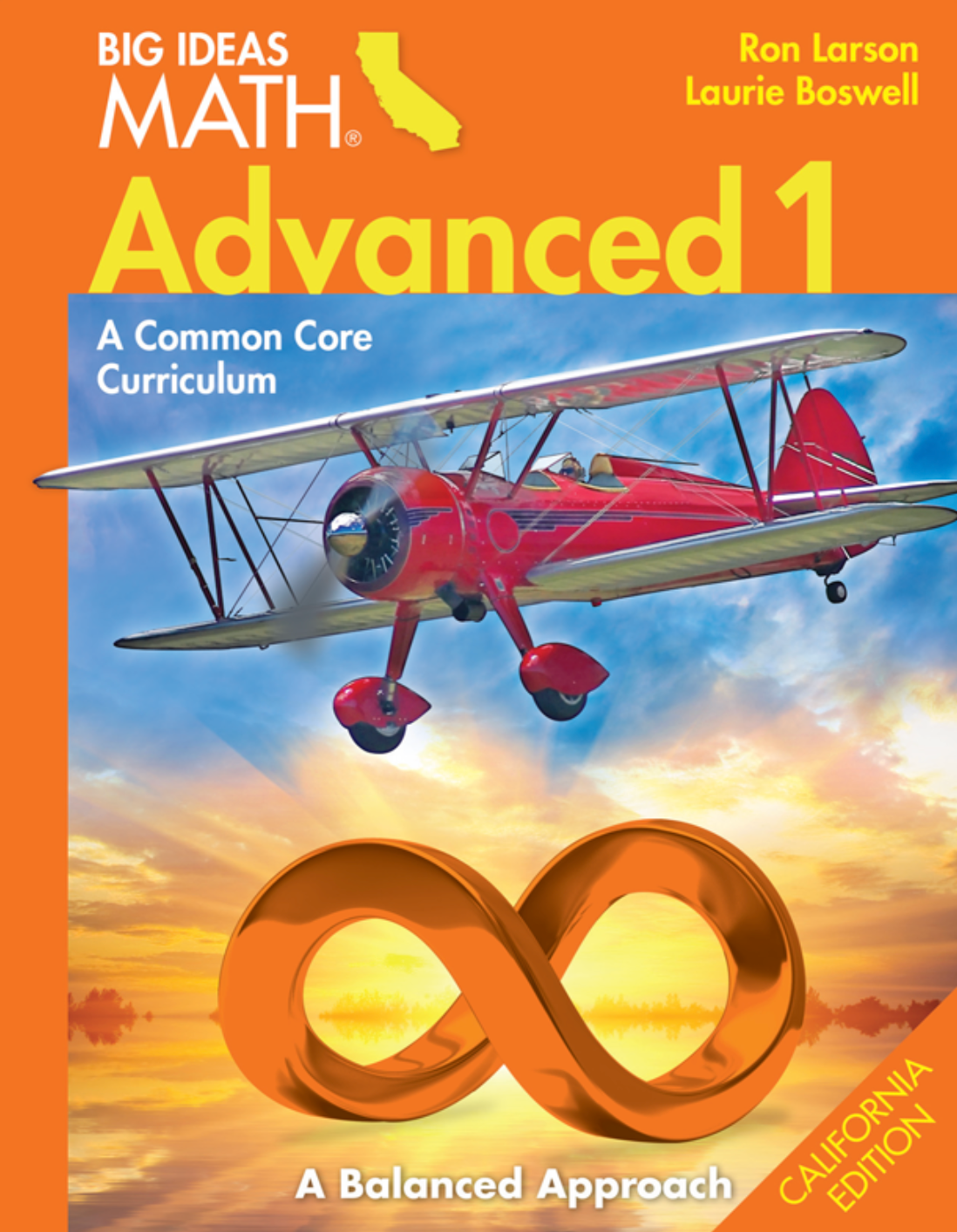
Big Ideas Math, Advanced 1
Big Ideas Math, Advanced 1, published by Big Ideas Learning LLC, is an accelerated Grade 6 mathematics textbook designed to build a strong foundation in middle school math concepts. The text covers a wide range of topics including numerical expressions and factors, fractions and decimals, ratios and rates, algebraic expressions, equations and inequalities, integers and the coordinate plane, rational numbers, and proportional reasoning with percents. Students also explore geometry through areas of polygons and surface area and volume, as well as data analysis through statistical measures and data displays.
Chapters & Lessons
Chapter 1: Numerical Expressions and Factors
6 lessonsIn this Grade 6 lesson from Big Ideas Math Advanced 1, Chapter 1, students learn how to identify which of the four basic whole number operations — addition, subtraction, multiplication, and division — to apply when solving real-life problems. Students practice recognizing key words and phrases in word problems, performing multi-digit calculations, and using estimation and inverse operations to check the reasonableness of their answers, in alignment with Common Core Standard 6.NS.2.
In this Grade 6 lesson from Big Ideas Math, Advanced 1 (Chapter 1: Numerical Expressions and Factors), students learn how to write and evaluate powers using bases and exponents, converting repeated multiplication such as 4 × 4 × 4 × 4 × 4 into exponential form like 4⁵. The lesson introduces key vocabulary including power, base, exponent, and perfect square, with students practicing how to identify perfect squares and apply exponents to real-life area problems.
In this Grade 6 lesson from Big Ideas Math Advanced 1, Chapter 1, students learn how to evaluate numerical expressions using the order of operations — performing calculations in parentheses first, then exponents, then multiplication and division from left to right, and finally addition and subtraction from left to right. Students practice applying these rules to expressions involving whole numbers, fractions, and decimals, including cases with exponents and nested parentheses. The lesson also explores how inserting parentheses into an expression changes its value and outcome.
In this Grade 6 lesson from Big Ideas Math Advanced 1, students learn how to write composite numbers as a product of their prime factors, known as prime factorization, using factor trees and factor pairs. The lesson also covers divisibility rules for 2, 3, 5, 6, 9, and 10, helping students determine whether one number is divisible by another without performing division. These skills are part of Chapter 1: Numerical Expressions and Factors and build foundational number theory concepts for middle school math.
In this Grade 6 lesson from Big Ideas Math Advanced 1, students learn how to find the greatest common factor (GCF) of two or more numbers using two methods: listing factors and using prime factorizations. The lesson uses Venn diagrams to visually identify common factors and common prime factors shared between numbers. Students also practice interpreting factor relationships and determining which pairs of numbers share a given GCF, aligned with Common Core standard 6.NS.4.
In this Grade 6 lesson from Big Ideas Math, Advanced 1, students learn how to find the least common multiple (LCM) of two or more numbers using two methods: listing multiples and using prime factorizations. The lesson covers identifying common multiples through Venn diagrams and factor trees, then applying the LCM to real-world problems such as finding when repeating events coincide. Part of Chapter 1: Numerical Expressions and Factors, this lesson aligns with Common Core standard 6.NS.4.
Chapter 2: Fractions and Decimals
6 lessonsIn this Grade 6 lesson from Big Ideas Math Advanced 1, Chapter 2, students learn how to multiply fractions by multiplying numerators together and denominators together, expressed algebraically as (a/b) × (c/d) = (ac)/(bd). Using visual models and paper folding activities, students build understanding of fraction multiplication before applying the standard algorithm, including simplifying products by dividing out common factors. The lesson prepares students for Common Core Standard 6.NS.1 on dividing fractions.
In this Grade 6 lesson from Big Ideas Math Advanced 1, students learn how to divide fractions by fractions using the concept of reciprocals and the rule of multiplying by the reciprocal of the divisor. The lesson covers writing reciprocals, applying the Multiplicative Inverse Property, and using visual models to understand division problems such as finding how many two-thirds are in three. Students practice solving real-life problems involving fraction division in alignment with Common Core standard 6.NS.1.
In this Grade 6 lesson from Big Ideas Math Advanced 1, students learn how to divide mixed numbers by converting them to improper fractions and multiplying by the reciprocal. The lesson covers dividing a mixed number by a fraction, dividing two mixed numbers, and applying order of operations with mixed number division. Students also practice solving real-life problems using these skills, aligned to Common Core standard 6.NS.1.
In this Grade 6 lesson from Big Ideas Math, Advanced 1 (Chapter 2: Fractions and Decimals), students learn how to add and subtract decimals by lining up decimal points vertically and inserting placeholder zeros to match decimal places. The lesson uses base ten block models and place value charts to build understanding before moving to standard algorithm practice with tenths, hundredths, and thousandths. It aligns with Common Core standard 6.NS.3 and includes real-life applications such as calculating costs and making change.
In this Grade 6 lesson from Big Ideas Math Advanced 1, students learn how to multiply decimals by whole numbers and by other decimals, applying the rule of counting and adding decimal places to place the decimal point correctly in the product. The lesson uses base ten block rectangles, area models on 10×10 grids, and mental math shortcuts for multiplying by powers of 10 to build conceptual understanding alongside the standard algorithm. It aligns with Common Core standard 6.NS.3 as part of Chapter 2: Fractions and Decimals.
In this Grade 6 lesson from Big Ideas Math Advanced 1, students learn how to divide decimals by both whole numbers and other decimals, including the technique of multiplying the divisor and dividend by a power of 10 to convert decimal division into whole number division. The lesson begins with hands-on base ten block models to build conceptual understanding before introducing the standard algorithm for placing the decimal point in the quotient. It aligns with Common Core standard 6.NS.3 and is part of Chapter 2: Fractions and Decimals.
Chapter 3: Algebraic Expressions and Properties
4 lessonsIn this Grade 6 lesson from Big Ideas Math, Advanced 1, students learn to identify and define the parts of an algebraic expression, including terms, variables, coefficients, and constants. Students practice writing algebraic expressions using exponents and evaluating expressions with one or two variables by substituting values and applying the order of operations. Real-life scenarios, such as calculating hourly wages and costs, help students connect algebraic thinking to everyday problem-solving.
In this Grade 6 lesson from Big Ideas Math Advanced 1, students learn how to translate verbal phrases into numerical and algebraic expressions by identifying key words that signal the four operations, such as "product of" for multiplication and "fewer than" for subtraction. The lesson covers writing expressions with variables, evaluating algebraic expressions, and applying them to real-world contexts like modeling tree growth with the expression 10 + 15t. Part of Chapter 3 on Algebraic Expressions and Properties, this lesson also emphasizes the importance of order when writing subtraction and division expressions.
In Lesson 3.3 of Big Ideas Math Advanced 1, Grade 6 students explore the Commutative and Associative Properties of Addition and Multiplication, learning how changing the order or grouping of addends and factors does not change the sum or product. Students apply these properties to write and simplify equivalent expressions involving variables, such as rewriting 7 + (12 + x) as 19 + x. The lesson also investigates why these properties do not extend to subtraction or division.
In this Grade 6 lesson from Big Ideas Math Advanced 1, students learn the Distributive Property and how it applies to both arithmetic and algebra, including the rules a(b + c) = ab + ac and a(b − c) = ab − ac. Students practice using the property as a mental math strategy for multiplying multi-digit numbers and mixed numbers, then extend the skill to simplifying algebraic expressions such as 4(n + 5) and 12(2y − 3). The lesson aligns with Common Core standards 6.NS.4, 6.EE.3, and 6.EE.4 within the Algebraic Expressions and Properties chapter.
Chapter 4: Areas of Polygons
4 lessonsIn this Grade 6 lesson from Big Ideas Math Advanced 1, students learn how to derive and apply the area formula for a parallelogram using deductive reasoning, connecting it to the known formula for a rectangle. Students practice using the formula A = bh, where b is the base and h is the height, to calculate areas with whole numbers, fractions, and decimals. The lesson also covers finding areas on a coordinate grid and solving real-life problems involving composite figures.
In this Grade 6 lesson from Big Ideas Math Advanced 1, students derive the formula for the area of a triangle, A = ½bh, by exploring the relationship between a rectangle and the two triangles formed by its diagonal. Students then apply the formula to calculate triangle areas in square units and compare scaled figures to understand how doubling the base and height affects overall area.
In this Grade 6 lesson from Big Ideas Math Advanced 1, students learn how to find the area of a trapezoid using the formula A = ½h(b₁ + b₂), which they derive by cutting and rearranging a trapezoid into a familiar figure. Students apply the formula to calculate areas with given dimensions, on a coordinate grid, and in real-life contexts such as estimating population density.
In this Grade 6 lesson from Big Ideas Math Advanced 1, students learn how to draw polygons in the coordinate plane by plotting ordered pairs as vertices and connecting them in order. They also discover how to find the lengths of horizontal and vertical line segments by subtracting the coordinates of their endpoints, then apply this skill to calculate perimeter and solve real-life distance problems. The lesson aligns with Common Core standard 6.G.3 within Chapter 4: Areas of Polygons.
Chapter 5: Ratios and Rates
7 lessonsIn this Grade 6 lesson from Big Ideas Math Advanced 1, Chapter 5, students learn how to define and write ratios as comparisons of two quantities, including part-to-part, part-to-whole, and whole-to-part relationships. Students practice expressing ratios in multiple forms, such as "6 to 7" and "6:7," and use tape diagrams to solve problems involving ratios with known totals.
In this Grade 6 lesson from Big Ideas Math Advanced 1, Chapter 5, students learn how to use ratio tables to find and organize equivalent ratios. They practice completing ratio tables by applying addition, subtraction, multiplication, and division to generate ratios that describe the same relationship. The lesson connects to Common Core standards 6.RP.1 and 6.RP.3a through real-life contexts such as mixing beverages and measuring ingredients for hummingbird feeders.
In this Grade 6 lesson from Big Ideas Math Advanced 1, students learn the concepts of rates, unit rates, and equivalent rates as defined in Common Core standards 6.RP.2 and 6.RP.3. Students practice writing rates from real-life situations, finding unit rates using ratio tables and division, and using double number lines to model and solve rate problems. The lesson connects these skills to practical contexts such as speed, earnings, and population change.
In this Grade 6 lesson from Big Ideas Math Advanced 1, students learn how to compare ratios using ratio tables and unit rates, then graph ordered pairs from ratio tables in the coordinate plane. The lesson covers standards 6.RP.2 and 6.RP.3a, guiding students to analyze and interpret lines on a graph to determine which of two ratios is greater. Real-world contexts like frosting mixtures and unit pricing help students connect ratio comparison to practical decision-making.
In this Grade 6 lesson from Big Ideas Math Advanced 1, students learn what a percent is and how it connects to ratios and fractions, practicing how to convert percents to fractions with a denominator of 100 and how to write fractions as equivalent percents. The lesson covers writing percents such as 35% or 174% as simplified fractions or mixed numbers, and converting fractions like 3/50 to percents by finding equivalent fractions with a denominator of 100. It aligns with Common Core standard 6.RP.3c and includes real-world applications of part-to-whole reasoning.
In this Grade 6 lesson from Big Ideas Math Advanced 1, Chapter 5, students learn how to solve percent problems by finding the percent of a number and finding the whole when given the part and the percent. The lesson covers key methods including writing percents as fractions, using ratio tables, and applying mental math strategies such as breaking a percent into multiples of 10% and 1%. Real-world applications like sales tax, tips, and service charges are used to reinforce the concepts aligned with Common Core standard 6.RP.3c.
In Lesson 5.7 of Big Ideas Math Advanced 1, Grade 6 students learn how to convert measures between the U.S. customary system and the metric system using conversion factors and unit analysis. The lesson covers key equivalencies such as 1 inch ≈ 2.54 cm and 1 mile ≈ 1.61 km, and teaches students to apply the "Magic One" multiplication method to convert unit rates across different measurement systems.
Chapter 6: Integers and the Coordinate Plane
5 lessonsIn this Grade 6 lesson from Big Ideas Math Advanced 1, students learn to identify and work with integers, including positive numbers, negative numbers, and opposites, and understand how they extend the whole number system below zero. Students practice writing positive and negative integers to represent real-world situations such as temperature changes, point gains or losses, and building floors, then graph integers and their opposites on a number line. The lesson builds foundational vocabulary and number sense needed for Chapter 6's exploration of integers and the coordinate plane.
In this Grade 6 lesson from Big Ideas Math Advanced 1, students learn how to compare and order positive and negative integers using both horizontal and vertical number lines. The lesson covers applying inequality symbols to compare integers and ordering sets of integers from least to greatest, grounded in real-life contexts like rocket launch countdowns. Students also practice reasoning about integers within a given range, building foundational skills aligned with Common Core Standards 6.NS.6c, 6.NS.7a, and 6.NS.7b.
In this Grade 6 lesson from Big Ideas Math Advanced 1, students learn to graph positive and negative fractions, mixed numbers, and decimals on a number line and identify their opposites. The lesson focuses on comparing and ordering negative fractions and decimals using number line position, applying concepts from Common Core standards 6.NS.5, 6.NS.6, and 6.NS.7. Real-life contexts, such as temperature changes from Chinook winds and ocean diving depths, help students connect these skills to practical situations.
In this Grade 6 lesson from Big Ideas Math, Advanced 1, students learn to find the absolute value of integers, fractions, and decimals by measuring a number's distance from zero on a number line. The lesson also covers using absolute value to compare numbers and solve real-life problems, such as determining which animal is closest to sea level based on elevation. This addresses Common Core standards 6.NS.7c and 6.NS.7d within Chapter 6: Integers and the Coordinate Plane.
In this Grade 6 lesson from Big Ideas Math Advanced 1, students learn how to graph and locate points using ordered pairs in the full coordinate plane, including points with negative x- and y-coordinates. The lesson introduces key vocabulary such as origin, quadrants, and x- and y-coordinates, and covers Common Core standards 6.NS.6b, 6.NS.6c, and 6.NS.8. Students practice identifying ordered pairs, plotting points across all four quadrants, and finding distances between points on the coordinate plane.
Chapter 7: Equations and Inequalities
7 lessonsIn this Grade 6 lesson from Big Ideas Math, Advanced 1, students learn how to write equations in one variable by translating word sentences into algebraic equations using key phrases like "is," "the same as," and "equals." The lesson covers identifying operations such as addition, subtraction, multiplication, and division within verbal expressions and representing them with variables. Students also practice simplifying word problems to extract only the essential information needed to set up and solve an equation.
In this Grade 6 lesson from Big Ideas Math Advanced 1, students learn to solve one-variable equations using the Addition and Subtraction Properties of Equality, applying inverse operations to isolate the variable. The lesson covers checking solutions by substitution and distinguishing true solutions from non-solutions using the not-equal symbol. Students practice with equations in the form x + a = b and x − a = b, building foundational algebraic reasoning aligned with Common Core standards 6.EE.5 and 6.EE.7.
In this Grade 6 lesson from Big Ideas Math, Advanced 1, students learn to solve one-variable equations using the Multiplication Property of Equality and the Division Property of Equality. The lesson covers techniques such as multiplying both sides by a reciprocal to isolate a variable and dividing both sides by a coefficient, with practice using substitution to check solutions. Real-world word problems involving shared costs and unit conversions help students apply these equation-solving strategies in context.
In Lesson 7.4 of Big Ideas Math Advanced 1, Grade 6 students learn how to write equations in two variables by identifying independent and dependent variables and representing relationships between two changing quantities. Students practice recognizing solutions of equations in two variables as ordered pairs and use tables and graphs to analyze how variables relate to one another. This lesson aligns with Common Core standard 6.EE.9 and applies these concepts to real-world contexts such as hourly earnings and perimeter formulas.
In this Grade 6 lesson from Big Ideas Math, Advanced 1 (Chapter 7), students learn to write word sentences as inequalities using the symbols <, >, ≤, and ≥, identifying key phrases like "at most," "at least," "fewer than," and "more than." Students also explore solution sets and practice graphing inequalities on a number line using open and closed circles to indicate whether an endpoint is included. The lesson aligns with Common Core standards 6.EE.5 and 6.EE.8 and applies these concepts to real-life situations.
In this Grade 6 lesson from Big Ideas Math, Advanced 1 (Chapter 7: Equations and Inequalities), students learn to solve one-variable inequalities using the Addition Property of Inequality and the Subtraction Property of Inequality. They practice isolating the variable by applying inverse operations, then representing the solution set on a number line. Real-life problems, such as voting age and manatee growth, help students connect inequality solving to practical contexts.
In this Grade 6 lesson from Big Ideas Math, Advanced 1 (Chapter 7), students learn how to solve one-variable inequalities using the Multiplication Property of Inequality and the Division Property of Inequality. Students practice isolating the variable by multiplying or dividing both sides of an inequality by a positive number, then graphing the solution set on a number line using open and closed circles. Real-life applications, such as comparing costs and budgets, help students apply these skills to problems aligned with Common Core Standards 6.EE.5 and 6.EE.8.
Chapter 8: Surface Area and Volume
4 lessonsIn this Grade 6 lesson from Big Ideas Math Advanced 1, students learn to identify and draw three-dimensional figures, including prisms and pyramids, using square and isometric dot paper. Students practice counting faces, edges, and vertices of polyhedra and draw front, side, and top views of solids. The lesson prepares students for Common Core Standard 6.G.A.4 on surface area and volume.
In this Grade 6 lesson from Big Ideas Math Advanced 1, Chapter 8, students learn how to find the surface area of rectangular and triangular prisms by using nets — two-dimensional unfolded representations of a solid — to calculate and sum the areas of all faces. The lesson covers key vocabulary including surface area and nets, and walks students through worked examples using dimensions to compute total surface area in square units. Students apply these skills to both prisms with rectangular and triangular bases, connecting to Common Core standard 6.G.A.4.
In this Grade 6 lesson from Big Ideas Math Advanced 1, students learn how to find the surface area of square pyramids and triangular pyramids using nets. They identify base faces and lateral faces, then calculate surface area by summing the areas of the square or triangular base and each triangular lateral face. The lesson addresses Common Core standard 6.G.4 and applies these skills to real-life problems.
In this Grade 6 lesson from Big Ideas Math, Advanced 1, students learn how to find the volume of rectangular prisms with fractional edge lengths using the formulas V = Bh and V = ℓwh. Through hands-on activities with unit cubes divided into equal parts, students build understanding of cubic units and practice multiplying fractions to calculate volume. The lesson also covers applying volume formulas to real-world problems and solving for missing dimensions of a rectangular prism, aligning with Common Core standard 6.G.A.2.
Chapter 9: Statistical Measures
5 lessonsIn this Grade 6 lesson from Big Ideas Math Advanced 1, Chapter 9, students are introduced to statistics by learning to identify statistical questions — questions that anticipate variability in answers rather than a single fixed response. Students explore concepts like data distribution, clustering, peaks, gaps, and dot plots using real-world heart rate data collected from their classmates. The lesson aligns with Common Core standards 6.SP.1 and 6.SP.4, building foundational vocabulary and reasoning skills for statistical thinking.
In this Grade 6 lesson from Big Ideas Math Advanced 1, Chapter 9: Statistical Measures, students learn how to calculate the mean of a data set by dividing the sum of all values by the number of values. The lesson also introduces the concept of an outlier and explores how the mean represents a balance point or fair share within a distribution. Students practice finding and comparing means using real-world contexts such as text messages sent and monthly rainfall totals.
In this Grade 6 lesson from Big Ideas Math Advanced 1, Chapter 9, students learn to identify and calculate measures of center, specifically the median and mode of a data set. Students practice ordering data to find the middle value, averaging the two middle values when the set is even-numbered, and identifying the most frequently occurring value or values. The lesson also compares median and mode with the mean, helping students determine which measure best represents a given data set.
In this Grade 6 lesson from Big Ideas Math Advanced 1, Chapter 9, students learn how to describe the spread of a data set using measures of variation, including range, quartiles, and interquartile range. Students practice finding the range by subtracting the least value from the greatest, then explore how quartiles divide a data set into four equal parts to measure how spread out the data are. The lesson also introduces students to identifying outliers and interpreting what variation reveals about real-world data sets.
In this Grade 6 lesson from Big Ideas Math Advanced 1, Chapter 9, students learn how to calculate and interpret the mean absolute deviation (MAD) as a measure of variation in a data set. Students practice the four-step process of finding the MAD by computing the mean, measuring each data value's distance from the mean, summing those distances, and dividing by the number of values. The lesson connects MAD to other statistical measures like range and interquartile range, helping students understand how spread out a data set is around its mean.
Chapter 10: Data Displays
4 lessonsIn this Grade 6 lesson from Big Ideas Math Advanced 1, students learn how to create and interpret stem-and-leaf plots by breaking data values into stems and leaves based on place value. The lesson covers ordering data sets, choosing appropriate stems and leaves, reading a key, and building back-to-back stem-and-leaf plots to compare two data distributions. Students also practice describing how data are distributed using real-world contexts such as the ages of U.S. presidents and first ladies.
In this Grade 6 lesson from Big Ideas Math, Advanced 1, students learn how to create and interpret histograms, including how to organize data values into equal-sized intervals using frequency tables. The lesson covers constructing histograms from frequency tables, reading bar heights to determine frequencies, and analyzing data distributions to answer questions about ranges and intervals. Students also compare different interval sizes to evaluate which representation best displays a given data set.
In this Grade 6 lesson from Big Ideas Math Advanced 1, Chapter 10, students learn to identify and describe the shapes of data distributions — specifically skewed left, skewed right, symmetric, and uniform distributions — using dot plots and histograms. Students explore how the position of a distribution's "tail" determines whether it is skewed and how symmetry appears when the left and right sides mirror each other. The lesson also connects distribution shape to appropriate measures of center and variation, helping students decide when the mean or median best represents a data set.
In this Grade 6 lesson from Big Ideas Math, Advanced 1 (Chapter 10: Data Displays), students learn how to make and interpret box-and-whisker plots using the five-number summary, which includes the least value, first quartile, median, third quartile, and greatest value. Students practice ordering data sets, identifying quartiles, and drawing plots on a number line to display the variability of a data set. The lesson also covers comparing two box-and-whisker plots to analyze and contrast data distributions, aligned with Common Core standards 6.SP.2, 6.SP.4, and 6.SP.5c.
Chapter 11: Integers
5 lessonsIn this Grade 6 lesson from Big Ideas Math Advanced 1, students learn to define and find the absolute value of integers, understanding it as the distance between a number and 0 on a number line. The lesson also explores the difference between speed and velocity, using positive and negative integers to represent direction of motion. Students practice comparing absolute values and apply integer concepts to real-life scenarios involving falling and rising objects.
In this Grade 6 lesson from Big Ideas Math Advanced 1, students learn the rules for adding integers with the same sign, different signs, and opposite signs using integer counters and number lines. They practice finding sums by comparing absolute values and applying the Additive Inverse Property, which states that an integer and its opposite always sum to zero. The lesson builds toward writing general rules for determining whether a sum of two integers will be positive, negative, or zero.
In this Grade 6 lesson from Big Ideas Math Advanced 1, Chapter 11, students learn to subtract integers by applying the rule of adding the opposite, converting expressions like −8 − (−13) into −8 + 13. Students practice subtracting positive and negative integers, evaluate multi-term expressions, and apply integer subtraction to real-life problems such as calculating ranges of elevation.
In this Grade 6 lesson from Big Ideas Math Advanced 1, Chapter 11, students learn the rules for multiplying integers, including how to determine whether the product of two integers with the same sign or different signs is positive or negative. Students use repeated addition, number lines, and pattern tables to discover that same-sign products are always positive and different-sign products are always negative. The lesson also extends to evaluating expressions with integer exponents, such as distinguishing between (-2)² and -5².
In this Grade 6 lesson from Big Ideas Math Advanced 1, students learn the rules for dividing integers, including how to determine whether a quotient is positive, negative, or zero based on the signs of the two integers. Through hands-on activities and inductive reasoning, students discover that dividing two integers with the same sign yields a positive quotient, while dividing integers with different signs yields a negative quotient. The lesson covers standard 7.NS.2b and applies these division rules to evaluating algebraic expressions and solving real-life problems.
Chapter 12: Rational Numbers
4 lessonsIn this Grade 6 lesson from Big Ideas Math Advanced 1, Chapter 12, students learn to define rational numbers as any number written as a ratio of two integers, including fractions, mixed numbers, and decimals. Students practice converting rational numbers to terminating and repeating decimals using long division, and use number lines to compare and order rational numbers such as negative fractions and decimals. The lesson aligns with Common Core standards 7.NS.2b and 7.NS.2d.
In this Grade 6 lesson from Big Ideas Math Advanced 1, Chapter 12, students learn how to add rational numbers — including fractions, mixed numbers, and decimals with positive and negative values — by applying the same sign rules used for integers. The lesson covers finding a least common denominator to add fractions like negative improper fractions, adding decimals such as -4.05 + 7.62, and evaluating algebraic expressions with rational number substitution. Real-life applications, such as calculating cumulative profit and loss, reinforce how adding rational numbers works in practical contexts.
In this Grade 6 lesson from Big Ideas Math Advanced 1, Chapter 12, students learn to subtract rational numbers — including fractions, mixed numbers, and decimals — by applying the same sign rules used for subtracting integers. The lesson covers converting subtraction to addition of the opposite, finding differences on a number line, and using absolute value to calculate distances between rational numbers. Real-life contexts such as checkbook balancing and boat measurements help students connect the concept to practical applications.
In this Grade 6 lesson from Big Ideas Math Advanced 1, Chapter 12, students learn to multiply and divide rational numbers — including fractions, mixed numbers, and decimals — by applying integer sign rules to rational number operations. Through guided activities, students prove why the product of two negative rational numbers is positive and practice computing expressions such as mixed number division and decimal multiplication with negative values.
Chapter 13: Expressions and Equations
5 lessonsIn this Grade 6 lesson from Big Ideas Math Advanced 1, students learn to simplify algebraic expressions by identifying like terms and combining them using the Distributive Property. The lesson covers key vocabulary including terms, like terms, and simplest form, with examples involving variable expressions with fractions and multiple variables. Students practice rewriting expressions as sums, applying the Commutative Property of Addition, and reducing expressions to simplest form with no like terms and no parentheses.
In this Grade 6 lesson from Big Ideas Math Advanced 1, students learn how to add and subtract linear expressions by combining like terms using both vertical and horizontal methods. The lesson introduces key vocabulary such as "linear expression" and applies properties of operations to simplify expressions like (2x + 4) − (x + 2) or 2(−7.5z + 3) + (5z − 2). Algebra tiles are also used to build conceptual understanding before moving to symbolic methods.
In this Grade 6 lesson from Big Ideas Math, Advanced 1 (Chapter 13), students learn to solve one-variable addition and subtraction equations by applying the Addition and Subtraction Properties of Equality to produce equivalent equations. The lesson introduces algebra tiles as a hands-on modeling tool before moving to symbolic methods using inverse operations. Students also practice writing and solving equations from real-life contexts, aligned to Common Core standard 7.EE.4a.
In this Grade 6 lesson from Big Ideas Math, Advanced 1, students learn to solve one-variable equations using the Multiplication Property of Equality and the Division Property of Equality, including equations with fractions solved by multiplying by a reciprocal. The lesson covers equations of the forms x/a = b, ax = b, and (a/b)x = c, with both positive and negative rational numbers. Students also apply these methods to real-life problems, setting up and solving equations from written descriptions.
In this Grade 6 lesson from Big Ideas Math Advanced 1, students learn to solve two-step equations by applying inverse operations in sequence, first adding or subtracting to isolate the variable term, then dividing to find the solution. The lesson uses algebra tiles as a hands-on model to build understanding before transitioning to the standard algebraic procedure, connecting concrete manipulation to abstract steps like adding 3 to each side and dividing by 2. Real-life problem-solving and working-backwards strategies reinforce the concept as outlined in Common Core standard 7.EE.4a.
Chapter 14: Ratios and Proportions
6 lessonsIn this Grade 6 lesson from Big Ideas Math Advanced 1, Chapter 14, students learn to find and write ratios, rates, and unit rates, including how to simplify complex fractions involving ratios of fractions. Through hands-on activities, students use ratio tables to generate equivalent rates and apply unit analysis to real-world contexts such as satellite speed and hourly pay. The lesson builds foundational proportional reasoning skills aligned with standards 7.RP.1 and 7.RP.3.
In this Grade 6 lesson from Big Ideas Math Advanced 1, Chapter 14, students learn to identify and write proportions by determining whether two ratios are equivalent using simplest form and the Cross Products Property. Students practice applying the concept of proportional relationships to real-world scenarios, such as comparing prices, distances, and fairness in trades. The lesson aligns with Common Core standard 7.RP.2a and builds foundational skills for working with proportional reasoning.
In this Grade 6 lesson from Big Ideas Math Advanced 1, students learn how to write proportions by setting up equivalent ratios using tables to organize real-world information, then solving for unknown quantities using mental math. Drawing on contexts like baseball batting averages and recipe scaling, students practice expressing proportional relationships in the form of equivalent fractions with consistent units across numerators and denominators. The lesson aligns with standards 7.RP.2c and 7.RP.3, building foundational skills in recognizing and applying proportional reasoning.
In this Grade 6 lesson from Big Ideas Math Advanced 1, students learn to solve proportions using the Multiplication Property of Equality and the Cross Products Property. The lesson covers setting up and solving proportions with variables, applied through real-world contexts such as calculating dissolved compounds in solutions and converting units using ratios. Students practice both algebraic methods across a range of proportion problems, including those with variable expressions in the denominator.
In this Grade 6 lesson from Big Ideas Math Advanced 1, Chapter 14, students learn how to calculate slope as the ratio of vertical change to horizontal change between two points on a line. The lesson connects slope to real-world unit rates by comparing the speeds of animals graphically, helping students see how the steepness of a line represents a constant rate of change. Students practice finding slopes of lines using the formula slope equals change in y divided by change in x.
In this Grade 6 lesson from Big Ideas Math Advanced 1, students learn the concept of direct variation, including how to identify it from graphs, tables, and equations using the form y = kx and the constant of proportionality. Students practice determining whether two quantities vary directly by checking if a graph passes through the origin or if an equation can be written in the form y = kx. The lesson connects direct variation to proportional relationships through real-life applications such as a robotic vacuum and body measurements.
Chapter 15: Percents
7 lessonsIn this Grade 6 lesson from Big Ideas Math Advanced 1, Chapter 15, students learn how to convert between percents and decimals by moving the decimal point two places left or right. The lesson covers writing percents as decimals, writing decimals as percents, and expressing values like fractions, percents, and decimals as equivalent forms. Real-life applications, such as comparing UV ray reflection percentages, help students apply these conversion skills in context.
In this Grade 6 lesson from Big Ideas Math Advanced 1, Chapter 15, students learn how to compare and order fractions, decimals, and percents by converting all values to a common form — either all fractions, all decimals, or all percents. Students practice identifying the greater or lesser value in real-world contexts such as test scores, measurements, and soccer statistics, then place numbers on a number line to arrange them from least to greatest. The lesson builds fluency in moving between the three representations of rational numbers.
In this Grade 6 lesson from Big Ideas Math Advanced 1, Chapter 15, students learn to use the percent proportion (a/w = p/100) to solve three types of percent problems: finding a part, finding a percent, and finding a whole. Using bar models and ratio tables, students estimate and calculate answers before applying the Cross Products Property and Multiplication Property of Equality to solve proportions precisely.
In this Grade 6 lesson from Big Ideas Math Advanced 1, Chapter 15, students learn to apply the percent equation (a = p · w) to find the part, percent, or whole in a percent problem. The lesson covers how the percent equation is derived from the percent proportion and how to use it across real-life contexts such as election results. Students practice converting percents to decimal or fraction form and solving all three types of percent problems with estimation checks.
In this Grade 6 lesson from Big Ideas Math Advanced 1, Chapter 15, students learn how to calculate percent of change, including percent of increase and percent of decrease, using the ratio of the amount of change to the original amount. Students apply these formulas to real-world scenarios and also learn to compute percent error by comparing an estimated quantity to an actual amount. By the end of the lesson, students can identify whether a change represents an increase or decrease and express that change as a percentage.
In this Grade 6 lesson from Big Ideas Math Advanced 1, Chapter 15, students learn how to calculate discounts, sale prices, original prices, and markups using percent equations and ratio tables. The lesson covers two key concepts: applying a percent of discount to find a reduced sale price and applying a percent of markup to determine a store's selling price. Students practice both methods — subtracting the discount amount from the original price and multiplying the original price by the remaining percent — to solve real-world pricing problems.
In this Grade 6 lesson from Big Ideas Math Advanced 1, Chapter 15: Percents, students learn how to apply the simple interest formula I = Prt to calculate interest earned on savings accounts and interest owed on loans. They practice solving for all variables in the formula, including finding the principal, annual interest rate, and time in years. Real-world contexts such as credit card debt and the national debt reinforce how simple interest works in everyday financial situations.
Frequently Asked Questions
- Is Big Ideas Math Advanced 1 right for my child?
- Big Ideas Math Advanced 1 is designed for sixth graders who are on an accelerated math track, covering both standard Grade 6 content and extending into Grade 7 territory (Chapters 11-15 on integers, rational numbers, ratios, and percents). It is the right choice if your child is moving toward Algebra 1 in seventh or eighth grade. The program combines clear visual explanations with real-world applications. If your child is solid with arithmetic but ready to start thinking algebraically, this book is a strong launchpad for the middle school math pathway.
- Which chapters or concepts are hardest in Big Ideas Math Advanced 1?
- Chapter 3 (Algebraic Expressions and Properties) and Chapter 7 (Equations and Inequalities) are where most students first hit a wall — the shift from arithmetic to symbolic algebra is a genuine conceptual jump. Chapter 5 (Ratios and Rates) trips up students who can compute but struggle to set up proportional reasoning problems. In the advanced chapters, Chapter 12 (Rational Numbers — adding and subtracting positive and negative fractions) and Chapter 14 (Ratios and Proportions) are notoriously difficult because they combine multiple skills under time pressure.
- My child is struggling with fractions and decimals. Where should they start?
- Go directly to Chapter 2, Fractions and Decimals, which reviews and extends these skills in context. Make sure your child can fluently convert between fractions and decimals before moving to Chapter 5 (Ratios and Rates) or Chapter 12 (Rational Numbers), because both chapters assume that fluency. If Chapter 2 feels too hard, that signals a gap in fifth-grade fraction work — spend a week reviewing fraction multiplication and division before re-entering. Pengi can diagnose exactly where the gap is and assign targeted practice.
- What should my child study after finishing Big Ideas Math Advanced 1?
- Students who complete Big Ideas Math Advanced 1 are well-positioned for Big Ideas Math Advanced 2 (Grade 7 accelerated), which covers proportional relationships, geometry, probability, and pre-algebra topics. From there, the pathway leads to Big Ideas Math Algebra 1 in Grade 8 or 9. If your child is aiming for a STEM track, supplementing with Art of Problem Solving Prealgebra will deepen problem-solving skills beyond what any standard curriculum offers. The algebraic foundations from Chapters 3, 7, and 13 are the key prerequisites for that next step.
- How can Pengi help my child with Big Ideas Math Advanced 1?
- Big Ideas Math Advanced 1 spans a wide range of topics, and many students get lost when the material suddenly shifts from numerical to algebraic in Chapter 3. Pengi can tutor your child lesson by lesson — explaining why the distributive property works in Chapter 3, walking through ratio tables in Chapter 5, or building intuition for integer rules in Chapter 11. Pengi also tracks which topics your child misses consistently and adapts practice to close those gaps before they compound into bigger problems later in the book.
Ready to start learning?
Jump into your first lesson for Big Ideas Math, Advanced 1. Free, no account required.
Start Learning