
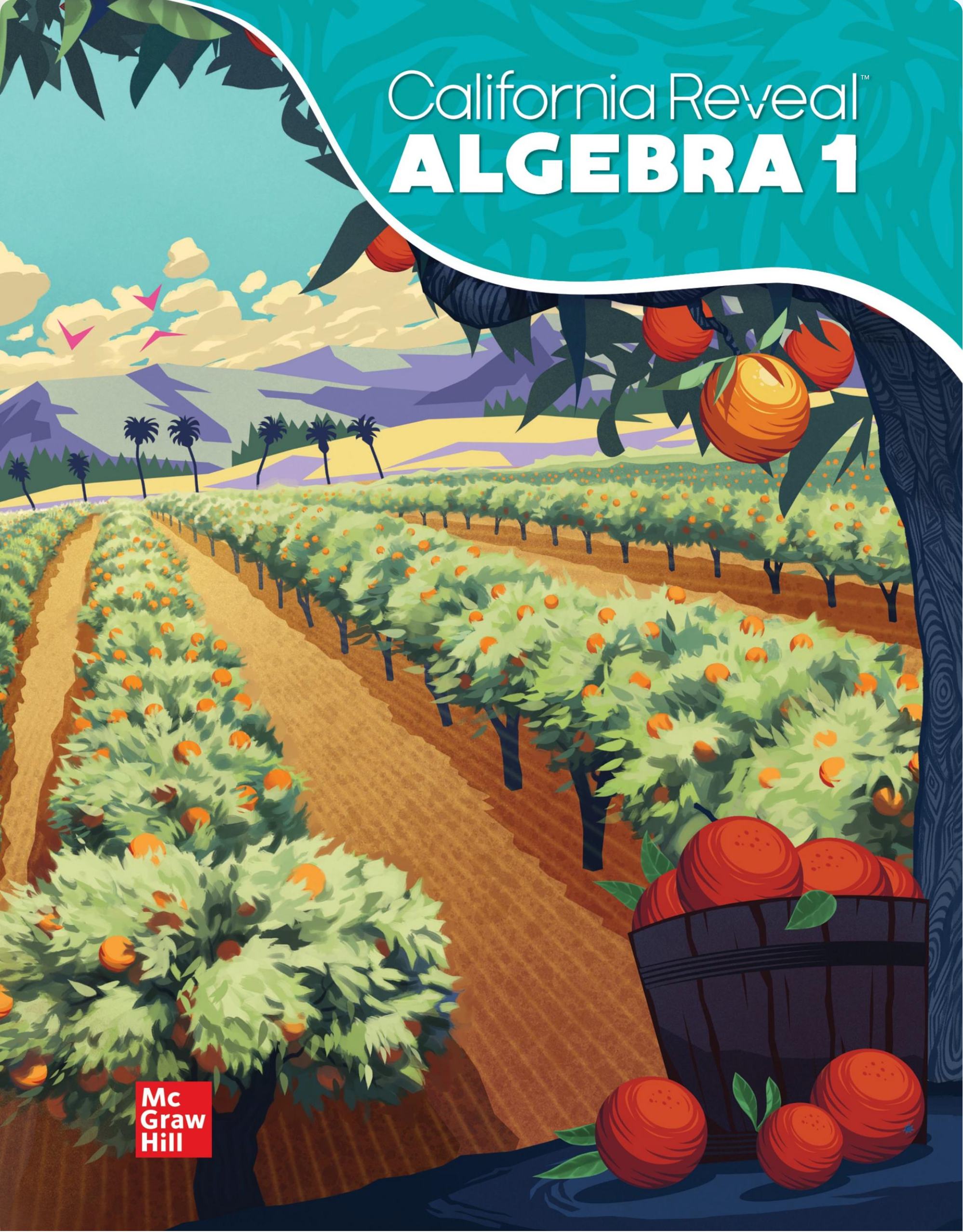
California Reveal Math, Algebra 1
California Reveal Math, Algebra 1 is a Grade 9 mathematics textbook designed for California students, covering the full scope of first-year algebra concepts. The course spans eleven units that take students from foundational expressions and equations through relations and functions, linear and nonlinear functions, linear equations and inequalities, systems of equations and inequalities, exponents and roots, exponential functions, and polynomials, culminating in quadratic functions and introductory statistics. Built to align with California's math standards, it gives ninth graders a rigorous, concept-driven foundation in algebraic reasoning and data analysis.
Chapters & Lessons
Unit 1: Using Expressions and Equations
5 lessonsIn this Grade 9 California Reveal Math Algebra 1 lesson, students learn to recognize and apply core properties of real numbers, including the Reflexive, Symmetric, and Transitive Properties of Equality, along with the Additive Identity, Additive Inverse, Multiplicative Identity, Multiplicative Inverse, and Multiplicative Property of Zero. Students practice using these properties to evaluate numerical expressions step by step, building the algebraic reasoning skills needed throughout Unit 1. The lesson is part of Chapter 1, Unit 1: Using Expressions and Equations.
In this Grade 9 Algebra 1 lesson from California Reveal Math, students learn to apply descriptive modeling by using mathematical expressions called metrics to represent and evaluate real-world situations. Using examples such as the Academic Index formula for college athletic recruitment and a state park scoring system, students substitute values into multi-step expressions and compare results to make decisions. The lesson also covers choosing an appropriate level of accuracy when reporting calculated quantities.
In this Grade 9 lesson from California Reveal Math Algebra 1, students learn to solve one-variable equations using the properties of equality, including addition, subtraction, multiplication, and division. The lesson covers writing and solving equations with fractions, grouping symbols such as parentheses and the distributive property, and identifying special cases like equations with no solution or infinitely many solutions (identities). Students also explore constraints as conditions a solution must satisfy and use algebra tiles to model and reason about equation-solving.
In this Grade 9 lesson from California Reveal Math, Algebra 1, students learn to evaluate absolute value expressions and solve absolute value equations by considering two cases for nonnegative and negative values inside the absolute value symbols. The lesson uses real-world contexts such as thermometer accuracy and margin of error to connect absolute value to positive differences and distance on a number line. Students also explore special cases, including equations with no solution (the empty set), and graph solution sets on a number line.
In this Grade 9 lesson from California Reveal Math, Algebra 1, students learn how to solve formulas for a specific variable by applying algebraic properties such as factoring and dividing by a quantity, using examples like the trapezoid area formula and multi-variable equations. The lesson also introduces dimensional analysis as a method for converting units of measurement. Students practice applying rearranged formulas to real-world contexts, including calculating geometric dimensions and modeling costs with linear equations.
Unit 2: Relations and Functions
6 lessonsIn this Grade 9 California Reveal Math Algebra 1 lesson, students learn to represent relations using mappings, tables, and graphs, and identify the domain and range of a relation from sets of ordered pairs. The lesson also covers choosing and interpreting appropriate scales for graph axes to accurately model real-world relationships between two variables. Students practice with independent and dependent variables while analyzing how different graphical representations can describe the same relation.
In this Grade 9 lesson from California Reveal Math Algebra 1 (Unit 2: Relations and Functions), students learn to identify whether a relation is a function by applying the definition that each element of the domain must be paired with exactly one element of the range. Students practice using mapping diagrams, ordered pairs, tables, and the vertical line test to classify relations as functions or non-functions. The lesson also introduces function notation f(x) and guides students through evaluating and interpreting function values in real-world contexts.
In this Grade 9 lesson from California Reveal Math Algebra 1, Unit 2, students learn to classify functions as continuous, discrete, or neither, and as linear or nonlinear by analyzing real-world graphs and tables. Key vocabulary includes continuous function, discrete function, linear function, nonlinear function, and standard form. Students apply these concepts to practical scenarios — such as parking garage pricing and pool-filling rates — to understand how context shapes the domain and shape of a graph.
In this Grade 9 lesson from California Reveal Math Algebra 1, students learn how to identify x-intercepts and y-intercepts from graphs and tables, determine intervals where a function is positive or negative, and interpret the meaning of roots and zeros in real-world contexts. Students practice finding intercepts using visual graphs, data tables, and applied scenarios such as a ball's height over time or a declining account balance. The lesson builds foundational skills for solving equations graphically and analyzing function behavior across Unit 2: Relations and Functions.
In this Grade 9 lesson from California Reveal Math Algebra 1 (Unit 2: Relations and Functions), students learn to analyze the shapes of function graphs by identifying line symmetry and the line of symmetry, determining where a function is increasing or decreasing, and locating extrema including maximum, relative maximum, minimum, and relative minimum values. Students also explore end behavior of functions using real-world contexts such as suspension bridge cables and water fountain arcs. These concepts build foundational skills for interpreting and describing the behavior of functions across different intervals.
In this Grade 9 lesson from California Reveal Math Algebra 1, students learn to sketch graphs of linear and nonlinear functions using key features such as intercepts, relative maxima and minima, increasing and decreasing intervals, and end behavior. Students also practice interpreting these features in real-world contexts and comparing the properties of two functions. The lesson is part of Unit 2: Relations and Functions and builds graph-reading and function analysis skills essential for Algebra 1.
Unit 3: Linear and Nonlinear Functions
7 lessonsIn this Grade 9 lesson from California Reveal Math, Algebra 1, students learn how to graph linear functions by creating tables of ordered pairs and plotting points on a coordinate plane. The lesson covers graphing equations in slope-intercept form, choosing appropriate domain values for fractional coefficients, and identifying horizontal lines (y = a) and vertical lines (x = a) as special cases. Students practice connecting a linear equation to its table of values and its graph as a complete set of solutions.
In this Grade 9 California Reveal Math Algebra 1 lesson, students learn to calculate rate of change using the ratio of change in y to change in x, and to find the slope of a line through two points using the slope formula. The lesson covers comparing rates of change across intervals, interpreting positive and negative rates in real-world contexts, and determining whether a function is linear by checking for a constant rate of change. Part of Unit 3: Linear and Nonlinear Functions, this lesson builds the foundational skills students need to analyze and graph linear functions.
In this Grade 9 lesson from California Reveal Math, Algebra 1 (Unit 3), students learn to write, rewrite, and graph linear equations in slope-intercept form y = mx + b, where m represents slope and b represents the y-intercept. The lesson covers converting standard form equations like -22x + 8y = 4 into slope-intercept form using properties of equality, as well as modeling real-world situations with linear equations. Students also explore how the parameters m and b affect the graph of a linear function.
In this Grade 9 lesson from California Reveal Math Algebra 1, students learn how to apply and identify transformations of linear functions, including vertical and horizontal translations, dilations, and reflections. Using the parent function f(x) = x as a starting point, students explore how adding or subtracting constants inside or outside the function shifts its graph on the coordinate plane. The lesson covers key vocabulary such as family of graphs, identity function, translation, dilation, and reflection within the context of Unit 3: Linear and Nonlinear Functions.
In this Grade 9 lesson from California Reveal Math, Algebra 1, students learn to identify arithmetic sequences by finding a common difference between consecutive terms, write an equation for the nth term using the formula a_n = a_1 + (n-1)d, and graph arithmetic sequences as linear functions. The lesson also covers finding any specific term in a sequence and applying these skills to real-world contexts such as modeling savings account growth.
In this Grade 9 lesson from California Reveal Math Algebra 1, students learn to identify and graph piecewise-defined functions, piecewise-linear functions, step functions, and the greatest integer function. Students practice graphing multi-rule functions by plotting each piece over its specified domain interval, using open and closed endpoints to indicate strict versus inclusive inequalities. Real-world contexts like swim team age groups help illustrate how step functions model situations where output values change abruptly at defined boundaries.
In this Grade 9 lesson from California Reveal Math Algebra 1, students learn how to graph and interpret absolute value functions using the general form f(x) = a|x − h| + k, identifying how the parameters a, h, and k produce translations, vertical stretches, and horizontal compressions of the parent function. Students practice describing and writing equations for transformed absolute value graphs, including identifying the vertex after horizontal and vertical shifts. The lesson is part of Unit 3: Linear and Nonlinear Functions and builds understanding of how operations on a function affect its graph.
Unit 4: Creating Linear Equations
5 lessonsIn this Grade 9 lesson from California Reveal Math Algebra 1, students learn to write equations of a line in slope-intercept form (y = mx + b) given the slope and one point or given two points. The lesson covers finding the y-intercept by substituting known coordinates into the slope-intercept equation, as well as applying the slope formula when only two points are provided. Real-world contexts, such as oven temperature changes, help students connect linear equations to practical situations.
In this Grade 9 Algebra 1 lesson from California Reveal Math, students learn to write linear equations in point-slope form using the formula y minus y₁ equals m times x minus x₁, given a slope and a point or two points on a line. Students also practice converting between point-slope form, slope-intercept form, and standard form, including applying these skills to real-world contexts. The lesson is part of Unit 4: Creating Linear Equations and builds fluency in translating among equivalent representations of linear equations.
In this Grade 9 lesson from California Reveal Math Algebra 1, Unit 4, students learn to analyze bivariate data by creating scatter plots and identifying positive correlation, negative correlation, and no correlation. Students also explore the difference between correlation and causation, and practice drawing lines of fit to make predictions using linear interpolation and linear extrapolation. Real-world data sets, including Olympic participation figures and Formula One driver measurements, are used to build and apply these skills.
In this Grade 9 lesson from California Reveal Math Algebra 1, Unit 4, students learn how to use linear regression to write equations for best-fit lines from real-world data sets using graphing technology. Students interpret the correlation coefficient to evaluate how well a linear model fits the data, and analyze the slope and y-intercept in context. The lesson also covers using best-fit line equations to make predictions through linear interpolation and extrapolation.
In this Grade 9 lesson from California Reveal Math, Algebra 1 (Unit 4), students learn how to find and graph inverse relations and inverse functions of linear equations. The lesson covers exchanging x- and y-coordinates to determine inverse relations, reflecting graphs over the line y = x, and solving for f⁻¹(x) by interchanging variables and isolating y. Students also apply inverse linear functions to real-world problems, such as calculating rental time from a total cost function.
Unit 5: Linear Inequalities
5 lessonsIn this Grade 9 lesson from California Reveal Math Algebra 1, Unit 5, students learn to solve one-step inequalities using addition, subtraction, multiplication, and division, including the rule that multiplying or dividing by a negative number reverses the inequality symbol. Students also practice graphing solution sets on a number line using open and closed circles, and expressing solutions in set-builder notation. The lesson builds foundational skills for working with linear inequalities throughout the unit.
In this Grade 9 lesson from California Reveal Math, Algebra 1, students learn to solve multi-step inequalities using the Properties of Inequalities, including applying the Distributive Property and reversing the inequality symbol when multiplying or dividing by a negative number. The lesson covers translating real-world situations into inequalities, solving algebraically, and graphing solutions on a number line. Students also explore special cases where the solution is the empty set or all real numbers.
In this Grade 9 lesson from California Reveal Math Algebra 1, Unit 5, students learn how to solve and graph compound inequalities using the concepts of intersection and union. Students practice writing and solving inequalities joined by the words "and" or "or," including expressions like -8 ≤ h - 2 < 1, and interpreting solution sets on a number line. The lesson also covers how to write a compound inequality from a given graph by analyzing open and closed endpoints.
In this Grade 9 lesson from California Reveal Math, Algebra 1 (Unit 5), students learn to solve absolute value inequalities involving both less-than and greater-than cases by rewriting each inequality as a compound inequality and applying the nonnegative and negative cases. Students practice graphing solution sets on a number line and recognize special cases such as inequalities with no solution, where the absolute value expression cannot be less than a negative number.
In this Grade 9 lesson from California Reveal Math, Algebra 1 (Unit 5: Linear Inequalities), students learn to graph linear inequalities in two variables by identifying a boundary line, determining whether it forms a closed or open half-plane, and shading the correct region using a test point. The lesson covers key vocabulary including half-plane, boundary, and open versus closed half-planes, and applies these concepts to real-world budget problems. Students practice writing and graphing inequalities such as 3x + 4y ≤ 0 and interpreting solution regions in context.
Unit 6: Systems of Linear Equations and Inequalities
5 lessonsIn this Grade 9 lesson from California Reveal Math, Algebra 1 (Unit 6), students learn to solve systems of linear equations by graphing and identify the number of solutions a system has. Students practice writing equations in slope-intercept form to compare slopes and y-intercepts, then classify systems as consistent and independent (one solution), consistent and dependent (infinitely many solutions), or inconsistent (no solution). The lesson also connects graphical solutions to algebraic methods by showing how the point of intersection represents the solution to the system.
In this Grade 9 lesson from California Reveal Math, Algebra 1 (Unit 6), students learn to solve systems of linear equations using the substitution method, replacing a variable in one equation with an equivalent expression from the other to reduce the system to a single equation in one variable. The lesson covers three outcome types — one unique solution, infinitely many solutions, and no solution — and applies substitution to real-world word problems. Students practice isolating a variable, applying the Distributive Property, and interpreting ordered-pair solutions.
In this Grade 9 lesson from California Reveal Math Algebra 1, students learn to solve systems of linear equations using the elimination method, specifically by adding equations when variables have opposite coefficients and subtracting when they share the same coefficient. The lesson walks through step-by-step examples that apply the Addition Property of Equality to eliminate one variable, then uses substitution to find the remaining unknown. Students also practice writing and solving real-world systems, such as determining the price of individual items from combined purchase totals.
In this Grade 9 lesson from California Reveal Math Algebra 1, students learn to solve systems of linear equations using the elimination method with multiplication, including cases where one or both equations must be multiplied by a constant to create opposite coefficients. The lesson covers identifying common multiples of coefficients, applying scalar multiplication to set up variable cancellation, and using substitution to find the remaining unknown after elimination. Students also practice writing and solving real-world systems using this method within Unit 6 on Systems of Linear Equations and Inequalities.
In this Grade 9 lesson from California Reveal Math, Algebra 1 (Unit 6), students learn to solve systems of linear inequalities by graphing, identifying the overlapping feasible region as the solution set. The lesson covers key concepts including dashed versus solid boundary lines, half-plane shading, and cases where parallel boundaries produce no solution. Students also apply systems of inequalities to real-world constraints, writing and graphing inequalities to model situations with limited resources.
Unit 7: Exponents and Roots
6 lessonsIn this Grade 9 lesson from California Reveal Math Algebra 1, students learn to simplify monomials by applying the Product of Powers, Power of a Power, and Power of a Product properties of exponents. The lesson covers multiplying and dividing powers with the same base, raising a power to a power, and using scientific notation in real-world contexts. It builds foundational skills for working with exponential expressions throughout Unit 7.
In this Grade 9 California Reveal Math Algebra 1 lesson, students learn to simplify expressions containing zero and negative exponents using the Zero Exponent Property, the Negative Exponent Property, and the Quotient of Powers Property. The lesson covers rewriting expressions with negative exponents as equivalent fractions with positive exponents and applying these rules to multi-variable algebraic expressions. Students also explore the concept of order of magnitude as a real-world application of powers of ten.
In this Grade 9 Algebra 1 lesson from California Reveal Math, students learn to evaluate nth roots, interpret index and radicand, and rewrite expressions using rational exponents in both radical and exponential form. Key skills include applying the rule that the nth root of b equals b to the power of 1/n, and evaluating expressions with fractional exponents such as b to the power of m/n using powers of nth roots. The lesson connects these concepts to real-world contexts like Kepler's Laws of Planetary Motion.
In this Grade 9 lesson from California Reveal Math Algebra 1, students learn to simplify radical expressions using the Product Property and Quotient Property of Square Roots, prime factorization, and the concept of principal roots. The lesson covers simplifying square roots like √72, multiplying and dividing radicals, and rationalizing expressions so they contain no perfect square factors, no fractions under the radical, and no radicals in the denominator. Students also apply these skills to solve real-world radical equations involving interest rates and optimal order quantities.
In this Grade 9 lesson from California Reveal Math Algebra 1, Unit 7, students learn how to add, subtract, and multiply radical expressions by applying properties such as combining like radicands, the Product Property of Square Roots, and the Distributive Property. Students practice simplifying expressions like 4√5 + 3√7 − 2√5 + 7√7 and multiplying terms such as 5√3 · 4√6, including cases where the resulting radicand must be further simplified. The lesson draws parallels between operations with radical expressions and operations with monomials to build conceptual understanding.
In this Grade 9 lesson from California Reveal Math, Algebra 1 (Unit 7: Exponents and Roots), students learn to solve exponential equations by applying the Power Property of Equality. They practice rewriting expressions with a common base to isolate variables in the exponent, working through one-step and multi-step problems such as solving 27^(x−1) = 3 using the power of a power property. The lesson also extends to real-world applications involving square root equations, reinforcing how exponent properties work together to find unknown values.
Unit 8: Exponential Functions
6 lessonsIn this Grade 9 lesson from California Reveal Math Algebra 1, students learn to identify and graph exponential functions of the form f(x) = ab^x, distinguishing between exponential growth and exponential decay functions based on the value of b. The lesson covers key vocabulary including asymptotes and uses real-world contexts like the Richter scale and paper folding to recognize exponential behavior through constant multiplicative rates of change. Students also compare exponential and linear behavior and practice finding y-intercepts, domain, range, and asymptotes when graphing exponential functions.
In this Grade 9 lesson from California Reveal Math, Algebra 1, students learn how to apply transformations — including vertical and horizontal translations, vertical and horizontal dilations, and reflections — to exponential functions of the form g(x) = a·b^(x−h) + k. Students practice identifying how the parameters a, h, and k affect the graph of the exponential parent function f(x) = b^x, including shifts in the asymptote. They also write equations of transformed exponential functions by analyzing key features of graphs.
In this Grade 9 lesson from California Reveal Math Algebra 1, students learn to write equations for exponential functions in the form y = ab^x using two points, a graph, or a written description. The lesson covers identifying the initial value and common ratio, solving systems of equations by substitution, and distinguishing between exponential growth and decay. Students also apply these skills to real-world contexts such as population growth and compound interest.
In this Grade 9 lesson from California Reveal Math Algebra 1, Unit 8, students learn to apply the Power of a Power rule to transform exponential expressions and write equivalent forms with different compounding periods. Using real-world bank interest rate scenarios, students convert between annual, monthly, and quarterly compounding to find effective interest rates and make accurate comparisons. The lesson builds fluency with properties of exponents in the context of exponential growth functions.
In this Grade 9 lesson from California Reveal Math Algebra 1, students learn to identify geometric sequences by finding the common ratio and apply the nth term formula a_n = a_1 r^(n-1) to calculate specific terms. The lesson covers how to determine whether a sequence is geometric, extend sequences by multiplying successive terms by the common ratio, and write equations to model real-world situations such as a bouncing ball. Students also practice graphing geometric sequences as part of the Unit 8 study of exponential functions.
In this Grade 9 lesson from California Reveal Math Algebra 1, students learn to write and evaluate recursive formulas for arithmetic and geometric sequences, using the notation a_n = a_(n-1) + d for arithmetic sequences and a_n = r · a_(n-1) for geometric sequences. Students practice identifying common differences and common ratios to determine sequence type, then construct recursive formulas from lists of terms and graphs. The lesson also contrasts recursive formulas with explicit formulas, helping students understand two distinct methods for finding the nth term of a sequence.
Unit 9: Polynomials
7 lessonsIn this Grade 9 lesson from California Reveal Math Algebra 1, students learn to identify, classify, and work with polynomials, including key vocabulary such as monomial, binomial, trinomial, degree of a polynomial, standard form, and leading coefficient. Students practice writing polynomials in standard form and adding and subtracting polynomials using both horizontal and vertical methods by combining like terms. The lesson is part of Unit 9 and builds foundational polynomial skills needed for more advanced algebraic reasoning.
In this Grade 9 lesson from California Reveal Math Algebra 1, students learn to multiply polynomials by monomials using the Distributive Property to simplify expressions such as -2x(4x² + 3x - 5). The lesson covers distributing monomials with negative coefficients, combining like terms, and applying the technique to solve equations and real-world area problems involving trapezoids and rectangular prisms. Students also explore why the set of polynomials is closed under multiplication.
In this Grade 9 Algebra 1 lesson from California Reveal Math, students learn to multiply polynomials using the vertical, horizontal, and box methods, applying the Distributive Property to produce quadratic expressions and higher-degree polynomial products. The lesson covers multiplying binomials and trinomials, combining like terms, and writing results in standard form. Real-world applications, such as calculating the area of a parking lot with a surrounding sidewalk, show students how polynomial multiplication models practical problems.
In this Grade 9 lesson from California Reveal Math Algebra 1, students learn to multiply binomials using three special product patterns: the Square of a Sum, the Square of a Difference, and the Product of a Sum and a Difference. By recognizing these patterns, students can simplify expressions like (a + b)², (a − b)², and (a + b)(a − b) = a² − b² more efficiently than applying the Distributive Property each time. The lesson is part of Unit 9: Polynomials and builds on students' prior knowledge of multiplying binomials.
In this Grade 9 lesson from California Reveal Math Algebra 1, students learn to factor polynomials using the Distributive Property and factoring by grouping. The lesson covers finding the greatest common factor (GCF) of polynomial terms and applying it to rewrite expressions in factored form, as well as grouping four-term polynomials to identify common binomial factors. Real-world applications, such as modeling projectile height with expressions like 440t − 16t², reinforce how factoring relates to multiplying polynomials.
In this Grade 9 lesson from California Reveal Math, Algebra 1, students learn to factor quadratic trinomials of the form ax² + bx + c by identifying two integers whose sum equals b and whose product equals c. The lesson covers cases where the leading coefficient a equals 1 with both positive and negative constant terms, and introduces the concept of a prime polynomial when no integer factor pairs exist. Students practice using factor tables and algebra tiles to write trinomials in factored form as a product of two binomials.
In Lesson 9-7 of California Reveal Math Algebra 1, Grade 9 students learn to factor two types of special polynomial products: differences of two squares using the pattern a² − b² = (a + b)(a − b), and perfect square trinomials using the patterns (a + b)² and (a − b)². The lesson includes recognizing when repeated factoring is needed and identifying whether a trinomial meets all three conditions to qualify as a perfect square trinomial.
Unit 10: Quadratic Functions
9 lessonsIn this Grade 9 lesson from California Reveal Math Algebra 1, students learn to analyze and graph quadratic functions written in standard form f(x) = ax² + bx + c by identifying the axis of symmetry, vertex, and y-intercept of a parabola. Students practice using the formula x = -b/2a to find the axis of symmetry, determine whether the vertex is a minimum or maximum based on the value of a, and describe end behavior. Real-world applications, including suspension bridge design and a horse's jump trajectory, illustrate how quadratic functions model maximum and minimum points.
In this Grade 9 lesson from California Reveal Math Algebra 1, students learn how to identify the effects of translations, dilations, and reflections on the graph of the parent quadratic function f(x) = x². The lesson covers vertex form g(x) = a(x − h)² + k, explaining how the constants h, k, and a produce horizontal and vertical shifts, stretches, compressions, and reflections across the x- or y-axis. Students practice describing and graphing these transformations as part of Unit 10 on Quadratic Functions.
In this Grade 9 lesson from California Reveal Math, Algebra 1 (Unit 10), students learn to solve quadratic equations by graphing the related quadratic function and identifying its x-intercepts, also called zeros or roots. The lesson covers equations with two solutions, one solution, and no real solutions, connecting the standard form ax² + bx + c = 0 to the behavior of its parabola. Students also practice approximating solutions using tables when x-intercepts fall between integer values.
In this Grade 9 California Reveal Math Algebra 1 lesson, students learn to solve quadratic equations using the Square Root Property, the Zero Product Property, and factoring techniques including GCF factoring, trinomial factoring, and difference of squares. Students practice applying these methods to equations in standard form and connect the roots of an equation to the zeros of its related quadratic function to sketch parabola graphs. The lesson also introduces the concept of a double root, found when a perfect square trinomial factors to a repeated linear factor.
In this Grade 9 lesson from California Reveal Math Algebra 1, students learn how to solve quadratic equations by completing the square, including cases where the leading coefficient is not 1. The lesson covers finding the value of c that creates a perfect square trinomial using the pattern x² + bx + (b/2)² = (x + b/2)², then applying the Square Root Property to isolate solutions. Students also use completing the square to convert quadratic functions into vertex form and identify key features such as the axis of symmetry, extrema, and zeros.
In this Grade 9 lesson from California Reveal Math Algebra 1, students learn to solve quadratic equations using the Quadratic Formula, including how to rewrite equations in standard form and identify the coefficients a, b, and c. The lesson also covers the discriminant and how the expression b²−4ac determines the nature of solutions, including irrational roots. Real-world applications, such as modeling blood pressure with a quadratic equation, help students connect the formula to practical problem-solving.
In this Grade 9 lesson from California Reveal Math Algebra 1, students learn to solve systems of linear and quadratic equations using both graphical and algebraic methods, including substitution and factoring with the Zero Product Property. Students explore how the relative positions of a parabola and a line determine whether a system has zero, one, or two points of intersection. The lesson also applies these skills to real-world contexts, such as finding when two revenue models represented by quadratic and linear functions produce equal values.
In this Grade 9 lesson from California Reveal Math Algebra 1, students learn how to use first differences, second differences, and ratios of successive y-values to determine whether a data set is best modeled by a linear, quadratic, or exponential function. Students then apply curve fitting techniques to write the specific equation — in slope-intercept or standard form — that represents the data. The lesson also introduces the coefficient of determination as a measure of how well a function fits a given data set.
In this Grade 9 lesson from California Reveal Math, Algebra 1 (Unit 10), students learn how to combine standard function types — including linear, quadratic, and exponential functions — by performing addition, subtraction, and multiplication of functions using notation such as (f+g)(x), (f−g)(x), and (f·g)(x). Students practice substituting and simplifying expressions to find the resulting combined function, and apply these operations to real-world contexts such as modeling student loan debt with exponential growth.
Unit 11: Statistics
5 lessonsIn this Grade 9 lesson from California Reveal Math Algebra 1, Unit 11, students learn how to represent data using dot plots, bar graphs, and histograms, and explore key vocabulary including variable, categorical data, and univariate data. Students practice constructing each display by following step-by-step procedures, such as ordering data points, setting appropriate scales, and labeling axes. The lesson also builds data literacy by helping students identify which type of graph is most appropriate for a given data set.
In this Grade 9 California Reveal Math Algebra 1 lesson from Unit 11, students learn to calculate and interpret key measures of center and spread, including mean, median, range, interquartile range, standard deviation, and variance. The lesson introduces vocabulary such as quartiles, five-number summary, and box plots, and explores why range and other measures of spread are necessary when the mean alone does not fully describe a data set. Real-world contexts like NCAA basketball scores and dog food bag weights help students understand how data can vary even when averages are similar.
In this Grade 9 lesson from California Reveal Math, Algebra 1 (Unit 11: Statistics), students learn to analyze the shapes of data distributions — including symmetric, negatively skewed, and positively skewed distributions — using histograms and box plots. Students also develop the skill of selecting appropriate summary statistics, choosing between mean and standard deviation for symmetric data or the five-number summary for skewed data, and identifying outliers. The lesson connects graphical representations to real-world contexts such as movie ticket sales to build statistical reasoning.
In this Grade 9 lesson from California Reveal Math Algebra 1, Unit 11, students learn how to compare two or more data sets by selecting appropriate measures of center and spread based on distribution shape. For symmetric distributions, students use mean and standard deviation, while for skewed distributions they apply the five-number summary and interquartile range. Students also use graphing technology to construct histograms and box plots to analyze and interpret real-world data.
In this Grade 9 lesson from California Reveal Math Algebra 1, Unit 11, students learn how to organize and interpret categorical data using two-way frequency tables. The lesson covers key concepts including joint frequencies, marginal frequencies, relative frequency, and conditional relative frequency, with students practicing how to calculate and read values across two categories simultaneously. By working through real-world data sets, students develop skills in constructing both two-way frequency tables and two-way relative frequency tables to analyze patterns across categorical variables.
Frequently Asked Questions
- Is California Reveal Math Algebra 1 right for my ninth grader?
- California Reveal Math Algebra 1 is designed specifically for California standards and works well for ninth graders taking Algebra 1 for the first time or students transitioning from an accelerated middle school path. The course organizes 11 units that move logically from expressions and equations through functions, linear and quadratic relationships, and statistics. It emphasizes conceptual understanding alongside procedural fluency, which suits students who learn better when they understand the why behind a method. If your child's school uses Big Ideas or CPM instead, the core topics are similar, but Reveal Math's visual models and California-specific framing make it a natural fit for CA public school students.
- Which units in California Reveal Math Algebra 1 are hardest for students?
- Unit 10 on Quadratic Functions is where most students hit a wall—graphing parabolas, identifying the vertex and axis of symmetry, and connecting the three forms of a quadratic equation demand fluency with multiple representations at once. Unit 6 (Systems of Linear Equations and Inequalities) is also consistently difficult because students must coordinate graphing, substitution, and elimination methods and know when to apply each. Unit 9 (Polynomials) trips up students who are not yet fluent with the distributive property and signed number operations. Units 7 and 8 on exponents and exponential functions introduce new conceptual territory—growth and decay modeling—that most ninth graders encounter for the first time.
- My child is weak on functions—where should they start in this textbook?
- Start with Unit 2 (Relations and Functions), which introduces domain, range, function notation, and the vertical line test. Work through every lesson there before moving to Unit 3, which distinguishes linear from nonlinear functions and introduces rate of change as slope. If your child struggles with the graphing in Unit 3, return to Unit 1 to confirm that equation-solving and expression evaluation are solid—those are prerequisites. The function concept then reappears in Units 8 and 10, so a strong Unit 2 foundation pays dividends throughout the course. Pengi can help identify which specific definition or notation is causing the confusion.
- What should my child study after finishing California Reveal Math Algebra 1?
- The standard California pathway continues with Geometry, followed by Algebra 2. Students who finish Algebra 1 with strong performance in Units 6, 9, and 10 are well-positioned for Geometry since proof and reasoning skills transfer directly. If your child is on an accelerated track aiming for AP Calculus by senior year, mastering the exponential and quadratic work in Units 8 through 10 is critical before moving forward. Summer work that reinforces factoring polynomials, solving quadratic equations by multiple methods, and graphing linear and exponential functions will make the transition to Geometry much smoother.
- How can Pengi help my child with California Reveal Math Algebra 1?
- Pengi can walk your child through any unit in Reveal Math with step-by-step explanations tailored to their current level. For the notorious trouble spots—factoring in Unit 9, graphing parabolas in Unit 10, or setting up systems of equations in Unit 6—Pengi can generate similar practice problems, explain where a specific solution went wrong, and offer alternative methods when the standard approach is not clicking. Students preparing for California state assessments can use Pengi to review the statistics unit and practice interpreting data displays. Pengi is available late at night before a test, which is exactly when students need help most.
Ready to start learning?
Jump into your first lesson for California Reveal Math, Algebra 1. Free, no account required.
Start Learning