
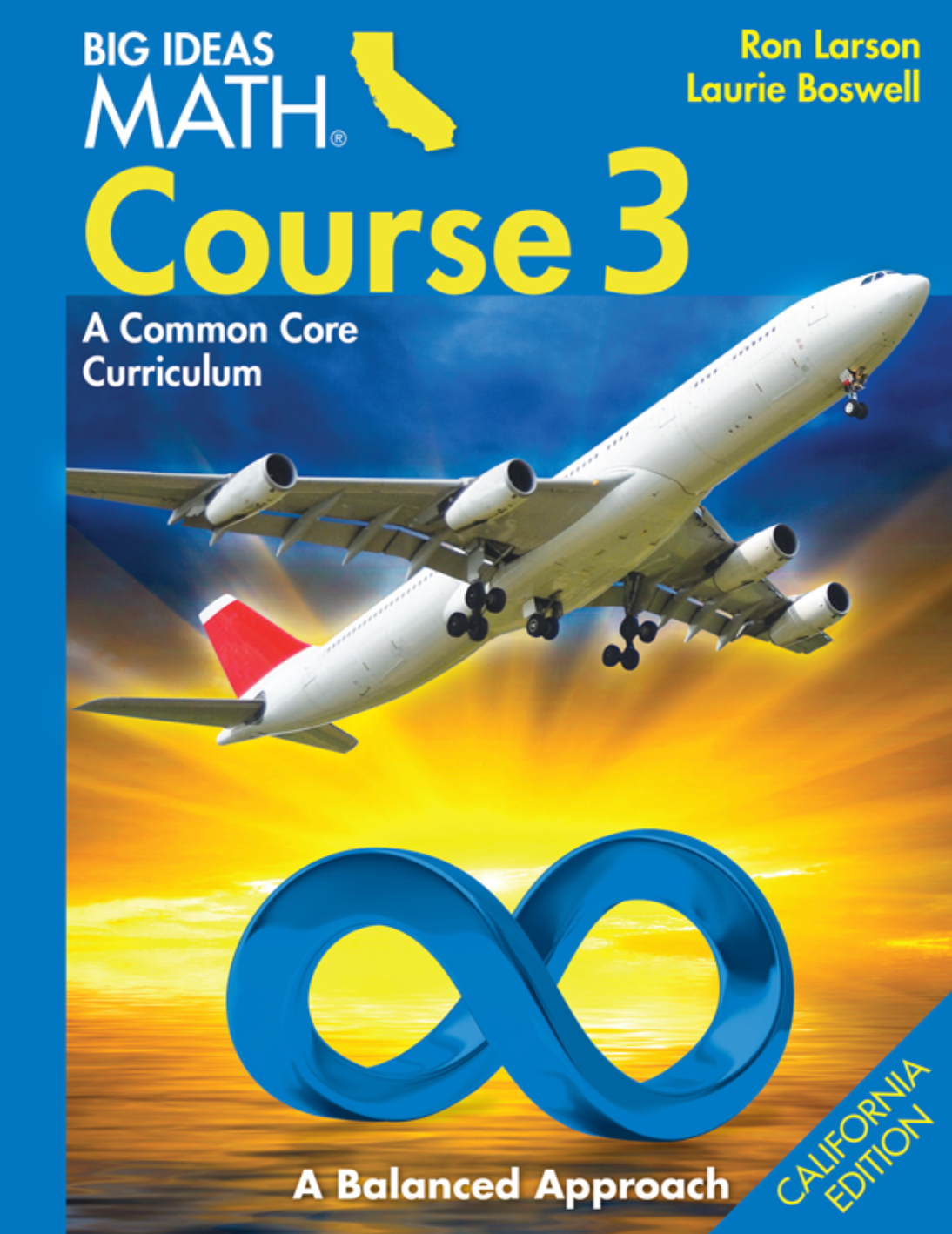
Big Ideas Math, Course 3
Big Ideas Math, Course 3, published by Big Ideas Learning LLC, is a Grade 8 mathematics textbook designed to build algebraic reasoning and geometric understanding in middle school students. The course covers a wide range of topics including solving equations, graphing and writing linear equations, systems of linear equations, functions, transformations, angles and triangles, the Pythagorean theorem, real numbers, volume and similar solids, exponents and scientific notation, and data analysis and displays. Aligned with Common Core standards, it provides a rigorous, balanced approach that prepares eighth graders for high school algebra and geometry.
Chapters & Lessons
Chapter 1: Equations
4 lessonsIn this Grade 8 lesson from Big Ideas Math, Course 3 (Chapter 1), students learn to solve simple equations using the Addition, Subtraction, Multiplication, and Division Properties of Equality. The lesson also introduces inductive reasoning through triangle angle-sum exploration, where students write and apply equations to find unknown angle measures. Aligned to standards 8.EE.7a and 8.EE.7b, students practice isolating variables with integers, decimals, fractions, and expressions involving pi.
In this Grade 8 lesson from Big Ideas Math, Course 3, students learn to solve multi-step equations by applying inverse operations, combining like terms, and using the Distributive Property to isolate the variable. Practice problems drawn from real-life contexts — such as calculating tree growth and weekly running averages — reinforce the step-by-step process aligned with standards 8.EE.7a and 8.EE.7b. Students also develop strategies for checking the reasonableness of their solutions.
In this Grade 8 lesson from Big Ideas Math, Course 3 (Chapter 1: Equations), students learn to solve equations with variables on both sides by collecting variable terms on one side and constant terms on the other using the Addition, Subtraction, and Division Properties of Equality. The lesson also covers applying the Distributive Property to multi-step equations and determining whether an equation has one solution, no solution, or infinitely many solutions. Real-world contexts like perimeter, area, surface area, and volume are used to build and solve these equations.
In this Grade 8 lesson from Big Ideas Math, Course 3, Chapter 1, students learn to rewrite literal equations and formulas by solving for one variable in terms of the other variables. Using properties of equality, they isolate specific variables in geometric formulas such as the surface area of a cone, perimeter of a rectangle, and volume of a prism, as well as the Fahrenheit-to-Celsius temperature conversion formula. This skill directly supports Common Core Standard 8.EE.7 and builds fluency with multi-variable algebraic manipulation.
Chapter 2: Transformations
7 lessonsIn this Grade 8 lesson from Big Ideas Math, Course 3 (Chapter 2: Transformations), students learn to identify congruent figures by determining whether corresponding angles and corresponding sides are congruent. Using geoboards and geometric diagrams, students practice naming corresponding parts of congruent polygons and applying the congruence symbol (≅) to express relationships between figures such as triangles and trapezoids. The lesson prepares students for Common Core Standard 8.G.2 by building foundational skills in recognizing and working with congruent figures.
In this Grade 8 lesson from Big Ideas Math Course 3, Chapter 2, students learn how to identify and perform translations in the coordinate plane by sliding figures without turning them, using the rule (x, y) → (x + a, y + b) to shift vertices horizontally and vertically. Students also explore how translations can be used to create tessellations, covering a plane with repeated congruent shapes and no gaps. The lesson connects coordinate geometry to real-world patterns while reinforcing the concept that translated figures are always congruent to the original.
In this Grade 8 lesson from Big Ideas Math Course 3, Chapter 2, students learn how to identify and perform reflections by flipping figures across a line of reflection to produce a congruent mirror image. Students practice reflecting figures in the x-axis and y-axis of the coordinate plane using the coordinate rules (x, y) → (x, −y) and (x, y) → (−x, y). The lesson also connects reflections to real-world frieze patterns, showing how symmetry across horizontal and vertical fold lines can be used to classify repeating designs.
In this Grade 8 lesson from Big Ideas Math Course 3, students learn how to identify and perform rotations in the coordinate plane, using key terms such as center of rotation and angle of rotation. Students practice rotating figures by specific degree measures — including 90°, 180°, and 270° — both clockwise and counterclockwise about a point or the origin. The lesson also connects rotations to the broader set of rigid transformations, reinforcing that a figure and its rotated image are always congruent.
In this Grade 8 lesson from Big Ideas Math, Course 3 (Chapter 2: Transformations), students learn to identify similar figures by determining whether corresponding side lengths are proportional and corresponding angles are congruent. Using similarity statements and the symbol ~, students practice naming corresponding parts, identifying similar figures from a set, and setting up proportions to find unknown side lengths. The lesson connects these geometric concepts to real-world applications in art, design, and magazine layouts.
In this Grade 8 lesson from Big Ideas Math, Course 3 (Chapter 2: Transformations), students explore how changes in the dimensions of similar figures affect their perimeters and areas. Students learn that the ratio of the perimeters of two similar figures equals the ratio of their corresponding side lengths, while the ratio of their areas equals the square of that side length ratio. The lesson prepares students for Common Core Standard 8.G.4 through hands-on activities and coordinate geometry examples.
In this Grade 8 lesson from Big Ideas Math Course 3, students learn how to identify and perform dilations in the coordinate plane by multiplying vertex coordinates by a scale factor k to produce enlargements (k > 1) or reductions (0 < k < 1). Students practice locating the center of dilation, calculating scale factors, and distinguishing dilations from other transformations such as translations. The lesson supports Common Core standards 8.G.3 and 8.G.4 and builds toward using multiple transformations together to find images of figures.
Chapter 3: Angles and Triangles
4 lessonsIn this Grade 8 lesson from Big Ideas Math, Course 3, students learn to identify and classify angles formed when parallel lines are cut by a transversal, including corresponding angles, interior angles, and exterior angles. Students apply the property that corresponding angles are congruent and use supplementary angle relationships to find missing angle measures. This lesson supports Common Core standard 8.G.5 within Chapter 3: Angles and Triangles.
In this Grade 8 lesson from Big Ideas Math Course 3, students explore the interior and exterior angle relationships of triangles, discovering that the sum of interior angle measures always equals 180°. Students also learn the Exterior Angle Theorem, which states that an exterior angle of a triangle equals the sum of the two nonadjacent interior angles. They apply these concepts algebraically to find missing angle measures in a variety of triangle configurations.
In this Grade 8 lesson from Big Ideas Math, Course 3 (Chapter 3: Angles and Triangles), students learn how to find the sum of interior angle measures of polygons using the formula S = (n − 2) · 180°, and discover that the sum of exterior angle measures of any convex polygon is always 360°. Students also practice distinguishing between convex and concave polygons and apply these concepts to find missing angle measures in figures such as pentagons, hexagons, and heptagons.
In this Grade 8 lesson from Big Ideas Math, Course 3 (Chapter 3: Angles and Triangles), students learn how to identify similar triangles using the Angle-Angle (AA) criterion, which states that two triangles are similar when two pairs of their angles are congruent. Students also apply indirect measurement, using proportional relationships in similar triangles to calculate distances or heights that cannot be measured directly, such as the height of a flagpole.
Chapter 4: Graphing and Writing Linear Equations
7 lessonsIn this Grade 8 lesson from Big Ideas Math Course 3, students learn to identify and graph linear equations by creating tables of solution points and plotting ordered pairs in a coordinate plane. The lesson covers graphing equations in the form y = ax + b, as well as special cases including horizontal lines (y = b) and vertical lines (x = a). Students also explore using a graphing calculator and adjusting the viewing window to analyze linear equations in real-life contexts.
In this Grade 8 lesson from Big Ideas Math Course 3, students learn how to define and calculate the slope of a line using the formula m = (y₂ − y₁) / (x₂ − x₁), identifying rise and run between any two points on a line. Students practice finding slopes from graphs and tables, and explore how positive and negative slopes describe whether a line rises or falls from left to right. The lesson also uses similar triangles to show why slope is constant between any two points on the same line, addressing Common Core standard 8.EE.6.
In this Grade 8 lesson from Big Ideas Math Course 3, students learn to identify proportional relationships, graph the direct variation equation y = mx, and interpret the slope m as the constant of proportionality and unit rate. Using real-world contexts like internet data costs and planetary weights, students practice writing direct variation equations and connecting the slope of a line through the origin to real-life rates. The lesson aligns with Common Core standards 8.EE.5 and 8.EE.6.
In this Grade 8 lesson from Big Ideas Math Course 3, Chapter 4, students learn how to identify the slope and y-intercept from a linear equation written in slope-intercept form (y = mx + b) and use them to graph lines on a coordinate plane. Students also explore x-intercepts and y-intercepts, discovering how the values of m and b directly determine the steepness and vertical position of a line. Real-world applications, such as modeling taxi fare costs, help students connect slope-intercept form to proportional and nonproportional linear relationships.
In this Grade 8 lesson from Big Ideas Math, Course 3 (Chapter 4), students learn to graph linear equations written in standard form (ax + by = c) using two methods: converting to slope-intercept form and using x- and y-intercepts. Real-world scenarios, such as selling concert tickets or buying cheese, help students understand how to write and interpret standard form equations on a coordinate plane.
In this Grade 8 lesson from Big Ideas Math, Course 3 (Chapter 4), students learn how to write equations of lines in slope-intercept form by identifying the slope and y-intercept from a graph. The lesson covers finding slope using the slope formula, recognizing the y-intercept where a line crosses the y-axis, and applying these values to construct the equation y = mx + b, including special cases like horizontal lines. Real-world contexts, such as modeling distance over time, help students interpret the meaning of slope and y-intercept in practical situations.
In this Grade 8 lesson from Big Ideas Math, Course 3, Chapter 4, students learn how to write linear equations in point-slope form, y − y₁ = m(x − x₁), given a slope and a point or two points on a line. Students derive the point-slope formula by analyzing rise and run between two coordinate points, then apply it to write and convert equations into slope-intercept form.
Chapter 5: Systems of Linear Equations
4 lessonsIn this Grade 8 lesson from Big Ideas Math, Course 3, students learn how to solve a system of linear equations by graphing, identifying the solution as the point of intersection of two lines on a coordinate plane. The lesson covers writing systems of linear equations, estimating intersection points, and verifying solutions by substitution. Real-life context, such as finding a break-even point, helps students connect the graphing method to practical problem-solving as outlined in Common Core standards 8.EE.8a–8c.
In this Grade 8 lesson from Big Ideas Math, Course 3, students learn how to solve systems of linear equations using the substitution method. The lesson walks through a three-step process: solving one equation for a variable, substituting that expression into the second equation, and back-substituting to find both values. Students apply this skill to real-life word problems and practice verifying solutions by checking answers in both original equations.
In this Grade 8 lesson from Big Ideas Math, Course 3, students learn how to solve systems of linear equations by elimination, a method that involves adding or subtracting equations to cancel out one variable and find the solution. The lesson covers both cases: when coefficients are already opposites or equal, and when students must first multiply one or both equations by a constant to create matching coefficients. Part of Chapter 5, this lesson aligns with Common Core standards 8.EE.8b and 8.EE.8c.
In this Grade 8 lesson from Big Ideas Math Course 3, students learn to identify and solve special systems of linear equations that have no solution or infinitely many solutions. Students explore how parallel lines indicate no solution and coincident lines indicate infinitely many solutions, using both graphing and substitution methods to recognize these cases. The lesson covers Common Core standards 8.EE.8a–8c within Chapter 5's broader unit on systems of linear equations.
Chapter 6: Functions
5 lessonsIn this Grade 8 lesson from Big Ideas Math Course 3, students learn to define relations and functions using mapping diagrams and ordered pairs. They practice determining whether a relation is a function by checking if each input is paired with exactly one output. The lesson also covers describing patterns in mapping diagrams, aligning with Common Core standard 8.F.1.
In this Grade 8 lesson from Big Ideas Math, Course 3 (Chapter 6), students learn how to represent functions in multiple ways, including writing function rules as equations, creating input-output tables, and plotting graphs. Students practice translating verbal descriptions into algebraic function rules such as y = x − 5 or y = x², then evaluate functions by substituting specific input values to find outputs. The lesson aligns with Common Core standard 8.F.1 and develops understanding of independent and dependent variables through real-world contexts like engine horsepower and race car speeds.
In Grade 8 Big Ideas Math Course 3, Lesson 6.3 introduces students to linear functions, teaching them that any function whose graph is a nonvertical line can be written in the form y = mx + b, where m is the slope and b is the y-intercept. Students practice writing linear functions by calculating slope and identifying the y-intercept from both graphs and tables of values. The lesson also applies these skills to real-world contexts, such as modeling the descent rate of an unmanned aerial vehicle.
In this Grade 8 lesson from Big Ideas Math, Course 3, students learn to identify and compare linear and nonlinear functions by analyzing whether the rate of change is constant or variable across tables, graphs, and equations. Students practice recognizing nonlinear functions such as y = 4/x and distinguishing them from linear functions written in slope-intercept form. Real-world contexts, including falling objects and compound interest, are used to illustrate the difference between linear and nonlinear patterns.
In this Grade 8 lesson from Big Ideas Math Course 3, Chapter 6, students learn how to analyze and sketch graphs that represent relationships between quantities without using specific numerical values on the axes. Students interpret qualitative features of graphs — such as increasing, decreasing, constant, linear, and nonlinear sections — to describe real-world situations involving speed, temperature, height, and distance over time. They also practice sketching graphs from verbal descriptions and comparing the steepness and shape of different graphs.
Chapter 7: Real Numbers and the Pythagorean Theorem
5 lessonsIn this Grade 8 lesson from Big Ideas Math, Course 3, students learn the Pythagorean Theorem — that in any right triangle, the sum of the squares of the legs equals the square of the hypotenuse (a² + b² = c²). Students practice identifying the legs and hypotenuse of a right triangle, then apply the theorem to find missing side lengths in both two- and three-dimensional contexts. The lesson builds from a geometric proof activity to solving real-life problems such as calculating the length of a guy wire on a telephone pole.
In this Grade 8 lesson from Big Ideas Math Course 3, Chapter 7, students learn how to approximate irrational square roots to the nearest integer and tenth by locating them between consecutive perfect squares on a number line. The lesson also introduces key vocabulary including irrational numbers and real numbers, and students practice classifying real numbers within the broader number system. Geometric methods using the Pythagorean Theorem are explored as tools for estimating non-perfect square roots such as the square root of 3 and the square root of 5.
In this Grade 8 lesson from Big Ideas Math Course 3, students learn to apply the converse of the Pythagorean Theorem to determine whether a triangle is a right triangle by checking if its side lengths satisfy the equation a² + b² = c². Students also derive and use the distance formula by applying the Pythagorean Theorem to right triangles formed in a coordinate plane. The lesson covers real-world problem solving using both the theorem and its converse, aligned to standards 8.G.6, 8.G.7, and 8.G.8.
Chapter 8: Volume and Similar Solids
4 lessonsIn this Grade 8 lesson from Big Ideas Math, Course 3 (Chapter 8), students learn how to calculate the volume of a cylinder using the formula V = πr²h, where the volume equals the product of the base area and height. Students also practice finding a missing height when the volume is given by solving for the unknown in the formula. The lesson connects to real-life contexts and supports Common Core standard 8.G.9.
In this Grade 8 lesson from Big Ideas Math Course 3, students learn how to calculate the volume of a cone using the formula V = ⅓Bh, discovering that a cone holds exactly one-third the volume of a cylinder with the same base and height. Students apply the formula to find both the volume and the height of right and oblique cones, including real-life problem solving. The lesson aligns with Common Core standard 8.G.9 and builds on prior knowledge of cylinder and pyramid volume formulas.
In this Grade 8 lesson from Big Ideas Math Course 3, Chapter 8, students learn how to calculate the volume of a sphere using the formula V = (4/3)πr³, which is derived by comparing a sphere's volume to that of a cylinder and through a pyramid-based approach. Students practice applying the formula to find volume given a radius and to find the radius when volume is known, working with concepts such as hemisphere and surface area of a sphere.
In this Grade 8 lesson from Big Ideas Math, Course 3, students explore similar solids and learn how surface area and volume change when dimensions are scaled by a factor of k. Students apply the rule that the ratio of surface areas equals the square of the ratio of corresponding linear measures, and the ratio of volumes equals the cube of that ratio. The lesson covers identifying similar solids, finding missing measures using proportional reasoning, and solving problems involving cylinders, cones, pyramids, and prisms.
Chapter 9: Data Analysis and Displays
4 lessonsIn this Grade 8 lesson from Big Ideas Math Course 3, students learn how to construct and interpret scatter plots by graphing two related data sets as ordered pairs in a coordinate plane. Students identify positive linear, negative linear, and nonlinear relationships between variables such as weight and circumference of sports balls or student absences and final grades. The lesson also introduces how to read specific data values from a scatter plot and use patterns in the data to make predictions.
In this Grade 8 lesson from Big Ideas Math, Course 3, students learn how to draw a line of fit on a scatter plot and write its linear equation to model real-world data. They practice interpreting the slope and y-intercept of the line and use the equation to make predictions, applying Common Core standards 8.SP.1, 8.SP.2, and 8.SP.3. Contexts such as river depth and animal growth illustrate how lines of fit reveal linear relationships in data sets.
In this Grade 8 lesson from Big Ideas Math, Course 3, students learn how to read, create, and interpret two-way tables to display two categories of data collected from the same source. The lesson covers key vocabulary including joint frequencies and marginal frequencies, with students practicing how to find and interpret row and column sums. Aligned to standard 8.SP.4, the lesson appears in Chapter 9: Data Analysis and Displays.
In this Grade 8 lesson from Big Ideas Math, Course 3, students learn how to choose appropriate data displays — including bar graphs, circle graphs, line graphs, histograms, stem-and-leaf plots, box-and-whisker plots, and scatter plots — based on the nature of their data. Students practice selecting the right display for different situations, such as using a line graph to show change over time or a scatter plot to compare two data sets. The lesson also covers identifying and analyzing misleading data displays, aligned to Common Core standard 8.SP.1.
Chapter 10: Exponents and Scientific Notation
7 lessonsIn this Grade 8 lesson from Big Ideas Math, Course 3, students learn how to write and evaluate expressions using integer exponents, including identifying the base and exponent of a power. Students practice converting repeated multiplication into exponential notation, working with negative bases such as (-3)^n, and distinguishing between expressions like (-2)^4 and -2^4. The lesson aligns with Common Core standard 8.EE.1 and builds foundational skills for the chapter's broader study of scientific notation.
In this Grade 8 lesson from Big Ideas Math Course 3, students learn three key exponent properties: the Product of Powers Property (adding exponents when multiplying powers with the same base), the Power of a Power Property (multiplying exponents), and the Power of a Product Property (distributing an exponent to each factor in a product). Students use inductive reasoning to discover these rules through pattern exploration, then apply them to simplify expressions involving both numeric and algebraic bases. The lesson aligns with Common Core standard 8.EE.1 and builds foundational skills for working with scientific notation later in Chapter 10.
In this Grade 8 lesson from Big Ideas Math, Course 3, students learn the Quotient of Powers Property, which states that when dividing two powers with the same base, you subtract the exponents using the rule a^m divided by a^n equals a^(m-n). Students practice simplifying expressions involving numerical and variable bases, including multi-step problems that combine the Quotient of Powers Property with the Product of Powers Property, and apply the concept to a real-world population density problem.
In this Grade 8 lesson from Big Ideas Math Course 3, students learn how to evaluate expressions with zero exponents using the rule a⁰ = 1 and with negative integer exponents using the definition a⁻ⁿ = 1/aⁿ. Students apply the Product of Powers and Quotient of Powers Properties to simplify expressions and rewrite them using only positive exponents. The lesson also connects these concepts to real-world rate problems and place value patterns.
In this Grade 8 lesson from Big Ideas Math, Course 3, Chapter 10, students learn how to read and interpret scientific notation by identifying whether numbers are correctly written in scientific notation, converting between scientific notation and standard form, and comparing numbers written in scientific notation. Students practice moving the decimal point left or right based on the sign and absolute value of the exponent in expressions such as 3.22 × 10⁻⁴ and 7.9 × 10⁵. The lesson addresses Common Core standards 8.EE.3 and 8.EE.4, helping students work fluently with very large and very small numbers.
In this Grade 8 lesson from Big Ideas Math, Course 3, students learn how to convert numbers into scientific notation by moving the decimal point and applying positive or negative exponents of 10. The lesson covers writing both large numbers and small decimals in the form a × 10ⁿ, including real-world contexts such as planetary distances and hydrogen ion concentrations. Students also practice ordering and comparing values expressed in scientific notation.
In this Grade 8 lesson from Big Ideas Math Course 3, students learn how to add, subtract, multiply, and divide numbers written in scientific notation, including cases where the powers of 10 are the same or different. Key skills include applying the Distributive Property to combine like powers of 10, rewriting numbers to match exponents before adding or subtracting, and using the Product of Powers Property when multiplying. The lesson aligns with Common Core standards 8.EE.3 and 8.EE.4 and builds toward real-world estimation problems using scientific notation.
Frequently Asked Questions
- Is Big Ideas Math Course 3 the right textbook for my 8th grader?
- Big Ideas Math Course 3 is a widely used, Common Core-aligned 8th-grade math textbook that covers the full range of content expected before Algebra 1 or Algebra 1 itself: equations, transformations, the Pythagorean theorem, linear functions, systems of equations, exponents, and data analysis. It is appropriate for students at standard grade-level pacing and is used in many public school districts nationwide. If your child is on the standard track, this textbook covers exactly what they need to be ready for high school math.
- Which chapters in Big Ideas Math Course 3 are the hardest for 8th graders?
- Chapter 4 on graphing linear equations and Chapter 5 on systems of linear equations are where many students struggle — slope-intercept form, writing equations from graphs, and solving systems by graphing, substitution, and elimination all arrive in rapid succession. Chapter 7 on the Pythagorean theorem requires understanding square roots and irrational numbers, which Chapter 6 on real numbers introduces just before. Students with shaky equation-solving skills from Chapter 1 also find later chapters disproportionately hard.
- My child is weak in linear equations and slope — where should they start?
- Make sure Chapter 1 is solid first — especially Lesson 1 (solving simple equations) and Lesson 3 (variables on both sides). Then work through Chapter 4 lesson by lesson: Lesson 1 introduces linear equations by graphing, Lesson 2 covers slope as rise over run, and Lessons 3–4 develop slope-intercept and point-slope forms. Many students struggle with slope not because it is hard, but because they rush into the formula without a solid picture of what slope means visually on a graph.
- What does my child study after Big Ideas Math Course 3?
- Students who complete Course 3 on track typically move to Algebra 1 or a combined Algebra 1/Geometry course in 9th grade. The linear equations, systems, functions, and exponents covered in Course 3 are the direct foundations of high school Algebra 1 and Algebra 2. Big Ideas Learning also publishes the Algebra 1 and Geometry textbooks that follow in this sequence, so the notation and problem-solving structure will already be familiar to your child.
- How can Pengi help my child with Big Ideas Math Course 3?
- Pengi can walk through any lesson from Big Ideas Math Course 3 step-by-step. If your child cannot figure out why a system of equations has infinitely many solutions (Chapter 5), or is confused about how dilations differ from other transformations (Chapter 2, Lesson 7), Pengi explains it at exactly the right level and then asks questions to check understanding. Pengi is also great for exam prep — your child can describe which chapter they are being tested on and Pengi will generate targeted practice problems and catch common mistakes.
Ready to start learning?
Jump into your first lesson for Big Ideas Math, Course 3. Free, no account required.
Start Learning