
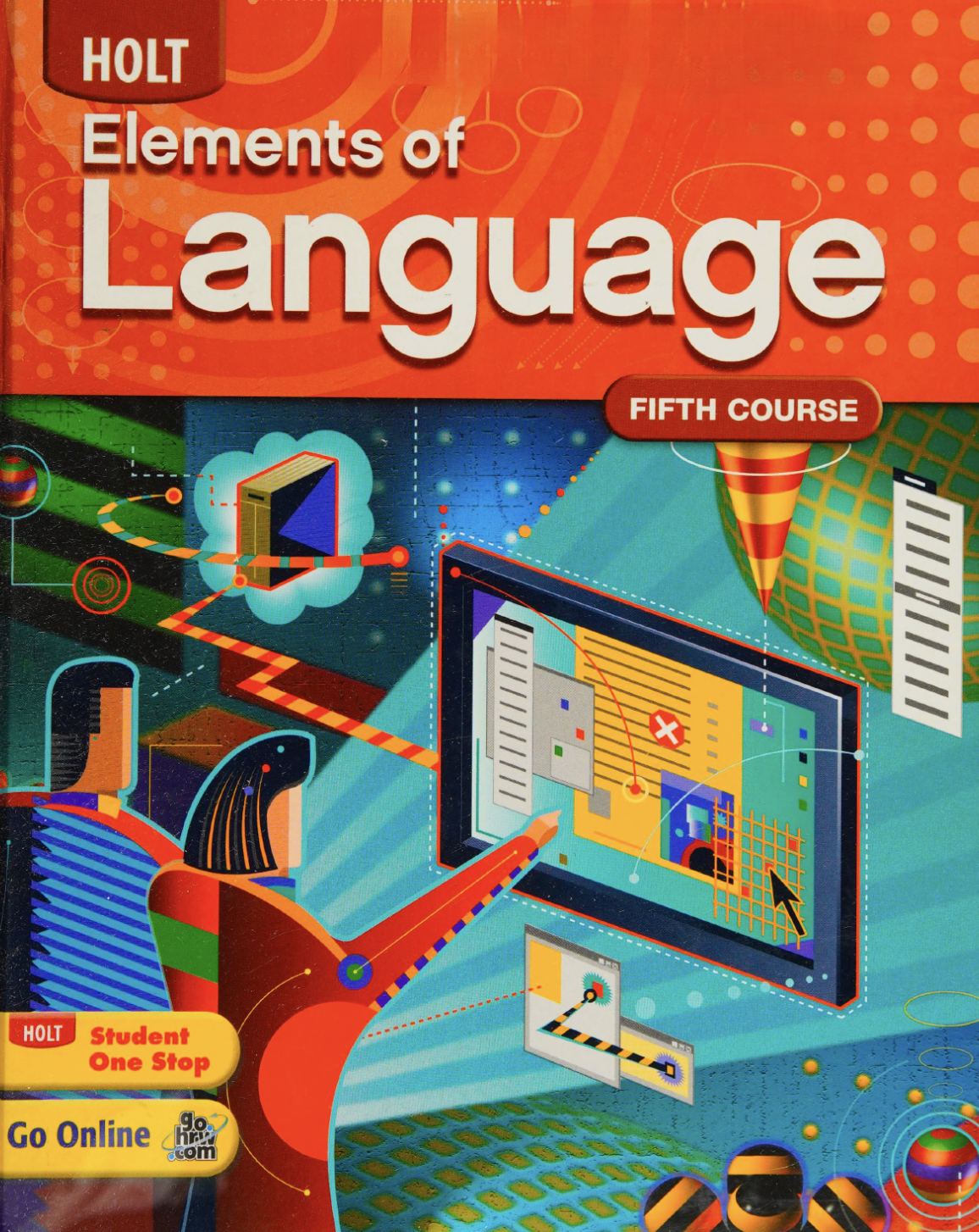
Elements of Language, 5th Course
Elements of Language, Fifth Course, published by Holt, Rinehart and Winston, is a comprehensive grammar and language arts textbook designed for Grade 8 students. It covers the full range of foundational English grammar skills, including parts of speech, sentence structure, phrases and clauses, verb usage, pronoun case and reference, modifier placement, and subject-verb agreement. The textbook also addresses punctuation, capitalization, spelling, and common usage problems, making it a complete reference for developing clear and correct written communication.
Chapters & Lessons
Chapter 1: The Parts of Speech: The Work That Words Do
6 lessonsIn this Grade 8 grammar lesson from Elements of Language, 5th Course, students learn to identify and classify nouns as common or proper, concrete or abstract, and collective or compound. The lesson covers key terminology and distinctions, such as how proper nouns name specific people, places, or things and require capitalization, while abstract nouns represent ideas and qualities that cannot be perceived by the senses. Practice exercises reinforce each concept by having students identify and categorize nouns in context.
In this Grade 8 grammar lesson from Elements of Language, 5th Course, students learn to identify and use pronouns, including personal pronouns categorized by first, second, and third person, as well as reflexive and intensive pronouns ending in -self or -selves. Students practice recognizing antecedents and distinguishing reflexive pronouns, which complete a verb's meaning or serve as objects of prepositions, from intensive pronouns, which simply emphasize their antecedents. Exercises drawn from real sentences reinforce these concepts through identification and labeling tasks.
In this Grade 8 lesson from Elements of Language, 5th Course, students learn how adjectives modify nouns and pronouns by indicating what kind, which one, how many, or how much. The lesson covers adjective placement, predicate adjectives, articles, proper adjectives, and how the same word can function as a noun, pronoun, or adjective depending on context. Students practice identifying and analyzing adjectives through sentence-level exercises.
In this Grade 8 grammar lesson from Elements of Language, 5th Course, students learn how verbs express action or state of being and how to identify verb phrases made up of main verbs and helping verbs, including modals such as may, could, and will. The lesson also distinguishes between action verbs and linking verbs, and clarifies that adverbs like not, never, and always are never part of a verb phrase. Practice exercises guide students through underlining verb phrases and recognizing auxiliary verbs in complex sentences.
In this Grade 8 grammar lesson from Elements of Language, 5th Course, students learn how adverbs modify verbs, adjectives, and other adverbs to make meaning more specific. The lesson covers the four questions adverbs answer — how, when, where, and to what extent — with practice exercises requiring students to identify adverbs and trace them to the words they modify.
In this Grade 8 grammar lesson from Elements of Language, 5th Course, students learn how prepositions show the relationship between a noun or pronoun and another word, and how to identify prepositional phrases including their objects and modifiers. The lesson also covers compound prepositions such as "in front of" and "because of," and teaches students to distinguish between words used as prepositions versus adverbs. Conjunctions and interjections are introduced as additional parts of speech within Chapter 1's broader study of how words function in sentences.
Chapter 2: The Parts of a Sentence: Subjects, Predicates, Complements
5 lessonsIn this Grade 8 grammar lesson from Elements of Language, 5th Course, students learn to identify and distinguish between simple subjects and complete subjects in sentences, including how to avoid confusing subjects with nouns inside prepositional phrases. The lesson also covers compound subjects, where two or more subjects share the same verb and are joined by conjunctions such as and, or, and neither...nor. Practice exercises reinforce these skills by having students locate and underline subjects in a variety of sentence structures.
In this Grade 8 grammar lesson from Elements of Language, 5th Course, students learn to identify and distinguish between the simple predicate (verb or verb phrase) and the complete predicate in a sentence. The lesson also introduces compound verbs, explaining how two or more verbs can share the same subject and be joined by conjunctions such as and, but, or, or nor. Students practice these skills through exercises that require underlining predicates and recognizing all parts of verb phrases within real sentences.
In this Grade 8 grammar lesson from Elements of Language, 5th Course, students learn to identify direct objects, indirect objects, and objective complements within sentences. The lesson covers how direct objects answer "whom" or "what" after an action verb, how indirect objects indicate to whom or for whom an action is performed, and how objective complements identify or modify a direct object. Practice exercises reinforce recognizing compound direct objects and distinguishing each complement type in context.
In this Grade 8 grammar lesson from Elements of Language, 5th Course, students learn to identify and use predicate nominatives and predicate adjectives as subject complements in sentences with linking verbs. The lesson covers how a predicate nominative renames or identifies the subject and how a predicate adjective modifies the subject, including compound forms of each. Practice exercises guide students in recognizing these complements across a variety of sentence structures, including questions and inverted sentences.
In this Grade 8 grammar lesson from Elements of Language, 5th Course, students learn to classify sentences by purpose, distinguishing among declarative, interrogative, and imperative sentences. The lesson covers how each type uses specific end punctuation and introduces the concept of the understood subject "you" in imperative sentences. Students practice identifying sentence types and applying correct punctuation through guided exercises.
Chapter 3: The Phrase: Kinds and Functions
5 lessonsIn this Grade 8 grammar lesson from Elements of Language, 5th Course, students learn how prepositional phrases are structured and function within sentences, covering the preposition, its object, and any modifiers. The lesson distinguishes between adjective phrases, which modify nouns or pronouns by answering "what kind" or "which one," and adverb phrases, which modify verbs, adjectives, or adverbs by telling how, when, where, or to what extent. Practice exercises guide students to identify and analyze prepositional phrases in context.
In this Grade 8 grammar lesson from Elements of Language, 5th Course, students learn to identify and use participles — present participles ending in -ing and past participles ending in -d or -ed — as adjectives that modify nouns and pronouns. The lesson then extends this concept to participial phrases, showing how a participle combined with its modifiers or complements functions as an adjectival phrase within a sentence. Exercises guide students to distinguish participles used as adjectives from those in verb phrases and to construct their own participial phrases using both regular and irregular verb forms.
In this Grade 8 grammar lesson from Elements of Language, 5th Course, students learn to identify gerunds — verb forms ending in –ing that function as nouns — and distinguish them from present participles and verb phrases. The lesson covers how gerunds and gerund phrases can serve as subjects, predicate nominatives, direct objects, indirect objects, and objects of prepositions within a sentence. Practice exercises guide students in recognizing and using these structures in context.
In this Grade 8 grammar lesson from Elements of Language, 5th Course, students learn to identify and use infinitives and infinitive phrases, understanding how these verb forms function as nouns, adjectives, or adverbs in a sentence. The lesson also covers the distinction between the word to as a preposition versus as the sign of an infinitive, and introduces the concept of split infinitives in formal writing. Practice exercises guide students through recognizing infinitive phrases, locating the infinitive within them, and correcting improperly split infinitives.
In this Grade 8 grammar lesson from Elements of Language, 5th Course, students learn to identify and use appositives and appositive phrases — nouns or pronouns placed beside another noun or pronoun to identify or describe it. The lesson covers single, compound, and proper noun appositives, as well as appositive phrases that include modifiers. Students practice recognizing appositives in sentences as part of Chapter 3's broader study of phrases and their functions.
Chapter 4: The Clause: Independent and Subordinate Clauses
5 lessonsIn this Grade 8 grammar lesson from Elements of Language, 5th Course, students learn to identify and use adjective clauses, the subordinate clauses that modify nouns or pronouns by answering "what kind" or "which one." The lesson covers relative pronouns such as that, which, who, whom, and whose, as well as relative adverbs when and where, showing how each connects a clause to the word it modifies. Students also practice distinguishing between essential and nonessential adjective clauses and applying correct comma usage for each type.
In this Grade 8 grammar lesson from Elements of Language, 5th Course, students learn to identify and use noun clauses, a type of subordinate clause that functions as a noun within a sentence. The lesson covers the five grammatical roles a noun clause can play — subject, predicate nominative, direct object, indirect object, and object of a preposition — along with the introductory words that signal them, such as who, whoever, what, and that. Students practice locating noun clauses in sentences and identifying their specific function through two sets of exercises.
In this Grade 8 grammar lesson from Elements of Language, 5th Course, students learn to identify and use adverb clauses, subordinate clauses that modify verbs, adjectives, or adverbs and are introduced by subordinating conjunctions. The lesson covers how adverb clauses answer questions of how, when, where, why, to what extent, or under what condition, and also introduces elliptical clauses, where part of a clause is omitted because its meaning is understood from context. Students practice underlining adverb clauses, identifying the subordinating conjunctions that introduce them, and correctly forming elliptical clauses.
In this Grade 8 grammar lesson from Elements of Language, 5th Course, students learn to identify and distinguish simple sentences and compound sentences based on the number of independent clauses each contains. The lesson covers the three methods for joining simple sentences into compound sentences: using a coordinating conjunction with a comma, a semicolon alone, or a semicolon with a conjunctive adverb and comma. Students practice identifying independent clauses and applying these structures through classification and sentence-combining exercises.
In this Grade 8 grammar lesson from Elements of Language, 5th Course, students learn to identify and construct complex sentences, which contain one independent clause and at least one subordinate clause, and compound-complex sentences, which combine two or more independent clauses with at least one subordinate clause. The lesson uses clear examples and exercises to help students recognize how subordinate clauses function within each sentence structure. It builds on students' understanding of independent and subordinate clauses as part of Chapter 4's broader study of sentence classification.
Chapter 5: Agreement: Subject and Verb, Pronoun and Antecedent
4 lessonsIn this Grade 8 grammar lesson from Elements of Language, 5th Course, students learn the foundational rules of subject-verb agreement, including how singular and plural subjects take matching verb forms. The lesson covers compound subjects joined by and, or, and nor, as well as how intervening phrases and clauses between a subject and verb do not change agreement. Students also practice identifying correct verb agreement with indefinite pronouns through guided exercises.
In this Grade 8 grammar lesson from Elements of Language, 5th Course, students learn how to apply subject-verb agreement rules to collective nouns, expressions of amount, and fractions or percentages. The lesson explains how collective nouns like team or staff can be singular or plural depending on whether the group acts as a unit or as individuals, and how numerical expressions follow similar logic based on context. Practice exercises guide students in selecting the correct verb form for each type of subject.
In this Grade 8 grammar lesson from Elements of Language, 5th Course, students learn how pronouns must agree with their antecedents in number, gender, and person. The lesson covers singular and plural pronoun agreement, masculine, feminine, and neuter gender pronouns, first through third person pronouns, and the rules for compound antecedents joined by and, or, or nor. Practice exercises give students guided opportunities to identify antecedents and select the correct agreeing pronoun in context.
In this Grade 8 grammar lesson from Elements of Language, 5th Course, students practice pronoun-antecedent agreement with indefinite pronouns such as anybody, each, both, many, and several. They learn to identify whether an indefinite pronoun is singular or plural — and how pronouns like all, any, most, and some can shift based on the noun in a following phrase. The lesson includes guided exercises where students select the correct pronoun form to match its antecedent in number and gender.
Chapter 6: Using Pronouns Correctly: Case Forms of Pronouns
3 lessonsIn this Grade 8 grammar lesson from Elements of Language, 5th Course, students learn to use personal pronouns correctly in the nominative and possessive cases. The lesson covers rules for pronoun use as subjects, predicate nominatives following linking verbs, and possessive pronouns before gerunds, with practice identifying correct forms such as I, she, they, mine, and his in context. Students apply these rules through exercises selecting the correct nominative or possessive pronoun in compound subjects, compound predicate nominatives, and gerund phrases.
In this Grade 8 grammar lesson from Elements of Language, 5th Course, students learn to use personal pronouns in the objective case — me, you, him, her, it, us, and them — correctly as direct objects, indirect objects, and objects of prepositions. The lesson explains how each function determines which pronoun form to choose, with guided examples and practice exercises reinforcing the rules. Students also explore possessive pronouns such as mine, hers, and theirs when used in object positions within a sentence.
In this Grade 8 grammar lesson from Elements of Language, 5th Course, students learn how to correctly use the relative pronouns who, whom, whoever, and whomever by identifying whether the pronoun functions as a subject, predicate nominative, direct object, indirect object, or object of a preposition within its clause. The lesson also covers pronoun case in appositives, teaching students that an appositive pronoun must match the case of the noun or pronoun it identifies. Guided exercises reinforce both concepts through sentence-level practice.
Chapter 7: Clear Reference: Pronouns and Antecedents
2 lessonsIn this Grade 8 grammar lesson from Elements of Language, 5th Course, students learn to identify and correct two types of unclear pronoun reference: ambiguous reference, where a pronoun could logically point to more than one antecedent, and general reference, where pronouns like it, that, this, or which refer to a vague idea rather than a specific word. Through guided exercises, students practice recognizing unclear antecedents and rewriting sentences for clarity.
In this Grade 8 grammar lesson from Elements of Language, 5th Course, students learn to identify and correct weak pronoun reference, a problem that occurs when a pronoun's antecedent is implied but not explicitly stated in the sentence. Through guided exercises, students practice revising sentences by replacing vague pronouns with specific nouns to achieve clear pronoun-antecedent agreement.
Chapter 8: Using Verbs Correctly: Principal Parts, Tense, Voice, Mood
6 lessonsIn this Grade 8 grammar lesson from Elements of Language, 5th Course, students learn the four principal parts of verbs — the base form, present participle, past, and past participle — and how all other verb forms are derived from them. The lesson distinguishes between regular verbs, which form their past and past participle by adding –d or –ed, and irregular verbs, which change vowels, consonants, or both. Students practice identifying and completing verb forms through exercises using common regular and irregular verbs.
In this Grade 8 grammar lesson from Elements of Language, 5th Course, students learn to correctly use six commonly confused verb pairs: sit and set, rise and raise, and lie and lay. The lesson explains how each pair differs in meaning and whether it takes a direct object, covering all principal parts such as sat, set, rose, raised, lay, laid, and lain. Practice exercises reinforce proper usage in context so students can confidently distinguish these troublesome verbs in their own writing.
In this Grade 8 grammar lesson from Elements of Language, 5th Course, students learn to identify and use all six English verb tenses — past, present, future, past perfect, present perfect, and future perfect — including how helping verbs form the perfect and future tenses. Through structured exercises, students practice writing missing tense forms and identifying the tense of underlined verbs in context.
In this Grade 8 grammar lesson from Elements of Language, 5th Course, students learn how to form and use the progressive forms of verbs across all six tenses, including present, past, future, present perfect, past perfect, and future perfect progressive. Lessons explain that progressive forms combine a tense of the verb be with a present participle to express continuing action, and students practice constructing these forms through targeted exercises.
Grade 8 students learn to identify and correctly use all six verb tenses — present, past, future, present perfect, past perfect, and future perfect — including their progressive forms, in this lesson from Elements of Language, 5th Course. The lesson covers the specific purposes of each tense, such as expressing ongoing actions, completed past events, or actions that will end before a future occurrence. Students practice recognizing tense in context through exercises using helping verbs like have, has, had, and will have.
In this Grade 8 grammar lesson from Elements of Language, 5th Course, students learn to identify and distinguish between active voice and passive voice in verb usage. The lesson explains that active voice occurs when the subject performs the action, while passive voice occurs when the subject receives the action, and that passive voice constructions always include a form of "be" plus the past participle of the main verb. Students practice recognizing both voices across a variety of sentence types, including questions and imperative sentences.
Chapter 9: Using Modifiers Correctly: Forms and Uses of Adjectives and Adverbs; Comparison
2 lessonsIn this Grade 8 grammar lesson from Elements of Language, 5th Course, students learn how to correctly use troublesome modifier pairs including bad versus badly, good versus well, slow versus slowly, and real versus really. The lesson focuses on distinguishing adjectives from adverbs and applying the rule that only adjectives should follow linking verbs as predicate adjectives. Guided practice exercises help students identify the correct modifier form in context.
In this Grade 8 lesson from Elements of Language, 5th Course, students learn how modifiers change form across the three degrees of comparison — positive, comparative, and superlative — including regular forms using -er/-est and more/most/less/least, as well as irregular forms such as good/better/best and bad/worse/worst. Students practice forming both increasing and decreasing degrees for one-, two-, and three-syllable modifiers and apply their understanding by identifying correct comparative and superlative forms in context.
Chapter 10: Placement of Modifiers: Misplaced and Dangling Modifiers
2 lessonsIn this Grade 8 grammar lesson from Elements of Language, 5th Course, students learn to identify and correct misplaced modifiers — words, phrases, and clauses that describe the wrong word in a sentence — and squinting modifiers, which ambiguously modify either of two words. The lesson covers how proper placement of modifying words, phrases, and clauses clarifies meaning and eliminates unintended or illogical descriptions. Students practice both skills through guided exercises using proofreading symbols to reposition misplaced and two-way modifiers in example sentences.
In this Grade 8 grammar lesson from Elements of Language, 5th Course, students learn to identify and correct dangling modifiers — modifiers that do not clearly or sensibly modify any word or word group in a sentence. The lesson explains two correction strategies: rewriting the independent clause with a new subject or adding a subject to the opening word group. Students practice by underlining dangling modifiers in sentences featuring misplaced participial and adverb phrases.
Chapter 11: A Glossary of Usage: Common Usage Problems
4 lessonsIn this Grade 8 grammar lesson from Elements of Language, 5th Course, students work through a glossary of common usage problems covering easily confused words and expressions such as accept/except, beside/besides, between/among, and the correct use of done versus did. Students learn the precise grammatical roles of these terms — including their functions as verbs, prepositions, and adverbs — and practice applying standard usage rules, such as avoiding redundant prepositions in where-clauses. The lesson includes guided exercises that reinforce correct word choice in context.
In this Grade 8 grammar lesson from Elements of Language, 5th Course, students practice correct usage of commonly confused terms including don't versus doesn't with singular and plural subjects, fewer versus less with countable and uncountable nouns, standard reflexive pronouns himself and themselves in place of nonstandard hisself and theirselves, and the formal adverbs rather and somewhat instead of kind of or sort of. The lesson presents clear rules with examples and provides two sets of exercises where students identify the correct form in context. It is part of Chapter 11's broader glossary of common usage problems.
In this Grade 8 grammar lesson from Elements of Language, 5th Course, students practice correcting common usage errors covered in the Glossary of Usage C, including supposed to vs. suppose to, try to vs. try and, than vs. then, demonstrative adjectives (this, that, those vs. them, this here, that there), when and where in definitions, and the contraction you're vs. the possessive your. Through two sets of exercises, students identify the standard, formal English form in context sentences to reinforce proper word choice and usage.
In this Grade 8 grammar lesson from Elements of Language, 5th Course, students learn to identify and correct double negatives by recognizing common negative words such as hardly, scarcely, never, and none, and understanding that standard usage requires only one negative word per idea. The lesson also introduces nonsexist language, teaching students to replace gender-specific terms with inclusive alternatives and to avoid using masculine singular pronouns to refer to indefinite pronouns like everyone or anyone.
Chapter 12: Capitalization: Rules of Standard Usage
2 lessonsIn this Grade 8 grammar lesson from Elements of Language, 5th Course, students learn the foundational rules of capitalization, including capitalizing the first word of sentences and quoted sentences, the first words of letter salutations and closings, the pronoun I, and proper nouns and proper adjectives. The lesson distinguishes between common nouns and proper nouns and explains how proper adjectives are formed from proper nouns using endings such as -ish, -ese, and -ian. Practice exercises throughout the lesson reinforce each capitalization rule in context.
In this Grade 8 grammar lesson from Elements of Language, 5th Course, students learn the rules for capitalizing geographical names such as cities, countries, bodies of water, and natural landmarks, as well as the names of planets, stars, and constellations. The lesson also covers capitalization of organizations, teams, government bodies, and institutions, including the rule that short prepositions, articles, and coordinating conjunctions within multi-word names are not capitalized. Practice exercises give students hands-on experience identifying and correcting capitalization errors in context.
Chapter 13: Punctuation: End Marks and Commas
3 lessonsIn this Grade 8 grammar lesson from Elements of Language, 5th Course, students learn how to use the four types of end marks — periods, question marks, and exclamation points — with declarative, interrogative, exclamatory, and imperative sentences. The lesson also covers the correct use of periods with abbreviations, including personal names, social titles such as Dr. and Mrs., and civil or military titles. Practice exercises help students identify sentence types and apply the appropriate punctuation in context.
In this Grade 8 grammar lesson from Elements of Language, 5th Course, students learn the rules for using commas with items in a series, two or more adjectives before a noun, independent clauses joined by coordinating conjunctions, and nonessential clauses and phrases. The lesson covers key distinctions, such as when to omit commas in a series connected by and, or, or nor, and how to tell an adverb-adjective pair from two coordinate adjectives. Practice exercises reinforce correct comma placement across a variety of sentence types found in Chapter 13.
In this Grade 8 grammar lesson from Elements of Language, 5th Course, students learn how to use commas correctly with introductory elements, including introductory words like well and yes, participial phrases, prepositional phrases, and adverb clauses. The lesson also covers using commas to set off interrupters such as nonessential appositives and appositive phrases. Part of Chapter 13 on punctuation, the lesson includes guided exercises where students identify and insert commas in sentences to reinforce each rule.
Chapter 14: Punctuation: Other Marks of Punctuation
5 lessonsIn this Grade 8 grammar lesson from Elements of Language, 5th Course, students learn how to use semicolons to join independent clauses — both with and without conjunctive adverbs or transitional expressions — as well as in series that contain internal commas. The lesson also covers colons and their role in introducing lists, formal statements, and explanatory clauses. Practice exercises guide students in applying these punctuation rules through proofreading and sentence correction activities.
In this Grade 8 grammar lesson from Elements of Language, 5th Course, students learn how to correctly use parentheses, dashes, brackets, and italics in their writing. The lesson covers rules such as using parentheses for minor explanatory material, dashes to signal abrupt breaks in thought or to introduce explanations, brackets to add clarification within quoted or parenthetical material, and italics for titles of books, plays, periodicals, and other works. Guided exercises give students practice applying each punctuation mark in context.
In this Grade 8 grammar lesson from Elements of Language, 5th Course, students learn the rules for using quotation marks to enclose direct quotations, including how to capitalize quoted sentences, punctuate interrupting expressions, and place commas, question marks, and exclamation points correctly relative to closing quotation marks. The lesson also covers using quotation marks with titles of short works such as short stories, songs, and book chapters, as well as with slang, invented words, technical terms, and dictionary definitions. Part of Chapter 14 on punctuation, this lesson gives students clear guidelines and practice exercises for applying quotation mark conventions in standard written English.
In this Grade 8 grammar lesson from Elements of Language, 5th Course, students learn how to use ellipsis points (. . .) to mark omissions from quoted material and to indicate pauses in dialogue. The lesson covers where ellipsis points appear at the beginning, middle, and end of quoted sentences, including how to handle capitalization and punctuation when words are removed. Students practice both skills through exercises that require rewriting quotations with omissions and inserting ellipsis points to show hesitation in dialogue.
In this Grade 8 grammar lesson from Elements of Language, 5th Course, students learn how to use apostrophes to form the possessive case of singular and plural nouns, indefinite pronouns, and to create contractions. The lesson covers key rules such as when to add an apostrophe and s versus an apostrophe alone, and how possessive personal pronouns differ from contractions like its versus it's. Part of Chapter 14 on punctuation, the lesson includes guided exercises to reinforce correct apostrophe usage in context.
Chapter 15: Spelling: Improving Your Spelling
6 lessonsIn this Grade 8 spelling lesson from Elements of Language, 5th Course, students learn the ie and ei spelling rules, including when to write ie for the long e sound, ei after c, and ei for non-long-e sounds such as the long a. The lesson also covers common exception words like either, neither, friend, and mischief that do not follow standard rules. Practice exercises guide students in applying these guidelines to correctly spell words such as ceiling, relief, conceited, and seized.
In this Grade 8 grammar lesson from Elements of Language, 5th Course, students learn the spelling rules for adding prefixes and suffixes to words, including when to keep or change a word's base spelling. Key rules covered include dropping the final silent e before vowel suffixes, changing y to i before certain suffixes, and leaving the original word unchanged when adding a prefix. Practice exercises reinforce each rule using examples like impossible, happiness, riding, and multiplying.
In this Grade 8 lesson from Elements of Language, 5th Course, students learn the spelling rules for forming noun plurals, covering when to add –s or –es, how to handle nouns ending in –y, –f, or –fe, and how to recognize irregular plurals like mice and children. The lesson uses syllable counting as a practical tip for choosing between –s and –es endings. Practice exercises reinforce each rule with common and proper nouns across a range of word patterns.
In this Grade 8 grammar lesson from Elements of Language, 5th Course, students learn the rules for writing numbers correctly, covering cardinal numbers, sentence-opening numbers, and ordinal numbers. They practice determining when to spell out a number versus use numerals, such as spelling out numbers expressible in one or two words and always spelling out ordinal numbers like "first" or "tenth." The lesson also addresses consistency when multiple numbers appear in the same sentence.
In this Grade 8 grammar lesson from Elements of Language, 5th Course, students learn to distinguish commonly confused words including homonyms and words with similar spellings but different meanings, such as already/all ready, altogether/all together, brake/break, capital/capitol, and coarse/course. The lesson explains the precise meaning and part of speech for each word, then provides guided exercises where students choose the correct word to complete sentences based on context. By working through these practice sets, students build the spelling accuracy and vocabulary awareness needed to use these terms correctly in their own writing.
In this Grade 8 grammar lesson from Elements of Language, 5th Course, students learn to distinguish between pairs of commonly confused words including homonyms and similarly spelled terms such as complement/compliment, desert/dessert, formally/formerly, its/it's, lead/led, loose/lose, and passed/past. The lesson explains the distinct meanings, parts of speech, and pronunciations of each word pair, then reinforces understanding through two sets of fill-in-the-blank exercises. Students practice selecting the correct word based on context clues and precise definitions drawn directly from the chapter.
Chapter 16: Correcting Common Errors: Key Language Skills Review
1 lessonsIn this Grade 8 grammar lesson from Elements of Language, 5th Course, students review and correct common usage errors including subject-verb agreement, pronoun case and reference, modifier placement, and troublesome words such as affect versus effect. The lesson uses guided proofreading exercises with correction marks to help students identify mistakes in realistic writing samples. Students apply a checklist of key questions to evaluate their own writing for standard usage and audience-appropriate language.
Frequently Asked Questions
- Is Elements of Language Fifth Course the right grammar textbook for my eighth grader?
- Elements of Language Fifth Course by Holt, Rinehart and Winston is a comprehensive Grade 8 grammar and language arts textbook that covers parts of speech, sentence structure, phrases and clauses, verb usage, pronoun reference, modifier placement, subject-verb agreement, punctuation, capitalization, and spelling. It is a solid, thorough reference that works well both as a classroom text and as a supplemental grammar resource. If your child needs structured grammar instruction to improve their writing clarity and to prepare for high school English and standardized tests, this book delivers rigorous, systematic coverage of every foundational skill.
- Which chapters in Elements of Language Fifth Course are hardest for eighth graders?
- The chapters on pronoun case and reference are consistently the most challenging - students mix up nominative and objective case (I vs. me, who vs. whom) and lose track of unclear pronoun antecedents in complex sentences. The modifier chapters on dangling and misplaced modifiers also trip up students because the errors often sound acceptable in casual speech. Subject-verb agreement with compound subjects, collective nouns, and indefinite pronouns (Chapter on agreement) requires careful attention to sentence structure that many students find tedious. Verb usage - specifically distinguishing lie/lay, sit/set, rise/raise - is notoriously difficult.
- My child struggles with pronoun usage and agreement. Where should they start in this textbook?
- Start with Chapter 1 on nouns to ensure your child can identify noun types, then move immediately to Chapter 2 on pronouns. Work through the personal pronoun section carefully before tackling pronoun case. The critical insight is that pronoun case depends on the pronoun's grammatical function in the sentence - subject vs. object. Have your child diagram or label sentences before choosing a pronoun form. Do not move to reflexive/intensive pronouns or relative pronouns until personal pronoun case feels automatic. Subject-verb agreement with pronouns should come after solid pronoun identification.
- My child just finished Elements of Language Fifth Course. What should they study next?
- The natural follow-on is Elements of Language Sixth Course for Grade 9, which builds on the same grammatical framework with more complex sentence structures and writing applications. For students heading into high school, shifting from grammar study to applied composition - essays, literary analysis, argument writing - is the right move. Grammar becomes most useful when applied in context. Consider pairing any grammar review with regular writing practice where your child consciously applies the rules learned in this textbook. SAT/ACT writing sections test exactly the grammar concepts covered here.
- How can Pengi help my child with Elements of Language Fifth Course?
- Pengi is particularly effective for grammar work because it can explain rules in multiple ways and generate unlimited practice sentences. If your child cannot remember whether to use who or whom, or keeps making modifier errors, Pengi can explain the underlying rule conversationally, create practice sentences tailored to the exact problem, and immediately check the answers. Pengi can also help your child apply grammar rules from the textbook to their own writing by reviewing a paragraph they wrote and identifying specific issues from the chapters they have studied.
Ready to start learning?
Jump into your first lesson for Elements of Language, 5th Course. Free, no account required.
Start Learning