
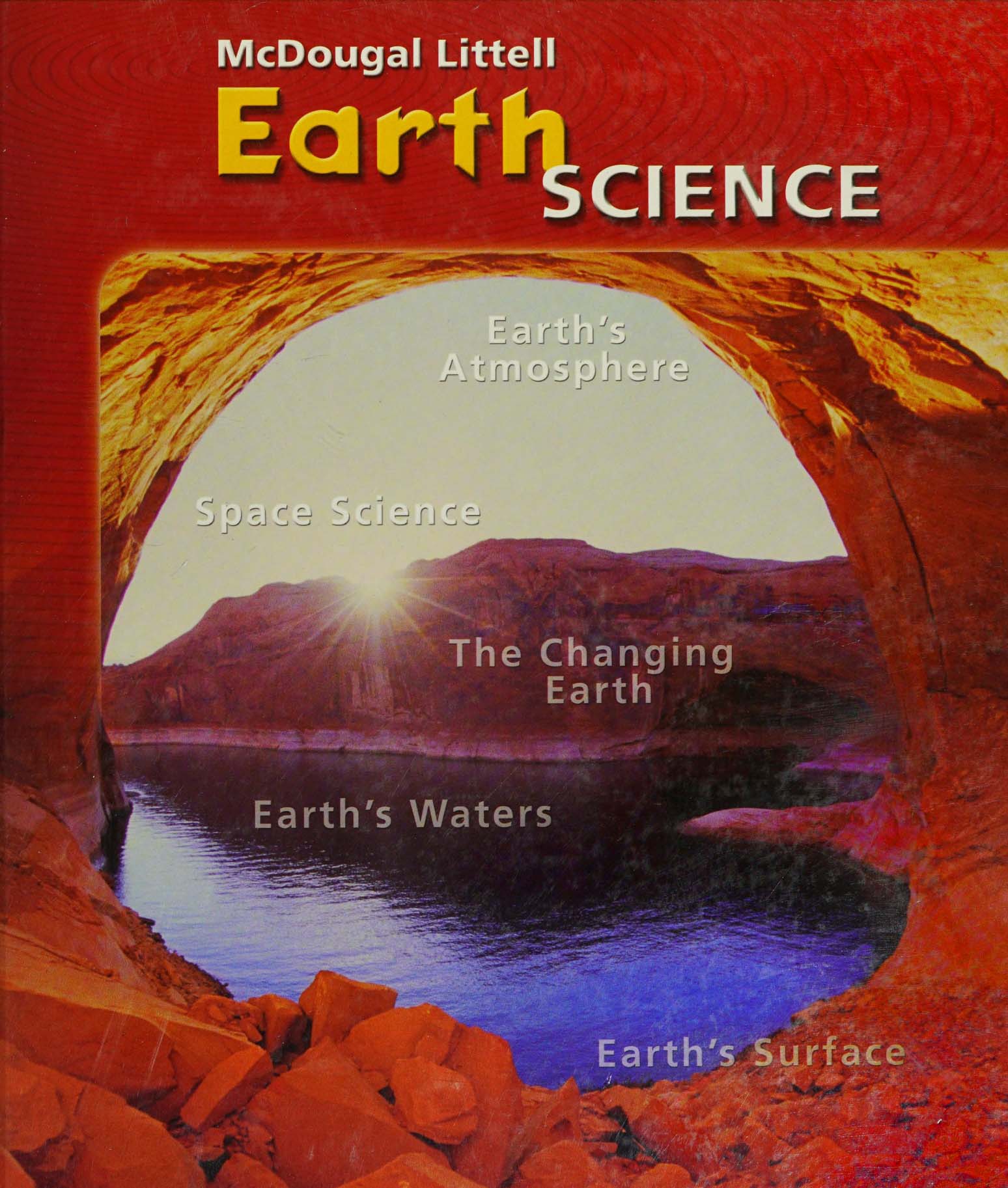
Earth Science (Grade 6)
Earth Science for Grade 6 is a comprehensive middle school science textbook covering the full breadth of Earth and space sciences across 22 chapters. Students explore topics ranging from geology and plate tectonics — including earthquakes, volcanoes, rocks, and minerals — to Earth's water systems, weather patterns, climate change, and natural resources. The course also extends into astronomy, guiding students through Earth's relationship with the Moon and Sun, our solar system, and the wider universe of stars and galaxies.
Chapters & Lessons
Chapter 1: Views of Earth Today
4 lessonsIn this Grade 6 Earth Science lesson from Chapter 1: Views of Earth Today, students learn to identify the Earth system and its four major parts: the atmosphere, hydrosphere, biosphere, and geosphere. The lesson explains how these interconnected spheres function as open systems that together form one closed planetary system, and how technology is used to explore each part. Students also model the geosphere's layers through hands-on experimentation.
In this Grade 6 Earth Science lesson from Chapter 1, students learn how maps and globes serve as models of Earth's surface, exploring key concepts such as relief maps, map scale, map legends, latitude, longitude, and map projection. Students discover how to find exact locations on Earth using the equator, prime meridian, and coordinate systems, and why all flat maps distort Earth's curved surface. The lesson also examines the differences between maps and globes in representing natural and human-made features.
In this Grade 6 Earth Science lesson from Chapter 1: Views of Earth Today, students learn how to read topographic maps by interpreting contour lines to determine elevation, slope, and relief. Using Mount Hood as a real-world example, students discover how the spacing of contour lines indicates steepness and how subtracting the lowest elevation from the highest calculates an area's relief. This lesson builds foundational map-reading skills aligned with the Earth Science textbook's introduction to Earth's surface features.
In this Grade 6 Earth Science lesson from Chapter 1: Views of Earth Today, students learn how remote sensing and satellite sensors are used to gather detailed, accurate information about Earth's surface. They explore how geographic data can be displayed in layers to build maps, and experiment with graphing a model that shows how satellites transmit images to Earth. The lesson builds on prior knowledge of topographic maps to introduce key vocabulary including remote sensing, sensors, false-color images, and geographic information systems.
Chapter 2: Minerals
3 lessonsIn this Grade 6 Earth Science lesson from Chapter 2: Minerals, students learn the four characteristics that define a mineral — that it forms in nature, is a solid, has a definite chemical makeup, and has a crystal structure. Students also explore how minerals are classified into groups and identify the most common mineral group, using everyday examples like halite (table salt) and copper. The lesson includes a hands-on exploration activity where students observe crystal structure and properties using table salt and rock salt.
In this Grade 6 Earth Science lesson from Chapter 2: Minerals, students learn how to identify minerals using key physical properties including color, streak, luster, cleavage, fracture, density, and hardness. The lesson explains why color alone is unreliable for identification and introduces tools like the streak plate used by geologists to distinguish minerals such as hematite and fluorite. Students also apply their understanding by classifying common minerals according to hardness through hands-on experimentation.
In this Grade 6 Earth Science lesson from Chapter 2: Minerals, students explore how minerals such as quartz, feldspar, fluorite, graphite, and corundum are used in everyday industrial products and decorative arts including jewelry and gemstones. Students also learn how minerals form from magma and lava, how they are extracted through mining, and examine the trade-offs involved in the mining process. The lesson connects classroom mineral identification skills to real-world applications, helping students recognize minerals in familiar items like toothpaste, paint, glass, and pencils.
Chapter 3: Rocks
4 lessonsIn this Grade 6 Earth Science lesson from Chapter 3: Rocks, students learn that most rocks are composed of one or more minerals and explore the key differences between rocks and minerals in terms of structure and composition. Students identify the three main rock types — igneous, sedimentary, and metamorphic — and explain how the rock cycle describes the processes by which one rock type can transform into another. The lesson also covers how common each rock type is within Earth's crust.
In this Grade 6 Earth Science lesson from Chapter 3: Rocks, students learn how igneous rocks form from molten rock, distinguishing between intrusive igneous rocks that cool within Earth and extrusive igneous rocks that cool at the surface. Students explore why silica content is used to classify igneous rocks and how cooling time determines crystal size, using granite and rhyolite as real-world examples of rocks with the same mineral composition but different crystal structures. The lesson also explains why igneous rocks form durable, long-lasting landforms.
In this Grade 6 Earth Science lesson from Chapter 3: Rocks, students learn how sedimentary rocks form from loose materials such as rock particles, minerals, and plant and animal remains that settle in layers through a process called sedimentation. Students identify the three groups of sedimentary rocks, explore how particle size determines layering, and discover how sedimentary rocks preserve records of past environmental conditions. The lesson connects to real-world examples like sandstone formation and uses hands-on experiments to model how sediment layers build up over time.
In this Grade 6 Earth Science lesson from Chapter 3: Rocks, students learn how existing rocks are transformed through the process of metamorphism, in which heat and pressure change parent rocks — such as limestone or shale — into new metamorphic rocks like marble or schist. Students explore recrystallization, the process by which mineral bonds break and reform to create larger crystals or entirely new minerals, and examine real-world examples such as garnet and graphite forming from sedimentary materials. The lesson also includes a hands-on experiment modeling how pressure and temperature can alter a solid without melting it.
Chapter 4: Weathering and Soil Formation
3 lessonsIn this Grade 6 Earth Science lesson from Chapter 4, students learn how mechanical weathering and chemical weathering break down rocks into smaller pieces. The lesson covers specific processes such as exfoliation and abrasion, and examines the factors that affect the rate at which weathering occurs. Students also practice identifying variables through a hands-on experiment exploring rust formation.
In this Grade 6 Earth Science lesson from Chapter 4, students learn that soil is a mixture of weathered rock particles, organic matter, water, and air, with decayed organic material called humus playing a key role in soil composition. Students explore how climate, landforms, plant cover, and the activities of organisms influence a soil's characteristics, and examine how properties like texture and color differ across soil types. The lesson builds directly on prior knowledge of mechanical and chemical weathering to explain how soil horizons and soil profiles develop over time.
In this Grade 6 Earth Science lesson from Chapter 4, students explore why soil is a necessary resource and examine how land-use practices such as farming, overgrazing, construction, and mining contribute to soil loss and desertification. Students learn how fertilizers, erosion, and the removal of plant cover degrade soil quality, and they investigate methods people use to conserve soil. The lesson connects directly to the chapter's broader focus on weathering and soil formation, building on students' prior knowledge of soil horizons and organic matter.
Chapter 5: Erosion and Deposition
4 lessonsIn this Grade 6 Earth Science lesson from Chapter 5, students learn how erosion and deposition shape Earth's surface, exploring how water, wind, and ice transport weathered rock and sediment to new locations. The lesson also covers how gravity drives mass wasting, the large-scale movement of rock and soil down slopes. Students examine real-world examples, such as valley formation in Iceland, to understand how these natural forces continuously reshape landforms over time.
In this Grade 6 Earth Science lesson from Chapter 5, students learn how moving water shapes Earth's surface through the processes of erosion and deposition, forming landforms such as floodplains, alluvial fans, and deltas. Students also explore how drainage basins and divides organize the flow of water across landscapes, and how water moving underground creates features like sinkholes and caves. A hands-on investigation connects these concepts by having students model how streams shape the land.
In this Grade 6 Earth Science lesson from Chapter 5, students learn how waves and wind shape shorelines and landscapes through processes including longshore drift, longshore current, sandbar and barrier island formation, and dune building. Students explore how wave action erodes rocky coastlines to form features like sea stacks while also depositing sediment to build up beaches. The lesson includes a hands-on experiment modeling how sand moves along a beach, connecting key vocabulary to real-world landforms.
In this Grade 6 Earth Science lesson from Chapter 5, students learn how glaciers form, move, and shape landscapes through the processes of erosion and deposition. The lesson covers key vocabulary including glacier, till, moraine, and kettle lake, while exploring how moving ice carves landforms and deposits sediment. Students also examine the extent of glaciers during past ice ages and their lasting effects on North American landscapes.
Chapter 6: Plate Tectonics
4 lessonsIn this Grade 6 Earth Science lesson from Chapter 6, students explore the concept that Earth is composed of distinct internal layers, building foundational knowledge of Earth's structure within the context of plate tectonics. The lesson introduces key vocabulary and prior knowledge connections related to Earth's geosphere, setting the stage for understanding how tectonic processes operate beneath the surface. Students use combination notes and inquiry-based activities to examine how Earth's layered composition relates to broader natural processes that shape the planet.
In this Grade 6 Earth Science lesson from Chapter 6: Plate Tectonics, students learn how Alfred Wegener developed the continental drift hypothesis and how evidence from fossils, ancient climate records, and sea floor observations supports the idea that continents were once joined in a single landmass called Pangaea. Students also explore how scientists used concepts like mid-ocean ridges and convection currents to build the theory of plate tectonics.
In this Grade 6 Earth Science lesson from Chapter 6: Plate Tectonics, students learn to identify the three types of tectonic plate boundaries — divergent, convergent, and transform — with a focus on what happens when plates move apart at divergent boundaries. Students explore how mid-ocean ridges and rift valleys form as molten material rises to create new crust at spreading centers, and investigate magnetic reversal to understand how scientists measure the direction and speed of plate movement. The lesson builds on prior knowledge of sea-floor spreading and the theory of plate tectonics.
Chapter 19: Exploring Space
4 lessonsIn this Grade 6 Earth Science lesson from Chapter 19: Exploring Space, students learn how the universe is arranged into structures such as planets, solar systems, and galaxies, and how gravity groups objects in space together. Students also explore how stars form patterns called constellations in the sky and how Earth's rotation affects the apparent motion of the Sun and the positions of space objects as seen from Earth.
In this Grade 6 Earth Science lesson from Chapter 19: Exploring Space, students learn how electromagnetic radiation — including visible light, radio waves, and X-rays — carries information about objects in space. Students explore how telescopes and other instruments help astronomers detect different forms of radiation to determine the size, distance, composition, and movement of distant objects. The lesson also examines how Earth's atmosphere can distort light from space, connecting to a hands-on investigation of light distortion.
In this Grade 6 Earth Science lesson from Chapter 19: Exploring Space, students learn how astronauts survive and work in the weightless environment of orbiting spacecraft and how different types of spacecraft — including satellites, space stations, landers, and probes — are used to explore beyond Earth. The lesson traces the history of space exploration from the first artificial satellite to the Apollo Moon landings, highlighting how missions like Apollo 11 advanced scientific knowledge of the Moon's surface and interior. Students also identify variables in a launch planning experiment, connecting real mission planning challenges to scientific inquiry skills.
In this Grade 6 Earth Science lesson from Chapter 19: Exploring Space, students learn how space exploration benefits society by expanding our understanding of Earth's surface features, impact craters, and atmosphere. Students explore how comparing Earth with other worlds — such as studying impact craters on the Moon and Mercury — helps scientists understand geological processes and Earth's history. The lesson also covers how space technology developed through exploration has practical applications back on Earth.
Chapter 20: Earth, Moon, and Sun
3 lessonsIn this Grade 6 Earth Science lesson from Chapter 20, students learn how Earth's rotation on its axis of rotation causes day and night, and how Earth's tilted axis and orbit around the Sun produce the changing seasons. The lesson also introduces key vocabulary including revolution, equinox, and solstice, and explores how time zones relate to Earth's rotation. This content aligns with the McDougal Littell Earth Science textbook's unit on Earth, Moon, and Sun.
In this Grade 6 Earth Science lesson from Chapter 20, students learn why the Moon has phases, what causes solar and lunar eclipses, and why Earth's oceans have tides. Students explore how the Moon's position in its monthly orbit determines which portion of its sunlit half is visible from Earth, and distinguish between terms like waxing, waning, crescent, and gibbous phases. The lesson also introduces key vocabulary including eclipse, umbra, and penumbra to explain how the alignment of the Sun, Moon, and Earth produces these phenomena.
Chapter 21: Our Solar System
4 lessonsIn this Grade 6 Earth Science lesson from Chapter 21, students learn to identify the types of objects in the solar system, compare the sizes and distances of planets from the Sun, and explore how the solar system formed. Key vocabulary includes astronomical unit (AU) and ellipse, which help students measure and describe planetary distances and orbits. Students also conduct a hands-on experiment modeling planet formation to understand how spinning matter gathers into clumps over time.
In this Grade 6 Earth Science lesson from Chapter 21, students learn about the terrestrial planets — Mercury, Venus, Earth, and Mars — and how four key processes, including tectonics and volcanism, shape the surfaces of these rocky worlds. Students also explore how atmospheres form and influence planetary conditions, and why terrestrial planets share similar rocky crusts, dense mantles, and cores. The lesson uses Earth as a model to help students compare and understand the other inner planets closest to the Sun.
In this Grade 6 Earth Science lesson from Chapter 21, students learn to identify the four gas giants — Jupiter, Saturn, Uranus, and Neptune — and explore what makes these outer solar system planets unique. Students examine the layered atmospheres of gas giants, discovering how gravity compresses hydrogen and helium gases into increasingly dense states toward each planet's solid core. The lesson also investigates planetary ring systems and includes a hands-on model experiment to explain why Saturn's rings appear to change orientation over time.
In this Grade 6 Earth Science lesson from Chapter 21, students learn how small solar system objects like Pluto, asteroids, and comets are composed of ice and rock, and how their composition depends on where they formed relative to the Sun. Students also compare the characteristics of asteroids and comets, explore Pluto and the moons of the giant planets, and discover what happens when tiny objects such as meteors and meteorites enter Earth's atmosphere.
Chapter 22: Stars, Galaxies, and the Universe
4 lessonsIn this Grade 6 Earth Science lesson from Chapter 22, students learn how the Sun produces energy through nuclear fusion, converting hydrogen into helium in its core. The lesson also covers how energy flows through the Sun's layers and explores solar features such as the corona, sunspots, and solar wind. Part of a unit on stars, galaxies, and the universe, this lesson builds students' understanding of the Sun's size, composition, and its role as the source of light and energy in our solar system.
In this Grade 6 Earth Science lesson from Chapter 22, students learn how stars are classified by size, brightness, and temperature, and how they form and change over their life cycles. Key vocabulary includes light-years, nebula, main sequence, neutron stars, and black holes. Students also explore parallax through hands-on experiments to understand how astronomers measure the distance of stars from Earth.
In this Grade 6 Earth Science lesson from Chapter 22, students learn about the size, shape, and structure of the Milky Way galaxy, including its disk shape, central bulge, and location of our solar system within it. Students also analyze how galaxies are classified by shape and explore the characteristics of galactic centers, including the concept of quasars. A hands-on experiment helps students understand why the Milky Way appears as a hazy band of light from Earth's edge-on perspective inside the galaxy's disk.
In this Grade 6 Earth Science lesson from Chapter 22, students learn how the Doppler effect provides evidence that galaxies are moving farther apart and that the universe is expanding. Students explore key vocabulary including the Doppler effect and the big bang, and examine how astronomers use the stretching of light wavelengths from distant galaxies to draw conclusions about the universe's development. The lesson also introduces concepts such as superclusters and the vast scale of the universe, which contains roughly 100 billion galaxies.
Frequently Asked Questions
- Is Earth Science Grade 6 the right science textbook for my child?
- Earth Science Grade 6 is an excellent choice for sixth graders following a standard middle school science sequence where Earth science is the Grade 6 focus. The textbook covers a comprehensive range of topics — maps and topography, minerals and rocks, weathering and soil, erosion and deposition, plate tectonics, and a full astronomy unit on space exploration, the solar system, stars, and galaxies. The course is well-suited for students who are curious about the physical world and how the Earth works. If your child will take Life Science in Grade 7 and Physical Science in Grade 8, this course provides the natural foundation for that three-year middle school science sequence.
- Which chapters or topics in Earth Science Grade 6 tend to be the hardest?
- Chapter 6 (Plate Tectonics) is typically the most challenging because students must understand Earth's internal layers, sea-floor spreading, magnetic reversal, and three types of plate boundaries all in sequence. The abstract scale of geological processes — events taking millions of years — makes the concepts harder to visualize. Chapter 22 (Stars, Galaxies, and the Universe) is also demanding because light-years, the life cycles of stars, galaxy classification, and the Big Bang require comfort with very large numbers and abstract space concepts. Chapter 5 (Erosion and Deposition) confuses students who struggle to distinguish between the different agents of erosion — water, wind, glaciers, and waves — and the specific landforms each creates.
- My child is confused about Earth's structure and geology — where should they start?
- Start with Chapter 1 (Views of Earth Today) to build map-reading skills and the four-sphere framework. Then work through Chapter 2 (Minerals) and Chapter 3 (Rocks) in order — these provide the vocabulary for everything that follows. Do not skip Chapters 2 and 3 in favor of jumping to plate tectonics; students who do not understand the difference between igneous, sedimentary, and metamorphic rocks will struggle with Chapter 6. Use the rock cycle diagram in Chapter 3 as a reference tool throughout the course. Chapter 4 on weathering and soil connects rocks to surface processes and makes a logical bridge to the erosion and plate tectonics chapters.
- What should my child study after finishing Earth Science Grade 6?
- After completing Earth Science Grade 6, students typically move to Life Science in Grade 7 and Physical Science in Grade 8, completing the standard middle school science sequence. The chemistry vocabulary from the minerals and rocks units — elements, compounds, properties — directly supports Grade 8 Physical Science. The astronomy chapters in Chapters 19-22 provide a foundation for any high school astronomy or physics elective. Students who are particularly interested in geology, environmental science, or astronomy after this course can explore supplemental resources; Earth science is often underrepresented in later high school science offerings so this Grade 6 course may be the most extensive Earth science your child studies before college.
- How can Pengi help my child with Earth Science Grade 6?
- Pengi is very helpful for the visual and spatial concepts in this textbook that are hard to review purely from re-reading. When your child struggles with the three types of plate boundaries in Chapter 6, Pengi can describe each one clearly — divergent spreading, convergent subduction, transform faulting — and ask questions to test understanding. For the astronomy chapters, Pengi can help your child work through how moon phases work or why the seasons occur using step-by-step explanations. Pengi can also create personalized vocabulary reviews for the mineral and rock identification chapters, quizzing your child on properties like luster, cleavage, and hardness until the distinctions are solid before a test.
Ready to start learning?
Jump into your first lesson for Earth Science (Grade 6). Free, no account required.
Start Learning