
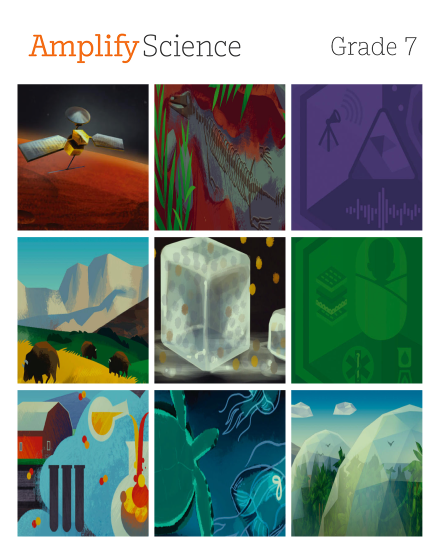
Amplify Science (California) Grade 7
Amplify Science (California) Grade 7 is a middle school science curriculum published by Amplify Education, designed to meet California's Next Generation Science Standards for seventh grade. The program covers a wide range of life, earth, and physical science topics, including photosynthesis, cellular respiration, carbon cycling and ecosystem dynamics, population stability, plate tectonics, rock formations, phase change, atomic properties, and chemical reactions. Each unit blends hands-on investigations, data analysis, and Science Seminar case studies — such as deforestation, tsunami warning systems, and planetary comparisons — to build scientific reasoning and real-world problem-solving skills.
Chapters & Lessons
Chapter 1: Comparing Earth and Rocky Planets
3 lessonsChapter 2: Using Models as Evidence
3 lessonsChapter 3: Analyzing New Evidence
3 lessonsChapter 1: Introducing Earth’s Outer Layer
4 lessonsChapter 2: Understanding Plate Boundaries
4 lessonsChapter 3: Investigating the Rate of Plate Movement
3 lessonsChapter 4: Science Seminar (Case Study: Jalisco Block)
3 lessonsChapter 1: Tsunami Warning Systems
3 lessonsChapter 1: Rock Formations
4 lessonsChapter 2: Sediment and Magma
4 lessonsChapter 3: Movement of Rock Formations
4 lessonsChapter 4: Science Seminar (Case Study: Venus)
3 lessonsChapter 1: Describing Phase Change at Two Scales
4 lessonsChapter 2: Investigating Energy and Phase Change
3 lessonsChapter 3: Investigating Attraction and Phase Change
3 lessonsChapter 4: Science Seminar (Case Study: Liquid Oxygen)
3 lessonsChapter 1: Portable Baby Incubators
3 lessonsChapter 1: Properties and Atoms
4 lessonsChapter 2: Reactions
3 lessonsChapter 3: Accounting for Atoms
3 lessonsChapter 4: Science Seminar (Case Study: The Diamond Heist)
3 lessonsChapter 1: Stability and Change in Populations
3 lessonsChapter 2: Energy and Changes to Populations
4 lessonsChapter 3: Indirect Effects in Ecosystems
3 lessonsChapter 4: Science Seminar (Case Study: Orange-Bellied Parrot)
3 lessonsChapter 1: Photosynthesis
4 lessonsChapter 2: Cellular Respiration in Ecosystems
3 lessonsChapter 3: Carbon Movement in Ecosystems
3 lessonsChapter 4: Science Seminar (Case Study: Deforestation)
3 lessonsFrequently Asked Questions
- Is Amplify Science California Grade 7 the right science textbook for my seventh grader?
- If your child attends a California middle school, there is a good chance their district uses Amplify Science. It is built specifically around California's Next Generation Science Standards for Grade 7, covering life science topics like photosynthesis and carbon cycling, earth science topics like plate tectonics and rock formations, and physical science topics like chemical reactions and phase change. The program uses case studies - deforestation, tsunamis, planetary comparisons - which makes it engaging for students who learn better through real-world problems. For California students, it is an excellent fit.
- Which units or topics are hardest for seventh graders in Amplify Science?
- The chemistry units on atomic properties and chemical reactions are consistently the most challenging - students often struggle with the conceptual leap from visible matter to invisible atoms and molecules. The carbon cycling unit is also difficult because it requires connecting photosynthesis, cellular respiration, decomposition, and human activity into one integrated system. Plate tectonics is manageable for most students, but understanding evidence-based claims and applying the scientific argument structure that Amplify emphasizes throughout every unit trips up students who prefer memorizing facts over explaining reasoning.
- My child is struggling with the carbon cycle. Where should they start?
- Start with the photosynthesis unit first, making sure your child can clearly explain what plants take in and what they release. Then move to cellular respiration - ensuring they understand it as essentially the reverse process. Only after those two are solid should you tackle carbon cycling as a system. The key concept is that carbon does not appear or disappear; it moves between living things, the atmosphere, and the soil. A simple diagram of the cycle drawn by hand helps most students. Amplify's Science Seminar on deforestation is a great anchor for making it feel real.
- My child just finished Amplify Science Grade 7. What should they study next?
- Grade 8 science in California typically covers Earth history, waves and electromagnetic radiation, forces and motion, and information technology - again aligned to NGSS. Amplify Science Grade 8 is the natural follow-on. For students who loved the chemistry units, a supplemental introduction to the periodic table and basic chemical nomenclature would be great enrichment before high school chemistry. For students who enjoyed the plate tectonics unit, reading about real earthquake and volcano events connects the classroom concepts to the news.
- How can Pengi help my child with Amplify Science California Grade 7?
- Pengi is especially useful for Amplify Science because the program emphasizes explanation and argumentation - skills that benefit from back-and-forth conversation. If your child needs help explaining how photosynthesis connects to carbon cycling, or why tectonic plates move, Pengi can probe their understanding with follow-up questions, correct misconceptions, and help them build clear written explanations. Pengi can also help your child prepare for Science Seminar discussions on topics like deforestation and tsunamis by summarizing key evidence and helping structure their argument.
Ready to start learning?
Jump into your first lesson for Amplify Science (California) Grade 7. Free, no account required.
Start Learning