
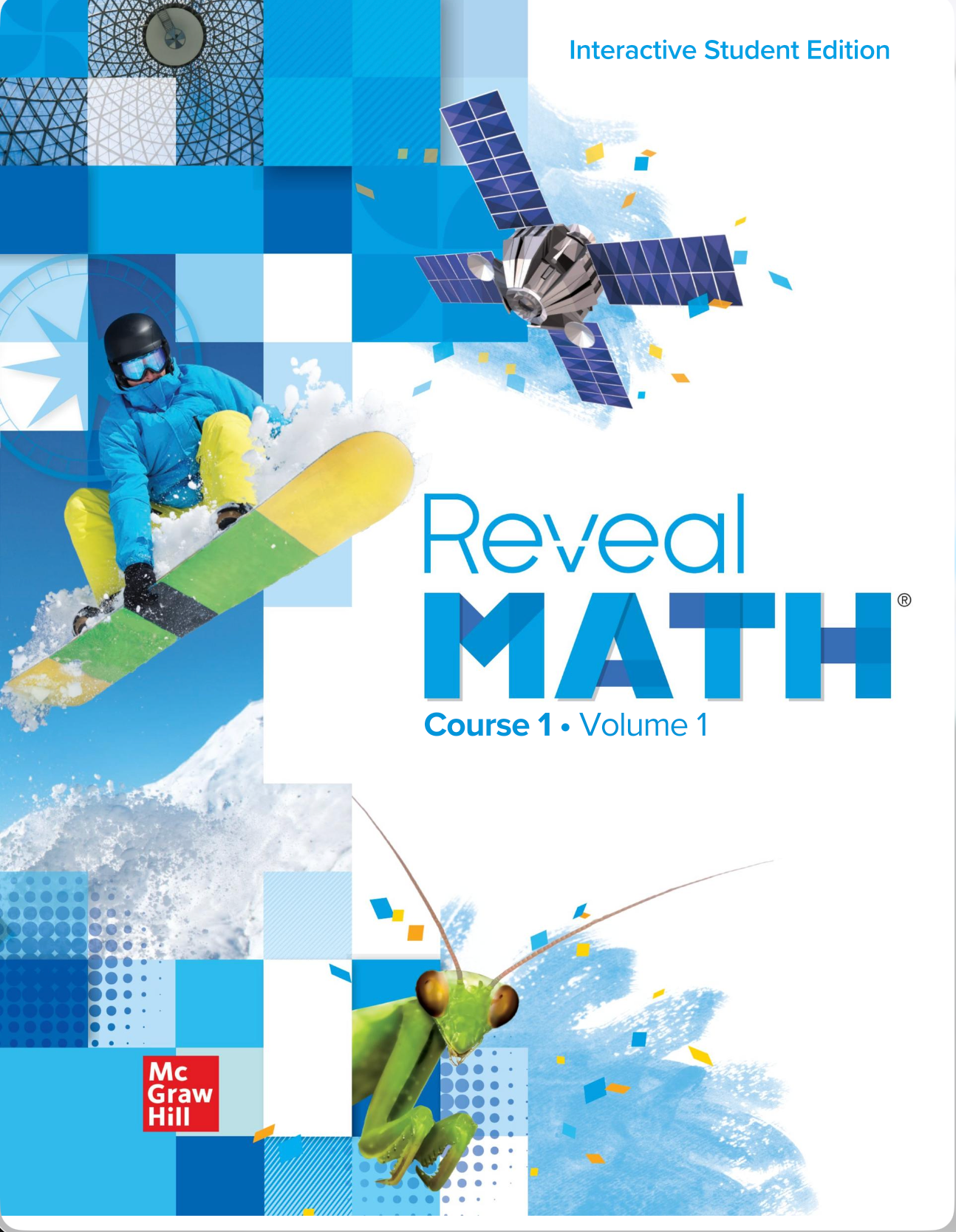
Reveal Math, Course 1
Reveal Math Course 1 is a Grade 6 mathematics textbook published by McGraw-Hill that covers a comprehensive range of foundational math topics aligned with Common Core standards. The curriculum spans number sense and operations including ratios, rates, fractions, decimals, percents, integers, and rational numbers, alongside introductory algebra covering numerical and algebraic expressions, equations, inequalities, and relationships between two variables. Students also explore geometry concepts such as area, volume, and surface area, as well as data analysis through statistical measures and displays.
Chapters & Lessons
Module 1: Ratios and Rates
8 lessonsIn this Grade 6 lesson from Reveal Math, Course 1, students learn how to define and represent ratios as multiplicative comparisons between two quantities, distinguishing between part-to-whole and part-to-part ratios. Using real-world contexts like lemonade recipes and paint mixtures, students practice writing ratios in three forms — word form, colon notation, and fraction notation — while exploring how equivalent ratios scale across multiple batches. This lesson builds the foundational ratio language and reasoning skills central to Module 1: Ratios and Rates.
In this Grade 6 lesson from Reveal Math, Course 1, students learn how to represent equivalent ratios using ratio tables and double number lines. They practice both the additive and multiplicative structures of ratio tables, including the process of scaling to find unknown quantities in equivalent ratios. The lesson builds skills in scaling forward and backward to solve real-world problems involving proportional relationships.
In this Grade 6 lesson from Reveal Math, Course 1 (Module 1: Ratios and Rates), students learn how to represent equivalent ratios as ordered pairs and graph ratio relationships on the coordinate plane. Using real-world contexts like salad dressing and bracelet making, students practice generating tables of equivalent ratios, plotting the corresponding ordered pairs, and interpreting patterns in the resulting graphs.
In this Grade 6 lesson from Reveal Math Course 1, Module 1, students learn how to compare ratio relationships that are presented in different representations, including graphs and tables. They practice converting ratios to a common representation, such as plotting ordered pairs on a coordinate graph or generating equivalent ratios in a table, to determine which ratio is greatest. Real-world contexts like dog food protein content, pizza toppings, and smoothie recipes are used to build understanding of how the steepness of a graph or scaled table values reveal differences between ratios.
In this Grade 6 lesson from Reveal Math, Course 1, Module 1, students learn to solve real-world ratio problems using bar diagrams, double number lines, and equivalent ratios. They practice applying part-to-whole and part-to-part ratio relationships to find unknown quantities in contexts like surveys and comparisons. The lesson builds problem-solving skills by guiding students through step-by-step methods to set up and interpret visual models for ratio reasoning.
In this Grade 6 lesson from Reveal Math, Course 1 (Module 1: Ratios and Rates), students learn to convert customary units of length, weight, and capacity using ratio reasoning and unit ratios. They practice setting up equivalent ratios and using bar diagrams to convert between units such as pints to fluid ounces or gallons to cups. The lesson builds on students' understanding of ratio relationships to explain why numerical values increase when converting from larger to smaller units.
In this Grade 6 lesson from Reveal Math, Course 1 (Module 1: Ratios and Rates), students learn how rates differ from ratios and how to calculate unit rates by dividing to find a first quantity compared to 1 unit of a second quantity. Using ratio tables and equivalent rates, students practice finding unit rates in real-world contexts such as wing flap frequency and unit price comparisons. By the end of the lesson, students can apply rate and unit rate reasoning to determine the better buy when comparing differently sized products.
In Grade 6 Reveal Math Course 1, Lesson 1-8, students learn to solve real-world rate problems by finding unit rates and applying bar diagrams, double number lines, and equivalent rates. The lesson covers how to calculate unit prices, unit speeds, and rates per minute, then scale those rates to compare and find differences over larger quantities or time intervals. Students work through multi-step problems involving rates such as miles per hour, price per can, and heartbeats per minute.
Module 2: Fractions, Decimals, and Percents
6 lessonsIn this Grade 6 lesson from Reveal Math, Course 1 (Module 2: Fractions, Decimals, and Percents), students learn to understand percent as a rate per 100 and express it using ratio notation such as 45:100 or 45/100. Students practice identifying and modeling percents using two visual tools: 10×10 grids, where each square represents 1%, and bar diagrams divided into equal sections representing multiples of 5% or 10%.
In this Grade 6 lesson from Reveal Math, Course 1 (Module 2: Fractions, Decimals, and Percents), students learn to identify and model percents greater than 100% and less than 1% by writing equivalent ratios and comparing a part to a whole. Using 10×10 grids and real-world contexts like rainfall totals and kitten weights, students practice expressing values such as 125% or 200% when the part exceeds the whole, and values like 0.93% when the part is a very small fraction of the whole. The lesson builds conceptual understanding of percent as a ratio comparing any number — not just those between 0 and 100 — to 100.
In this Grade 6 lesson from Reveal Math, Course 1 (Module 2), students learn to convert between fractions, decimals, and percents using place-value reasoning and the definition of percent as a ratio comparing a number to 100. Students practice writing percents like 35% and 95% as equivalent fractions and decimals, and converting fractions like 3/20 and 6/8 into percent and decimal form by finding equivalent ratios with a denominator of 100. The lesson also covers simplifying fractions first when no whole-number multiplier directly yields a denominator of 100.
In this Grade 6 lesson from Reveal Math, Course 1 (Module 2: Fractions, Decimals, and Percents), students learn how to find the percent of a number by reasoning about percent as a rate per 100. The lesson presents four methods — bar diagrams, ratio tables, equivalent ratios, and double number lines — to calculate values such as 20% of 50 or 30% of 240.
In this Grade 6 lesson from Reveal Math, Course 1, students learn how to estimate the percent of a number using benchmark percents such as 10%, 20%, and 25% and their multiples, as well as rounding strategies. The lesson covers how to apply these estimation techniques through bar diagrams, equivalent ratios, and mental calculations in real-world contexts like calculating tips and discounts. Students practice choosing appropriate benchmark percents and rounding both the percent and the whole number to find reasonable approximations.
In this Grade 6 lesson from Reveal Math Course 1, students learn how to find the whole when given a part and a percent, using strategies such as bar diagrams, ratio tables, double number lines, and equivalent ratios. The lesson builds on percent concepts from Module 2: Fractions, Decimals, and Percents, guiding students through real-world problems like determining total school enrollment or original sale prices. By the end of the lesson, students can set up and solve problems of the form "60% of what number is 114?" using multiple methods.
Module 3: Compute with Multi-Digit Numbers and Fractions
5 lessonsIn Lesson 3-1 of Module 3 in Reveal Math Course 1, Grade 6 students learn to divide multi-digit whole numbers using the standard long division algorithm, including key vocabulary such as dividend, divisor, and quotient. The lesson covers dividing with and without remainders, annexing zeros to express quotients as decimals, and converting remainders to fractions or decimals. Students apply these skills to real-world problems involving multi-digit division.
In this Grade 6 lesson from Reveal Math, Course 1, students learn to apply standard algorithms for addition, subtraction, multiplication, and division with multi-digit decimals, including numbers extending to the thousandths place. Key techniques covered include aligning decimal points, annexing zeros, and determining correct decimal placement in products by summing the decimal places of each factor. Students also practice using estimation to verify the reasonableness of their solutions.
In this Grade 6 lesson from Reveal Math Course 1, Module 3, students learn how to divide whole numbers by fractions using both visual bar models and equations. The lesson introduces key vocabulary including reciprocals, multiplicative inverses, and the Inverse Property of Multiplication, then teaches students to divide by multiplying the whole number by the reciprocal of the fraction. Practice problems reinforce finding reciprocals and solving division expressions in simplest form.
In this Grade 6 lesson from Reveal Math, Course 1 (Module 3), students learn how to divide fractions by fractions using both visual models and the multiply-by-the-reciprocal method. The lesson covers key concepts such as identifying the reciprocal of the divisor, simplifying quotients, and interpreting fractional results in real-world word problems. Students also practice writing their own story contexts to represent fraction division expressions.
In this Grade 6 lesson from Reveal Math Course 1, Module 3, students learn how to divide fractions by whole numbers and divide with mixed numbers by applying reciprocals and converting mixed numbers to improper fractions. Using both visual fraction bar models and equations, students practice multiplying by the reciprocal to solve division problems involving fractions and mixed numbers. The lesson builds on prior knowledge of fraction operations to solve real-world problems such as dividing quantities into equal parts.
Module 4: Integers, Rational Numbers, and the Coordinate Plane
7 lessonsIn this Grade 6 lesson from Reveal Math, Course 1, students learn to identify and represent integers, including positive integers, negative integers, and zero, using real-world contexts such as temperature, football yardage, and elevation. Students also practice graphing sets of integers on both horizontal and vertical number lines.
In this Grade 6 lesson from Reveal Math Course 1, Module 4, students learn the concepts of opposites and absolute value of integers, including how to use number line models to find the opposite of a number (such as solving -(-5) = 5) and how to evaluate absolute value expressions like |-150| = 150. The lesson covers key vocabulary, symbolic notation for opposites, and real-world applications to build a foundational understanding of integer relationships.
In this Grade 6 lesson from Reveal Math, Course 1 (Module 4), students learn how to compare and order integers using sign rules and number lines, including writing inequality statements for both positive and negative integers. The lesson covers comparing integers with different signs, using horizontal and vertical number lines to compare same-sign integers, and ordering sets of integers from least to greatest or greatest to least. Real-world contexts such as trivia game scores and continental elevations help students apply these skills to interpret the meaning of inequalities.
In this Grade 6 lesson from Reveal Math, Course 1, Module 4, students learn to define rational numbers as any number expressible as a fraction a/b, graph sets of rational numbers on a number line, and find absolute values of rational numbers as their distance from zero. Students also practice comparing rational numbers by examining signs and magnitude using number line models.
In this Grade 6 lesson from Reveal Math, Course 1, students learn to identify and graph rational numbers on the coordinate plane, including recognizing the four quadrants and the x- and y-axes based on the signs of coordinates. Students practice writing ordered pairs, locating points such as fractions and mixed numbers on the grid, and determining which quadrant or axis a given point belongs to.
In this Grade 6 lesson from Reveal Math, Course 1, students learn how to graph reflections of points across the x-axis and y-axis on a coordinate plane. Students discover that reflecting a point across the x-axis keeps the x-coordinate the same while reversing the sign of the y-coordinate, and reflecting across the y-axis keeps the y-coordinate the same while reversing the sign of the x-coordinate. The lesson also covers prime notation for reflected points and how to identify the axis of reflection by comparing coordinate pairs.
In this Grade 6 lesson from Reveal Math Course 1, Module 4, students learn how to use absolute value to find horizontal and vertical distances between points on the coordinate plane. They practice identifying whether two points share the same x- or y-coordinate, then apply the rules of subtracting absolute values for points in the same quadrant and adding absolute values for points in different quadrants. Examples work with integers, fractions, and decimals to build fluency across a range of coordinate pairs.
Module 5: Numerical and Algebraic Expressions
7 lessonsIn Lesson 5-1 of Module 5 in Reveal Math Course 1, Grade 6 students learn how to write repeated multiplication as a power using a base and an exponent, and how to evaluate powers involving whole numbers, fractions, and decimals. The lesson covers key vocabulary including base, exponent, and power, and walks through examples such as writing 7 × 7 × 7 × 7 × 7 as 7⁵ and evaluating expressions like (1/3)⁴. A real-world biology application connects exponential notation to bacterial growth patterns.
In this Grade 6 lesson from Reveal Math, Course 1 (Module 5), students learn to write and evaluate numerical expressions using the order of operations, applying rules for parentheses, exponents, multiplication, division, addition, and subtraction in the correct sequence. Students practice evaluating multi-step expressions involving whole numbers, decimals, and fractions, then extend the skill to real-world contexts by writing expressions to represent situations with multiple quantities and costs.
In this Grade 6 lesson from Reveal Math Course 1, Module 5, students learn to write algebraic expressions by identifying variables, coefficients, constants, and like terms within expressions such as 6n + 7n + 4 + 2n. Students practice defining the variable and translating verbal phrases — like "ten dollars more than Anthony earned" — into one-step algebraic expressions using key operation words for addition, subtraction, multiplication, and division. The lesson builds foundational algebra vocabulary and skills needed to model real-world problems with symbolic expressions.
In Lesson 5-4 of Module 5 in Reveal Math Course 1, Grade 6 students learn how to evaluate algebraic expressions by substituting given values for variables and simplifying using the order of operations. The lesson covers one-step and multi-step expressions involving fractions, exponents, and multiple variables, including real-world applications such as finding the area of a trapezoid using the formula one-half a times the quantity b plus c.
In this Grade 6 lesson from Reveal Math, Course 1 (Module 5), students learn how to find the greatest common factor (GCF) and least common multiple (LCM) of two or more whole numbers. The lesson covers multiple methods including listing factors, using factor trees, and listing multiples to identify common factors and common multiples. Students apply these skills to real-world problems, such as determining when repeating events will coincide.
In this Grade 6 lesson from Reveal Math, Course 1, students learn to apply the Distributive Property to expand algebraic expressions such as 2(x + 3) into 2x + 6, evaluate numerical expressions with mixed numbers, and factor expressions using the greatest common factor. The lesson covers both expanding and factoring numerical and algebraic expressions, giving students a complete understanding of how multiplication distributes over addition and subtraction.
In this Grade 6 lesson from Reveal Math, Course 1, students learn how to use the Commutative, Associative, Distributive, and Identity Properties of operations to write algebraic expressions in simplest form and determine whether two expressions are equivalent. Students practice applying these properties step by step to simplify expressions and draw conclusions about equivalence, then verify results using substitution. This lesson builds foundational algebra skills as part of Module 5: Numerical and Algebraic Expressions.
Module 6: Equations and Inequalities
6 lessonsIn Grade 6 Reveal Math (Course 1), Lesson 6-1 introduces students to equations and the concept of a solution, teaching them how to use substitution and the guess, check, and revise strategy to determine whether a given value makes a one-step equation true. Students practice testing candidate values in equations involving addition, subtraction, and multiplication with decimals and fractions. This lesson is part of Module 6: Equations and Inequalities.
In this Grade 6 lesson from Reveal Math, Course 1, students learn to write and solve one-step addition equations by defining variables and applying the Subtraction Property of Equality as an inverse operation. Using bar diagrams, algebra tiles, and real-world contexts, learners practice translating word problems into algebraic equations such as m + 23 = 33 and solving for the unknown. The lesson builds foundational algebra skills covered in Module 6: Equations and Inequalities.
In this Grade 6 lesson from Reveal Math, Course 1, students learn to write and solve one-step subtraction equations by applying the Addition Property of Equality. They practice translating real-world problems into algebraic equations using variables, then isolate the unknown by adding the same value to both sides. The lesson covers equations with whole numbers, decimals, and mixed numbers, reinforcing the connection between inverse operations and algebraic reasoning.
In this Grade 6 lesson from Reveal Math, Course 1 (Module 6: Equations and Inequalities), students learn to write and solve one-step multiplication equations using the Division Property of Equality. They practice translating real-world problems into algebraic equations by defining variables and applying inverse operations to find unknown values. Both visual models like algebra tiles and algebraic methods are used to build conceptual understanding.
In this Grade 6 lesson from Reveal Math, Course 1 (Module 6), students learn to write and solve one-step division equations using the Multiplication Property of Equality. They practice translating real-world problems into algebraic equations such as x ÷ 3 = 9 or x/9 = 13, then solve by multiplying both sides by the same value. The lesson also covers solving division equations involving fractions and decimals, with bar diagrams used to build conceptual understanding.
In this Grade 6 lesson from Reveal Math, Course 1, students learn what inequalities are and how they differ from equations, including the four inequality symbols (greater than, less than, greater than or equal to, and less than or equal to). Students practice writing algebraic inequalities to represent real-world situations by identifying key words such as "at least," "at most," and "no more than." The lesson also introduces graphing inequalities on a number line using open and closed dots to show whether a value is included in the solution set.
Module 7: Relationships Between Two Variables
4 lessonsIn this Grade 6 lesson from Reveal Math, Course 1 (Module 7), students learn to identify independent and dependent variables in real-world situations and use equations and rules to find missing input and output values in tables. Using examples like cheetah speed, babysitting earnings, and arcade game costs, students practice applying a given rule to calculate dependent variable values and work backward from outputs to solve for unknown independent variable values.
In this Grade 6 lesson from Reveal Math, Course 1, Module 7, students learn how to write one-step and two-step equations to represent relationships shown in tables, using independent and dependent variables. Students practice identifying constant ratios in input-output tables and translating those patterns into algebraic equations such as d = 8h or c = 9t. The lesson connects unit rate concepts to equation writing through real-world scenarios like earning money and purchasing items.
In this Grade 6 lesson from Reveal Math, Course 1 (Module 7), students learn how to graph relationships between independent and dependent variables by creating tables of values, writing ordered pairs, and plotting them on a coordinate plane. Students also practice the reverse process, writing an equation from a graph by identifying patterns in ordered pairs. The lesson covers real-world contexts such as bushels of apples and canoe rentals, and addresses when to use solid versus dashed lines based on whether continuous values are possible.
In this Grade 6 lesson from Reveal Math Course 1, Module 7, students learn how to identify independent and dependent variables and use them to create multiple representations of a relationship, including equations, tables, and graphs. Using real-world scenarios like a car wash fundraiser and an online store, students practice writing linear equations such as t = 7c + 150, building corresponding input-output tables, and plotting ordered pairs on a coordinate graph. The lesson emphasizes how words, equations, tables, and graphs each describe the same relationship in different ways.
Module 8: Area
5 lessonsIn this Grade 6 lesson from Reveal Math, Course 1, students learn how to find the area of parallelograms by decomposing them into rectangles and applying the formula A = bh, where b is the base and h is the perpendicular height. The lesson covers both calculating area given base and height dimensions and solving for a missing dimension when the area is known. Students practice with real-world contexts such as flag stripes and parking spaces involving whole numbers and fractions.
In this Grade 6 lesson from Reveal Math, Course 1, Module 8, students learn how a parallelogram can be decomposed into two congruent triangles to derive the triangle area formula A = ½bh. Students apply the formula to find the areas of right triangles and non-right triangles, including cases with mixed number dimensions, and also work backward from the area to find missing base or height values.
In this Grade 6 lesson from Reveal Math, Course 1, students learn how to find the area of a trapezoid using three methods: decomposing it into triangles and rectangles, composing two congruent trapezoids into a parallelogram, and applying the area formula A = ½h(b₁ + b₂). The lesson builds understanding of trapezoid-specific vocabulary including base, height, and the relationship between parallel sides. Students also practice finding missing dimensions using the formula within the context of Module 8: Area.
In this Grade 6 lesson from Reveal Math, Course 1, Module 8, students learn how to find the area of a regular polygon by decomposing it into congruent triangles, parallelograms, or trapezoids, calculating each smaller figure's area, and then adding or multiplying to find the total. The lesson introduces the term "regular polygon" and applies the decomposition strategy to real-world shapes like octagons and hexagons using the trapezoid and triangle area formulas.
In this Grade 6 lesson from Reveal Math Course 1, Module 8, students learn how to graph polygon vertices on the coordinate plane and calculate perimeter and area by subtracting x- or y-coordinates to find side lengths. The lesson covers both regular and irregular polygons, including rectangles and multi-sided figures, using coordinate subtraction to determine distances between points.
Module 9: Volume and Surface Area
4 lessonsIn this Grade 6 lesson from Reveal Math, Course 1 (Module 9), students learn how to find the volume of rectangular prisms using two methods: packing with unit cubes and applying the volume formula V = ℓwh. The lesson extends beyond whole-number measurements to include rectangular prisms with fractional dimensions, using both the unit cube method and the formula V = Bh to calculate volume in cubic units.
In this Grade 6 lesson from Reveal Math, Course 1, students learn how to find the surface area of rectangular prisms by drawing and using nets to deconstruct three-dimensional figures into their six two-dimensional faces. Students calculate the area of each pair of congruent faces using the formulas A = ℓh, A = ℓw, and A = wh, then add the results to find the total surface area. The lesson connects mathematical and real-world contexts, such as determining how much wrapping paper is needed to cover a gift box.
In this Grade 6 lesson from Reveal Math, Course 1, students learn how to create a net to represent a triangular prism and use that net to calculate surface area. The lesson covers identifying the two congruent triangular bases and three rectangular faces of a right triangular prism, applying the triangle area formula A = ½bh, and adding all face areas to find the total surface area. Part of Module 9: Volume and Surface Area, the lesson builds students' understanding of three-dimensional figures through both drawing and computation.
In this Grade 6 lesson from Reveal Math, Course 1, students learn how to identify and define pyramids, including key vocabulary such as lateral faces and slant height, and represent square and triangular pyramids using nets made up of squares and triangles. Using those nets, students calculate surface area by finding the area of the base and each triangular lateral face separately, then adding them together. This lesson builds spatial reasoning and applies the area formulas for squares and triangles in a three-dimensional context.
Module 10: Statistical Measures and Displays
7 lessonsIn this Grade 6 lesson from Reveal Math, Course 1, students learn to distinguish statistical questions from non-statistical questions by recognizing that statistical questions anticipate a variety of responses when data is collected. The lesson introduces the vocabulary of statistics and guides students through a four-step process of constructing a statistical question, collecting data, organizing results in a table, and using that data to draw conclusions. It aligns with Module 10: Statistical Measures and Displays and builds the foundational data literacy skills students will apply throughout the chapter.
In this Grade 6 lesson from Reveal Math Course 1, students learn how to construct and interpret dot plots and histograms to display and analyze numerical data sets. Students practice organizing raw data into dot plots by plotting values above a number line, and into histograms by grouping data into equal consecutive intervals using a frequency table. The lesson also addresses when each representation is most appropriate for visualizing data distributions.
In this Grade 6 lesson from Reveal Math, Course 1, students learn how to calculate the mean and identify the median as measures of center that summarize a numerical data set with a single value. Students practice finding the mean by dividing the sum of data values by the number of values, and explore the mean as the balance point of a dot plot. The lesson also teaches students how to find a missing data value when the mean is known, using both a balance-point method and an algebraic equation.
In this Grade 6 lesson from Reveal Math, Course 1, Module 10, students learn how to calculate measures of variation, including range, quartiles, and interquartile range (IQR), to describe the spread of a data set. Students practice finding Q1, Q2, and Q3 by dividing ordered data into four equal parts, then computing the IQR using the formula Q3 minus Q1. The lesson also introduces box plots as a visual tool for displaying the five-number summary of a data set on a number line.
In this Grade 6 lesson from Reveal Math, Course 1 (Module 10), students learn how to calculate and interpret the mean absolute deviation (MAD) as a measure of variation in a data set. They practice finding the MAD by computing the mean, determining each value's absolute deviation from the mean, and averaging those distances. Students also compare MAD values across two data sets to draw conclusions about which set shows greater variability or consistency.
In this Grade 6 lesson from Reveal Math Course 1, Module 10, students learn how to identify outliers in a data set using the interquartile range (IQR), specifically by calculating upper and lower limits based on Q1, Q3, and 1.5 times the IQR. Students then explore how the presence of an outlier affects measures of center such as the mean and median, and measures of variation such as the MAD and IQR. By comparing calculations with and without an outlier, students determine which measure of center best represents a data set depending on whether an outlier is present.
In this Grade 6 Reveal Math lesson from Module 10, students learn how to interpret dot plots and histograms by analyzing the distribution of data for symmetry, clusters, gaps, and peaks. Students practice selecting the most appropriate measure of center and variation — mean and mean absolute deviation for symmetric distributions, or median and interquartile range for non-symmetric ones — and use those measures to describe real-world data sets. This lesson builds core statistical reasoning skills aligned with the Course 1 curriculum.
Frequently Asked Questions
- Is Reveal Math Course 1 the right textbook for my sixth grader?
- Reveal Math Course 1 from McGraw-Hill is a strong Grade 6 math program that covers all Common Core standards for the year - ratios, fractions, decimals, percents, integers, algebraic expressions, equations, inequalities, geometry, and statistics. It takes a conceptual approach that asks students to understand why procedures work, not just how to execute them, which is excellent for long-term math development. Compared to Big Ideas Math or enVision, it has more emphasis on mathematical discussion and reasoning. It is a good fit for students who are ready to think mathematically, not just calculate.
- Which modules in Reveal Math Course 1 are hardest for sixth graders?
- Module 1 on ratios and rates is where many students first struggle because proportional reasoning requires a conceptual leap from additive to multiplicative thinking. Modules 4 and 5 on algebraic expressions and equations challenge students who have never formalized the idea of a variable before. Module 8 on area and Module 9 on surface area and volume require strong spatial visualization that some sixth graders have not yet developed. Module 11 on statistical measures - especially mean absolute deviation and choosing appropriate data displays - demands a level of statistical reasoning that is new for most 11-year-olds.
- My child is struggling with ratios and proportional reasoning. Where in this textbook should they start?
- Start at Module 1, Lesson 1-1 (Understand Ratios) and make sure your child can correctly write and interpret a ratio before moving to Lesson 1-2 on equivalent ratio tables. The critical conceptual move is understanding that ratios describe a multiplicative relationship, not an additive one. Use real examples: if a recipe uses 2 cups of flour for every 3 cups of sugar, doubling the recipe means 4 cups and 6 cups - not 3 and 4. Ratio tables in Lesson 1-2 make this concrete. Do not advance to unit rates or percents until equivalent ratios are solid.
- My child just finished Reveal Math Course 1. What should they study next?
- Reveal Math Course 2 covers Grade 7 content including proportional relationships, operations with rational numbers (including negatives), probability, statistics sampling, and geometry of circles and 3D shapes. If your child performed well in Course 1, they are well-positioned for Course 2. For accelerated students, Reveal Math Accelerated compresses Grade 7 and Grade 8 content to reach Algebra 1 by ninth grade or earlier. Building fluency with negative number operations and strengthening fraction arithmetic over the summer is the best preparation for Course 2.
- How can Pengi help my child with Reveal Math Course 1?
- Pengi is especially helpful for the reasoning and explanation tasks that Reveal Math emphasizes. If your child can calculate a unit rate but cannot explain what it means, or can follow a procedure for solving equations but does not understand why it works, Pengi can probe that understanding with targeted questions and provide explanations that build genuine comprehension. Pengi can also generate practice problems at any difficulty level for any module, quiz your child on key vocabulary like constant of proportionality or mean absolute deviation, and provide immediate feedback on homework problems.
Ready to start learning?
Jump into your first lesson for Reveal Math, Course 1. Free, no account required.
Start Learning