
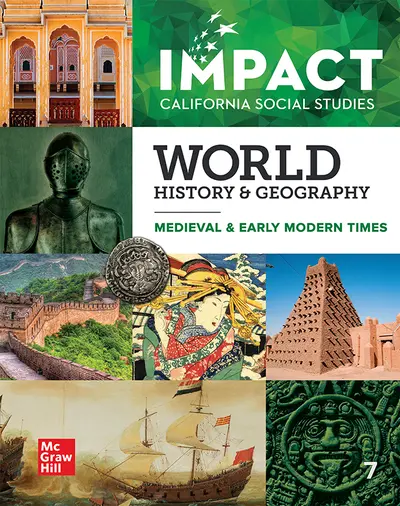
IMPACT California Social Studies, Grade 7
IMPACT California Social Studies for Grade 7, published by McGraw-Hill, is a world history textbook designed to meet California's seventh-grade social studies standards. It guides students through the medieval and early modern world, covering the rise of Christianity and the Roman legacy, medieval Europe, Islamic civilization, Imperial China, feudal Korea and Japan, the civilizations of India, the Americas, and Africa, as well as the spread of world religions and the emergence of new ideas during the Renaissance. The course concludes with the Age of Exploration and global trade, connecting ancient foundations to the early modern era.
Chapters & Lessons
Chapter 1: Rome and the Rise of Christianity
5 lessonsIn this Grade 7 lesson from IMPACT California Social Studies, Chapter 1, students examine the factors that led to the collapse of the Roman Empire, including economic pressures like inflation, political corruption, and the geographic limits of Roman expansion. Students analyze primary sources such as Diocletian's Price Edict of 301 C.E. and explore how the Pax Romana shaped Rome's multicultural society before its eventual decline.
Grade 7 students explore the Byzantine Empire in this lesson from IMPACT California Social Studies, examining how geography shaped Constantinople's rise as a powerful trade and military center. Students analyze key factors behind Byzantine prosperity, including the city's strategic peninsula location, multicultural population, and the cultural influences of Roman, Greek, Egyptian, and Persian traditions. The lesson also addresses Emperor Justinian's role in expanding the empire and how cultural blending gave rise to a distinct Byzantine civilization.
In this Grade 7 lesson from IMPACT California Social Studies, students examine the origins of Early Christianity within the context of Roman rule over Judaea and Galilee, exploring Jewish responses to Roman control including cooperation, withdrawal, and armed revolt by the Zealots. Students analyze the life of Jesus of Nazareth and the significance of his teachings to his followers, as well as how Roman rulers perceived him as a threat. The lesson draws on primary sources such as Flavius Josephus's account of the siege of Jerusalem to develop skills in analyzing point of view and distinguishing fact from opinion.
In this Grade 7 lesson from IMPACT California Social Studies, students explore how Christianity spread throughout the Roman Empire by examining factors such as Roman roads, the Latin and Greek languages, and the faith's promise of community and afterlife. Students analyze why some Romans mistreated early Christians, including conflicts over emperor worship, military service, and false accusations like Nero's charge that Christians caused the Great Fire of Rome. The lesson also covers the role of martyrs, the catacombs, and Emperor Constantine's conversion in shaping the early Christian church.
In this Grade 7 lesson from IMPACT California Social Studies, students examine the division between the Roman Catholic Church and the Eastern Orthodox Church, focusing on disputes over papal authority and the use of icons. Students analyze how Byzantine emperors controlled the Eastern Orthodox Church and the role of iconoclasts in the 726 C.E. controversy sparked by Emperor Leo III. The lesson builds historical thinking skills by asking students to cite text evidence and compare the views of the western and eastern churches on key religious and political issues.
Chapter 2: Medieval Europe
5 lessonsIn this Grade 7 lesson from IMPACT California Social Studies, students explore feudalism as a political and social system in medieval Europe, examining how the relationships between lords, vassals, and knights were structured through oaths of loyalty, military service, and the granting of fiefs. Students analyze the feudal hierarchy — from kings and queens down to peasants and serfs — and investigate how the collapse of Charlemagne's empire led local nobles to take on governing roles in exchange for protection. The lesson draws on primary sources, including a 10th-century land grant and a 1479 vassal oath, to help students understand why feudalism emerged and how it shaped European society by the year 1000.
In this Grade 7 lesson from IMPACT California Social Studies Chapter 2, students examine how royal power developed and was limited in medieval England, tracing key events from Alfred the Great's unification of Anglo-Saxon kingdoms through William the Conqueror's Norman conquest and the Domesday Book. Students also analyze the causes and effects of the Crusades and how they contributed to the weakening of feudalism. The lesson builds skills in identifying sequence, causation, and the use of primary sources as text evidence.
In this Grade 7 lesson from IMPACT California Social Studies, students explore how the Catholic Church shaped medieval European culture by examining the construction of Romanesque and Gothic cathedrals, the founding of early universities in Bologna, Paris, Oxford, and Cambridge, and the development of theology as a formal field of study. Students analyze how flying buttresses, stained-glass windows, and academic disciplines like grammar, logic, and astronomy reflected the values and stability of medieval society. The lesson connects religious institutions to the broader cultural and intellectual developments of the Middle Ages.
Chapter 3: Islamic Civilization
3 lessonsIn this Grade 7 lesson from IMPACT California Social Studies Chapter 3, students explore the origins of Islam and the role of Arabia's physical geography in shaping early Arab life. They examine how features like the Arabian Desert, oases, and key trade cities such as Makkah and Madinah influenced the development and spread of Islam beginning in the 600s C.E. Students also learn about Bedouin nomadic culture, tribal structure, and how trade connected Arabia to surrounding civilizations.
In this Grade 7 lesson from IMPACT California Social Studies Chapter 3, students examine how Islam spread beyond the Arabian Peninsula through military conquest, trade, and religious teaching. Students learn about the role of the caliph as Muhammad's successor, the fall of the Persian Sasanian Empire to Arab Muslim armies, and the expansion of the Arab Empire under the Umayyad caliphs from 661 to 750 C.E. The lesson also explores how Muslims treated conquered peoples, including the concept of "People of the Book," and how Arab culture and language spread alongside Islamic rule.
Chapter 4: India in the Middle Ages
3 lessonsGrade 7 students explore how Hinduism evolved through the bhakti movement, examining how singer-poets expressed loyal devotion to chosen deities in common languages, challenging priestly authority and making Hinduism more accessible across social classes. The lesson also traces the development of Theravada and Mahayana Buddhism, comparing their central ideas and the concept of nirvana, using the travels of the monk Xuanzang as a historical entry point. This content is part of Chapter 4 in IMPACT California Social Studies, Grade 7, focusing on India in the Middle Ages.
In this Grade 7 lesson from IMPACT California Social Studies, students learn how Islam spread to India through the Umayyad conquest of Sind in 711 C.E., Arab and Persian trade networks, and the Turkish invasions that led to the establishment of the Delhi Sultanate in 1206 C.E. Students examine why conflict develops as they trace the events that transformed Islam from a minority religion in western India into a dominant political force across northern India. The lesson also explores the Delhi Sultanate's cultural contributions and its complex relationship with Hinduism and Buddhism during its rule from 1206 to 1526.
Chapter 5: Imperial China
4 lessonsGrade 7 students explore how Tang and Song dynasty China experienced major economic and technological growth in this lesson from IMPACT California Social Studies, Chapter 5. Students examine specific advancements such as champa rice cultivation, iron plow technology, waterwheel irrigation, and the expansion of the Silk Road trade network. The lesson also analyzes how farming improvements, population growth, and increased trade in goods like silk, porcelain, and tea transformed Chinese society during this period.
Grade 7 students learn how the Mongols built a vast empire in the 1200s, tracing how Temujin became Genghis Khan and unified the Mongol clans through military reforms, a new legal code, and conquest. This lesson from Chapter 5 of IMPACT California Social Studies explores the Mongols' nomadic origins on the steppes, their superior cavalry tactics, and their invasion of northern China in 1211. Students analyze the sequence of events that enabled a nomadic people to become the first non-Chinese rulers of all of China.
In this Grade 7 lesson from IMPACT California Social Studies Chapter 5, students examine how the Ming dynasty rose to power after the decline of Mongol rule, exploring the reforms of emperors Hong Wu and Yong Le, including the restoration of civil service examinations, the construction of the Forbidden City, and economic expansion through infrastructure projects. Students also analyze the causes and long-term effects of the voyages of Zheng He on China and its relationships with the wider world.
Chapter 6: The Civilizations of Korea and Japan
3 lessonsGrade 7 students explore the history and culture of Korea using IMPACT California Social Studies, examining how Korea's geographic position on the Korean Peninsula shaped its development as a cultural bridge between China and Japan. The lesson covers early Korean civilization, including shamanism and tribal origins, followed by the Three Kingdoms period featuring Koguryo, Paekche, and Silla, and traces how Korean society adopted and adapted Chinese and Japanese influences in government, Buddhism, and Confucianism. Students also analyze the later Silla, Koryo, and Yi dynasties, noting similarities across these kingdoms and key cultural achievements such as the creation of the hangul alphabet under King Sejong.
In this Grade 7 lesson from IMPACT California Social Studies, students explore how Japan's archipelago geography shaped its early settlement, agriculture, and isolation from mainland Asia. Students examine the rise of the Yamato clan, the origins of the imperial line through Jimmu, and the development of animism and Shinto as Japan's early spiritual tradition. The lesson also introduces the Yayoi people's contributions, including rice farming and metalworking, as foundations of Japanese civilization.
In this Grade 7 lesson from IMPACT California Social Studies, Chapter 6, students explore the rise of military power in medieval Japan, examining how emperors lost authority to nobles and regents during the Heian period. Students analyze the samurai class, including the code of bushido, the warrior's obligations of loyalty and honor, and the role of the shogun in Japan's feudal structure. The lesson also introduces primary sources such as Miyamoto Musashi's A Book of Five Rings and The Tale of Heike to illustrate samurai culture and the rare but notable participation of women warriors like Tomoe.
Chapter 7: The Americas
2 lessonsIn this Grade 7 lesson from IMPACT California Social Studies, students explore how the geography of the Americas — including its climate zones, mountain ranges such as the Rocky Mountains, and physical features like the Central American isthmus — shaped the settlement and ways of life of the first Americans. Students analyze the four main geographical areas (North America, South America, Central America, and the Caribbean) and examine the origins of Native Americans as descendants of prehistoric hunters from northeastern Asia. The lesson also introduces early civilizations like the Olmec through primary source accounts and artifact evidence.
In this Grade 7 lesson from IMPACT California Social Studies Chapter 7, students explore how the ancient Maya built and governed complex city-states in the rain forests of Mesoamerica, including cities like Tikal and Palenque. Students examine Maya social structure, including the roles of God-kings, nobles, priests, and farmers, as well as how the Maya used sinkholes and underground water systems to sustain their civilization. The lesson also connects ancient Maya culture to the descendants who continue to live across Mexico, Guatemala, Honduras, El Salvador, and Belize today.
Chapter 8: African Civilizations
3 lessonsIn this Grade 7 lesson from IMPACT California Social Studies, students explore the rise of early African civilizations, examining how geography shaped settlement patterns across Africa's five major zones — rain forests, savannas, the Sahel, deserts, and Mediterranean regions. Students identify the three major West African trading kingdoms and analyze how control of resources like gold and salt enabled these kingdoms to grow wealthy and powerful. The lesson draws on primary sources, including al-Bakri's historical accounts, to help students understand the economic and political foundations of ancient African empires.
Chapter 9: World Religions
4 lessonsIn this Grade 7 lesson from IMPACT California Social Studies, students examine the origins of the Protestant Reformation, exploring key causes such as Catholic Church corruption, the sale of indulgences, and challenges to papal authority by figures like John Wycliffe and Erasmus. Students analyze how Christian humanism and calls for reform ultimately led to the rise of Protestantism across Europe by 1600. The lesson is part of Chapter 9: World Religions and develops skills in identifying causes and effects within religious and historical change.
Grade 7 students explore the Catholic Reformation in this lesson from IMPACT California Social Studies, examining how the Catholic Church responded to the spread of Protestantism through key reforms such as the Council of Trent, the founding of the Jesuits by Ignatius of Loyola, and the establishment of seminaries. Students also analyze the role of Catholic Spain under Ferdinand and Isabella, including the treatment of Jews and Muslims during this period of religious conflict. The lesson helps students understand why and how religious conflict developed in 16th-century Europe.
In this Grade 7 lesson from IMPACT California Social Studies, Chapter 9, students examine how Sufism spread Islam across the medieval world, exploring the distinctive practices and beliefs of Sufi missionaries, including their emphasis on devotion, poetry, and virtuous living over formal theology. Students analyze why Sufi missionaries were effective at converting populations in regions such as Anatolia, Central Asia, Persia, India, and Indonesia, where Zoroastrianism and Hinduism had long been practiced. The lesson also connects the decline of the Abbasid Caliphate to the continued expansion of the Islamic world through trade, conquest, and missionary activity.
In this Grade 7 lesson from IMPACT California Social Studies, students explore the origins and core teachings of Sikhism, including Guru Nanak's monotheistic beliefs, the concept of a formless and infinite God, and the principles of equality, service, and meditation. Students analyze how the multicultural environment of Punjab influenced Nanak's teachings and how he challenged the Hindu jati system and priestly authority. The lesson connects geography and religious development as part of the broader study of world religions in Chapter 9.
Chapter 10: New Ideas
4 lessonsIn this Grade 7 lesson from IMPACT California Social Studies Chapter 10, students explore the origins of the Renaissance in Italy, examining how the Black Death's decline, renewed interest in classical Greek and Roman ideas, and the rise of secular thinking sparked a cultural rebirth between 1350 and 1650. Students analyze how the wealth of Italian city-states, driven by urban growth and strong economies, enabled powerful patrons like Lorenzo de' Medici to fund artists, architects, and scholars. The lesson also introduces key vocabulary including Renaissance, secular, and urban, and asks students to explain the economic and cultural conditions that made Italy the birthplace of this transformative era.
In this Grade 7 lesson from IMPACT California Social Studies Chapter 10, students explore Renaissance humanism and how scholars like Petrarch rediscovered ancient Greek and Roman writings to develop new ideas about the individual, reason, and human society. Students examine how these ideas gave rise to new forms of art, literature, and technology, including the shift from classical Latin to vernacular languages in writing. The lesson helps students understand how the Renaissance laid the groundwork for later movements such as the Scientific Revolution, the Enlightenment, and the Reformation.
In this Grade 7 lesson from IMPACT California Social Studies Chapter 10, students explore the Scientific Revolution by tracing how early scientific ideas from ancient Greek and Roman thinkers, including Aristotle's classification of living things and Ptolemy's geocentric theory, were preserved and passed down through medieval Islamic scholars. Students examine how Nicolaus Copernicus challenged centuries of accepted belief by proposing a heliocentric model of the universe, and they analyze the shift from observation-based reasoning to evidence-backed scientific theory. The lesson builds foundational understanding of how revolutionary ideas in astronomy and natural science transformed human knowledge and everyday life.
Grade 7 students explore the Age of Enlightenment in this lesson from IMPACT California Social Studies, Chapter 10, examining how European thinkers applied reason and natural law to government. Students analyze the contrasting political philosophies of Thomas Hobbes and John Locke, as well as Mary Wollstonecraft's arguments for extending natural rights to women. The lesson focuses on how Enlightenment ideas challenged traditional authority and shaped new thinking about how governments should be structured and changed.
Chapter 11: Age of Exploration and Trade
3 lessonsIn this Grade 7 lesson from IMPACT California Social Studies, Chapter 11, students examine why Europeans began overseas exploration during the 1400s and 1500s, focusing on the search for direct trade routes to Asia and the role of key navigational technologies. Students learn how tools such as the astrolabe and compass, improved ship designs with triangular sails, and the wider availability of accurate maps enabled explorers like Christopher Columbus to navigate vast oceans. The lesson also traces how political disruptions to the Silk Road and Mediterranean trading networks motivated European merchants and monarchs to fund expeditions to Asia and the Americas.
In this Grade 7 lesson from IMPACT California Social Studies, students examine how Spanish conquistadors Hernán Cortés and Francisco Pizarro conquered the Aztec and Inca empires in the Americas. Students analyze the specific methods Cortés used to defeat the Aztec, including military force, Native American alliances through figures like Malintzin, and the devastating spread of European diseases such as smallpox and measles. The lesson connects to the chapter's broader exploration of the Age of Exploration by asking students to evaluate the motivations driving Spanish conquest and the factors behind the rise and fall of civilizations.
In this Grade 7 lesson from IMPACT California Social Studies Chapter 11, students examine how European nations built empires in the Americas during the Age of Exploration, focusing on the economic and labor systems that sustained Spanish, Portuguese, English, French, and Dutch colonies. Students analyze how Spain and Portugal used plantations, gold and silver mines, missionary settlements, and enslaved African labor to generate wealth, and explore the devastating impact of European diseases on Native American populations. The lesson uses primary sources like Captain John Smith's 1608 account of Jamestown to help students understand the economic choices and hardships that shaped early colonial life.
Frequently Asked Questions
- Is IMPACT California Social Studies Grade 7 the right world history textbook for my seventh grader?
- If your child is in seventh grade in California, IMPACT by McGraw-Hill is one of the two most commonly adopted textbooks for this course. It covers the medieval and early modern world - Rome, Medieval Europe, Islam, Imperial China, feudal Japan, the Americas, the Renaissance, and the Age of Exploration - exactly what California's seventh-grade standards require. Compared to myWorld Interactive, IMPACT tends to emphasize primary source analysis and higher-order thinking. It is a strong choice for students who are ready to engage seriously with historical evidence rather than just read narratives.
- Which chapters are hardest for seventh graders in IMPACT California Social Studies?
- The chapters on the Islamic world and the Renaissance tend to be hardest for American students because the cultural context is less familiar. Keeping track of the many dynasties, caliphates, and empires across Chapter 2 (Islamic civilization) and distinguishing them from the medieval European kingdoms in Chapter 3 is challenging. The feudal systems of Japan and Korea (Chapter 5) also confuse students who mix up the terminology with European feudalism. The final chapters on the Age of Exploration require synthesizing content from almost every earlier unit, which is cognitively demanding.
- My child struggles with keeping world history civilizations straight. Where should they start?
- Start by building a simple timeline on paper or a wall chart - place each major civilization covered in the textbook (Rome, Byzantine, Islamic, Medieval Europe, Tang/Song China, Feudal Japan, Aztec, Mali) on a single horizontal timeline with rough dates. Seeing them simultaneously eliminates the most common confusion: students think all these societies existed in sequence when many overlapped. Then tackle Chapter 1 on Rome first, since it is the foundation that explains the Byzantine Empire, early Christianity, and eventually the Renaissance. That chapter provides context for almost everything that follows.
- My child just finished this world history textbook. What should they study next?
- Eighth grade California social studies shifts to U.S. history, covering the founding era through the Civil War and Reconstruction. McGraw-Hill IMPACT California Grade 8 is the direct follow-on in that series. For students who enjoyed world history, supplemental reading about the period covered - medieval primary sources, biographies of Saladin or Marco Polo, or books about the Silk Road - deepens the understanding well beyond what any textbook provides. Geography skills developed in this course also pair well with a National Geographic world atlas exploration.
- How can Pengi help my child with IMPACT California Social Studies Grade 7?
- Pengi is highly effective for the kind of synthesis questions IMPACT emphasizes. If your child needs to compare how feudalism worked in Japan versus Medieval Europe, or explain why the Renaissance emerged when and where it did, Pengi can walk through the comparison, help organize the argument, and check that the reasoning is sound. Pengi also helps with the vocabulary load - terms like caliphate, feudalism, scholasticism, and mercantilism - by explaining them in context rather than just providing definitions. It is great prep for essay tests that require explaining historical change.
Ready to start learning?
Jump into your first lesson for IMPACT California Social Studies, Grade 7. Free, no account required.
Start Learning