
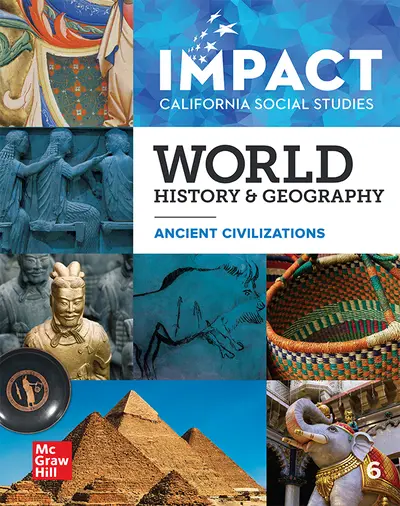
IMPACT California Social Studies, Grade 6
IMPACT California Social Studies, Grade 6, published by McGraw-Hill, is a sixth-grade history textbook designed to meet California state standards for ancient world history. It guides students through the major civilizations of the ancient world, covering topics such as early humans and the Agricultural Revolution, Mesopotamia, Ancient Egypt and Kush, the Israelites, Ancient Greece, Ancient India, Early China, the Roman Republic and Empire, the rise of Christianity, and the pre-Columbian Americas. The course builds students' understanding of how early societies developed, interacted, and shaped the foundations of the modern world.
Chapters & Lessons
Chapter 1: Early Humans and the Agricultural Revolution
3 lessonsGrade 6 students explore the origins of modern humans in this lesson from IMPACT California Social Studies, examining the evolutionary relationship between primates, apes, and hominins, including key species within the genus Homo. Students analyze fossil evidence, such as the Australopithecus afarensis skeleton known as Lucy, to understand how bipedalism and other physical characteristics developed over millions of years. The lesson builds foundational knowledge of early human ancestry and how scientists use fossils and skeletal remains to reconstruct prehistoric life.
In this Grade 6 lesson from IMPACT California Social Studies, students explore life during the Paleolithic Age, learning how early humans survived as nomadic hunter-gatherers by developing stone tools, weapons, and shelters. The lesson examines how Paleolithic bands adapted to their environments through hunting, fishing, and foraging, and how division of labor within groups supported survival. Part of Chapter 1 on Early Humans and the Agricultural Revolution, it builds foundational understanding of prehistoric human behavior and adaptation.
In this Grade 6 lesson from IMPACT California Social Studies Chapter 1, students explore the Agricultural Revolution and the transition from nomadic hunting and gathering to systematic agriculture during the Neolithic Age (approximately 8000–4000 B.C.E.). Students examine how the domestication of animals and the cultivation of crops like wheat and barley created a stable food supply, enabled population growth, and led to the rise of settled communities. The lesson also traces how early farming practices spread from Southwest Asia into southeastern Europe and beyond.
Chapter 2: Mesopotamia
2 lessonsIn this Grade 6 lesson from IMPACT California Social Studies, students explore why early civilizations first developed in Mesopotamia, the land between the Tigris and Euphrates Rivers, around 3000 B.C.E. Students examine how geography — particularly river valley settlement, the Fertile Crescent, and irrigation challenges — shaped the rise of Sumerian civilization and influenced the way people lived and organized society. The lesson also introduces key characteristics shared by early civilizations, including social classes, specialized labor, government, and systems of belief.
In this Grade 6 lesson from IMPACT California Social Studies Chapter 2, students examine the rise of major Mesopotamian empires, including Sargon's Akkadian Empire — recognized as the world's first empire — and Hammurabi's Babylonian Empire. Students analyze how conquest and trade spread culture across regions and explore Hammurabi's Code, one of history's earliest written law systems. The lesson builds skills in identifying cause-and-effect relationships and comparing how empires differed from earlier Sumerian city-states.
Chapter 3: Ancient Egypt and Kush
4 lessonsGrade 6 students explore how the Nile River shaped the development of ancient Egypt and Kush in this lesson from IMPACT California Social Studies, Chapter 3. Students learn why the Nile's annual flooding created fertile "black land" (Kemet), how the river provided drinking water, irrigation for crops, and natural geographic protection for early settlements dating back to 5000 B.C.E. The lesson also covers the river's physical geography, including the Blue Nile and White Nile sources and the river's 4,000-mile course to the Mediterranean Sea.
Grade 6 students explore the structure of ancient Egyptian civilization in this lesson from IMPACT California Social Studies, Chapter 3. Students learn how Egypt was governed as a theocracy during the Old Kingdom, examining the pharaoh's dual role as both political and religious leader, including his relationship to the sun god Re. The lesson also introduces key vocabulary such as bureaucrats and granaries while analyzing how Egyptian society was organized around loyalty, unity, and divine authority.
In this Grade 6 lesson from IMPACT California Social Studies, students examine Egypt's Middle Kingdom and New Kingdom, analyzing how pharaohs expanded territory, collected tribute, and advanced arts and architecture during a golden age. Students also learn how the Hyksos invasion, featuring horse-drawn chariots and bronze weapons, brought the Middle Kingdom to an end. The lesson uses a comparison chart to help students organize key details about government, economy, and dates across both kingdoms.
Grade 6 students explore the Kingdom of Kush in this lesson from IMPACT California Social Studies, examining how Nubia developed from early cattle-herding settlements into the powerful kingdom of Kerma through agriculture, gold mining, and trade along the Nile River. Students analyze the cultural exchange between Nubia and Egypt, including the adoption of hieroglyphs, Egyptian gods, and bronze tools following Egypt's conquest of Kerma. The lesson builds toward understanding how Kush later rose to conquer Egypt, using cause-and-effect analysis to explain the factors behind the rise and fall of ancient civilizations.
Chapter 4: The Israelites
4 lessonsIn this Grade 6 lesson from IMPACT California Social Studies, students explore the origins of the ancient Israelites and the foundational beliefs of Judaism, including the concepts of monotheism and polytheism and how Israelite religion differed from other cultures of Southwest Asia. Students examine the Hebrew Bible as a primary source, tracing key figures such as Abraham and Moses and learning about the Promised Land and the migration to Canaan. The lesson builds an understanding of how Judaism influenced the later development of Christianity and Islam.
In this Grade 6 lesson from IMPACT California Social Studies, students examine the rise of the Israelite monarchy, tracing the reigns of Saul, King David, and King Solomon and their roles as both political and religious leaders. Students analyze how David united the Twelve Tribes, established Jerusalem as the capital, and how Solomon constructed the Temple, using text evidence to compare and contrast the two kings' achievements. The lesson builds skills in citing evidence and determining central ideas within the context of ancient Israelite history in Canaan around 1100–900 B.C.E.
In this Grade 6 lesson from IMPACT California Social Studies, students explore how Judaism developed and survived during and after the Babylonian exile, focusing on the roles of synagogues as houses of worship and scribes in preserving the Torah as written scrolls. Students examine key practices such as observing the Sabbath and Yom Kippur, the rebuilding of the Second Temple, and how the Hebrew Bible is organized into the Torah, the Prophets, and the Writings. The lesson addresses the essential question of how religion shapes society through the leadership of priests and scribes in guiding Jewish communal life.
In this Grade 6 lesson from IMPACT California Social Studies, Chapter 4, students examine how Greek and Roman rule shaped Jewish life in Judah, exploring key concepts such as the Diaspora, the Septuagint, and the Maccabees' revolt against Seleucid king Antiochus IV. Students analyze how conflict over religious freedom led to the Hanukkah tradition and how Jewish ideas spread throughout the Mediterranean world. The lesson builds critical thinking skills by comparing Greek and Roman rule using a Venn diagram and close reading of primary sources.
Chapter 5: The Ancient Greeks
4 lessonsIn this Grade 6 lesson from IMPACT California Social Studies, students explore how the mountainous terrain and surrounding seas of the Balkan Peninsula shaped early Greek civilization, examining concepts like geographic isolation, trade, and independent community development. The lesson also introduces the Minoan and Mycenaean civilizations, comparing their origins, key features, and decline using primary sources and archaeological evidence. Students build skills in citing text evidence and analyzing how physical geography influences the way people live.
In this Grade 6 lesson from IMPACT California Social Studies, Chapter 5, students examine how ancient Greek city-states evolved through different forms of government, including monarchy, tyranny, oligarchy, and democracy. Using Sparta and Athens as contrasting examples, students analyze how political changes — from noble rule to the rise of tyrants to broader citizen participation — shaped daily life and social structure in ancient Greece. Students compare the two rival city-states using a Venn diagram to understand how differences in government and society affected the standard of living for citizens and non-citizens alike.
In this Grade 6 lesson from IMPACT California Social Studies, students examine the causes and major events of the Persian Wars, including the Battle of Marathon and the roles of Persian kings Darius I and Cyrus the Great. Students analyze how Persia built and governed its vast empire through satrapies, the Royal Road, and a professional army, and explore why these conflicts ultimately contributed to Persia's downfall. The lesson draws on primary source excerpts from Herodotus to help students identify key participants and practice citing text evidence.
In this Grade 6 lesson from IMPACT California Social Studies, Chapter 5, students explore the Age of Pericles and its impact on Athenian government and culture, including the rise of direct democracy and how Pericles expanded civic participation to ordinary citizens. Students also examine the contrast between direct democracy in ancient Athens and representative democracy in the United States, using Pericles's Funeral Oration as a primary source. The lesson sets the stage for understanding how Athens' golden age of prosperity and cultural achievement eventually gave way to conflict and decline through the Peloponnesian War with Sparta.
Chapter 6: Greek Civilization
4 lessonsIn this Grade 6 lesson from IMPACT California Social Studies, students explore the foundations of ancient Greek culture, including Greek mythology, the Olympian Gods and Goddesses, and the religious rituals and festivals that united Greek city-states. Students examine how myths like the story of Orpheus reflected Greek religious beliefs, and how practices such as prayers, temple worship, and the Olympic Games honored Gods like Zeus and Athena. The lesson also introduces key vocabulary including city-states, mythology, and rituals within the context of Chapter 6: Greek Civilization.
Grade 6 students explore the major thinkers of ancient Greece's Golden Age, learning about the Sophists, Socrates, Plato, and Aristotle and the distinct ideas each contributed to philosophy, logic, and science. The lesson examines key concepts such as the Socratic method, rhetoric, and absolute truth, showing how Greek philosophers developed new ways of seeking knowledge and understanding the world. Part of Chapter 6 in IMPACT California Social Studies, this lesson connects ancient Greek intellectual traditions to their lasting influence on education and reasoning today.
In this Grade 6 lesson from IMPACT California Social Studies, students examine how Philip II of Macedonia built a powerful army to conquer the Greek city-states and how his successor Alexander the Great expanded that empire across the ancient world. Students analyze the Battle of Chaeronea, Alexander's military strategies against the Persian Empire, and the spread of Hellenistic culture to non-Greek peoples. The lesson also develops historical literacy skills through primary source analysis, including speeches by Demosthenes and accounts from Plutarch's Life of Alexander.
In this Grade 6 lesson from IMPACT California Social Studies, students explore the achievements of Hellenistic culture following Alexander the Great's death, examining how Greek art, architecture, and literature spread across Southwest Asia and Egypt. Students analyze the contributions of Alexandria as a major center of learning, including its famous library of over 500,000 scrolls and the museum that attracted scholars from across the ancient world. The lesson also introduces key literary works of the era, such as the epic poem Argonautica by Apollonius of Rhodes, helping students understand how new ideas shaped life during the Hellenistic Era.
Chapter 7: Ancient India
3 lessonsIn this Grade 6 lesson from IMPACT California Social Studies Chapter 7, students explore how the physical geography of the Indian subcontinent — including the Himalaya, the Indus, Ganges, and Brahmaputra rivers, and the Deccan Plateau — shaped the development of early civilizations. Students also examine how seasonal monsoon winds influenced agriculture, flooding, and drought across the region. The lesson then introduces the Indus Valley Civilization and how the Aryan migrations transformed ancient India.
In this Grade 6 lesson from IMPACT California Social Studies, students explore the origins and core beliefs of Hinduism, Buddhism, and Jainism in ancient India. Students examine key concepts such as Brahman, the Vedas, the Upanishads, reincarnation, moksha, and the life of Siddhartha Gautama as they analyze how these major religions developed. The lesson also challenges students to connect the principle of ahimsa to the teachings of Indian leader Mohandas Gandhi.
In this Grade 6 lesson from IMPACT California Social Studies, students explore the rise and development of the Mauryan Empire, examining how Chandragupta Maurya unified northern India through centralized government and military power beginning in 321 B.C.E. Students analyze the reign of Emperor Ashoka, including his conversion to Buddhism and how he promoted nonviolence, religious toleration, and public welfare across the empire. The lesson connects religion, leadership, and imperial decline to help students understand what makes ancient Indian culture unique.
Chapter 8: Early China
3 lessonsGrade 6 students explore the origins of Chinese civilization in this lesson from IMPACT California Social Studies Chapter 8, examining how the Huang He and Chang Jiang rivers, the Himalaya and other mountain ranges, and the Gobi Desert shaped China's geographic isolation and agricultural development. Students learn how loess-rich river valleys supported early farming, why the Huang He earned the name "China's Sorrow," and how natural barriers led the Chinese to develop a distinct culture and call their land "the Middle Kingdom." The lesson also introduces the Shang dynasty and how ancestor beliefs influenced early Chinese society.
In this Grade 6 lesson from IMPACT California Social Studies, Chapter 8, students examine three major Chinese philosophies — Confucianism, Daoism, and legalism — that emerged between 500 B.C.E. and 200 B.C.E. during the Period of the Warring States. Learners explore the core teachings of Confucius, including the concepts of duty, respect, and moral conduct, and analyze how these philosophies aimed to restore order and harmony to ancient Chinese society and government.
In this Grade 6 lesson from IMPACT California Social Studies, Chapter 8, students explore how Qin Shihuangdi unified China by centralizing government authority, standardizing currency and writing, and constructing the Great Wall to defend against the Xiongnu nomads. Students then compare the Qin and Han dynasties using a Venn diagram to analyze how each dynasty changed Chinese government and society.
Chapter 9: Rome: Republic to Empire
4 lessonsIn this Grade 6 lesson from IMPACT California Social Studies, students explore how geography shaped the rise of Roman civilization, examining Italy's central Mediterranean location, the Tiber River, the Apennine Mountains, and the seven hills of Rome. Students also analyze the legendary origins of Rome, including the myths of Romulus and Remus and the Trojan warrior Aeneas as described in Virgil's Aeneid. The lesson builds toward understanding the sequence of events from Rome's founding through the Roman Republic's expansion across most of the Italian Peninsula.
In this Grade 6 lesson from IMPACT California Social Studies, Chapter 9, students learn how the Roman Republic was structured and governed, including the roles of patricians and plebeians, the functions of the consuls, Senate, praetors, and Assembly of Centuries, and how the system of checks and balances worked. Students also examine how class conflict between patricians and plebeians drove political changes in Rome, including the creation of the Twelve Tables as Rome's first written laws around 451 B.C.E.
In this Grade 6 lesson from IMPACT California Social Studies, Chapter 9, students examine the factors that led to the fall of the Roman Republic, including the economic gap between patricians and plebeians, the rise of latifundia, and the political crisis surrounding Julius Caesar's assassination in 44 B.C.E. Students analyze primary source accounts of Caesar's murder by senators Cassius and Brutus, connecting political conflict and social unrest to the collapse of republican government. The lesson builds students' skills in identifying cause-and-effect relationships within ancient Roman history.
In this Grade 6 lesson from IMPACT California Social Studies, Chapter 9, students examine how Emperor Augustus transformed Rome after the Republic, exploring key reforms including the establishment of a professional army, the Praetorian Guard, and the system of proconsuls to govern the provinces. Students also learn about the Pax Romana, a roughly 200-year period of peace and prosperity during which Rome reached the height of its imperial power. The lesson uses primary sources and visual analysis to help students evaluate the characteristics and achievements of effective leadership.
Chapter 10: Roman Civilization
3 lessonsIn this Grade 6 lesson from IMPACT California Social Studies, Chapter 10, students explore daily life in ancient Rome, learning how Roman cities were organized around the Forum, how social hierarchy shaped living conditions for wealthy citizens versus the poor, and how political leaders used "bread and circuses" to maintain public support. Students also examine the role of the patriarchal family structure at the center of Roman society and analyze the influence of Greek culture on Roman traditions.
Grade 6 students explore the fall of the Roman Empire in this lesson from IMPACT California Social Studies, Chapter 10, examining the interconnected causes of Rome's decline including political confusion, economic weaknesses such as inflation and the devaluation of Roman coins, and invasions by Germanic tribes and Parthian Persia. Students analyze how the breakdown of government authority triggered a chain reaction of civil wars, food shortages, and currency collapse that destabilized Roman society. The lesson also introduces Emperor Diocletian's reforms as a response to these mounting crises.
Chapter 11: The Rise of Christianity
3 lessonsIn this Grade 6 lesson from IMPACT California Social Studies Chapter 11, students explore the origins of Early Christianity by examining the life and teachings of Jesus of Nazareth, including his use of parables to spread his message. Students also analyze how Jews responded to Roman rule in Judaea, studying the roles of groups such as the Zealots and key events like the Jewish revolts and the fall of Jerusalem. The lesson builds foundational knowledge of the political and religious tensions that shaped the rise of Christianity in the ancient world.
In this Grade 6 lesson from IMPACT California Social Studies Chapter 11, students explore how Christianity spread throughout the Roman Empire by examining key factors such as Roman roads, a shared language, the promise of the afterlife, and Christian community bonds. Students also learn why Romans persecuted early Christians, including conflicts over emperor worship and military service, and how figures like Emperor Constantine and the Edict of Milan of 313 C.E. transformed Christianity from an outlawed religion to a legally protected faith.
In this Grade 6 lesson from IMPACT California Social Studies Chapter 11, students examine the division between the Roman Catholic Church and the Eastern Orthodox Church, exploring how differences over papal authority and the use of icons created lasting conflict between the two branches of Christianity. Students also analyze the role of Byzantine emperors in controlling the Eastern Orthodox Church and study key terms such as iconoclasts and the Iconoclast Controversy of the 700s C.E.
Frequently Asked Questions
- Is IMPACT California Social Studies Grade 6 right for my sixth grader?
- IMPACT California Social Studies Grade 6 is a McGraw-Hill program specifically designed for California's sixth-grade social studies standards, which focus on ancient world history. Its 11 chapters cover early humans, Mesopotamia, Egypt and Kush, the Israelites, Greece, Greek civilization, India, early China, Rome, Roman civilization, and the rise of Christianity—a comprehensive sweep of the ancient world. The IMPACT series uses primary sources, inquiry questions, and civic engagement activities throughout, making it more analytical than a traditional textbook. It is the right resource if your child's California school uses this edition. Compare it to History Alive! The Ancient World if your school uses that alternative for the same grade level content.
- Which chapters in IMPACT California Social Studies Grade 6 are hardest for students?
- Chapters 5 and 6 on the Ancient Greeks are consistently the most demanding—students must track democracy, philosophy, the Persian Wars, the Peloponnesian War, and Hellenistic culture across two full chapters with significant vocabulary and chronological complexity. Chapter 9 (Rome: Republic to Empire) requires students to understand the transformation from republic to empire—including the roles of Julius Caesar, Augustus, and the Senate—which is a dense political history lesson. Chapter 11 (The Rise of Christianity) covers religious history with nuance that requires careful reading. Chapter 4 (The Israelites) introduces religious and legal concepts from the Hebrew Bible that some students find unfamiliar and therefore challenging to analyze historically.
- My child struggles with ancient history—where should they start?
- Start with Chapter 1 (Early Humans and the Agricultural Revolution), which establishes the chronological and geographic framework the entire book depends on—how humans moved from hunter-gatherer bands to settled agricultural communities. Chapter 2 (Mesopotamia) is the ideal second stop: it is the most archetypal ancient civilization story and introduces concepts like city-states, writing, and law codes that reappear in every subsequent chapter. If your child is specifically confused about a later chapter like Chapter 7 (Ancient India) or Chapter 8 (Early China), reviewing the map at the start of that chapter and identifying the key river valley before reading the text typically resolves geographic confusion quickly.
- What should my child study after finishing IMPACT California Social Studies Grade 6?
- Seventh-grade social studies in California moves to medieval and early modern world history, typically using a program like History Alive! The Medieval World and Beyond, which picks up chronologically where this book's final chapters leave off. Students who have completed Chapter 11 (The Rise of Christianity) and the Rome chapters will find the medieval European chapters in seventh grade make much more sense, since they trace what happened to Rome after its fall. Students interested in deeper exploration of any civilization covered here—particularly Greece, Rome, or early China—can find supplemental resources on Pengi to extend their knowledge before starting seventh grade.
- How can Pengi help my child with IMPACT California Social Studies Grade 6?
- Pengi can strengthen your child's performance on the inquiry-based tasks that are central to the IMPACT curriculum. For the primary source analysis exercises—examining Hammurabi's Code in Chapter 2, Pericles' Funeral Oration in Chapter 5, or excerpts from the Roman Republic's legal documents in Chapter 9—Pengi can explain the historical context, help decode archaic language, and guide your child through the analytical questions the textbook poses. For civic engagement projects and writing assignments, Pengi can help organize arguments and verify historical accuracy. When your child has a chapter test on dense content like the Greek chapters, Pengi can run a focused review session targeting the specific terms and events the test will cover.
Ready to start learning?
Jump into your first lesson for IMPACT California Social Studies, Grade 6. Free, no account required.
Start Learning