
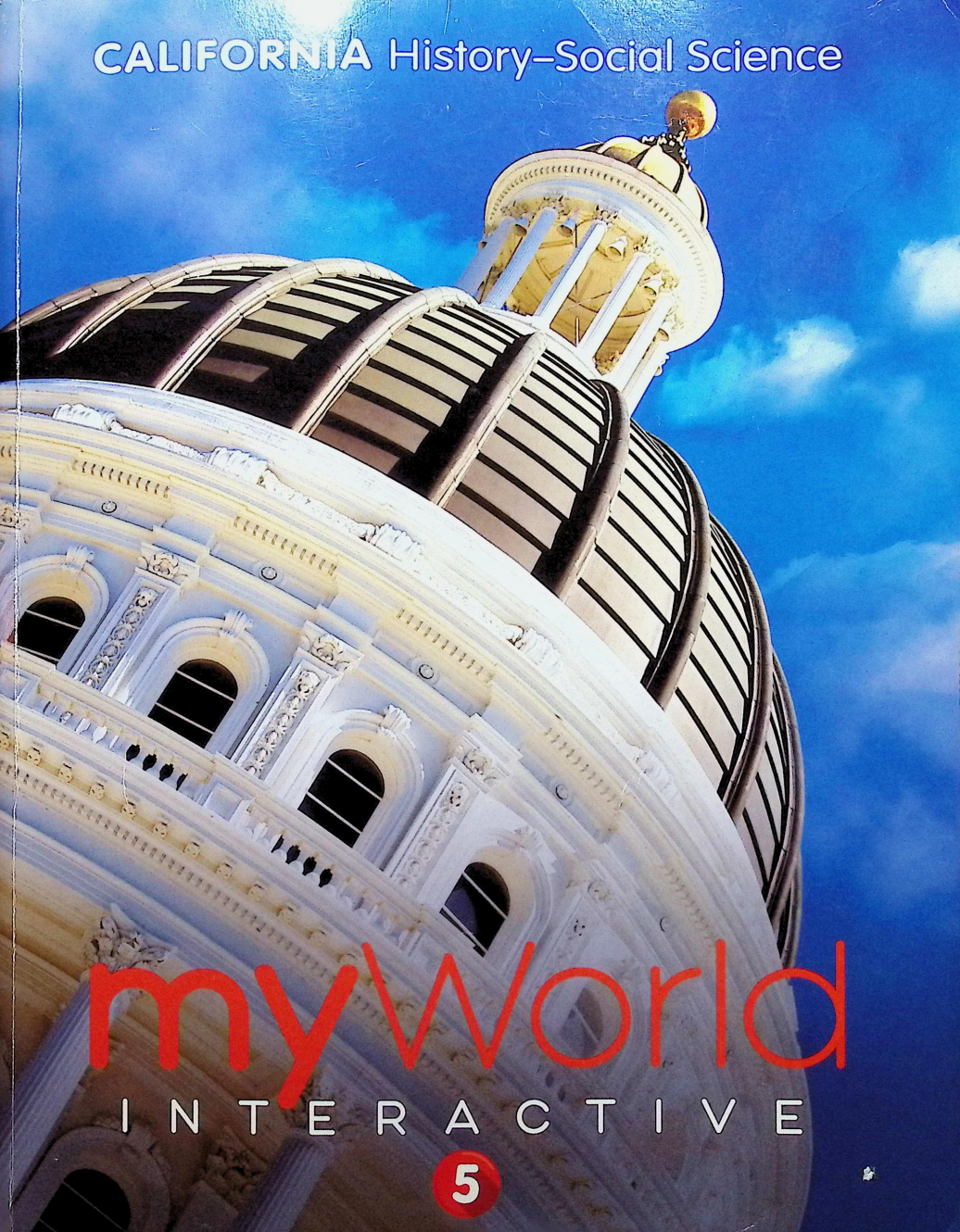
California myWorld Interactive, Grade 5
California myWorld Interactive Grade 5 is a social studies and history textbook designed for fifth-grade students in California, published as part of the myWorld Interactive series by Savvas Learning Company. It covers the full sweep of early American history, from the cultures of the First Americans and the Age of Exploration through colonial life, the American Revolution, the founding of a new nation, and westward expansion. The program blends primary sources, hands-on activities, and inquiry-based learning to help students understand how the United States developed from its earliest peoples to the growth of the young republic in the nineteenth century.
Chapters & Lessons
Chapter 1: The First Americans
3 lessonsIn this Grade 5 lesson from California myWorld Interactive, students explore how geography and climate shaped the lives of ancient American Indian civilizations across North America. Students learn key concepts including migration, hunter-gatherer societies, nomadic life, and the development of agriculture and irrigation as early peoples adapted to and modified their environments. The lesson traces the arrival of the first Americans from Asia via the Beringia land bridge approximately 15,000 years ago through the rise of permanent settlements in regions like the Southwest and Pacific Northwest.
In this Grade 5 lesson from California myWorld Interactive, students explore how culture — including language, customs, traditions, and folklore — varied widely among American Indian peoples across different regions. Students examine specific cultural practices such as the Green Corn Ceremony, potlatches, and daily life roles to understand how geography shaped each group's way of life. The lesson builds key vocabulary like tradition, ancestor, and folklore within the context of Chapter 1: The First Americans.
In this Grade 5 lesson from California myWorld Interactive, students learn how American Indian groups developed varied systems of government and economy, including councils, confederacies, and leagues such as the Iroquois Confederacy. Students explore the differences between nomadic and stationary group governance, examine specific examples like the Powhatan Confederacy and the Navajo tribal council, and trace how some of these governing structures continue today. The lesson also introduces key vocabulary such as confederacy, commodity, and trading network within the context of Chapter 1: The First Americans.
Chapter 2: Age of Exploration
3 lessonsIn this Grade 5 lesson from California myWorld Interactive's Age of Exploration chapter, students learn how advances in navigation technology — including the astrolabe and the caravel — enabled European sailors to venture beyond coastal waters and seek sea routes to Asia. The lesson covers early explorers such as the Vikings and Leif Ericsson, the role of Portuguese Prince Henry's navigation school, and the growth of trade and the slave trade along African coastlines. Students also practice drawing conclusions from evidence about why European nations competed to find new ocean routes.
In this Grade 5 lesson from California myWorld Interactive, Chapter 2: Age of Exploration, students learn why Spain sponsored voyages to the Americas, focusing on Christopher Columbus's 1492 journey across the Atlantic and his encounters with the Taino people. Students also explore the role of conquistadors like Hernán Cortés, examining concepts such as patron, expedition, empire, and colony as Spain expanded its reach through the conquest of the Aztec empire. The lesson draws on primary sources, including Columbus's journal and Cortés's letters to the Spanish king, to help students understand the motivations and consequences of Spanish exploration.
In this Grade 5 lesson from California myWorld Interactive, students learn what the Columbian Exchange was — the movement of people, animals, plants, cultures, and diseases between the Eastern and Western hemispheres following Columbus's voyages. Students examine specific examples of goods exchanged, such as corn, potatoes, and horses moving between the Americas and Europe, Africa, and Asia, and explore how this exchange transformed American Indian cultures and led to the rise of plantation labor. The lesson also covers the devastating impact of European diseases like smallpox and measles on American Indian populations.
Chapter 3: Settling the Colonies in North America
4 lessonsIn this Grade 5 lesson from California myWorld Interactive, Chapter 3, students learn why Spain explored and settled the Americas, examining how conquistadors and missionaries established New Spain and its colonial structure. Students explore key concepts including the viceroy system, the encomienda system, and the class system that defined life in Spanish colonies, as well as the role of missions in converting and exploiting American Indian labor. The lesson also covers European competition for land and resources, including the Treaty of Tordesillas that divided the Americas between Spain and Portugal.
In this Grade 5 lesson from California myWorld Interactive, students explore why England sought to colonize North America, examining key concepts such as royal charters, the Protestant Reformation, and England's rivalry with Spain. The lesson traces the failed attempts to establish English settlements, including the mystery of the Lost Colony of Roanoke Island. Students analyze primary sources and historical evidence to understand the challenges early colonists faced in Virginia and North Carolina.
In this Grade 5 lesson from California myWorld Interactive, students explore the key events behind the establishment of English colonies in New England, focusing on the Separatists and Puritans who sought religious freedom from the Church of England. Students learn how 102 passengers aboard the Mayflower became known as Pilgrims, and how the Mayflower Compact created a framework for self-government through town meetings. The lesson also covers the Pilgrims' settlement at Plymouth and their alliance with the Wampanoag people under Chief Massasoit.
In this Grade 5 lesson from California myWorld Interactive Chapter 3, students learn about the establishment of French and Dutch colonies in North America, including the search for the Northwest Passage and the development of the fur trade. Key figures such as Giovanni da Verrazano, Jacques Cartier, and Samuel de Champlain are examined, along with vocabulary terms like monopoly and royal province. Students also explore how conflicts between the Iroquois, Huron, French, and English shaped the growth of New France.
Chapter 4: Life in the Colonies
5 lessonsIn this Grade 5 lesson from California myWorld Interactive Chapter 4, students explore how geography shaped the settlement and development of the three colonial regions — New England, Middle, and Southern Colonies. Students learn how physical features like soil quality, climate, and access to waterways influenced where colonists settled and what industries they developed, from New England's fishing and timber trade to the Southern Colonies' cash crop plantations. The lesson also introduces key vocabulary including region, proprietor, and diverse, and examines early colonial society through examples like Puritan town governance and the founding of Rhode Island.
In this Grade 5 lesson from California myWorld Interactive Chapter 4, students explore how colonists earned a living through farming, fishing, shipbuilding, and trade, examining key economic concepts such as barter, exports, imports, raw materials, and mercantilism. Students learn how natural resources and geography shaped work patterns across the thirteen colonies and how England's trade policies, including the system of mercantilism and triangular trade, influenced colonial life. The lesson also compares colonial economic patterns with modern-day commerce, helping students understand how daily life and work have changed over time.
In this Grade 5 lesson from California myWorld Interactive Chapter 4, students learn how slavery developed in the English colonies, tracing its origins from the 1619 arrival of Africans at Jamestown through the establishment of slavery laws across all colonies by the 1680s. Students examine the slave trade, including the conditions of the Middle Passage and the experiences of enslaved Africans in both Northern and Southern colonies. Primary source accounts, such as Olaudah Equiano's narrative, help students analyze why slavery expanded as colonial demand for labor grew.
In this Grade 5 lesson from California myWorld Interactive, Chapter 4, students explore how early cooperation between English colonists and American Indians broke down due to conflicting views on land ownership, boundaries, and political authority. Students analyze specific conflicts including the three Powhatan Wars and the role of figures like Chief Powhatan and Captain John Smith, while comparing how colonists and American Indians understood land agreements differently. The lesson builds key vocabulary around terms like boundary and King Philip's War to help students understand the roots of colonial-era conflict.
In this Grade 5 lesson from California myWorld Interactive, students learn how the French and Indian War began over competing British and French claims to the Ohio River valley and how American Indian allies, including the Iroquois, shaped the conflict's outcome. Students explore key vocabulary such as ally and treaty while tracing how British victories at Fort Duquesne, Quebec, and Montreal ultimately made Great Britain the dominant colonial power in North America. The lesson also examines the 1763 Treaty of Paris and Pontiac's resistance as consequences of the war's end.
Chapter 5: The American Revolution
5 lessonsIn this Grade 5 lesson from California myWorld Interactive, students explore the causes of colonial unrest with Britain, examining how the French and Indian War debt led Parliament to pass the Stamp Act and Townshend Acts, and why colonists protested with the rallying cry "no taxation without representation." Students also learn how key events such as the Albany Plan of Union and the Stamp Act Congress united the colonies and introduced the concepts of boycott, tariff, and representative government. The lesson is part of Chapter 5: The American Revolution and builds foundational understanding of why the colonists ultimately rebelled against British rule.
In this Grade 5 lesson from California myWorld Interactive, Chapter 5, students explore the key events that pushed the American colonies toward war with Great Britain, including the Boston Massacre, the formation of Committees of Correspondence, and the Boston Tea Party. Students learn vocabulary such as massacre, Patriot, Loyalist, and militia while examining how British policies like the Townshend Acts and the Tea Act fueled colonial unrest. By the end of the lesson, students can explain why escalating tensions led colonists to choose armed conflict over continued British rule.
In this Grade 5 lesson from California myWorld Interactive Chapter 5, students learn why the American colonies declared independence from Great Britain, tracing the key events from the Second Continental Congress and the Olive Branch Petition to the influence of Thomas Paine's Common Sense and Enlightenment ideas about liberty and equality. Students examine how the Committee of Five, led by Thomas Jefferson, drafted the Declaration of Independence using concepts drawn from philosopher John Locke, culminating in Congress's vote on July 4, 1776.
In this Grade 5 lesson from California myWorld Interactive's Chapter 5, students compare the British and Continental armies, examining how Britain used mercenaries called Hessians while Patriots relied on local militias and fought with limited resources. Students trace major battles including the Siege of Boston, the crossing of the Delaware River, and the turning point at Saratoga, learning how geography, alliances with American Indian nations, and military strategy shaped the outcome of the American Revolution.
In this Grade 5 lesson from California myWorld Interactive's Chapter 5, students learn how the United States won its independence by examining key turning points in the American Revolution, including the hardships at Valley Forge, the roles of Baron von Steuben and French and Spanish allies, and the military strategies that led to British defeats in the South. Students also explore vocabulary terms such as peninsula, negotiate, and Treaty of Paris as they trace the path from continued Patriot struggles in 1777 to the final campaigns toward Yorktown, Virginia.
Chapter 6: A New Nation
4 lessonsIn this Grade 5 lesson from California myWorld Interactive, Chapter 6, students learn how the Articles of Confederation established America's first national government with a single legislative branch and no executive or judicial branch. Students explore the document's key weaknesses, including Congress's inability to collect taxes or regulate trade, and examine how these flaws led to economic problems such as inflation and events like Shays' Rebellion. The lesson builds understanding of the vocabulary terms ratified, legislative, executive, judicial, and inflation in the context of the post-Revolutionary War United States.
In this Grade 5 lesson from California myWorld Interactive, Chapter 6, students learn how the Constitutional Convention of 1787 produced a new written plan for government, exploring key concepts such as separation of powers, checks and balances, and the Preamble. Students examine the debates among delegates like James Madison, Alexander Hamilton, and Patrick Henry over replacing the Articles of Confederation, including competing proposals such as the Virginia Plan. The lesson also introduces the idea of compromise as essential to creating a government that balanced power between large and small states.
In this Grade 5 lesson from California myWorld Interactive, students explore the debate between Federalists and Anti-Federalists over ratifying the U.S. Constitution, examining how disagreements about federal power, states' rights, and individual liberties shaped early American government. Students learn key vocabulary including Federalist, Anti-Federalist, anarchy, constitutional republic, and popular sovereignty as they trace how the demand for a Bill of Rights became the critical compromise that secured the Constitution's ratification. Primary sources from Patrick Henry and James Madison help students understand both sides of the debate and why guaranteeing basic rights in writing was essential to the new nation.
In this Grade 5 history lesson from California myWorld Interactive, Chapter 6, students explore the key concepts of the U.S. Constitution, including the significance of the Preamble, the principle of rule of law, and the meaning of domestic tranquility. Students also examine how specific constitutional clauses — such as the Spending Clause, Commerce Clause, and Contracts Clause in Article 1 — shaped the nation's economy and limited government power. The lesson prepares students to explain how the Constitution established an agreement between the federal government and the American people.
Chapter 7: Life in the Young Republic
5 lessonsIn this Grade 5 lesson from California myWorld Interactive's Chapter 7, students learn how George Washington shaped the presidency through key actions such as establishing the Electoral College's role, forming the first Cabinet, and setting the two-term tradition. Students also explore the vocabulary of inauguration, Cabinet, and political party while examining how the Federalists and Democratic-Republicans emerged as the first two political parties. The lesson uses Washington's precedents to show how his decisions as the nation's first President created lasting models for all future presidents.
In this Grade 5 lesson from California myWorld Interactive, students learn how westward expansion, the Louisiana Purchase, and Jefferson's interpretation of presidential treaty-making powers reshaped the boundaries and settlement patterns of the early United States. Students explore key concepts including pioneer life, frontier caravans, and the political and constitutional challenges Jefferson faced when acquiring the Louisiana Territory from France in 1803. The lesson also examines figures like Daniel Boone and the impact of pioneer settlement on American Indian communities already living on the land.
In this Grade 5 lesson from California myWorld Interactive, students explore the causes and key battles of the War of 1812, including British impressment of American sailors, the role of Tecumseh and the Shawnee, and the rise of War Hawks driven by nationalism. Students examine naval engagements such as the USS Constitution's victory over the HMS Guerriere and the Battle of Lake Erie, and learn vocabulary terms like impressment, nationalism, and anthem. The lesson builds understanding of how this second conflict with Great Britain shaped a growing sense of national pride in the young United States.
In this Grade 5 lesson from California myWorld Interactive, students examine how Andrew Jackson's Indian removal policies forced thousands of American Indians from their homelands, culminating in the Trail of Tears. Students also learn about the Monroe Doctrine and U.S. foreign policy as the young republic expanded its borders through events like the Adams–Onís Treaty of 1819. The lesson builds key vocabulary including Monroe Doctrine, foreign policy, and Trail of Tears within the broader context of Chapter 7's exploration of life in the early United States.
In this Grade 5 lesson from California myWorld Interactive's Chapter 7, students explore the major waves of European immigration to the United States in the early and mid-1800s, examining push and pull factors that drove German and Irish immigrants to America, including the Great Irish Famine. Students also learn how the invention of the cotton gin expanded slavery in the South and how the Missouri Compromise attempted to balance free and slave states. The lesson introduces key vocabulary including reform, famine, and abolition as students study how different groups worked to shape American society during this period.
Chapter 8: Westward Expansion
4 lessonsIn this Grade 5 lesson from California myWorld Interactive Chapter 8, students explore how early 1800s inventions like the cotton gin, mechanical reaper, sewing machine, and electric telegraph transformed daily life and the economy. Students learn the concepts of profit, mass production, and interchangeable parts, examining how figures such as Eli Whitney and Cyrus McCormick changed farming, manufacturing, and communication. The lesson also addresses the costs and benefits of these innovations, including the expansion of slavery tied to cotton production and the rise of factory towns during the Industrial Revolution.
In this Grade 5 lesson from California myWorld Interactive, Chapter 8, students explore how American settlers moved into Mexican-held Texas in the 1820s and examine the causes and early battles of the Texas Revolution, including the Battle of the Alamo. Students learn key vocabulary such as vaquero, annex, and Manifest Destiny while analyzing the costs and benefits of achieving independence and statehood for Texas and California. The lesson uses primary sources like "America the Beautiful" to illustrate the frontier spirit that drove westward expansion.
In this Grade 5 lesson from California myWorld Interactive Chapter 8, students learn about the major westward trails used by American settlers between 1840 and 1860, including the Oregon Trail, and explore key vocabulary such as wagon train and prairie schooner. Students examine the costs and benefits of westward migration, analyzing the challenges pioneers faced crossing the Great Plains and Rocky Mountains. The lesson also includes a comparison of the prairie schooner to a modern SUV to help students connect historical transportation to present-day context.
In this Grade 5 lesson from California myWorld Interactive Chapter 8, students explore the California Gold Rush, learning how James Marshall's 1848 gold discovery triggered a massive migration of "forty-niners" from around the world and transformed small settlements into boomtowns like San Francisco. Students examine gold-mining techniques such as panning and sluicing, and analyze how entrepreneurs met miners' needs through goods and services. The lesson helps students weigh the costs and benefits of the gold rush, including economic opportunity, discrimination, and the impact on California's American Indian population.
Frequently Asked Questions
- Is California myWorld Interactive Grade 5 the right history textbook for my fifth grader?
- Yes, if your child is in fifth grade in California, this is the textbook their school almost certainly uses. It covers early American history from the First Americans through westward expansion — exactly what California’s fifth-grade standards require. The inquiry-based approach works well for students who enjoy hands-on activities and primary sources. If your child is in another state and you’re looking for a U.S. history survey, it’s still solid content, though some California-specific framing may not match your state’s standards. Overall, it’s one of the most widely used fifth-grade history programs in the country.
- Which chapters or topics are hardest for fifth graders in this textbook?
- Most students find Chapter 5 (The American Revolution) and Chapter 6 (A New Nation) the most challenging. The sheer number of names, dates, and political concepts — the Articles of Confederation, checks and balances, the Federalist vs. Anti-Federalist debate — can feel overwhelming. Chapter 4’s lesson on the French and Indian War also trips up students because the alliances are complex. Chapters 7 and 8 (westward expansion, the War of 1812, Trail of Tears) involve dense cause-and-effect chains that require students to track multiple storylines at once.
- My child struggles with understanding government and civics concepts. Where should they start?
- Start with Chapter 6, Lesson 1 (Articles of Confederation) before diving into Lessons 2 and 3 on the Constitution and Bill of Rights. That chapter builds progressively — understanding why the Articles failed makes the Constitutional Convention make sense. If your child is also shaky on WHY colonists rebelled, back up to Chapter 5, Lesson 1 (Tensions With Britain) first. The sequence matters: taxation grievances → revolution → failed first government → Constitutional Convention. Getting that flow right makes all three lessons in Chapter 6 click together.
- My child just finished this textbook. What should they study next?
- The natural next step is middle school U.S. history, which typically picks up at the Civil War era — right where this book leaves off after westward expansion. Look into the McGraw-Hill IMPACT or myWorld Interactive Grade 8 programs that cover the Civil War through the 20th century. For students who really enjoyed the civics angle of Chapters 6 and 7, a standalone civics or government elective that digs deeper into the Constitution and branches of government would be a great complement. Reading primary sources like excerpts from the Federalist Papers is also a great enrichment step.
- How can Pengi help my child with California myWorld Interactive Grade 5?
- Pengi can act as an on-demand tutor for any lesson in this textbook. If your child is struggling with Chapter 5’s causes of the American Revolution or gets confused sorting out Federalists from Anti-Federalists in Chapter 6, Pengi can walk through the concepts in plain language, quiz them with practice questions, and explain primary sources like the Declaration of Independence or the Mayflower Compact in age-appropriate terms. Pengi is especially helpful for the vocabulary-heavy lessons — like the Columbian Exchange in Chapter 2 or the Trail of Tears in Chapter 7 — where unfamiliar terms slow comprehension down.
Ready to start learning?
Jump into your first lesson for California myWorld Interactive, Grade 5. Free, no account required.
Start Learning