
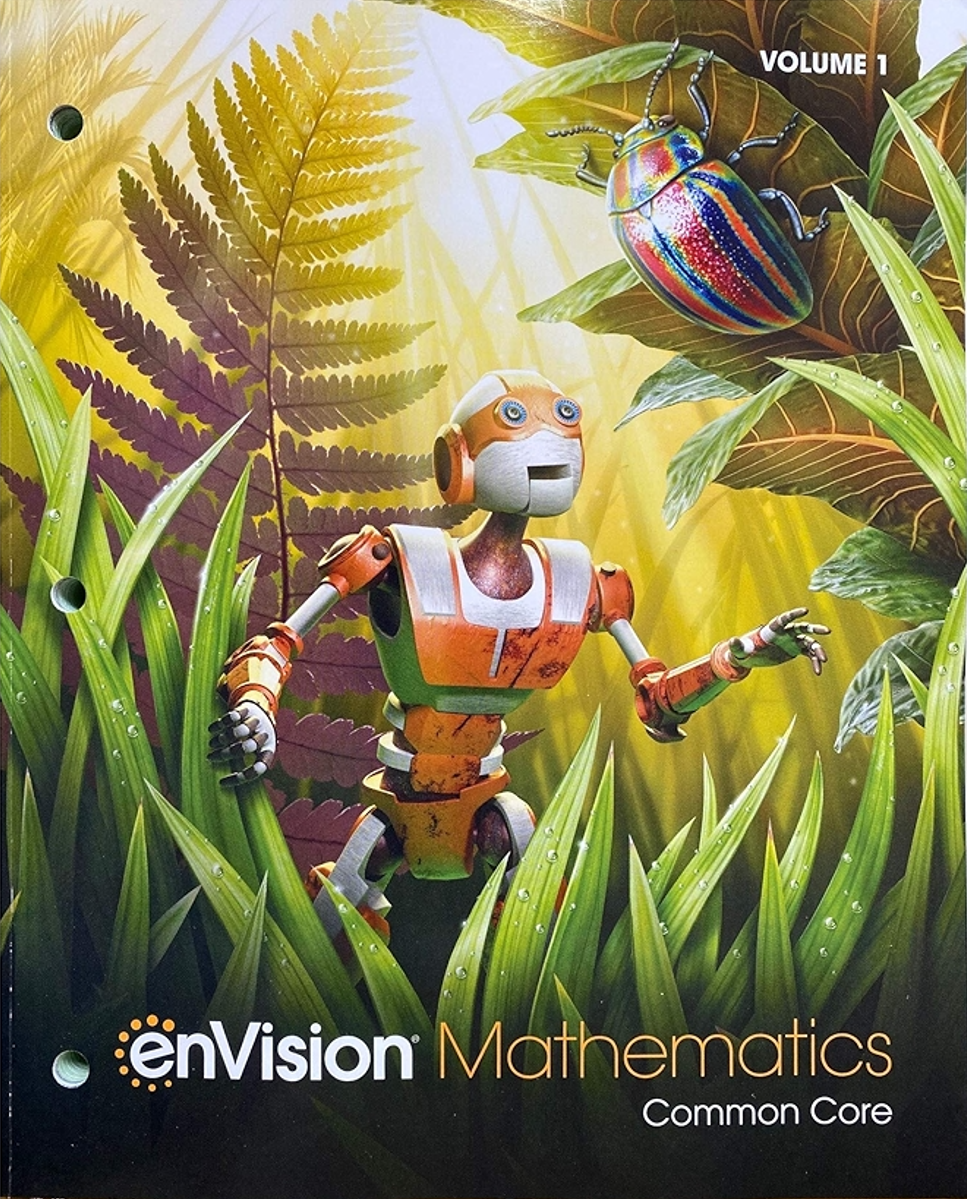
enVision, Mathematics, Grade 6
enVision Mathematics Grade 6, published by Savvas Learning Company, is a comprehensive sixth-grade math textbook designed to build strong foundational skills across key middle school topics. The curriculum covers positive rational numbers, integers, numeric and algebraic expressions, equations and inequalities, ratios and rates, percents, geometry concepts including area, surface area, and volume, and data analysis. With a problem-based learning approach, it prepares students for more advanced mathematical reasoning as they transition into middle school mathematics.
Chapters & Lessons
Chapter 1: Use Positive Rational Numbers
7 lessonsIn this Grade 6 lesson from enVision Mathematics Chapter 1, students develop fluency with adding, subtracting, and multiplying decimals, focusing on aligning place values, annexing zeros as placeholders, and determining decimal placement in products. The lesson covers Common Core standard 6.NS.B.3 through real-world contexts such as race times and area calculations. Students also learn to estimate with decimals to verify the reasonableness of their answers.
In this Grade 6 lesson from Chapter 1 of enVision Mathematics, students learn to fluently divide whole numbers and decimals using the standard division algorithm, compatible numbers for estimation, and powers of 10 to rewrite decimal divisors as whole numbers. Key skills include placing the first digit of the quotient correctly, expressing remainders as decimal quotients, and multiplying both the divisor and dividend by the same power of 10 before dividing. This lesson addresses Common Core standards 6.NS.B.2 and 6.NS.B.3.
In Grade 6 enVision Mathematics, Lesson 1-3 teaches students how to multiply fractions and mixed numbers using area models, number lines, and equations. Students learn to multiply numerators and denominators across unit fractions and non-unit fractions, and to rename mixed numbers as improper fractions before multiplying. The lesson builds foundational skills for dividing fractions as outlined in standard 6.NS.A.1.
In this Grade 6 lesson from enVision Mathematics Chapter 1, students learn how to divide whole numbers by fractions and fractions by whole numbers using models, number lines, and equations. The lesson introduces the concept of reciprocals and the rule that dividing by a fraction is equivalent to multiplying by its reciprocal. Students apply Common Core standard 6.NS.A.1 through real-world problems involving measurement and equal sharing.
In this Grade 6 enVision Mathematics lesson from Chapter 1, students learn how to divide a fraction by a fraction using area models, number lines, and the multiply-by-the-reciprocal method. The lesson covers key concepts such as finding common units by multiplying denominators and rewriting division equations as equivalent multiplication equations using the reciprocal of the divisor. Students apply these skills to real-world problems involving measurement and proportional reasoning.
In this Grade 6 lesson from enVision Mathematics Chapter 1, students learn how to divide mixed numbers by converting them to improper fractions and multiplying by the reciprocal of the divisor. The lesson covers dividing a mixed number by a mixed number, a whole number by a mixed number, and a mixed number by a whole number, aligned to Common Core standard 6.NS.A.1. Students also practice using compatible numbers to estimate quotients and check whether their answers are reasonable.
In Grade 6 math, students learn to solve multistep problems involving fractions and decimals by identifying the necessary information, selecting the correct operations, and interpreting solutions. This lesson from Chapter 1 of enVision Mathematics covers real-world applications such as calculating perimeters with mixed numbers, dividing fractions, and using decimal operations to find distances and totals. Students practice the full problem-solving process, from choosing operations to checking that answers are reasonable.
Chapter 2: Integers and Rational Numbers
6 lessonsIn this Grade 6 lesson from enVision Mathematics Chapter 2, students learn to define integers, including positive integers, negative integers, and zero, and identify opposites as numbers equidistant from zero on a number line. Students practice comparing and ordering integers and use positive and negative integers to represent real-world quantities such as temperature, altitude, elevation, and depth. The lesson aligns with Common Core Standards 6.NS.C.5, 6.NS.C.6a, and 6.NS.C.6c.
In this Grade 6 lesson from enVision Mathematics Chapter 2, students learn to represent rational numbers — including negative fractions and decimals — on both horizontal and vertical number lines by converting values like -4/3 and -1.5 into mixed numbers to find their precise positions. Students also practice comparing and ordering rational numbers using inequality symbols by plotting values such as -0.75, 2/3, and 1.75. Real-world contexts like ocean depths and temperatures help students interpret the meaning of negative rational numbers in everyday situations.
In this Grade 6 lesson from enVision Mathematics Chapter 2, students learn how to find and interpret the absolute value of rational numbers, including integers, fractions, and decimals. Students explore how absolute value represents a number's distance from zero on a number line and apply this concept to real-world contexts such as stock price changes, water level fluctuations, and overdrawn bank account balances. The lesson also distinguishes between comparing numbers by their value versus comparing them by the size of the quantity they represent using absolute value notation.
In this Grade 6 lesson from enVision Mathematics Chapter 2, students learn to graph points with rational coordinates — including integers, decimals, and fractions — on a coordinate plane using ordered pairs. The lesson covers identifying quadrants, locating points by moving along the x-axis and y-axis from the origin, and reflecting points across the axes by changing the signs of coordinates.
In this Grade 6 enVision Mathematics lesson from Chapter 2, students learn how to use absolute value to find the distance between two points on a coordinate plane, including both vertical and horizontal distances. They practice adding or subtracting the absolute values of coordinates to calculate real-world distances, such as miles between locations on a map. The lesson aligns with Common Core Standard 6.NS.C.8 and builds students' understanding of integers and rational numbers in a coordinate context.
In this Grade 6 lesson from enVision Mathematics Chapter 2, students learn how to find side lengths of polygons plotted on a coordinate plane by adding or subtracting the absolute values of vertex coordinates. The lesson covers calculating the perimeter of rectangles and irregular polygons using coordinates, and applying distance to determine whether triangles are isosceles. Real-world contexts such as archaeological dig sites and ranch fencing problems give students practice with standards 6.NS.C.8 and 6.G.A.3.
Chapter 3: Numeric and Algebraic Expressions
7 lessonsIn this Grade 6 lesson from enVision Mathematics Chapter 3, students learn to write and evaluate numbers with exponents by identifying the base, exponent, and power in expressions such as 2³ and 5⁴. Students practice converting repeated multiplication into exponential form, evaluating powers including zero exponents and decimal bases, and applying exponents in expressions like 1.9 × 10⁵. The lesson aligns with Common Core Standard 6.EE.A.1 on writing and evaluating numerical expressions involving whole-number exponents.
In this Grade 6 lesson from enVision Mathematics Chapter 3, students learn how to write the prime factorization of whole numbers using factor trees and repeated division, then apply that skill to find the greatest common factor (GCF) and least common multiple (LCM) of two numbers. Students also practice using the GCF alongside the Distributive Property to rewrite and evaluate sums. The lesson builds foundational number theory skills aligned with Common Core standard 6.EE.A.1.
In this Grade 6 lesson from enVision Mathematics Chapter 3, students learn how to write and evaluate numerical expressions using the order of operations, including expressions that contain parentheses, brackets, powers, decimals, and fractions. Students practice applying the four-step order of operations — evaluating grouping symbols from inside out, evaluating powers, multiplying and dividing left to right, and adding and subtracting left to right — to simplify complex expressions. The lesson also covers how to insert grouping symbols into an expression to achieve a target value, building foundational skills aligned with Common Core standards 6.EE.A.1 and 6.EE.A.3.
In this Grade 6 enVision Mathematics lesson from Chapter 3, students learn how to write algebraic expressions using variables to represent real-world situations involving addition, subtraction, multiplication, and division. Students also identify the parts of an expression, including terms, coefficients, and constants. The lesson covers translating word phrases into algebraic expressions and recognizing equivalent forms such as 4n, 4·n, and 4(n).
In Lesson 3-5 of enVision Mathematics Grade 6, students learn how to evaluate algebraic expressions by using substitution to replace variables with whole numbers, decimals, and fractions, then applying the order of operations to simplify. The lesson covers expressions with one or more variables and connects to Common Core standards 6.EE.A.2c and 6.EE.B.6. Real-world contexts such as bike rentals, gas mileage, and tile calculations help students practice substituting values and computing results accurately.
In this Grade 6 lesson from Chapter 3 of enVision Mathematics, students learn how to identify and write equivalent algebraic expressions using the Commutative, Associative, and Distributive Properties. They practice expanding expressions like 3(4x − 1) into 12x − 3 and factoring expressions like 2x + 4 into 2(x + 2), building fluency with Common Core standards 6.EE.A.3 and 6.EE.A.4. Students also use substitution to verify whether two expressions are equivalent by confirming they produce the same value for any value of the variable.
In Grade 6 enVision Mathematics, Lesson 3-7 teaches students how to simplify algebraic expressions by combining like terms using the Identity Property of Multiplication and the Distributive Property. Students practice writing equivalent expressions involving whole numbers, fractions, and decimals, including cases with parentheses. This lesson aligns with Common Core standards 6.EE.A.3 and 6.EE.A.4 in Chapter 3 on Numeric and Algebraic Expressions.
Chapter 4: Represent and Solve Equations and Inequalities
10 lessonsIn this Grade 6 lesson from enVision Mathematics, students learn to identify equations and their solutions by determining whether a given value for a variable makes an equation true. Using substitution, students evaluate expressions on both sides of an equation and check for equality across real-world contexts like gift cards and marbles. The lesson aligns with Common Core standard 6.EE.B.5 and builds foundational skills for solving equations in Chapter 4.
In this Grade 6 lesson from enVision Mathematics, students learn how to apply the Addition, Subtraction, Multiplication, and Division Properties of Equality to write equivalent equations. The lesson uses balance scale models to show that performing the same operation on both sides of an equation keeps it true. Students practice identifying and applying these properties to equations involving variables.
In this Grade 6 lesson from enVision Mathematics Chapter 4, students learn how to write and solve addition and subtraction equations using inverse relationships and the properties of equality. Students practice isolating a variable by applying inverse operations, such as subtracting to undo addition or adding to undo subtraction, and use bar diagrams and pan balances as visual tools. Real-world word problems guide students in setting up and solving one-variable equations like n + 7 = 25 and y - 19 = 34.
In this Grade 6 enVision Mathematics lesson from Chapter 4, students learn how to write and solve multiplication and division equations using inverse operations and properties of equality. Lessons guide students through setting up equations like 3x = 45 and t ÷ 15 = 39.50, then isolating the variable by dividing or multiplying both sides. Real-world problems involving shared costs, sticker albums, and reading schedules help students apply the Division and Multiplication Properties of Equality to find unknown values.
In this Grade 6 enVision Mathematics lesson from Chapter 4, students learn how to understand and write inequalities using the symbols <, >, ≤, ≥, and ≠ to represent real-world situations with more than one possible solution. Students practice translating verbal descriptions into algebraic inequalities with a variable, such as writing "at most 30 students" as s ≤ 30, and representing solution sets on a number line. By the end of the lesson, students can distinguish between strict and non-strict inequalities and apply inequality notation to contexts involving age, length, cost, and other quantities.
In this Grade 6 enVision Mathematics lesson from Chapter 4, students learn how to write and represent solutions of inequalities using inequality symbols such as greater than, less than, greater than or equal to, and less than or equal to. Students practice graphing inequalities on a number line using open and closed circles with directional shading, and solve inequalities by substituting values to test whether they satisfy a given condition. The lesson connects abstract inequality notation to real-world contexts, helping students understand that inequalities have infinitely many solutions.
Chapter 5: Understand and Use Ratio and Rate
10 lessonsIn this Grade 6 lesson from enVision Mathematics Chapter 5, students learn what a ratio is and how to write ratios three ways — using "to" notation, colon notation, and fraction notation — to compare quantities part-to-part and part-to-whole. Students also practice using bar diagrams and double number line diagrams as visual tools to solve ratio problems. The lesson builds foundational understanding of ratios as a mathematical way to describe relationships between two quantities.
In this Grade 6 lesson from enVision Mathematics Chapter 5, students learn how to generate equivalent ratios by multiplying or dividing both terms of a ratio by the same nonzero number. Using tables and direct calculations, students practice finding equivalent ratios in real-world contexts such as mixing paint colors, sports statistics, and the ratio of a circle's circumference to its diameter (pi). The lesson builds foundational understanding of proportional relationships essential for ratio and rate reasoning.
In this Grade 6 lesson from enVision Mathematics Chapter 5, students learn how to compare ratios by extending ratio tables until one corresponding term is equal, then analyzing the other term to determine which ratio is greater. The lesson covers real-world applications such as comparing batting averages, aquarium fish counts, and paint mixtures using the Common Core standard 6.RP.A.3a.
In this Grade 6 lesson from enVision Mathematics Chapter 5, students learn how to represent equivalent ratios using ratio tables and coordinate graphs. They practice plotting ordered pairs derived from ratio relationships, using both repeated addition and proportional reasoning to extend ratios and solve problems. Students also discover that points representing equivalent ratios always form a straight line on a coordinate plane, connecting the concept to real-world contexts like pricing and recipes.
In this Grade 6 enVision Mathematics lesson from Chapter 5, students learn to define and work with rates and unit rates as special types of ratios that compare quantities with unlike units of measure. Students practice finding equivalent rates using ratio tables and multiplication, then calculate unit rates by writing equivalent rates with a denominator of 1 to solve real-world problems involving speed, pricing, and recipes. Aligned to Common Core standards 6.RP.A.2 and 6.RP.A.3, the lesson builds fluency with proportional reasoning skills essential for sixth-grade math.
In this Grade 6 lesson from enVision Mathematics, students learn how to calculate and compare unit rates to solve real-world problems, including finding unit prices to determine better value. Using Common Core standards 6.RP.A.3a and 6.RP.A.3b, students practice dividing rates to find a single-unit quantity, then compare the resulting decimal values to draw conclusions. The lesson covers contexts such as speed, laps per minute, and cost per item, building fluency with ratio and rate reasoning in Chapter 5.
In this Grade 6 lesson from enVision Mathematics Chapter 5, students learn how to use unit rates to solve real-world problems involving constant speed, unit price, and distance-rate-time relationships. Students apply the formula d = r × t and use ratio tables and equivalent rates to find unknown quantities such as distance traveled or cost per item. The lesson aligns with Common Core standard 6.RP.A.3b and builds fluency with proportional reasoning in practical contexts.
In this Grade 6 lesson from enVision Mathematics Chapter 5, students use ratio reasoning and dimensional analysis to convert customary units of length, capacity, and weight, applying conversion factors such as 12 inches per foot, 4 quarts per gallon, and 16 ounces per pound. Students practice writing equivalent rates and multiplying or dividing by conversion factors to solve real-world problems, addressing Common Core standard 6.RP.A.3d. The lesson builds fluency with both the equivalent rate method and dimensional analysis as two strategies for unit conversion.
In this Grade 6 lesson from enVision Mathematics Chapter 5, students learn how to convert metric units of length, capacity, and mass using unit rates and dimensional analysis. Working with units such as meters, centimeters, liters, hectoliters, kilograms, and centigrams, students apply equivalent rates and conversion factors to solve real-world problems. The lesson builds ratio reasoning skills by showing two methods for converting between metric measurements accurately.
In this Grade 6 lesson from Chapter 5 of enVision Mathematics, students learn how to convert between customary and metric units of length, weight/mass, and capacity using conversion factors and dimensional analysis. They practice both single-step and two-step conversions, such as changing meters to inches or liters to cups, using approximate equivalents like 1 m ≈ 39.37 in. and 1 kg ≈ 2.20 lb. The lesson builds on students' understanding of ratios and rates to set up and simplify unit conversions accurately.
Chapter 6: Understand and Use Percent
6 lessonsIn this Grade 6 enVision Mathematics lesson, students learn what percent means as a rate that compares a part to a whole with 100 as the second term. Students practice representing percents using decimal grids, number lines, and equivalent fractions, converting ratios like 7/10 into 70/100 to express them as a percent. The lesson also applies percent concepts to find unknown lengths of line segments using mental math.
In this Grade 6 lesson from enVision Mathematics Chapter 6, students learn to write equivalent values as fractions, decimals, and percents by using division and equivalent ratios. The lesson covers converting between all three forms, including expressing percents like 30% as fractions with a denominator of 100, rewriting fractions such as 3/5 and 5/8 as decimals through long division, and finding equivalent rates to express results as percents. Aligned to Common Core standard 6.RP.A.3c, students build fluency recognizing that fractions, decimals, and percents are three different ways to represent the same part of a whole.
In this Grade 6 lesson from enVision Mathematics Chapter 6, students learn how to represent percents greater than 100 and percents less than 1 as equivalent fractions and decimals. Students practice converting values such as 140% to 7/5 and 1.4, and fraction or decimal percents like 1/2% and 0.9% to their fractional and decimal forms using division and reasoning strategies. The lesson builds on students' understanding of percent as a ratio out of 100 to extend their work beyond the typical 1–100 range.
In this Grade 6 lesson from enVision Mathematics Chapter 6, students learn how to estimate the percent of a number using three strategies: equivalent fractions, rounding, and compatible numbers. The lesson covers Common Core standard 6.RP.A.3c and guides students through real-world problems, such as approximating 46% of 500 by recognizing that 46% is close to 50%, which equals one-half. By the end of the lesson, students can choose the most efficient estimation method based on the numbers given.
In this Grade 6 enVision Mathematics lesson from Chapter 6, students learn how to find the percent of a number by converting percents to their decimal or fraction form and writing percent equations to solve for the part, the whole, or the percent. Using double number line diagrams and multiplication, students practice solving real-world problems such as calculating sale prices and determining quantities from circle graphs. The lesson builds fluency with percent equations and estimation strategies to check whether answers are reasonable.
In this Grade 6 lesson from enVision Mathematics Chapter 6, students learn how to find the whole amount in a percent problem when given a part and its corresponding percent. Using double number line diagrams and algebraic equations, they practice solving problems where the percent may be less than, greater than, or equal to 100, such as determining total possible test points or original quantities. This lesson addresses Common Core standard 6.RP.A.3c on applying ratio and rate reasoning to percent problems.
Chapter 7: Solve Area, Surface Area, and Volume Problems
8 lessonsIn this Grade 6 lesson from enVision Mathematics Chapter 7, students learn how to find the area of parallelograms, rhombuses, and triangles using the formulas A = bh and A = ½bh. Students explore how a parallelogram can be decomposed diagonally into two identical triangles to derive the triangle area formula. Practice problems apply these formulas to real-world contexts including stained glass windows, origami figures, and baseball diamonds.
In this Grade 6 lesson from enVision Mathematics Chapter 7, students apply the triangle area formula A = ½bh to find the areas of various triangles, including right triangles and triangles plotted on a coordinate plane. Students practice identifying the base and height, working with mixed units, and reasoning about how to reverse the formula to solve for an unknown base or height.
In this Grade 6 enVision Mathematics lesson, students learn to find the areas of trapezoids and kites by decomposing them into familiar shapes such as rectangles and triangles, then adding or subtracting their areas. Students apply the formulas for triangle and rectangle area to calculate dimensions of real-world polygons, including irregular figures like building walls and kite-shaped windows. The lesson also introduces the strategy of composing two identical trapezoids into a parallelogram to derive the area of a single trapezoid.
Grade 6 students practice finding the area of irregular polygons and composite figures by decomposing them into rectangles, triangles, and trapezoids or by subtracting cutout regions from a whole shape. This lesson from Chapter 7 of enVision Mathematics Grade 6 covers applying area formulas to L-shaped rooms, octagons, picture frames, and polygons on coordinate planes. Students also determine which algebraic expressions correctly represent the area of a given polygon.
In this Grade 6 lesson from enVision Mathematics Chapter 7, students learn to represent three-dimensional solid figures using two-dimensional nets by unfolding shapes such as prisms and pyramids to identify their faces and surface area. Students practice drawing and interpreting nets to connect flat patterns with the solid figures they form. This lesson builds foundational skills for solving surface area problems within the broader context of area, surface area, and volume.
In this Grade 6 enVision Mathematics lesson, students learn how to find the surface area of pyramids, including square pyramids and triangular pyramids made of equilateral triangles. Students use nets to identify and calculate the area of each face, then apply the formula SA = B + (nA) to find total surface area. The lesson is part of Chapter 7, which focuses on solving area, surface area, and volume problems.
In this Grade 6 enVision Mathematics lesson, students learn how to find the volume of rectangular prisms with fractional edge lengths by filling the prism with unit-fraction cubes and applying the formula V = ℓwh with mixed numbers and fractions. Students practice converting mixed numbers to improper fractions to calculate volume, including special cases like cubes using the formula V = s³. The lesson connects to Common Core standards 6.G.A.2 and 6.EE.A.2 within Chapter 7 on area, surface area, and volume problems.
In this Grade 6 enVision Mathematics lesson, students learn how to calculate the volume of rectangular prisms with fractional and decimal edge lengths by applying the volume formula V = l × w × h. The lesson covers multiplying mixed numbers and decimals to find volume, as well as working backwards from a known volume to find a missing dimension. These skills are practiced through real-world problems involving objects like gift boxes, school lockers, and shipping boxes.
Chapter 8: Display, Describe, and Summarize Data
7 lessonsIn this Grade 6 enVision Mathematics lesson from Chapter 8, students learn to identify statistical questions — questions that anticipate variability in the data collected — and distinguish them from questions with a single fixed answer. Students practice writing their own statistical questions, interpreting dot plots and frequency tables, and explaining their reasoning using real-world contexts like homework time and class surveys. The lesson builds foundational data literacy skills that prepare students for summarizing and analyzing data sets throughout the chapter.
In this Grade 6 lesson from enVision Mathematics Chapter 8, students learn how to summarize a data set using measures of center — mean, median, and mode — and the measure of variability known as range. Students practice calculating each statistic from real-world data, including how to find the mean by dividing the sum of values, identify the median by ordering data and locating the middle value, and determine the range by subtracting the least value from the greatest. The lesson also develops reasoning skills around how changes to a data set affect these summary statistics.
In this Grade 6 enVision Mathematics lesson, students learn how to construct and interpret box plots by identifying the minimum, maximum, median, first quartile, and third quartile of a data set. Practice problems guide students through organizing real-world data — such as violin practice times, ticket prices, and sprint times — into five-number summaries before plotting them on a number line. Students also develop skills in reading existing box plots to draw conclusions about data distribution and spread.
In this Grade 6 lesson from enVision Mathematics Chapter 8, students learn how to organize and display data using frequency tables and histograms, including how to choose appropriate intervals and interpret distributions. Practice problems guide students through completing tallies, calculating frequencies, and constructing histograms from real-world data sets such as song counts and bicycle stopping times. Students also develop critical thinking skills by determining what information can and cannot be read directly from a histogram.
In this Grade 6 enVision Mathematics lesson, students learn how to choose the most appropriate measures of center and variability — mean, median, mode, MAD, and IQR — to accurately describe a data set. Students explore how the presence of outliers determines whether the mean or median better represents the data, and correspondingly whether MAD or IQR is the better measure of variability. Real-world quiz score examples guide students through analyzing data distribution, clustering, and spread to justify their statistical choices.
In this Grade 6 enVision Mathematics lesson from Chapter 8, students practice choosing the most appropriate measures of center (mean, median, and mode) and measures of variability (MAD and IQR) to summarize data distributions. Students analyze real-world data sets, including cashier wages and bowling scores, to determine when outliers affect which measure best describes a data set. They also interpret the shape of data distributions, distinguishing between symmetric and skewed distributions, to justify their statistical choices.
In this Grade 6 lesson from enVision Mathematics Chapter 8, students practice summarizing data distributions by calculating mean, median, interquartile range, and identifying measures of center and variability. Students analyze real-world data sets using box plots and dot plots, describing the overall shape of distributions including clusters, gaps, and the effect of outliers on measures of center. The lesson also includes a 3-Act Mathematical Modeling task on vocal range, applying standards 6.SP.A.2, 6.SP.A.3, and 6.SP.B.5.
Frequently Asked Questions
- Is enVision Mathematics Grade 6 the right math textbook for my sixth grader?
- enVision Mathematics Grade 6 by Savvas is one of the most widely used middle school math programs in the U.S. It covers every major Grade 6 Common Core topic - rational numbers, fractions and decimals, algebraic expressions, equations and inequalities, ratios, percents, geometry, and data analysis - with a problem-based learning approach that builds conceptual understanding alongside procedural skill. It is a great fit for students who benefit from visual models and structured problem solving. If your child's school uses it, they are in good hands. It is also one of the better options for home tutoring support because the lessons are well-organized.
- Which chapters in enVision Mathematics Grade 6 are hardest for students?
- Chapter 5 on ratios and rates and Chapter 6 on percents are where many students first struggle significantly - the proportional reasoning required is a conceptual leap from earlier arithmetic. Chapter 3 on numeric and algebraic expressions challenges students who conflate evaluating expressions with solving equations. Chapters 8 and 9 on surface area and volume challenge students with weak spatial visualization skills. Chapter 10 on statistics - particularly understanding mean absolute deviation and choosing appropriate displays for data - is often underestimated but requires real statistical thinking.
- My child is weak at fractions and decimals going into Grade 6. Where should they start in this textbook?
- Start with Chapter 1, which covers adding, subtracting, multiplying, and dividing decimals and fractions. Lessons 1.1 through 1.5 are specifically designed to build fluency with these operations. If your child is still shaky on fraction division specifically, spend extra time on Lesson 1.5 before moving on - fraction division underpins ratio reasoning throughout the course. Do not rush to Chapter 5 on ratios until Chapters 1 and 2 are solid. Many sixth graders struggle with ratios not because the concept is hard but because their fraction fluency is not yet automatic.
- My child just finished enVision Mathematics Grade 6. What should they study next?
- Seventh grade math extends the Grade 6 foundations into proportional relationships, percent applications, negative number arithmetic, expressions and equations with rational numbers, geometry of circles and 3D shapes, and probability. enVision Mathematics Grade 7 is the direct follow-on in the same series and pairs perfectly. If your child did well in Grade 6, they may be ready for the accelerated pathway that compresses Grade 7 and Grade 8 material for early entry into Algebra 1. Building fluency with rational number operations over the summer is the best preparation.
- How can Pengi help my child with enVision Mathematics Grade 6?
- Pengi can provide step-by-step tutoring for any lesson in this textbook. If your child is stuck on a ratio problem from Chapter 5 or confused about how to set up an equation from Chapter 7, Pengi can walk through the reasoning, identify exactly where the thinking breaks down, and provide a similar practice problem to verify understanding. Pengi is particularly useful for the word problems throughout this book, which require translating real-world scenarios into math - a skill that benefits from guided conversation more than just reading worked examples.
Ready to start learning?
Jump into your first lesson for enVision, Mathematics, Grade 6. Free, no account required.
Start Learning