
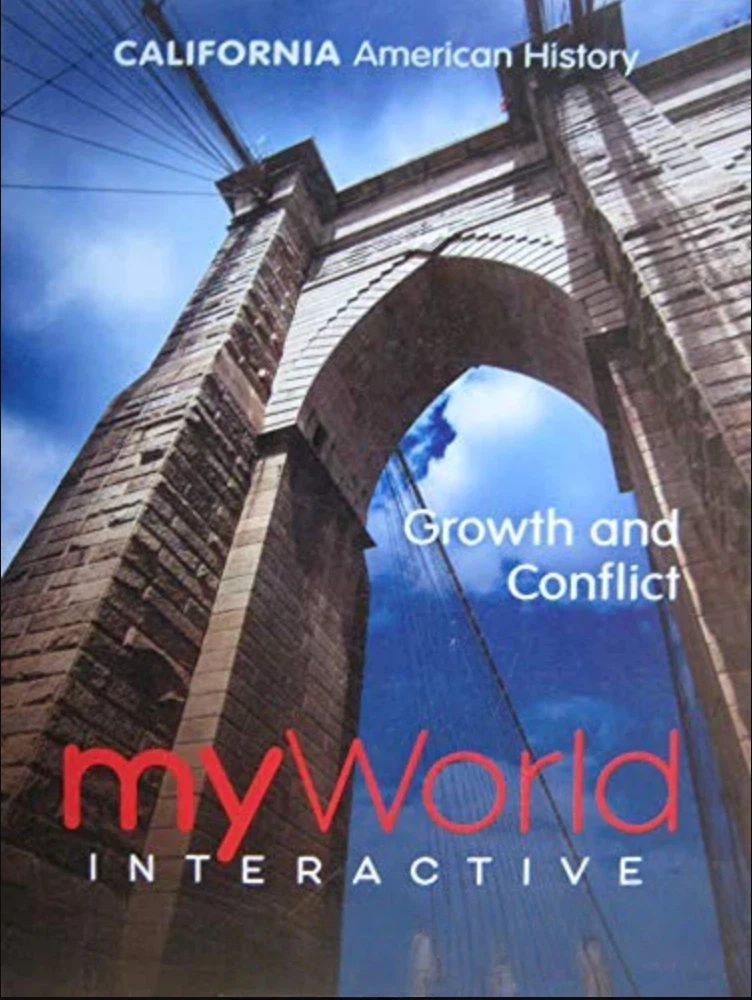
California myWorld Interactive, Grade 8
California myWorld Interactive Grade 8, published by Savvas Learning Company (formerly Pearson), is an eighth-grade United States history textbook designed to meet California state standards. It covers American history from the Revolutionary Era and the founding of the Constitution through the Early Republic, Jacksonian democracy, westward expansion, the causes and consequences of the Civil War, Reconstruction, and the rise of industrial capitalism and the Progressive Era. The curriculum emphasizes primary sources, geographic context, and civic understanding to help students connect historical events to modern American society.
Chapters & Lessons
Chapter 1: The Revolutionary Era (1750–1783)
5 lessonsIn this Grade 8 lesson from California myWorld Interactive Chapter 1, students explore the causes and early events of the French and Indian War, examining why Britain and France clashed over the Ohio River Valley and how American Indian groups like the Iroquois, Algonquins, and Hurons chose sides through rival alliances. Students also analyze the Albany Plan of Union and the role of key figures like William Johnson and Molly Brant in shaping colonial-Indian relations. The lesson builds sequencing skills as students trace how European imperial rivalry reshaped power in mid-18th-century North America.
Grade 8 students in California myWorld Interactive examine the growing colonial resentment against British rule in the years following the French and Indian War, focusing on key causes including the Proclamation of 1763, Pontiac's War, and the introduction of new taxes and writs of assistance. Students analyze how British policies restricting westward settlement and imposing financial burdens on colonists sparked organized resistance through petitions, boycotts, and committees of correspondence. The lesson also highlights the colonial leaders who emerged during this period of rising tensions with Britain.
In this Grade 8 lesson from California myWorld Interactive, students explore the escalating tensions between the American colonies and Britain, focusing on the Boston Tea Party, the Tea Act of 1773, and the concept of civil disobedience. Students examine the actions of the First and Second Continental Congresses and analyze the roles of Patriots and Loyalists as the Revolutionary War began. The lesson also asks students to compare the military advantages and disadvantages each side held at the outset of the conflict.
In this Grade 8 lesson from California myWorld Interactive, students examine the key events and ideas that drove the American colonies toward independence, including the Battle of Bunker Hill, Washington's siege of Boston, and the arguments Thomas Paine made in Common Sense. Students analyze the main ideas of the Declaration of Independence, including the concepts of natural rights and unalienable rights as expressed in its preamble. The lesson also explores the early challenges facing the Continental Army and how strategic geography, captured cannons, and shifting colonial attitudes helped turn the tide against British forces.
In this Grade 8 lesson from California myWorld Interactive Chapter 1, students examine how the American colonists won independence during the Revolutionary War, tracing the sequence of events from the hardships at Valley Forge through the final victory at Yorktown. Students learn the specific contributions of European allies like the Marquis de Lafayette and Friedrich von Steuben, as well as the roles women and African Americans played in the war effort. The lesson also covers key vocabulary including cavalry, guerrilla, siege, and ratify, and explores what the United States gained politically and territorially by winning the war.
Chapter 2: A Constitution for the United States (1776–Present)
7 lessonsIn this Grade 8 lesson from California myWorld Interactive, students examine the strengths and weaknesses of the Articles of Confederation, including why Congress lacked the power to tax, regulate trade, or enforce laws. Students also explore how the Northwest Ordinance organized new territory and how Shays' Rebellion exposed the limits of the new government. The lesson builds foundational understanding of why American leaders ultimately sought to replace the Articles with a stronger constitution.
In this Grade 8 lesson from California myWorld Interactive, students explore the Constitutional Convention of 1787, examining the key figures who shaped the debate, including James Madison, Alexander Hamilton, and George Washington. Students compare and contrast the Virginia Plan and the New Jersey Plan, analyzing how disagreements over legislative representation led to compromise. The lesson builds understanding of how rival proposals for a new federal government ultimately replaced the Articles of Confederation with the United States Constitution.
In this Grade 8 lesson from California myWorld Interactive Chapter 2, students explore the historical ideas and documents that shaped the U.S. Constitution, including civic republicanism drawn from the Roman Republic, the Magna Carta, and the English Bill of Rights. Students examine key concepts such as republic, dictatorship, separation of powers, and how traditions like trial by jury and limits on government power carried from ancient and British precedents into the founding era.
In this Grade 8 lesson from California myWorld Interactive, students examine the debate over ratifying the Constitution, comparing the Federalist arguments for a strong national government with the Antifederalist concerns about federal overreach and presidential power. Students learn how key figures like James Madison, Alexander Hamilton, and Patrick Henry shaped the ratification process and why Antifederalists demanded a Bill of Rights to protect individual liberties such as freedom of speech and religion. The lesson also introduces the Federalist Papers and the vocabulary of ratification, amendment, and political compromise central to understanding the founding of American government.
In this Grade 8 lesson from California myWorld Interactive, students explore the structure and principles of the U.S. Constitution, including the six goals of the Preamble, the purpose of each of the seven articles, and foundational principles such as popular sovereignty, separation of powers, and checks and balances. Students also learn key vocabulary including veto, override, impeach, and bill as they examine how the legislative, executive, and judicial branches are defined and limited by the Constitution.
In this Grade 8 lesson from California myWorld Interactive, students explore the constitutional amendment process outlined in Article 5, including the two methods of proposing and ratifying amendments. Students also examine the fundamental liberties protected by the Bill of Rights, such as freedom of religion, speech, and the press under the First Amendment, and the protections against government abuse of power in the Second through Fourth Amendments. The lesson is part of Chapter 2, which traces the development of the U.S. Constitution from 1776 to the present.
In this Grade 8 lesson from California myWorld Interactive Chapter 2, students explore the three pathways to U.S. citizenship — birth, naturalization, and parental naturalization — along with key terms such as resident alien, civic virtue, and patriotism. Students examine the rights guaranteed to all citizens and the responsibilities that accompany them, including voting, jury duty, and upholding democratic values. The lesson also traces the naturalization process through a primary source oath and real-world example, helping students understand what it means to be an engaged American citizen.
Chapter 3: The Early Republic (1789–1825)
6 lessonsIn this Grade 8 lesson from California myWorld Interactive, students explore how George Washington shaped the early republic (1789–1825) by establishing key precedents, forming the first Cabinet, and creating the federal court system through the Judiciary Act of 1789. Students also examine Alexander Hamilton's approach to the national debt using bonds and tariffs, and analyze the causes and effects of the Whiskey Rebellion alongside Washington's foreign policy principles from his Farewell Address. The lesson builds core vocabulary including inauguration, precedent, Cabinet, and speculator within the context of the new constitutional government.
In this Grade 8 lesson from California myWorld Interactive, students examine how political factions emerged during the early republic by comparing the contrasting views of Alexander Hamilton and Thomas Jefferson on federal power, economic policy, and the role of government. Students analyze key vocabulary such as faction, Federalists, and Democratic Republicans while exploring how these disagreements led to the formation of America's first two-party system. The lesson also addresses the political tensions surrounding Washington's presidency and the election of 1796.
In this Grade 8 lesson from California myWorld Interactive, students explore the presidencies of John Adams and Thomas Jefferson, examining key events such as the XYZ Affair, the Alien and Sedition Acts, and the landmark Supreme Court case Marbury v. Madison. Students analyze how Adams navigated foreign policy crises with France without declaring war and learn the concepts of judicial review, states' rights, and sedition within the context of the Early Republic. The lesson develops skills in identifying main ideas while building understanding of how political conflicts in the 1790s and early 1800s shaped the foundations of American government.
Grade 8 students in California myWorld Interactive Chapter 3 explore the Louisiana Purchase of 1803, examining Jefferson's constitutional authority to acquire new territory, the role of the Mississippi River and New Orleans in shaping U.S. domestic and foreign policy, and the Lewis and Clark expedition's exploration of the newly acquired lands. The lesson also covers key vocabulary including impressment, embargo, and continental divide as students analyze how geographic and economic pressures drove early American expansion.
In this Grade 8 lesson from California myWorld Interactive's Chapter 3: The Early Republic, students examine the causes and key events of the War of 1812, including frontier conflicts between white settlers and American Indian nations such as the Miamis and Shawnees. Students learn how Tecumseh worked to build a confederation among Northwest tribes to resist westward expansion, and how tensions with Britain contributed to the outbreak of war. The lesson also covers the consequences of the conflict and introduces vocabulary terms such as confederation, War Hawks, and nationalism.
In this Grade 8 lesson from California myWorld Interactive, students explore James Monroe's presidency, the "Era of Good Feelings," and the rise of sectionalism in the early republic. Students examine how regional leaders John C. Calhoun, Daniel Webster, and Henry Clay each represented different sectional interests, and how concepts like the Monroe Doctrine, interstate commerce, and the American System shaped the young nation. The lesson also introduces John Marshall's expansion of federal power and what daily life looked like in the early 1800s.
Chapter 4: The Age of Jackson and Westward Expansion (1824–1860)
7 lessonsIn this Grade 8 lesson from California myWorld Interactive, students examine how the expansion of suffrage during the Age of Jackson transformed American politics, including the rise of the Democratic and Whig parties and the spoils system. Students analyze the causes and effects of Jacksonian democracy, exploring how voting rights were extended to nearly all white men while remaining denied to women, enslaved people, and most free African Americans. The lesson draws on primary observations, including Alexis de Tocqueville's Democracy in America, to help students understand the regional and social forces shaping this era of U.S. history.
In this Grade 8 lesson from California myWorld Interactive, students examine the political conflicts that shaped Andrew Jackson's presidency, including the debate over states' rights, nullification, and the Tariff of Abominations. Students learn how figures like John C. Calhoun and Daniel Webster clashed over whether states could nullify federal laws, and how regional differences between the North, South, and West drove these disputes. The lesson also explores how economic crises, including banking conflicts and depression, influenced the political landscape through the election of 1840.
In this Grade 8 lesson from California myWorld Interactive, students examine the causes and consequences of conflict between American settlers and American Indian nations in the early nineteenth century, including the roles of the Proclamation Line of 1763, the Northwest Ordinance, and broken treaties like the Pickering Treaty. Students analyze key vocabulary such as the Indian Removal Act, Indian Territory, and the Trail of Tears while exploring the cultures and territorial lands of groups like the Cherokee, Creek, Shawnee, and Seminole. The lesson builds evidence-based reasoning skills as students investigate how westward expansion and frontier ideology shaped U.S. government policy toward American Indians.
In this Grade 8 history lesson from California myWorld Interactive, students explore the causes and patterns of American westward expansion in the early nineteenth century, examining how the Northwest Ordinance organized settlement, enabled land sales for government revenue, and established the path to statehood for new territories. Students also analyze how geographic features like rivers shaped migration routes and how expanded territories — gained through events like the Louisiana Purchase and the Mexican-American War — transformed the nation's boundaries. The lesson builds key vocabulary including revenue, flatboat, the Erie Canal, and the National Road within the context of Chapter 4's focus on the Age of Jackson and Westward Expansion.
In this Grade 8 lesson from California myWorld Interactive, students explore the settlement of Oregon Country in the early nineteenth century, examining the geography of the region and the roles played by mountain men such as James Beckwourth and explorers like John C. Frémont. Students learn how fur trappers pioneered routes through the Rocky Mountains that later became the Oregon Trail, and analyze how competing territorial claims among the United States, Britain, Spain, and Russia shaped westward expansion. The lesson builds skills in summarizing key developments that drew American settlers beyond the Mississippi toward the Pacific coast.
In this Grade 8 lesson from California myWorld Interactive, students examine the causes and consequences of Texas independence while exploring how Spanish and American settlements shaped the development of the Southwest. Students learn key terms such as vaquero, mission, the Santa Fe Trail, and siege as they trace the sequence of events from Spanish colonization under Juan de Oñate and Father Junípero Serra through Mexican independence in 1821. The lesson also covers the impact of mission life on Puebloans and California's American Indian peoples, and how Mexican land grants gave rise to the rancho economy.
In this Grade 8 lesson from California myWorld Interactive, students explore Manifest Destiny and its role in American westward expansion, examining how the ideology shaped U.S. policy under President Polk and contributed to the annexation of Texas. Students analyze the causes and early events of the Mexican-American War, including the border dispute between the Rio Grande and the Nueces River. Key terms covered include Manifest Destiny, the Bear Flag Republic, the Treaty of Guadalupe-Hidalgo, the Mexican Cession, and the forty-niners of the California gold rush.
Chapter 5: Society and Culture Before the Civil War (1820–1860)
6 lessonsIn this Grade 8 lesson from California myWorld Interactive, students explore how the Industrial Revolution transformed the American economy between 1800 and 1850, examining key concepts such as capital, capitalist, scarcity, supply, and interchangeable parts. Students analyze how technological innovations like the spinning jenny and water-powered looms shifted goods production from homes to factories, and how forces of supply and demand drove rapid industrialization. The lesson also connects these economic changes to shifts in where and how people worked and lived across different regions of the country.
In this Grade 8 lesson from California myWorld Interactive's Chapter 5, students examine how steam power transformed the Industrial Revolution, tracing the development of railroads from early obstacles like non-standard gauge and unsafe roadbeds to a nationwide rail network by the 1850s. Students also explore the rise of Yankee clipper ships and their role in expanding American sea trade. The lesson connects technological innovation to broader changes in urban growth, working conditions, immigration, and social class in the decades before the Civil War.
In this Grade 8 history lesson from California myWorld Interactive, students examine how Eli Whitney's cotton gin transformed the Southern economy by dramatically expanding plantation agriculture and driving the growth of the Cotton Kingdom from South Carolina to Texas. Students analyze the relationship between cotton production, the slave labor system, and the concept of cash crops, exploring how the boom in cotton output deepened reliance on enslaved African Americans. The lesson also addresses how northern industries and western businesses indirectly supported slavery through their commercial ties to the South.
In this Grade 8 lesson from California myWorld Interactive Chapter 5, students examine the abolitionist movement in America from the early 1800s through the 1850s, tracing how opposition to slavery evolved from gradual emancipation efforts and the American Colonization Society to more radical demands for immediate abolition. Students learn key vocabulary including civil disobedience and the Underground Railroad, and analyze the religious, political, and economic forces that shaped the debate over slavery. The lesson also explores the resistance abolitionists faced and the roles of figures like John Quincy Adams in pressing for slavery's end.
In this Grade 8 lesson from California myWorld Interactive, students explore the Era of Reform (1815–1860), examining how the Second Great Awakening, Jacksonian democratic ideals, and Industrial Revolution-era social conditions sparked organized movements for social reform. Students learn about key developments including the temperance movement, the Seneca Falls Convention, and the women's rights movement, as well as the roles of reformers like Dorothea Dix in improving prisons and education. The lesson builds literacy skills in drawing conclusions while connecting religious, political, and social causes to lasting changes in American society before the Civil War.
In this Grade 8 lesson from California myWorld Interactive Chapter 5, students explore how American painters and writers of the early to mid-1800s developed distinctly national styles and themes. Students examine the Hudson River School's landscape paintings, the rise of transcendentalism and individualism, and the works of poets such as Longfellow, Whitman, and Dickinson as expressions of American identity. The lesson also addresses how artists like George Catlin and writers like John Greenleaf Whittier responded to westward expansion and the abolitionist movement in the decades before the Civil War.
Chapter 6: Sectionalism and Civil War (1820–1865)
6 lessonsIn this Grade 8 lesson from California myWorld Interactive, students explore the causes and resolutions of sectional conflict over slavery, focusing on key events including the Missouri Compromise of 1820, the Wilmot Proviso, and the Compromise of 1850. Students analyze how debates over slavery in western territories deepened sectionalism between North and South and examine concepts such as popular sovereignty, the Free-Soil Party, and the Fugitive Slave Act. The lesson is part of Chapter 6: Sectionalism and Civil War (1820–1865) and builds students' skills in comparing and contrasting competing political positions.
In this Grade 8 lesson from California myWorld Interactive's Chapter 6, students examine the causes and consequences of the Kansas-Nebraska Act of 1854, including how its application of popular sovereignty effectively repealed the Missouri Compromise and reignited sectional conflict over slavery. Students analyze how proslavery Border Ruffians and antislavery settlers turned Kansas into a violent battleground, leading to rival governments and a breakdown of order. The lesson also introduces the Dred Scott v. Sandford case and the founding of the Republican Party as key developments that pushed the nation closer to Civil War.
In this Grade 8 lesson from California myWorld Interactive, Chapter 6, students examine the causes and outbreak of the Civil War, focusing on how the 1860 presidential election deepened sectional divisions between the North and South. Students analyze why Abraham Lincoln's victory prompted Southern secession, tracing the formation of the Confederate States of America and the failure of compromise measures like the Crittenden Compromise. The lesson also introduces key vocabulary such as unamendable and acquiescence while asking students to compare the strengths and weaknesses of each side as war began.
In this Grade 8 lesson from California myWorld Interactive, students examine how the Civil War was fought, comparing the Union's three-pronged offensive strategy — naval blockade, capturing Richmond, and controlling the Mississippi River — against the Confederacy's defensive strategy of outlasting Northern resolve. Students analyze key early battles including the Battle of Bull Run, the naval clash between the Virginia and Monitor, the Battle of Antietam, and the Battle of Shiloh, tracing how these engagements shaped the broader course of the war. The lesson is part of Chapter 6: Sectionalism and Civil War (1820–1865) and helps students understand how early military outcomes reflected each side's strengths, weaknesses, and long-term war aims.
In this Grade 8 lesson from California myWorld Interactive, students examine how and why the Civil War evolved from a fight to restore the Union into a war to end slavery, focusing on Lincoln's Emancipation Proclamation of January 1, 1863. Students analyze the proclamation's limited scope, its strategic impact on the Confederacy, and its effect on European sympathy for the South. The lesson also explores the contributions of African Americans, including the 54th Massachusetts Regiment, and the roles women played in the war effort.
In this Grade 8 lesson from California myWorld Interactive, students examine the turning point battles of the Civil War, including the Union siege of Vicksburg, the three-day Battle of Gettysburg, and the ill-fated Confederate assault known as Pickett's Charge. Students analyze how Union victories in July 1863 split the Confederacy and shifted momentum toward the war's end at Appomattox Court House. The lesson is part of Chapter 6: Sectionalism and Civil War and helps students understand how military strategy and key engagements determined the outcome of the conflict.
Chapter 7: The Reconstruction Era (1865–1877)
4 lessonsIn this Grade 8 lesson from California myWorld Interactive Chapter 7, students examine the economic, political, and social conditions facing the North and South after the Civil War, including the emergence of freedmen as a new class of nearly four million formerly enslaved people. Students analyze the causes and effects of Reconstruction, exploring key concepts such as the Thirteenth Amendment, the role of the Freedmen's Bureau, and the political conflicts that arose following Lincoln's assassination.
In this Grade 8 lesson from California myWorld Interactive, students examine how Congress responded to the black codes passed by southern legislatures after the Civil War by passing the Civil Rights Act of 1866 and proposing the Fourteenth Amendment, which granted citizenship and equal protection to African Americans. Students also analyze the goals of Radical Republicans like Thaddeus Stevens and Charles Sumner, and explore why President Johnson was impeached for resisting congressional Reconstruction efforts. The lesson is part of Chapter 7 on the Reconstruction Era and builds understanding of how this period redefined American citizenship and civil rights.
In this Grade 8 lesson from California myWorld Interactive, students examine how three new political groups — white southern Republicans (scalawags), northern carpetbaggers, and African Americans — reshaped Southern society during Radical Reconstruction. Students analyze the economic, social, and political challenges of the era, including the rise of sharecropping and the role of institutions like the Freedmen's Bureau, while tracing key milestones such as the election of Hiram Rhodes Revels and Blanche Kelso Bruce as the first African American U.S. senators. The lesson also explores how conservative resistance to Reconstruction, including the formation of the Ku Klux Klan, redefined American citizenship and democracy in the years following the Civil War.
In this Grade 8 lesson from California myWorld Interactive, students examine the key events that ended Reconstruction, including the Compromise of 1877 and the withdrawal of federal troops from the South. Students analyze how African Americans' rights were systematically suppressed through poll taxes, literacy tests, grandfather clauses, and Jim Crow laws, culminating in the Supreme Court's Plessy v. Ferguson ruling. The lesson also explores the economic changes of the "New South" and Reconstruction's lasting impact on southern politics.
Chapter 8: Industrial and Economic Growth (1865–1914)
6 lessonsIn this Grade 8 lesson from California myWorld Interactive, students explore the rise of the Cattle Kingdom on the Great Plains, examining how cattle drives, vaquero traditions, and the Chisholm Trail shaped Western agriculture after the Civil War. Students also analyze the effects of the Homestead Act and Morrill Acts on frontier farming, including the challenges faced by sodbusters and the formation of farmer cooperatives to combat inflation. The lesson covers key economic and social forces that drove industrial and agricultural expansion in the American West between 1865 and 1914.
In this Grade 8 lesson from California myWorld Interactive, students examine the early history and culture of the Plains Indians, exploring how the introduction of horses transformed bison hunting, migration patterns, and daily life through tools like the travois and tepee. The lesson then traces how shifting U.S. federal policies — including reservations and the allotment system — created lasting hardship for American Indian nations. Students practice summarizing key developments in westward expansion's impact on Indigenous peoples during the post-Civil War era from 1865 to 1914.
In this Grade 8 lesson from California myWorld Interactive, students examine how the Bessemer process revolutionized steel production and how entrepreneurs like Andrew Carnegie used vertical integration to dominate entire industries. Students also analyze the formation of corporations, trusts, and monopolies, weighing arguments for and against their role in American economic growth from 1865 to 1914. The lesson builds vocabulary around key capitalism concepts including stocks, dividends, and the relationship between efficiency, scarcity, and revenue.
In this Grade 8 history lesson from California myWorld Interactive, students examine the rise of the American labor movement between 1865 and 1914, exploring why workers organized trade unions and how groups like the Knights of Labor pursued collective bargaining for shorter workdays, safer conditions, and an end to child labor in sweatshops. Students also analyze key events such as the Haymarket Riot and the Triangle Fire to understand the challenges unions faced, including strikebreakers, employer opposition, and public backlash.
In this Grade 8 lesson from California myWorld Interactive, students explore how inventions of the late 1800s and early 1900s transformed communication and transportation in the United States, examining key technologies such as the transatlantic telegraph cable, Alexander Graham Bell's telephone, and early developments in automobiles and airplanes. Students analyze how concepts like patents, mass production, and the moving assembly line drove industrial growth and improved Americans' daily lives. The lesson is part of Chapter 8: Industrial and Economic Growth (1865–1914) and builds skills in identifying supporting details within primary and secondary sources.
Chapter 9: The Progressive Era (1865–1920)
6 lessonsIn this Grade 8 lesson from California myWorld Interactive, students examine the surge of immigration to the United States between 1865 and 1915, learning to distinguish push factors such as religious persecution and pogroms from pull factors like industrial job opportunities and political freedom. Students also explore the immigrant experience, including the hardships of steerage travel, the role of Ellis Island, and the challenges of acculturation and nativist opposition. The lesson connects to Chapter 9 on the Progressive Era and builds summarizing skills using primary sources and vocabulary in context.
In this Grade 8 lesson from California myWorld Interactive's Chapter 9 on the Progressive Era, students examine the causes and effects of urbanization in late 19th-century America, including the roles of industrialization, immigration, and domestic migration in driving rapid city growth. Students analyze how social and economic status shaped urban neighborhoods, from overcrowded tenements in slum districts to middle-class suburbs, and learn about key concepts such as building codes, the Social Gospel movement, and the settlement house movement exemplified by Hull House.
In this Grade 8 lesson from California myWorld Interactive, students explore the political corruption of the Gilded Age, examining how the spoils system, patronage, and political bosses like Boss Tweed shaped American government in the late 1800s. Students learn how reformers responded by pushing for civil service reform and Progressive Era changes including the initiative, referendum, and recall. The lesson builds understanding of the transition from Gilded Age politics to the Progressive movement within the context of Chapter 9.
In this Grade 8 lesson from California myWorld Interactive Chapter 9, students examine the reform goals of Presidents Theodore Roosevelt, William Howard Taft, and Woodrow Wilson during the Progressive Era. Students learn key concepts including trustbusting, the Square Deal, conservation policy, the Bull Moose Party, and Wilson's New Freedom agenda, including the Federal Reserve Act and the Federal Trade Commission. The lesson develops skills in classifying and categorizing the economic and political reform policies that defined Progressive Era leadership from 1901 through the 1910s.
In this Grade 8 lesson from California myWorld Interactive's Chapter 9 on the Progressive Era, students examine the women's suffrage movement, tracing key figures like Susan B. Anthony, Carrie Chapman Catt, and Alice Paul as they fought for the Nineteenth Amendment. Students also explore the campaign for prohibition and the hardships faced by other groups during this era, using vocabulary terms such as suffrage, NAACP, barrio, and mutualista to understand both the progress and setbacks in the pursuit of social justice.
Frequently Asked Questions
- Is California myWorld Interactive Grade 8 the right US history textbook for my child?
- California myWorld Interactive Grade 8 by Savvas (formerly Pearson) is the state-aligned 8th-grade US history textbook used in many California public schools. It covers American history from the French and Indian War and the Revolutionary Era through the founding of the Constitution, the Early Republic, Jacksonian democracy, westward expansion, the Civil War, Reconstruction, and the rise of industrial capitalism. If your child attends a California public school, there is a good chance this is their exact classroom text. It emphasizes primary sources, civic literacy, and geographic context alongside narrative history.
- Which chapters are the hardest in California myWorld Interactive Grade 8?
- Chapter 2 on the Constitution is where many students feel overwhelmed because it packs in the Articles of Confederation, the Constitutional Convention, the Virginia Plan vs. New Jersey Plan, Federalists vs. Antifederalists, and the Bill of Rights across seven dense lessons. The Civil War and Reconstruction chapters later in the year are also demanding because students have to analyze competing political positions, economic systems, and social movements simultaneously. Primary source analysis is consistently difficult for students who are not practiced readers of 18th- and 19th-century documents.
- My child is struggling to understand the Constitution and early republic — where should they start?
- Begin with Chapter 2, Lesson 1 to understand why the Articles of Confederation failed, then read Lesson 2 on the Constitutional Convention and Lesson 3 on the ideas that influenced the Constitution before moving to Lesson 4 on Federalists and Antifederalists. Context matters enormously here — students who understand why the Articles failed will see the Constitution debates as a logical response rather than a confusing list of competing proposals. Lesson 5 (Understanding the Constitution) is much clearer after that foundation is in place.
- What social studies content does my child study after Grade 8?
- In California, 9th and 10th graders typically cover World History and Geography, followed by US History again in 11th grade (at greater depth and often in an AP context) and Government/Economics in 12th grade. The constitutional literacy your child builds in 8th grade — understanding checks and balances, federalism, the amendment process, and civic rights — is the direct prerequisite for 12th-grade Government. Students who understand the Constitution well in 8th grade tend to excel in AP Government and AP US History in high school.
- How can Pengi help my child with California myWorld Interactive Grade 8?
- Pengi can help your child untangle the complex web of causes, events, and effects that define 8th-grade US history. Whether your child needs to understand the sequence from the French and Indian War to the Revolution (Chapter 1), explain the Great Compromise (Chapter 2, Lesson 2), or analyze what the Federalist Papers argued (Chapter 2, Lesson 4), Pengi can walk through it conversationally and ask questions to verify understanding. Pengi can also help your child practice primary source analysis and prepare document-based responses for class assessments.
Ready to start learning?
Jump into your first lesson for California myWorld Interactive, Grade 8. Free, no account required.
Start Learning