
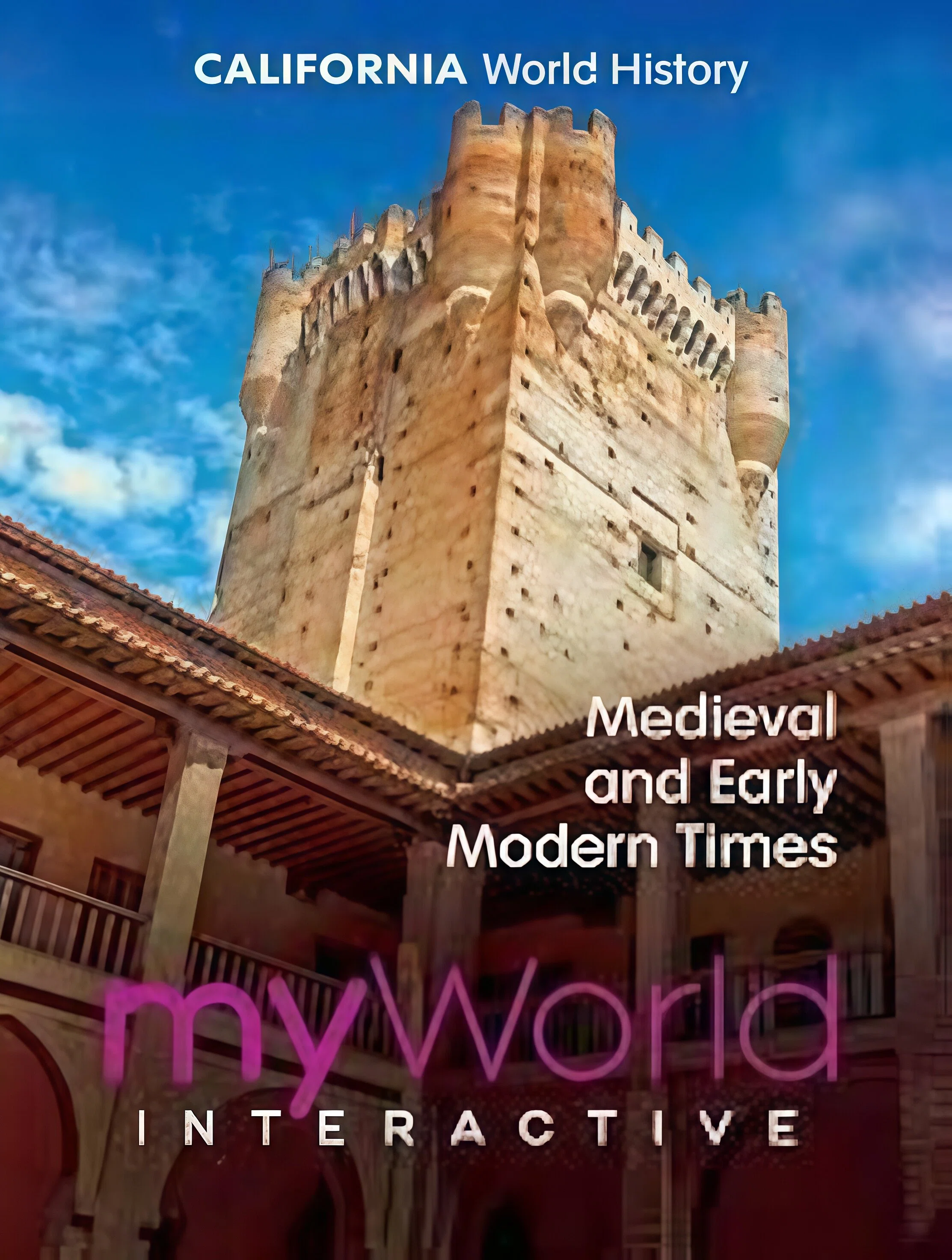
California myWorld Interactive, Grade 7
California myWorld Interactive Grade 7, published by Savvas Learning Company, is a world history textbook designed for seventh-grade students in California. It covers a broad sweep of ancient and medieval civilizations, including the Roman and Byzantine Empires, Medieval Europe and Christendom, the Islamic world, South Asia, East and Southeast Asia, African civilizations, and the Americas, before moving into the Renaissance, Reformation, and the era of global convergence. The course concludes with an exploration of absolutism and the Enlightenment, giving students a comprehensive foundation in the development of human societies across continents and centuries.
Chapters & Lessons
Chapter 1: The Roman and Byzantine Empires
7 lessonsIn this Grade 7 lesson from California myWorld Interactive Chapter 1, students explore how Rome grew from small settlements along the Tiber River into a powerful empire, examining the transition from the Roman Republic to rule by emperors. Students learn key concepts including the Pax Romana, the role of Augustus as the first Roman emperor, and how aqueducts and other architectural achievements supported Rome's expansion. The lesson also analyzes how Rome's geography, trade networks, and military power helped it gain and maintain control over people and territories across the ancient world.
In this Grade 7 lesson from California myWorld Interactive, students explore the origins of Christianity by examining the political tensions between Rome and Judea, the life and teachings of Jesus of Nazareth, and key vocabulary including crucifixion, resurrection, and baptism. Students learn how different Jewish groups such as the Zealots, Pharisees, and Sadducees responded to Roman rule, and how Jesus's ministry ultimately led to his arrest and execution under Roman governor Pontius Pilate. The lesson uses primary sources, including passages from the Gospels, to help students sequence the events that gave rise to a new religion in the Roman Empire.
In this Grade 7 lesson from California myWorld Interactive, students explore the core beliefs and sacred writings of Christianity, including the structure of the New Testament, the Gospels, parables, and epistles written by early leaders like Paul the Apostle. Students examine key Christian concepts such as the Trinity, resurrection, salvation, and the role of Jesus as both human and divine. The lesson is part of Chapter 1 on the Roman and Byzantine Empires, connecting early Christian belief to its historical context in the Roman world.
In this Grade 7 lesson from California myWorld Interactive, students explore Roman culture and its lasting legacy, examining how ancient Rome functioned as a site of encounter where multicultural exchange shaped Greco-Roman civilization. Students analyze Roman achievements in art, mosaics, Latin language, oratory, and satire, as well as how roads, colonies, and citizenship spread culture across the empire. The lesson also traces Rome's enduring influence on modern Romance languages, government, and concepts of citizenship.
In this Grade 7 lesson from California myWorld Interactive, students examine the key factors that caused the fall of the Roman Empire, including inflation, civil wars, the Imperial Crisis (235–284 CE), foreign invasions by the Sassanian Persians, and internal weaknesses such as corruption and depopulation. Students analyze how the end of the Pax Romana after 180 CE triggered a slow collapse, and how emperors like Septimius Severus attempted to hold power by relying on military support rather than the senate or people. The lesson develops cause-and-effect literacy skills as students trace how economic, political, and military pressures combined to destabilize one of history's greatest empires.
In this Grade 7 lesson from California myWorld Interactive, students explore how the Byzantine Empire emerged from the eastern Roman Empire, examining key differences between the two empires and the geographic advantages of Constantinople's location on the Bosporus Strait. Students analyze Emperor Justinian's military conquests, legal legacy, and the role of Empress Theodora, while learning vocabulary terms such as strait, moat, Greek fire, Cyrillic alphabet, and missionary. The lesson also covers the causes of Byzantine decline and the empire's lasting cultural influence on early Russia and surrounding regions.
In this Grade 7 lesson from California myWorld Interactive, students examine the religious and cultural divisions within Christianity during the Byzantine era, including the debate over the Nicene Creed, the iconoclast controversy, and the growing conflict between Eastern and Western church authority. Students learn how disagreements over icons, papal power, and apostolic succession contributed to the Great Schism that split the Roman Catholic and Eastern Orthodox churches. The lesson also explores how Byzantine culture developed its own distinct identity through these religious tensions and institutional structures.
Chapter 2: Life in Medieval Christendom
5 lessonsIn this Grade 7 lesson from California myWorld Interactive Chapter 2, students learn how Catholic missionaries converted pagan populations across Europe during the Middle Ages, tracing the work of figures like St. Patrick in Ireland and Boniface in Germany. Students explore the roles of monasteries, convents, and the Catholic Church in shaping medieval Christendom, and examine how the spread of Christianity contributed to the formation of new European states.
In this Grade 7 lesson from California myWorld Interactive's Chapter 2, students examine how Viking, Magyar, and Muslim invasions destabilized Western Europe following the collapse of Charlemagne's empire and led to the rise of feudalism. Students learn the relationships between lords, vassals, knights, and serfs, including how fiefs were granted in exchange for military loyalty and service. The lesson also explores how manorialism organized medieval society into small, self-sufficient economic units built around the manor system.
In this Grade 7 lesson from California myWorld Interactive's Chapter 2, students explore how agricultural innovations like the iron plow, horse harness, and the three-field system of crop rotation fueled population growth and economic revival in medieval Europe from 1000 to 1300 CE. Students examine how surplus food production led to the expansion of trade and the growth of towns, and analyze the role of institutions like Cistercian monasteries in advancing farming and the textile industry.
In this Grade 7 lesson from California myWorld Interactive Chapter 2, students explore how Christianity shaped medieval society and culture, examining the development of religious orders such as the Franciscans and Poor Clares, the role of mendicant friars, and how the Church influenced daily life during the Age of Faith. Students also analyze the characteristics of medieval universities and the concept of natural law as they investigate how Roman Catholicism dominated Western Europe and transformed art, education, and community life.
Chapter 3: Struggle in Medieval Europe
5 lessonsIn this Grade 7 lesson from California myWorld Interactive, students examine how the Norman Conquest of 1066 transformed England, tracing William the Conqueror's defeat of Harold at the Battle of Hastings and the end of Anglo-Saxon rule. Students also analyze how key developments such as the Magna Carta, common law, and habeas corpus shaped England's transition toward limited monarchy. The lesson draws on primary sources and map evidence to help students understand the political and cultural foundations of medieval England.
In this Grade 7 lesson from California myWorld Interactive, Chapter 3, students explore the causes and consequences of the Crusades, a series of medieval military campaigns launched by European Christians to establish control over the Holy Land. Students examine why Pope Urban II called for the First Crusade in 1095, how feudal and religious ideals motivated crusaders, and how the campaigns led to the persecution of Jews, Muslims, and Christian heretics. The lesson also addresses the lasting social and economic effects the Crusades had on both Europe and the Middle East.
In this Grade 7 lesson from California myWorld Interactive Chapter 3, students explore the Reconquista, the centuries-long Christian campaign to reclaim the Iberian Peninsula from Moorish rule. Students learn how the Moors built a multicultural society in al-Andalus, where Muslim, Jewish, and Christian scholars exchanged knowledge in cities like Córdoba, and how figures such as Ibn Rushd and Moses Maimonides shaped medieval philosophy. The lesson traces the political and military shifts that led to the fall of the Córdoba caliphate and the eventual expulsion of Muslims and Jews from Spain in 1492.
Grade 7 students studying California myWorld Interactive Chapter 3 examine the major crises that brought about the decline of medieval society, including the Great Famine, the Hundred Years' War between England and France from 1337 to 1453, and the devastating spread of the bubonic plague known as the Black Death across Europe and Asia in the 1300s. Students analyze how these overlapping disasters disrupted the feudal social order, explore the role of new weapons like the longbow and cannons in transforming medieval warfare, and learn about key figures such as Joan of Arc. The lesson emphasizes cause-and-effect relationships between famine, warfare, and plague and their combined impact on medieval European society.
Chapter 4: The Islamic World and South Asia
6 lessonsGrade 7 students explore the origins of Islam in this lesson from California myWorld Interactive, covering how the geography of the Arabian Peninsula shaped early settlement around oases, the life of Muhammad and his revelations that became the foundation of Islamic belief, and the significance of the Hijra from Mecca to Medina. Students learn key vocabulary including prophet, oasis, nomad, and Quran while examining how Arabia's harsh desert environment influenced the region's history and culture. The lesson is part of Chapter 4: The Islamic World and South Asia.
In this Grade 7 lesson from California myWorld Interactive, students explore the core beliefs of Islam, examining the Quran and the Sunnah as the primary sources of Islamic teaching and learning how each guides Muslim worship and daily life. Students also study foundational Islamic beliefs including monotheism, the meaning of submission to God's will, and teachings about the soul and afterlife. The lesson aligns with California History-Social Science Standards 7.2.2 and 7.2.3 within the unit on the Islamic World and South Asia.
In this Grade 7 history lesson from California myWorld Interactive, Chapter 4, students explore how the Muslim world expanded rapidly after the death of Muhammad in 632, tracing Arab Muslim conquests of the Sasanian Persian Empire, Byzantine territories, North Africa, and Spain through 750 CE. Students examine key vocabulary including caliph, Sunni, Shia, dynasty, Sufism, and sultan while analyzing the political, military, and religious factors that drove Islamic expansion across three continents. The lesson also covers how Islam spread peacefully through merchants and missionaries into South Asia, Southeast Asia, and sub-Saharan Africa, and how policies of religious toleration shaped life within the growing empire.
In this Grade 7 lesson from California myWorld Interactive Chapter 4, students explore how trade networks, urban centers like Baghdad and Cairo, and cross-cultural collaboration drove the achievements of Islamic civilization. Students examine the role of textiles, dhows, and the Silk Road in expanding commerce across three continents, and analyze how Muslim scholars built on Greek, Persian, and Indian knowledge to advance science, mathematics, and the arts. Key vocabulary includes Arabic numerals, calligraphy, and textile.
Grade 7 students explore the rise and fall of the Gupta Empire in northern India, examining how rulers like Chandra Gupta I, Samudra Gupta, and Chandra Gupta II expanded territory through conquest and alliance. The lesson covers Gupta political structure, including the concept of citizenship and local governance through councils and guilds, as part of California myWorld Interactive Chapter 4. Students also begin examining the cultural achievements of the Gupta period, including advances in literature, art, and the development of the decimal system and modern numerals.
In this Grade 7 lesson from California myWorld Interactive, students explore South Asia after the collapse of the Gupta Empire, examining how India fragmented into smaller kingdoms and how the Chola dynasty rose to power through maritime trade networks. Students analyze how Hinduism evolved through the Bhakti movement and how Buddhism spread and changed across the region. The lesson is part of Chapter 4: The Islamic World and South Asia and connects political fragmentation to cultural and religious transformation across the Indian subcontinent.
Chapter 5: Civilizations of East Asia and Southeast Asia
7 lessonsIn this Grade 7 lesson from California myWorld Interactive, students explore the rise and fall of the Tang and Song dynasties, examining how rulers like Tang Taizong used bureaucracy and a merit-based civil service system to build stable central governments. Students analyze the growth of Chang'an as a major commercial center and investigate the causes of China's economic revolution, including urbanization, the development of money economies, and advances in trade along the Silk Road. The lesson develops key vocabulary such as scholar-official, porcelain, and bureaucracy within the context of medieval East Asian history standards HSS 7.3.1, 7.3.2, and 7.3.6.
In this Grade 7 lesson from California myWorld Interactive, students examine the rise and expansion of the Mongol Empire, exploring how Genghis Khan united nomadic clans on the Central Asian steppes and built the largest empire in history through military strategy and conquest. Students also analyze how the empire was divided into khanates after Genghis Khan's death and how Mongol rule affected regions from China and Russia to Persia and the Muslim world. The lesson also addresses how Ming emperors later worked to erase Mongol influence and restore Chinese rule, using key vocabulary such as nomad, steppe, khan, tribute, and despot.
Grade 7 students explore Chinese thought and achievements from the Tang through Ming dynasties using California myWorld Interactive, Chapter 5. The lesson covers key technological innovations including the magnetic compass, block printing, movable type, and gunpowder, explaining how these inventions spread across Asia and into Europe. Students also examine how Confucianism, Daoism, and Buddhism shaped Chinese society and how Tang, Song, and Ming dynasty trade and tribute systems drove the exchange of goods and ideas across the world.
In this Grade 7 lesson from California myWorld Interactive, Chapter 5, students explore how Japan's archipelago geography, volcanic terrain, and island isolation shaped its early cultural development. They examine the rise of the Yamato clan, the role of kami in clan religion, and how Prince Shotoku worked to unify Japan as a kingdom. The lesson also traces how migrants from China and Korea introduced Buddhism, writing systems, and metalworking to Japanese society.
In this Grade 7 lesson from California myWorld Interactive, students explore how Japanese emperors lost power to rival clans like the Fujiwara, Taira, and Minamoto, leading to the rise of the shogun and a feudal system. Students learn key concepts including the roles of daimyo, samurai, and the code of bushido in structuring medieval Japanese society. The lesson aligns with California HSS standards 7.5.3 and 7.5.6, drawing comparisons between Japanese feudalism and medieval European knighthood.
In this Grade 7 lesson from California myWorld Interactive, students explore Japanese society and culture during the Heian period (794–1185), examining the literary masterpiece The Tale of Genji, the dramatic art forms of Noh and Kabuki, and the influence of Chinese scroll painting and architecture on Japanese style. Students also analyze the core values that shaped Japanese society, including family loyalty, Confucian harmony, and the practice of consensus. The lesson additionally covers how Shinto traditions and Buddhism shaped Japanese religious and cultural life.
In this Grade 7 lesson from California myWorld Interactive's Chapter 5, students explore how powerful neighbors like China and India shaped the cultures of Korea and Southeast Asia. Students examine Korea's geography, the three ancient kingdoms of Koguryo, Paekche, and Silla, and how the Silla dynasty unified the Korean peninsula with Tang dynasty support. The lesson also introduces key vocabulary including Hangul, celadon, archipelago, monsoon, and stupa to build understanding of the distinct civilizations that emerged across the region.
Chapter 6: Civilizations of the Americas
4 lessonsIn this Grade 7 lesson from California myWorld Interactive's Chapter 6: Civilizations of the Americas, students explore the rise of Maya civilization in Mesoamerica, examining how geographic features like highland volcanism and tropical lowland forests shaped agriculture, population growth, and urban development. Students learn how slash-and-burn farming, trade networks, and surplus food production laid the groundwork for complex societies, beginning with the Olmec. The lesson also introduces key advances the Maya made in hieroglyphic writing, mathematics, astronomy, and architecture within the context of their religion and government.
In this Grade 7 lesson from California myWorld Interactive, students explore how the Aztec empire rose to power in central Mexico, examining the geographic advantages of the Valley of Mexico and the island capital Tenochtitlan. Students learn key engineering concepts including chinampas, dikes, and aqueducts, and how these innovations supported a growing population. The lesson also covers the structure of Aztec imperial rule, including the Triple Alliance and the tribute system used to govern conquered city-states.
In this Grade 7 lesson from California myWorld Interactive Chapter 6, students explore how the Incan Empire rose to power in the Andes, examining how geographic challenges led Andean peoples to develop terrace farming and irrigation systems. Students learn how Pachacuti expanded the empire through military strength and political strategy, and analyze key concepts including the ayllu, the mita system, and the use of the quipu. The lesson connects Andean agricultural adaptation to broader patterns of civilization growth across South America before European contact.
In this Grade 7 lesson from California myWorld Interactive, students examine how early North American cultures, including the Ancestral Pueblo and Mississippians, adapted to their environments through farming techniques, architecture, and social organization. Students analyze archaeological artifacts and geographic conditions to understand how distinct culture areas — from the Eastern Woodlands to the Southwest — shaped the beliefs, dwellings, and traditions of Native American peoples. Key vocabulary such as drought, longhouse, wigwam, tepee, and potlatch help students compare and contrast the diverse societies that arose across the continent.
Chapter 7: African Civilizations
4 lessonsIn this Grade 7 lesson from California myWorld Interactive, students explore Africa's major geographical regions — including the Sahara, Sahel, savanna, and rain forest — and examine how natural resources like gold and salt drove the development of trans-Saharan trade. Students analyze how ironworking, caravan routes, and the Niger and Senegal rivers enabled early West African kingdoms to build wealth and power, ultimately leading to the rise of the Ghana Empire.
In this Grade 7 lesson from California myWorld Interactive, Chapter 7, students explore the rise of the Mali and Songhai empires in West Africa, tracing how rulers like Sundiata and Mansa Musa built power through control of trans-Saharan trade routes and the spread of Islam. Students examine Mali as a site of encounter where commercial and cultural exchanges shaped the empire, including the role of scholarship, griots, and Mansa Musa's famous hajj in spreading Mali's influence. The lesson develops sequencing skills as students follow the historical progression from the fall of Ghana through the height of Mali's prosperity and the emergence of Songhai.
In this Grade 7 lesson from California myWorld Interactive, students examine how the kingdoms of Kush and Axum rose to power as major commercial centers by controlling trade routes along the Nile River, Red Sea, and into Roman Egypt, southern Arabia, and India. Students also explore how Christianity spread into East Africa through Greco-Roman merchants and the influence of figures like King Ezana, who made Christianity Axum's official religion. Key concepts include the role of stelae as royal monuments, the decline of Kush, and East Africa's broader connection to ancient ocean trade networks.
Chapter 8: The Renaissance and Reformation
6 lessonsIn this Grade 7 lesson from California myWorld Interactive, Chapter 8, students explore the origins and defining features of the Renaissance, the cultural revival that swept Europe from the 1300s through the 1500s. Students learn how the breakdown of feudalism, the rise of Italian city-states, and renewed contact with classical Greek and Roman thought gave rise to key concepts including humanism, secularism, and individualism. The lesson also examines how Italian trade networks and wealthy patrons helped spread Renaissance ideas northward across Europe.
In this Grade 7 lesson from California myWorld Interactive, students explore how Renaissance art broke from medieval traditions by embracing secular themes, realism, and classical influences from ancient Greece and Rome. Students learn key concepts including linear perspective, proportion, and the techniques of master artists like Leonardo da Vinci. The lesson also examines how Renaissance literature and architecture established Western standards of beauty that endure today.
In this Grade 7 lesson from California myWorld Interactive Chapter 8, students explore how the Renaissance transformed daily life in Europe, including the rise of vernacular literacy, the role of women in politics and the arts, and the revolutionary impact of Johann Gutenberg's movable type printing press. Students examine how the printing press dramatically increased the availability of books and spread humanist ideas across Europe, from London to Constantinople, by 1500. The lesson builds key vocabulary such as movable type, censor, and recant while developing literacy skills around identifying main ideas and cause-and-effect relationships.
In this Grade 7 lesson from California myWorld Interactive, Chapter 8, students examine how Martin Luther challenged the Catholic Church by opposing the sale of indulgences and rejecting five of the seven sacraments, ultimately sparking the Reformation. Students learn key concepts including indulgences, sacraments, and the significance of Luther's 95 Theses posted in Wittenberg in 1517. The lesson also explores how the Reformation divided Christianity and how movements like the Jesuit order and the Council of Trent shaped the Catholic Counter-Reformation in response.
In this Grade 7 lesson from California myWorld Interactive Chapter 8, students explore the long-term legacy of the Protestant Reformation, examining how religious divisions between Catholics and Protestants reshaped European politics and triggered conflicts such as the formation of the Anglican Church, the Peace of Augsburg, and the French Wars of Religion. Students learn key vocabulary including annulment, edict, armada, and federalism while analyzing how the Reformation permanently shattered medieval Europe's religious unity. The lesson also traces how Lutheranism and Calvinism spread across northern Europe while Catholic power held firm in the south.
In this Grade 7 lesson from California myWorld Interactive Chapter 8, students explore the causes and development of the Scientific Revolution, tracing its roots from ancient Greek rationalism through medieval Islamic and European scholarship to Renaissance-era discoveries. Students learn how astronomers like Copernicus introduced the heliocentric theory to challenge Earth-centered views of the universe, and how concepts such as empiricism, inductive reasoning, and the scientific method transformed the way knowledge was pursued in 16th- and 17th-century Europe.
Chapter 9: Global Convergence
7 lessonsIn this Grade 7 lesson from California myWorld Interactive Chapter 9, students explore the economic, religious, and political motivations that drove European voyages of discovery in the 1400s and 1500s, including the roles of the spice trade, Christian missionaries, and competition among nations like Portugal and Spain. Students examine how new technology such as the caravel and advances in cartography made long ocean voyages possible, and trace key expeditions by explorers like Bartolomeu Dias and Vasco da Gama. The lesson also develops literacy skills in identifying cause and effect as students analyze how these voyages reshaped European understanding of the world.
In this Grade 7 lesson from California myWorld Interactive, students examine how Spanish conquistadors Hernán Cortés and Francisco Pizarro defeated the Aztec and Incan empires through military alliances, political manipulation, and the devastating spread of smallpox. Students learn key vocabulary including conquistador, colonization, bullion, and immunity, and analyze the causes and effects of Spanish conquest on Mesoamerican and Andean peoples. The lesson is part of Chapter 9: Global Convergence and uses primary sources, timelines, and visual analysis to build sequencing and historical thinking skills.
In this Grade 7 lesson from California myWorld Interactive Chapter 9, students examine how Spain built and governed its colonial empire in the Americas, including the roles of viceroys, the encomienda system, and the Catholic Church's mission network. Students analyze how Spanish colonialism created a new blended society through terms like peninsulare, creole, mestizo, and mulatto, while exploring the cultural and economic effects on Native American populations. The lesson also traces key explorations by figures such as Ponce de León, De Soto, and Coronado as Spain expanded its territorial control from the Caribbean to the Philippines.
In this Grade 7 lesson from California myWorld Interactive's Chapter 9, students learn how Portugal built a colonial empire through key concepts including the Line of Demarcation, the Treaty of Tordesillas, and the colonization of Brazil with its brazilwood trade and sugar plantations. Students also examine how Portugal constructed a profitable Asian spice trade empire and why that empire eventually declined. The lesson covers the impact of Portuguese colonization on the Tupi people of Brazil and the role of Jesuit missionaries in the colony.
In this Grade 7 lesson from California myWorld Interactive Chapter 9, students explore the Columbian Exchange and its far-reaching effects on global populations, agriculture, and trade networks. They examine how the exchange of crops, animals, people, and diseases between the Eastern and Western Hemispheres transformed societies worldwide, from corn sparking population growth in Africa and Asia to European livestock reshaping life in the Americas. Students also analyze the economic shifts that gave rise to mercantilism and capitalism as exploration connected global trade routes.
Chapter 10: Absolutism and Enlightenment
4 lessonsIn this Grade 7 lesson from California myWorld Interactive Chapter 10, students explore how absolute monarchy developed in Spain and France, examining the reigns of Charles V, Philip II, and Louis XIV and how these rulers used unlimited power to expand influence through war, religion, and royal alliances. Students also learn how Spain's Golden Age produced lasting cultural achievements, including the works of El Greco, Diego Velázquez, and Miguel de Cervantes, fueled by wealth from the Americas. Key vocabulary includes absolute monarch, armada, divine right, and inflation.
In this Grade 7 lesson from California myWorld Interactive's Chapter 10, students examine how absolute monarchs—including tsars Peter the Great and Catherine the Great—modernized Russia through Western reforms, military expansion, and the reliance on serf labor. Students also explore how Russia grew its empire by gaining access to the Baltic Sea and building St. Petersburg, while comparing these developments to the rise of strong monarchies in Prussia and Austria. Key vocabulary such as tsar, serf, and partition help students analyze how absolutism shaped central and Eastern Europe during this era.
In this Grade 7 lesson from California myWorld Interactive, students examine the rise of Parliament in England and the conflicts between Stuart monarchs and Parliament that led to the English Civil War. Students learn key concepts including the Petition of Right, constitutional monarchy, and how the Glorious Revolution and the English Bill of Rights established limits on royal power. The lesson connects to California HSS standard 7.11.6 and builds understanding of how England's experience contrasted with absolutism elsewhere in Europe.
In this Grade 7 lesson from California myWorld Interactive, Chapter 10, students explore how the Scientific Revolution gave rise to the Enlightenment, examining key concepts such as natural rights, the social contract, separation of powers, and tolerance. Students analyze the ideas of thinkers like John Locke and Montesquieu to understand how Enlightenment philosophy challenged absolute monarchy and laid the groundwork for modern democratic government. The lesson also traces the intellectual roots of the Enlightenment through the Renaissance, humanism, and the Protestant Reformation.
Frequently Asked Questions
- Is California myWorld Interactive Grade 7 the right world history textbook for my seventh grader?
- If your child attends a California public middle school, myWorld Interactive Grade 7 from Savvas is one of the two main textbooks adopted for the Grade 7 world history course. It covers the span from Rome and Byzantium through the Renaissance, Reformation, and Enlightenment - exactly what California's standards require. It is strong on visual aids, primary sources, and the Quest projects that run through each chapter. Compared to McGraw-Hill IMPACT, myWorld Interactive is more student-friendly in layout and pacing. It is a good fit for students who engage better with structured visual learning.
- Which chapters in myWorld Interactive Grade 7 are hardest for students?
- The chapters on the Islamic World and South Asian civilizations are often hardest for American students because the cultural context is unfamiliar and the terminology is dense. Chapters on the Renaissance and Reformation require students to hold complex cause-and-effect chains together - why humanism emerged, how it led to questioning church authority, and how that fed into political change. The Enlightenment chapter near the end of the book is conceptually abstract, with philosophical ideas that many seventh graders find difficult to anchor in concrete events. Keeping track of geography across all these civilizations is a persistent challenge.
- My child struggles with keeping medieval civilizations straight. Where should they start?
- Build a visual timeline first - put Rome, Byzantium, the Islamic Golden Age, Tang/Song China, Medieval Europe, and the Aztec/Inca civilizations on a single chart with dates. Students who think these empires were sequential rather than overlapping get confused by every chapter. Start with Chapter 1 on Rome and Byzantium because it provides the structural foundation - the fall of Rome creates both Medieval Europe and sets the context for the rise of the Islamic world. Do not try to memorize names and dates; focus on understanding why each civilization rose and fell.
- My child just finished myWorld Interactive Grade 7. What comes next?
- Eighth grade California social studies shifts to U.S. history - covering the founding era, the Constitution, slavery, westward expansion, the Civil War, and Reconstruction. Savvas myWorld Interactive Grade 8 is the direct follow-on in this series. For students who want to go deeper into world history topics covered this year, supplemental reading on the Silk Road, the Crusades, or the Mongol Empire offers great enrichment. The analytical writing skills developed in Grade 7 - comparing civilizations, evaluating primary sources - transfer directly to the document-based questions common in Grade 8 history.
- How can Pengi help my child with California myWorld Interactive Grade 7?
- Pengi is highly effective for the comparative and analytical tasks in this course. If your child needs to compare Islamic scholars to European scholars during the same period, or explain what made the Renaissance a break from medieval thinking, Pengi can help structure the argument and check the historical accuracy. Pengi also helps with the vocabulary load - terms like feudalism, caliphate, humanism, and absolutism - by explaining them in context. It is especially useful the night before a test when your child has questions about specific chapters and no teacher is available.
Ready to start learning?
Jump into your first lesson for California myWorld Interactive, Grade 7. Free, no account required.
Start Learning