
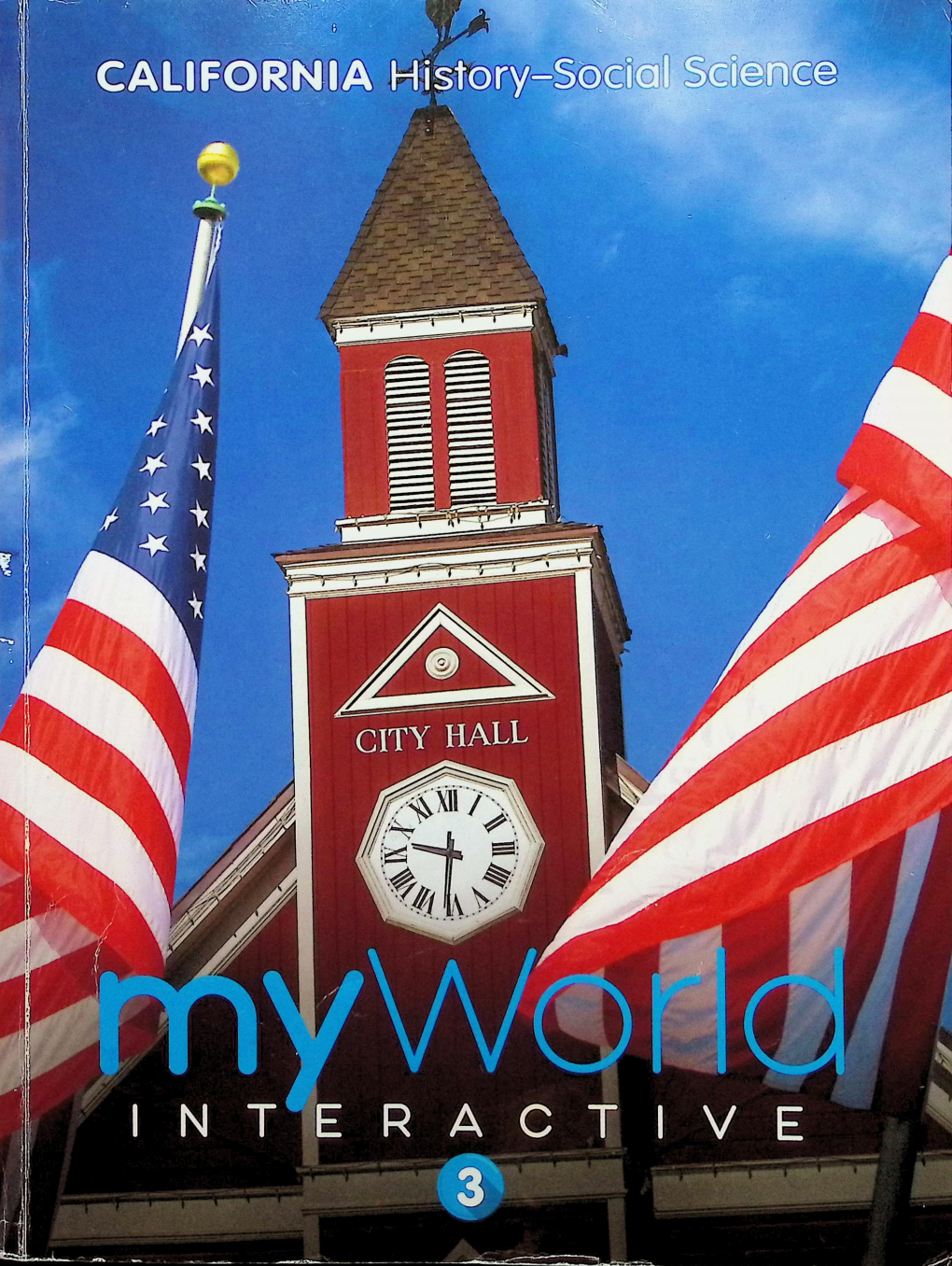
California myWorld Interactive, Grade 3
California myWorld Interactive Grade 3 is a social studies textbook published by Savvas Learning Company designed for third-grade students in California. It covers California-focused history, geography, and civics topics including the state's geography and natural resources, the American Indians of California, how California has changed over time, government landmarks and symbols, citizenship and civic engagement, and foundational economics concepts. The program uses an inquiry-based, interactive approach to help students connect their local community and state history to broader social studies skills.
Chapters & Lessons
Chapter 1: California's Geography and Resources
3 lessonsIn this Grade 3 lesson from California myWorld Interactive, students learn about California's physical geography, including key landforms such as mountains, hills, valleys, and deserts, as well as the state's major bodies of water and ecosystems. Students explore vocabulary terms like elevation, range, and irrigate to understand how these natural features shape the land and support both farming and wildlife. The lesson builds map awareness and helps students connect California's diverse physical features to everyday life in their own communities.
In this Grade 3 lesson from California myWorld Interactive, students learn to identify and describe California's four geographic regions: the coastal region, the Central Valley, the mountains, and the desert. Students explore key landforms, major cities, and defining features of each region, including concepts like bay, irrigation, and mountain ranges such as the Sierra Nevada and Cascade Range. The lesson builds geographic literacy by connecting regional characteristics to real places students may recognize across the state.
In this Grade 3 lesson from California myWorld Interactive, students learn how California's natural resources — including forests, agricultural land, and water — support communities and shape people's lives. Students explore key vocabulary such as natural resource, renewable and nonrenewable resource, agricultural region, and adapt while examining how people modify their environment to meet their needs. The lesson uses maps, primary sources, and real examples like the Central Valley to help students understand how resources are used, processed, and conserved across California's ecosystems.
Chapter 2: American Indians of California
3 lessonsIn this Grade 3 lesson from California myWorld Interactive, Chapter 2, students learn how the first people arrived in California over 10,000 years ago and lived as hunter-gatherers who adapted to diverse regions including forests, deserts, mountains, and coastlines. Students explore specific California Indian groups such as the Yurok, Hupa, Modoc, Washoe, Miwok, Yokuts, and Pomo, examining how each group modified their environment and used natural resources for food, shelter, and clothing. Key vocabulary includes settle and hunter-gatherer, with a focus on how physical geography shaped the distinct ways of life across nearly 300,000 California Indians.
In this Grade 3 lesson from California myWorld Interactive Chapter 2, students learn how California Indian groups adapted their daily lives to obtain food through hunting, fishing, and gathering, using tools made from obsidian, animal bones, and antlers. Students explore how groups like the Yurok, Hupa, Cahuilla, and Pomo used techniques such as weirs and deer traps, traded resources like shells, furs, and canoes, and built homes suited to their local climate. The lesson introduces key vocabulary including weir, obsidian, and climate within the context of California Indian culture and resourcefulness.
In this Grade 3 lesson from California myWorld Interactive Chapter 2, students explore how California Indian communities were organized and what shaped their identity, including the roles of leaders and elders, family structure, and traditions. Students learn key vocabulary such as custom, ceremony, tradition, and folklore while examining specific examples like the Hupa White Deerskin Dance and the storytelling practices of the Pomo and other groups. The lesson also introduces students to California Indian art forms, including pottery, woven baskets, and handmade musical instruments like bone whistles and wooden clapper sticks.
Chapter 3: Changes in California Over Time
5 lessonsIn this Grade 3 lesson from California myWorld Interactive, students learn why European explorers traveled to North America in the 1500s and 1600s, focusing on key vocabulary such as century, voyage, and explorer. They study the expeditions of Juan Rodríguez Cabrillo, Francis Drake, and Sebastián Vizcaíno, tracing how each explorer claimed parts of California's Pacific coast for Spain or England. The lesson also introduces students to the impact of exploration on California Indians who already lived in the region.
In this Grade 3 lesson from California myWorld Interactive, students learn why Spain established settlements in California and how communities developed through missions, presidios, pueblos, and ranchos. Students explore key vocabulary and events including Father Junípero Serra's 1769 expedition, the role of Catholic missionaries in converting California Indians, and how Mexican independence led to the division of mission lands into private ranchos. The lesson concludes with the discovery of gold in 1848 and the start of the California Gold Rush.
In this Grade 3 lesson from California myWorld Interactive, Chapter 3, students learn how early settlers and explorers interacted with California Indians through trade, conflict, and the spread of deadly diseases. Students examine the role of Spanish missions in forcing California Indians to convert and work, the impact of the 1848 Gold Rush on Indian land and culture, and how treaties and reservations reshaped California Indian life in the 1800s. Key vocabulary includes treaty and reservation, helping students understand how California changed over time for its earliest inhabitants.
In this Grade 3 lesson from California myWorld Interactive, students explore how people have transformed California's environment by using natural resources such as water, trees, and soil. They learn how practices like irrigation and dam construction produce electricity, how structures like breakwaters protect coastlines, and how settlers and communities changed the land over time through farming, building, and boundary changes. The lesson connects geography and history to help students understand both human-caused and natural changes to California's landscape.
In this Grade 3 lesson from California myWorld Interactive Chapter 3, students explore why settlements form near resources and how communities change across generations. They examine shifts in land use, transportation history from California Indian trails to modern highways, and how buildings evolve to serve new purposes over time. Key vocabulary includes generation, past, present, and future, helping students compare and contrast what changes and what stays the same in a community.
Chapter 4: Government, Landmarks, and Symbols
4 lessonsIn this Grade 3 lesson from California myWorld Interactive, students learn how the U.S. federal government is organized, including the origins and purpose of the United States Constitution and the roles of the three branches: legislative (Congress), executive (president), and judicial (Supreme Court). Students explore key vocabulary such as constitution, federal, legislative, and judicial while understanding how each branch shares power to make, carry out, and interpret laws. The lesson connects to the broader Chapter 4 focus on government, helping students understand how the Constitution guides national government and why civic participation matters.
In this Grade 3 lesson from California myWorld Interactive, students learn how California's state government is organized into three branches — the legislative, executive, and judicial branches — and explore the roles of key figures like the governor and the state legislature. Students also discover how local governments work, including the roles of mayors, city councils, and county charters. The lesson is part of Chapter 4 and builds foundational civics vocabulary including legislature, governor, charter, and council.
In this Grade 3 lesson from California myWorld Interactive, students learn how American Indian tribal governments work, including the concept of sovereignty and how sovereign groups have the power to govern themselves. Students explore how tribal governments create constitutions, elect leaders, form councils, and establish courts and police systems while also following federal laws. The lesson also examines how American Indians contribute to the United States as citizens of both their tribal government and the broader nation.
In this Grade 3 lesson from California myWorld Interactive, students learn to identify and explain key national and state documents, symbols, and landmarks, including the Declaration of Independence, the U.S. Constitution, the American flag, the Statue of Liberty, and California's bear flag. Students explore vocabulary terms such as ideals, symbol, landmark, and document to understand how shared beliefs and icons unite Americans as a group. The lesson is part of Chapter 4: Government, Landmarks, and Symbols and connects national concepts to California-specific examples like the Golden Gate Bridge and the California State Archives.
Chapter 5: Citizenship and Civic Engagement
4 lessonsIn this Grade 3 lesson from California myWorld Interactive, students learn why communities have rules and laws, exploring key concepts such as citizenship, rights, responsibilities, and the consequences of breaking rules. Students examine how the Constitution and the Bill of Rights protect fundamental rights like freedom of speech, religion, and peaceful protest. The lesson also covers what happens when rules and laws are violated, including consequences such as fines or other penalties.
In this Grade 3 lesson from California myWorld Interactive Chapter 5, students learn what it means to be a good citizen by exploring concepts such as public virtue, good deeds, role models, volunteering, civic engagement, and taxes. The lesson examines how citizenship is practiced at home, at school, and in the community, including through activism and responsible digital behavior. Students also build vocabulary around civic responsibilities and discuss how 21st-century technology shapes civic participation.
In this Grade 3 lesson from California myWorld Interactive Chapter 5, students learn about key American heroes including the Founding Fathers, Anne Hutchinson, and Abraham Lincoln, exploring vocabulary terms such as independence, civil war, slavery, and abolitionist. Students discover how figures like Thomas Jefferson, George Washington, James Madison, and Abraham Lincoln took risks to shape the nation through the Declaration of Independence, the Constitution, and the Emancipation Proclamation. The lesson builds civic understanding by showing how courageous individuals throughout American history worked to protect rights and freedoms.
In this Grade 3 lesson from California myWorld Interactive, students learn about the lives of California heroes who fought for civil rights and workers' rights, including César Chávez, Dolores Huerta, Larry Itliong, Charlotta Bass, Fred Korematsu, and Harvey Milk. Students explore key civic vocabulary such as union, strike, boycott, discrimination, stereotype, and advocacy through the stories of these activists and their movements. The lesson is part of Chapter 5: Citizenship and Civic Engagement and helps students understand how individuals can create change in their communities.
Chapter 6: Economics
4 lessonsIn this Grade 3 lesson from California myWorld Interactive, students learn the difference between goods and services and explore key vocabulary including consumer, producer, import, and export. The lesson traces how California's economy evolved from early settlers relying on local goods to today's global trade network, explaining why producers locate near their resources and how importing and exporting connect communities worldwide. Students also examine reasons people choose to buy locally produced goods versus products from other regions or countries.
In this Grade 3 lesson from California myWorld Interactive, students learn to identify and distinguish the three types of resources producers use: natural resources, human resources, and capital resources. Using real-world examples like dairy farming and furniture making, students explore how people's skills and talents, items found in nature, and human-made tools all work together to create goods and services. The lesson is part of Chapter 6: Economics and builds foundational vocabulary for understanding how products are made and delivered to consumers.
Grade 3 students learn how economic choices are made using key concepts including trade-offs, costs, opportunity costs, benefits, needs, and wants. The lesson, from Chapter 6 of California myWorld Interactive, guides students through weighing the costs and benefits of options to understand why limited resources require careful decision-making. Students practice applying these ideas through real-world examples like choosing between purchases or community spending decisions.
In this Grade 3 lesson from California myWorld Interactive Chapter 6, students learn how investing time and effort in school builds human capital — the skills, knowledge, and experiences that prepare them for future occupations. Students explore how education is funded by taxpayers, why it matters for work and civic life, and how different careers connect to subjects like math, science, history, and the arts.
Frequently Asked Questions
- Is California myWorld Interactive Grade 3 the right social studies textbook for my child?
- California myWorld Interactive Grade 3 is specifically designed for California third graders, so it is the right fit if your child is in a California public school or a private school that follows the California social studies framework. The book uses an inquiry-based approach with interactive activities, making it more engaging than a traditional read-and-answer format. It covers California geography, American Indians, state history, government, citizenship, and economics — all the foundational topics third graders need. If your child learns well through discussion, maps, and connecting history to their own community, this program works very well.
- Which chapters or topics in myWorld Grade 3 are usually the hardest for students?
- Chapter 4 (Government, Landmarks, and Symbols) is often where students struggle because it introduces the three branches of federal and state government simultaneously, and third graders find it difficult to keep the legislative, executive, and judicial roles distinct at both levels. Chapter 6 (Economics) concepts like opportunity cost, trade-offs, and human capital can also be abstract at this age. Chapter 2 (American Indians) sometimes challenges students because it covers multiple distinct tribal groups — Yurok, Pomo, Cahuilla, Miwok — and keeping their different regional adaptations organized takes effort.
- My child is struggling with geography concepts — where should they start in myWorld Grade 3?
- Start with Chapter 1, specifically Lesson 1 (California's Geography) and Lesson 2 (Regions of California). These lessons build the foundational vocabulary — elevation, region, irrigation, coastal, Central Valley, Sierra Nevada — that appears throughout the rest of the book. Lesson 3 on ecosystems and resources connects geography directly to how people use the land, which helps make the concepts feel relevant. Once your child can identify California's four geographic regions and name major landforms, the history chapters in Chapter 3 will make much more sense.
- What should my child study after finishing myWorld Interactive Grade 3?
- After Grade 3, California students typically move into Grade 4 California history, which covers the state's history in greater depth from Native Californians through the Gold Rush and statehood. The geography and American Indian foundations built in Chapters 1 and 2 of myWorld Grade 3 directly support that Grade 4 curriculum. The civics and government work in Chapters 4 and 5 prepares students for the deeper civic engagement and U.S. government topics they will encounter in Grade 5 and beyond. Encouraging your child to explore California state parks or museums can reinforce what they learned in a memorable, hands-on way.
- How can Pengi help my child with California myWorld Interactive Grade 3?
- Pengi can make review sessions for this textbook much more interactive than re-reading the chapters. If your child is confused about the three branches of government in Chapter 4, Pengi can use simple analogies and targeted questions to clarify the roles of the governor, legislature, and courts. For Chapter 2's American Indian groups, Pengi can create comparison exercises — asking your child to contrast how the Yurok and the Pomo adapted to their different environments. Pengi is especially helpful for test preparation, turning the chapter review questions into a personalized quiz session that focuses on exactly what your child has not yet mastered.
Ready to start learning?
Jump into your first lesson for California myWorld Interactive, Grade 3. Free, no account required.
Start Learning