
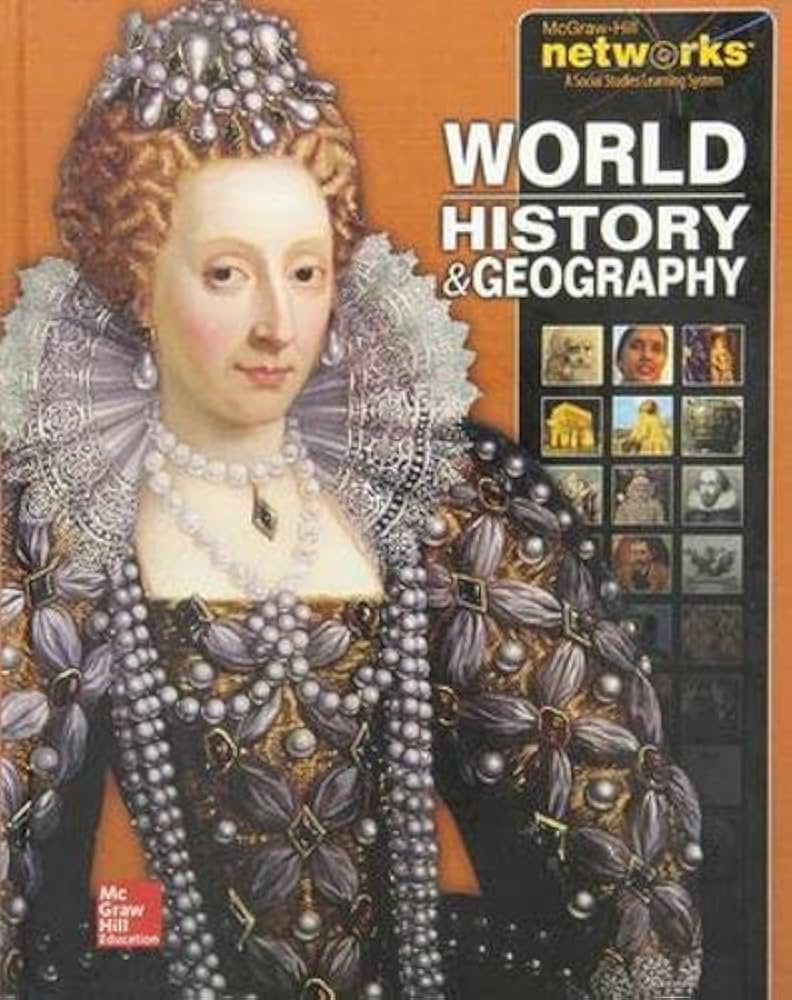
World History and Geography
World History and Geography is a Grade 5 history textbook that takes students on a sweeping journey through human civilization, from prehistoric societies and the ancient empires of Mesopotamia, Greece, Rome, India, and China through the medieval period, the Renaissance and Reformation, and into the modern era. The textbook covers major turning points such as the Age of Exploration, the Enlightenment, the French Revolution, industrialization, imperialism, both World Wars, the Holocaust, and the Cold War, while also examining the civilizations of medieval Africa, pre-Columbian America, the Byzantine Empire, the Islamic world, and East Asia. Students finish the course exploring contemporary global issues from 1989 to the present, giving them a comprehensive understanding of how world history and geography have shaped the modern world.
Chapters & Lessons
Chapter 1: The Rise of Civilization, Prehistory–c. 2300 B.C.
3 lessonsIn this Grade 5 World History and Geography lesson from Chapter 1, students learn how archaeology and anthropology reveal the story of prehistoric humans by examining artifacts, fossils, and biological evidence. The lesson introduces key concepts including radiocarbon dating, thermoluminescence, and the roles of archaeologists and anthropologists in uncovering how early hominids and Homo sapiens sapiens developed tools, used fire, and adapted to Ice Age conditions. Students also explore the "out-of-Africa" theory and how ancient DNA analysis continues to shape our understanding of human evolution.
In this Grade 5 World History and Geography lesson, students learn how the Neolithic Revolution transformed early human society through the development of systematic agriculture, including the domestication of animals and the shift from nomadic hunting and gathering to settled farming communities. The lesson examines how this agricultural revolution spread across regions from Southwest Asia to Africa, Europe, and Asia between 8000 B.C. and 5000 B.C., and why many historians consider it the single most important development in human history. Students also explore how sufficient food production enabled the growth of settled communities and laid the foundation for early civilization.
In this Grade 5 World History and Geography lesson, students explore how the geography of the Tigris and Euphrates River valley gave rise to Mesopotamian civilization, including the development of city-states, irrigation systems, and polytheistic religion. Students learn key terms such as ziggurat, cuneiform, theocracy, and city-state as they examine how Sumerians organized their society politically, economically, and spiritually. The lesson connects physical environment to cultural achievement, showing how abundant silt, flood control, and urban growth enabled one of history's earliest civilizations to emerge in the Fertile Crescent.
Chapter 2: The Spread of Civilization, c. 3100 B.C.–c. 200 B.C.
5 lessonsIn this Grade 5 World History and Geography lesson, students explore how the Nile River shaped ancient Egyptian civilization, examining concepts such as the Nile Delta, annual flooding, and Egypt's natural barriers. Students also learn key vocabulary including dynasty, pharaoh, bureaucracy, and hieroglyphics as they trace Egypt's development from the unification under King Menes around 3100 B.C. through the Old and Middle Kingdoms. The lesson is part of Chapter 2: The Spread of Civilization and addresses how geography and religion gave Egyptian society its distinctive sense of stability and continuity.
In this Grade 5 World History and Geography lesson from Chapter 2, students explore the role of pastoral nomads, the Phoenicians, and the Israelites in shaping the ancient eastern Mediterranean world. Students learn how nomadic peoples spread technology such as iron use, how the Phoenicians built trade networks and developed an influential alphabet, and how the Israelites introduced monotheistic religion through Judaism. The lesson connects geography to the rise of small kingdoms after the fall of the Hittites and the weakening of Egypt around 1200 B.C.
In this Grade 5 lesson from World History and Geography, students explore how monsoon patterns and river systems shaped the development of the Indian subcontinent and supported the rise of the Indus Valley Civilization. Learners examine the planned cities of Harappa and Mohenjo Daro, including their advanced drainage systems and urban layouts, as evidence of a sophisticated early civilization that thrived between 3000 B.C. and 1500 B.C. The lesson also introduces key vocabulary such as monsoon and Sanskrit within the broader context of Chapter 2's focus on how geography influences civilizational growth.
In this Grade 5 World History and Geography lesson, students explore how China's physical geography — including the Huang He and Chang Jiang river valleys, mountains, and deserts — shaped the location and isolation of its early civilizations. Students examine the Shang dynasty's aristocracy, the dynastic cycle, and foundational cultural concepts such as ancestor worship, the Mandate of Heaven, and filial piety. The lesson builds understanding of how geography influences civilizational development using key vocabulary drawn from ancient Chinese history.
In this Grade 5 World History and Geography lesson, students explore the early civilizations of Mesoamerica and South America, examining the Olmec, Zapotec, and Chavin peoples and their key characteristics including location, social structure, and cultural achievements. Students learn how the Olmec — the first known Mesoamerican civilization, dating to around 1200 B.C. — influenced later societies through shared practices such as ritual ball courts, a jaguar deity, and a calendar system. The lesson also introduces vocabulary terms such as obsidian and ritual while guiding students to analyze how geography shaped the development and spread of these ancient civilizations.
Chapter 3: Early Empires in the Ancient Near East, c. 2300 B.C.–c. 300 B.C.
3 lessonsIn this Grade 5 World History and Geography lesson, students explore the rise and fall of the Akkadian and Babylonian empires, examining how Sargon established the first empire in world history and how Hammurabi codified laws through his famous Code of Hammurabi. Students compare key concepts such as empire-building, military governance, and the patriarchal social structures of ancient Mesopotamia. The lesson builds critical thinking skills by analyzing how empires are created, maintained, and ultimately collapse.
In this Grade 5 World History and Geography lesson, students explore the rise of Egypt's New Kingdom (c. 1550–1070 B.C.), examining how the Hyksos invasion introduced horse-drawn war chariots and bronze weaponry that Egyptians later adopted to rebuild their empire. Students trace key rulers including Ahmose I, Hatshepsut, and Akhenaten, analyzing how military expansion, religious upheaval, and trade shaped Egyptian power across the ancient Near East. The lesson also introduces the African kingdom of Kush as a neighboring civilization that emerged to Egypt's south during this period.
In this Grade 5 World History and Geography lesson, students examine the rise and fall of the Assyrian and Persian Empires, exploring how concepts like absolute monarchy, satrapy, and satrap shaped imperial governance in the ancient Near East after 700 B.C. Students compare Assyrian military tactics and conquest strategies with the administrative and economic policies that sustained the Persian Empire across Southwest Asia. The lesson supports summarizing skills through analysis of how internal strife, coalition forces, and governing structures determined each empire's longevity.
Chapter 4: The Ancient Greeks, c. 1600 B.C.–c. 133 B.C.
5 lessonsIn this Grade 5 lesson from World History and Geography, Chapter 4: The Ancient Greeks, students explore how Greece's mountainous peninsula and surrounding seas shaped the development of its early civilization, leading to isolated and fiercely independent communities. Students also study the Mycenaean civilization, the first Greek state, and examine Homer's epic poems, learning key terms such as epic poem and arete. The lesson connects geography's role in political organization to the cultural foundations of ancient Greek society.
In this Grade 5 World History and Geography lesson, students explore how ancient Greek city-states were structured, learning key terms such as polis, acropolis, agora, phalanx, democracy, and oligarchy. The lesson examines how citizens, government, and military formations like the hoplite phalanx shaped life in city-states like Athens and Sparta between roughly 750 and 550 B.C. Students also investigate how overpopulation and trade drove Greek colonial expansion across the Mediterranean world.
In this Grade 5 World History and Geography lesson, students explore Classical Greece from around 500 B.C. to 338 B.C., examining how the Greek city-states, including Athens and Sparta, defended against Persian invasions at key battles like Marathon, Thermopylae, and Salamis. Students also study the Age of Pericles, the concept of direct democracy, and the social structure of Athenian society, including the roles and rights of male citizens, foreigners, slaves, and women. The lesson is part of Chapter 4: The Ancient Greeks and helps students understand how geography and political organization shaped one of history's most influential civilizations.
In this Grade 5 World History and Geography lesson from Chapter 4: The Ancient Greeks, students explore the intellectual and cultural achievements of classical Greece, including the foundations of Western philosophy laid by Socrates, Plato, and Aristotle. Students also examine the role of Greek religion in public life, learning key terms such as oracle, tragedy, and the Socratic method. The lesson further covers classical Greek art and architecture, including the significance of the Parthenon as an example of the enduring Greek ideals of reason, balance, and harmony.
In this Grade 5 World History and Geography lesson, students explore how Philip II and Alexander the Great united Macedonia and Greece to conquer the Persian Empire, tracing Alexander's campaigns from Asia Minor and Egypt to India. Students also examine the Hellenistic Era, including the cultural blending that followed Alexander's conquests and the philosophical schools of Epicureanism and Stoicism that emerged from it. The lesson builds understanding of Alexander's legacy and the lasting impact of Greek influence on the ancient world.
Chapter 5: India's First Empires, c. 1000 B.C.–A.D. 500
3 lessonsIn this Grade 5 World History and Geography lesson, students explore the origins of Hindu India by examining the Aryan social structure, including the four varnas and the development of the caste system, alongside the foundational beliefs of Hinduism such as reincarnation, karma, dharma, and yoga. The lesson explains how the interaction between Aryan and Dravidian peoples between 1500 B.C. and 400 B.C. gave rise to a distinct Indian culture shaped by religion and social hierarchy. Part of Chapter 5 on India's First Empires, this lesson provides essential context for understanding how early religious and social institutions influenced the broader development of Indian civilization.
In this Grade 5 World History and Geography lesson from Chapter 5, students learn about the origins of Buddhism and the life of its founder, Siddhartha Gautama, who abandoned his royal life to seek an end to human suffering. Students explore how Gautama rejected both luxury and asceticism in favor of meditation, ultimately achieving enlightenment and teaching the doctrine that became Buddhism. The lesson also examines how Buddhism emerged as a rival to Hinduism in sixth-century B.C. northern India and spread across Asia.
In this Grade 5 World History and Geography lesson, students explore the rise and fall of ancient India's Mauryan, Kushan, and Gupta Empires, examining how rulers like Candragupta Maurya and Asoka built centralized power and expanded trade along the Silk Road. Students learn how Asoka's conversion to Buddhism shaped his policies on welfare and governance, and how these empires influenced the spread of religion and culture across Asia. The lesson is part of Chapter 5 on India's First Empires and builds understanding of how religion, conquest, and commerce drove the development of early Indian civilization.
Chapter 6: The First Chinese Empires, 221 B.C.–A.D. 220
3 lessonsIn this Grade 5 World History and Geography lesson from Chapter 6, students explore the three major schools of thought that emerged in ancient China — Confucianism, Daoism, and Legalism — focusing on their core principles and historical context during the late Zhou dynasty. Students examine the teachings of Confucius in depth, including the Five Constant Relationships, the concepts of duty and humanity, and how Confucian ethics aimed to restore social order during the Warring States period. The lesson also introduces key vocabulary such as philosophy, ethical, and the distinctions between each school of thought.
In this Grade 5 World History and Geography lesson, students explore how Qin Shihuangdi unified and expanded China, including his military campaigns, the construction of the Great Wall to defend against the nomadic Xiongnu, and the discovery of the terra-cotta army buried near his tomb. Students also examine the political and economic costs of Qin rule, such as the massive labor forces required for major projects and the adoption of Legalism as official state policy. The lesson builds understanding of how the Qin dynasty shaped China's geography, culture, and governance during the period from 221 B.C. to A.D. 220.
In this Grade 5 World History and Geography lesson, students learn how the Han dynasty refined the political structures of the Qin dynasty, including the civil service examination system, the division of central government into three ministries, and the expansion of the Chinese Empire under Han Wudi. The lesson also covers how Confucian principles replaced Legalism as the foundation of government and how social conditions such as land ownership and family structure shaped life during the Han period, from 202 B.C. to A.D. 220.
Chapter 7: The Romans, 600 B.C.–A.D. 500
3 lessonsIn this Grade 5 World History and Geography lesson from Chapter 7, students explore the geographic and cultural factors that led to the rise of ancient Rome, including the strategic location of the city on the Tiber River, the influence of the Latins, Greeks, and Etruscans, and the founding of the Roman Republic in 509 B.C. Students learn key terms such as republic, patrician, plebeian, consul, and praetor as they examine how Rome's political institutions developed. The lesson connects Rome's early republican forms of government to the modern democratic societies they helped shape.
In this Grade 5 World History and Geography lesson, students learn how political and social unrest — including the decline of small farmers, the rise of large estates using slave labor, and the reforms attempted by the Gracchus brothers — weakened the Roman Republic from within. Students explore how changes in military recruitment under generals like Marius and Sulla shifted loyalty from the Roman state to individual commanders, setting the stage for civil war. The lesson covers key vocabulary including triumvirate, dictator, and imperator as part of Chapter 7's examination of Rome's transformation from republic to empire.
In this Grade 5 World History and Geography lesson, students examine the Early Roman Empire from Augustus's reign through A.D. 180, exploring how emperors like Trajan and Hadrian shaped Roman governance, expansion, and public works. Students learn key concepts including the Pax Romana, urbanization, and the role of the paterfamilias, while analyzing both the achievements and problems of imperial rule. The lesson draws on Chapter 7 of the textbook to help students understand how political power shifted from the Senate to the emperors and how succession challenges affected the stability of the empire.
Chapter 8: The Byzantine Empire and Emerging Europe, A.D. 50–800
5 lessonsIn this Grade 5 World History and Geography lesson from Chapter 8, students explore how a new movement within Judaism developed into Christianity, examining the teachings of Jesus, the role of Roman rule in Judaea, and the spread of the new faith throughout the Roman Empire. Students contrast the Roman state religion with early Christianity and learn key terms such as procurator, clergy, and laity. The lesson also traces how Christian values like humility, charity, and monotheism helped shape the foundations of Western civilization after the fall of the Western Roman Empire.
In this Grade 5 World History and Geography lesson from Chapter 8, students explore the political, economic, and social factors that led to the decline and fall of the Roman Empire, including civil wars, plague, inflation, and barbarian invasions. Students examine how emperors Diocletian and Constantine attempted reforms such as the tetrarchy and the founding of Constantinople to stabilize the empire. The lesson builds cause-and-effect thinking around why one of history's greatest empires ultimately collapsed.
In this Grade 5 World History and Geography lesson, students learn how the early Christian Church developed its organizational structure, including the roles of bishops, archbishops, and popes, and how Pope Gregory I expanded the power of the papacy. The lesson also examines monasticism, explaining how monks and nuns lived in communities dedicated to prayer and labor and how the monastic movement helped spread Christianity across Germanic Europe. This content appears in Chapter 8, which explores the Byzantine Empire and the foundations of early medieval European civilization.
In this Grade 5 World History and Geography lesson from Chapter 8, students learn how Germanic kingdoms transformed the post-Roman world, focusing on Clovis's conversion to Catholic Christianity and the rise of the Frankish kingdom. The lesson also explores Germanic social customs, including the role of the extended family, wergild, and trial by ordeal in early medieval society. Students compare the contributions of Clovis and Charlemagne in shaping Emerging Europe between A.D. 50 and 800.
In this Grade 5 World History and Geography lesson from Chapter 8, students explore how the Eastern Roman Empire transformed into the Byzantine Empire, examining Emperor Justinian's military campaigns, his codification of Roman law into The Body of Civil Law, and the internal and external pressures that reshaped the empire. Students analyze key vocabulary such as patriarch, icon, and idolatry while tracing the causes of Byzantine power, including its Greek language, Christian faith, and absolute imperial authority. The lesson also addresses how threats from the Persians, Slavs, Arabs, and Bulgars gradually reduced the empire's territory while sharpening its distinct cultural identity.
Chapter 9: Islam and the Arab Empire, 600–1400
3 lessonsIn this Grade 5 World History and Geography lesson, students learn about the origins of Islam on the Arabian Peninsula, including the life of Muhammad, the angel Gabriel's revelations, and key Islamic beliefs and practices such as the Five Pillars of Islam, the Quran, the Hijrah, and shari'ah. The lesson also examines early Arab society, including the tribal structure led by sheikhs, the polytheistic beliefs centered on the Kaaba in Makkah, and how caravan trade shaped communities in the region. Part of Chapter 9 on Islam and the Arab Empire, this lesson contrasts pre-Islamic Arab customs with the founding principles of the Islamic faith.
In this Grade 5 World History and Geography lesson, students learn how the Arab Empire expanded after the death of Muhammad, focusing on key vocabulary such as caliph, jihad, caliphate, and the roles of the Umayyad and Abbasid dynasties. The lesson explains how early caliphs like Abu Bakr unified the Muslim world and led military conquests across the Byzantine and Persian empires. Students also explore the origins of the Shia and Sunni divide and how religious and political leadership shaped the growth of the Islamic empire from 600 to 1400.
In this Grade 5 World History and Geography lesson from Chapter 9, students explore the key features of Islamic civilization between 600 and 1400 CE, including the role of trade networks, the Arab Agricultural Revolution, and the function of bazaars in Muslim cities. Students examine how the exchange of goods such as silk, spices, and grain across camel caravan and sea routes drove prosperity in cities like Baghdad, Cairo, and Damascus. The lesson also introduces vocabulary terms such as bazaar, arabesques, astrolabe, and minaret to help students understand Islamic economic, scientific, and cultural achievements.
Chapter 10: Medieval Kingdoms in Europe, 800–1300
3 lessonsIn this Grade 5 World History and Geography lesson from Chapter 10, students learn how the collapse of the Carolingian Empire and Viking invasions led to the rise of feudalism as a new political and social order in medieval Europe. Students explore key concepts including vassalage, the role of knights as heavily armored cavalry, and the feudal contract that bound lords and vassals through mutual obligations. The lesson also introduces the code of chivalry and examines how instability in royal governments reshaped both political power and everyday life between 800 and 1300.
In this Grade 5 World History and Geography lesson from Chapter 10, students explore how new farming technologies like the carruca and three-field crop rotation drove population growth in High Medieval Europe. They examine the manorial system, learning how serfs were legally bound to the land and obligated to provide labor and rent to lords. The lesson also traces how the revival of trade and agricultural surplus contributed to the rise of a money economy and the growth of European cities between 800 and 1300.
In this Grade 5 World History and Geography lesson from Chapter 10, students explore how European kingdoms expanded during the High Middle Ages, focusing on key developments in England such as the Norman Conquest, Henry II's establishment of common law, and the signing of the Magna Carta. Students examine how conflicts between monarchs and nobles shaped political systems, including the forced limits placed on King John's power in 1215 and the gradual formation of Parliament.
Chapter 11: Civilizations of East Asia, 220–1500
4 lessonsIn this Grade 5 World History and Geography lesson from Chapter 11, students learn how the Sui, Tang, and Song dynasties reunified and governed China between 581 and 1279, following centuries of civil war and disorder. Students examine key developments such as the construction of the Grand Canal, the restoration of the civil service examination system, and China's expansion of influence into Tibet and Southeast Asia. The lesson also introduces vocabulary terms like scholar-gentry and explores how each dynasty's rise and fall shaped political stability in East Asia.
In this Grade 5 World History and Geography lesson, students explore how the Mongols, led by Genghis Khan and later Kublai Khan, built the world's largest land empire and established the Yuan dynasty in China. Students examine key concepts including khanates, the Mongols' military tactics, and how the invasion affected Chinese culture, trade along the Silk Road, and the spread of gunpowder technology. The lesson also introduces neo-Confucianism and porcelain as part of the broader cultural context of East Asia during this period.
In this Grade 5 World History and Geography lesson, students explore how Japan's mountainous archipelago geography shaped its economy and culture, and how political power shifted from emperors to the Fujiwara clan and eventually to military leaders called shoguns. Students also examine key concepts such as the samurai class, Bushido, Shinto, and Zen, alongside Korea's struggle for independence from Chinese influence during the period 220–1500. The lesson helps students understand how geography, power struggles, and outside invasion defined early East Asian civilizations.
In this Grade 5 World History and Geography lesson, students examine how Buddhism, Hinduism, and Islam shaped the development of India after the fall of the Gupta Empire, including the key differences between the Theravada and Mahayana schools of Buddhism. The lesson also traces the eastward expansion of Islam into the Indian subcontinent through the conquests of Mahmud of Ghazna and the Turkish slave states. Students contrast the distinct political characteristics of Southeast Asian states, including Vietnam, the Angkor kingdom, and the Malay world, to understand why the region was never unified under a single government.
Chapter 12: Crusades and Culture in the Middle Ages, 1000–1500
4 lessonsIn this Grade 5 lesson from World History and Geography, students explore how the Catholic Church exercised political and spiritual power in medieval Europe, focusing on key concepts such as lay investiture, the Investiture Controversy, and the papal authority of figures like Pope Gregory VII and Pope Innocent III. Students examine how the conflict between church and secular rulers shaped governance during the High Middle Ages, culminating in the Concordat of Worms. The lesson also introduces vocabulary including interdict, sacrament, and heresy as students categorize the roles of emerging monastic orders such as the Cistercians, Dominicans, and Franciscans.
In this Grade 5 World History and Geography lesson, students examine the religious, political, and economic motivations behind the Crusades, the series of military expeditions launched by European Christians from 1095 onward to reclaim the Holy Land from Muslim control. Students trace the outcomes of the First, Second, and Third Crusades, learning key terms such as infidel and exploring the roles of figures like Pope Urban II, Saladin, and Richard I. The lesson is part of Chapter 12 on Crusades and Culture in the Middle Ages, covering the period 1000–1500.
Chapter 13: Kingdoms and States of Medieval Africa, 500–1500
2 lessonsIn this Grade 5 World History and Geography lesson from Chapter 13, students explore how Africa's four climate zones — mild, desert, rain forest, and savanna — shaped farming, herding, and settlement across the continent. Students also learn key vocabulary such as plateau, savanna, lineage groups, matrilineal, and patrilineal to understand how extended family structures and shared values defined medieval African societies. The lesson draws on the essential question of how geography influences society, culture, and trade in civilizations like Ghana, Mali, and Songhai.
In this Grade 5 World History and Geography lesson, students explore the medieval kingdoms and states of Africa from 500–1500, examining how the Kingdom of Ghana built a powerful trading empire through its abundant gold, iron ore, and strategic taxation of trans-Saharan trade routes. Students compare the economies, politics, and societies of East, West, and South Africa while learning key concepts such as subsistence farming, stateless society, and the role of Berber camel caravans in connecting African markets to the Mediterranean world. The lesson directly addresses how geography shaped trade, wealth, and cultural exchange across the African continent.
Chapter 14: Pre-Columbian America, 300–1550
2 lessonsIn this Grade 5 World History and Geography lesson from Chapter 14, students explore the early peoples of North America and Mesoamerica, learning how groups like the Hopewell Mound Builders, the Mississippian culture, and the Iroquois developed distinct societies through farming, trade, and political alliances such as the Iroquois League. Students examine key vocabulary including longhouse, clan, and tepee, and analyze how geography shaped the politics, religion, and culture of the Maya, Toltec, and Aztec civilizations. The lesson traces human migration into North America during the Ice Age and follows the rise of complex, organized societies from approximately 1200 B.C. through A.D. 1550.
In this Grade 5 World History and Geography lesson, students explore the early civilizations of South America, including the Nazca, Moche, and Inca cultures, learning how each society developed distinct characteristics such as the Nazca Lines, irrigated agriculture, and Inca political organization under Pachacuti. Students examine key vocabulary like maize and quipu while analyzing how geography influenced settlement patterns and how earlier cultures shaped the rise of the Inca Empire. The lesson is part of Chapter 14: Pre-Columbian America, 300–1550, and helps students understand the complexity of pre-Columbian South American societies.
Chapter 15: The Renaissance in Europe, 1350–1600
2 lessonsGrade 5 students explore the rise of the major Italian city-states during the Renaissance, learning how trade networks, mercenary forces, and republican governments shaped the political and economic power of Milan, Venice, and Florence. The lesson covers key vocabulary such as mercenary, republic, and burgher, and examines how Machiavelli's work influenced political thinking in the Western world. Set within Chapter 15 of World History and Geography, students also investigate how Italy's thriving trade routes helped spread Renaissance culture northward across Europe.
In this Grade 5 World History and Geography lesson from Chapter 15, students explore the key concepts of Renaissance humanism, vernacular literature, and the intellectual shift away from medieval religious-centered thinking toward a focus on the individual. Students learn how humanist thinkers like Petrarch revived classical Greek and Roman studies in grammar, rhetoric, poetry, and moral philosophy, and how writers like Dante chose the vernacular over Latin to reach broader audiences. The lesson connects Renaissance ideas to the origins of today's liberal arts curriculum.
Chapter 16: The Reformation in Europe, 1517–1600
2 lessonsGrade 5 students studying World History and Geography explore the origins of the Protestant Reformation in Chapter 16, learning how Christian humanism, the teachings of Desiderius Erasmus, and widespread corruption in the Catholic Church created the conditions for religious change in early 16th-century Europe. The lesson introduces key vocabulary including salvation, indulgence, and Lutheranism, and examines how Church practices such as selling indulgences and neglecting spiritual duties fueled public demand for reform. Students use cause-and-effect analysis to trace the steps that led Martin Luther to launch the Reformation.
In this Grade 5 World History and Geography lesson from Chapter 16, students explore how Protestantism spread across Europe between 1517 and 1600, focusing on key concepts such as Calvinism, predestination, and justification. Students examine the roles of John Calvin in Geneva and the political origins of the English Reformation under Henry VIII, including his use of church courts to annul his marriage. The lesson also highlights how theological differences among reformers led to distinct branches of Protestantism throughout Switzerland, France, Scotland, and England.
Chapter 17: The Age of Exploration, 1500–1800
3 lessonsIn this Grade 5 World History and Geography lesson from Chapter 17: The Age of Exploration, students examine the motivations behind European overseas expansion, including the pursuit of gold, glory, and God, as well as the role of trade in Asian spices and precious metals. Students learn how new technologies such as the caravel, astrolabe, and magnetic compass made long-distance voyages possible, and how knowledge of trade winds and ocean gyres guided early explorers. The lesson also introduces key vocabulary including conquistador and colony while tracing how Portugal and Spain led the race to discover new lands between 1500 and 1800.
In this Grade 5 World History and Geography lesson from Chapter 17, students learn how the Commercial Revolution reshaped the global economy through key concepts including mercantilism, joint-stock companies, and subsidies. Students explore how European powers used colonization and trade to build wealth, and how the Columbian Exchange spread plants, animals, and diseases between continents. The lesson also examines the causes and consequences of the Atlantic slave trade that brought millions of enslaved Africans to the Americas.
In this Grade 5 World History and Geography lesson from Chapter 17: The Age of Exploration, students examine the political, social, and economic structure of colonial Latin America under Spanish and Portuguese rule. Students learn to identify and distinguish the key social classes of colonial society, including peninsulares, creoles, mestizos, and mulattoes, and explore how the encomienda and mita labor systems were used to exploit Native American and enslaved African workers. The lesson also covers how resource extraction, intermarriage, and the blending of European, indigenous, and African populations shaped a uniquely multiracial colonial civilization.
Chapter 18: Conflict and Absolutism in Europe, 1550–1715
4 lessonsIn this Grade 5 World History and Geography lesson, students examine the religious, political, and economic conflicts that destabilized Europe between 1550 and 1715, focusing on the roles of Spain, England, and France. Key concepts include militant Catholicism under King Philip II, Protestant resistance in the Netherlands and England, and vocabulary terms such as heretic, armada, inflation, and national sovereignty. Students learn how clashes between Calvinism and Catholicism fueled wars for religious and political control across the continent.
In this Grade 5 World History and Geography lesson from Chapter 18, students explore the causes and effects of the English Civil War and Glorious Revolution, examining how disputes between the Stuart monarchs and Parliament over the divine right of kings led to armed conflict between the Cavaliers and Roundheads. Students learn how religious tensions involving the Puritans, Oliver Cromwell's New Model Army, and the execution of Charles I reshaped English government and established limits on royal power. The lesson also introduces key concepts such as natural rights and commonwealth, laying the groundwork for understanding how England's political struggles influenced modern democratic systems, including that of the United States.
Grade 5 students in World History and Geography explore absolutism in 17th-century Europe, learning how absolute monarchs like France's Louis XIV claimed divine right of kings to hold total power over lawmaking, taxation, and foreign policy. The lesson examines how Louis XIV's court at Versailles became the model of absolutism across Europe, and compares the rising powers of Prussia, Austria, and Russia under their own monarchs. Students also analyze the roles of Cardinal Richelieu and Cardinal Mazarin in strengthening royal authority before Louis XIV assumed sole rule in 1661.
Chapter 19: The Muslim Empires, 1450–1800
3 lessonsIn this Grade 5 World History and Geography lesson from Chapter 19: The Muslim Empires, students explore how the Ottoman Turks rose to power under Osman and expanded their empire through military innovations like the janissaries and gunpowder technology. Students learn key events including Mehmed II's 1453 conquest of Constantinople and the subsequent renaming of the city as Istanbul, as well as Sultan Selim I's conquests of Mesopotamia, Egypt, and Arabia. The lesson also introduces essential vocabulary such as sultan, grand vizier, and caliph within the context of Ottoman political and social structure.
Grade 5 students studying World History and Geography explore the rise and decline of the Ottoman Empire and the emergence of the Safavid dynasty in Chapter 19, Lesson 2. Students examine key concepts such as the internal disintegration of the Ottomans under sultans following Suleyman I, including government corruption and economic decline, as well as the founding of the Safavid state by Shah Esma'il and the role of Shia orthodoxy as a unifying force. The lesson also highlights the sectarian conflict between Sunni Ottomans and Shia Safavids and how religious and political differences shaped both empires between 1450 and 1800.
In this Grade 5 World History and Geography lesson from Chapter 19, students explore how the Mogul dynasty rose to power in India, focusing on Babur's conquest of Delhi and Emperor Akbar's political, military, and cultural accomplishments. Students learn key terms such as zamindars and suttee while examining how Akbar's policies of religious tolerance and administrative reform helped unify the Indian subcontinent under centralized Mogul rule. The lesson also traces the empire's decline under Jahangir and Shah Jahan as central authority weakened and economic pressures grew.
Chapter 20: The East Asian World, 1400–1800
3 lessonsIn this Grade 5 lesson from World History and Geography, students explore the achievements of the Ming and Qing dynasties in China from 1368 to 1800, including the role of centralized bureaucracy, the civil service examination system, and landmark projects like the Forbidden City and Zheng He's naval voyages. Students also examine how early contact with Portuguese traders and Christian missionaries sparked a cultural exchange between China and Europe, and how internal corruption and peasant unrest contributed to the Ming dynasty's decline.
In this Grade 5 World History and Geography lesson from Chapter 20, students learn how Japan was reunified under three powerful leaders — Oda Nobunaga, Toyotomi Hideyoshi, and Tokugawa Ieyasu — ending the chaos of collapsed shogunate rule. Students explore the political structure of the Tokugawa era, including the roles of daimyo, hans, and the hostage system used to maintain central authority. The lesson also examines how Japan responded to European contact and Christianity before enforcing cultural isolation.
In this Grade 5 World History and Geography lesson from Chapter 20, students explore the Yi dynasty's bureaucratic government and isolationist policies that earned Korea the name "Hermit Kingdom," including the role of the Hangul alphabet in shaping Korean identity. Students also examine the competing mainland states of Burma, Thailand, Vietnam, and Cambodia, tracing how territorial conflicts, the spice trade, and the spread of Islam shaped the kingdoms of Southeast Asia between 1400 and 1800.
Chapter 21: The Enlightenment and Revolutions, 1550–1800
4 lessonsGrade 5 students studying World History and Geography explore the core ideas of the Enlightenment in this lesson from Chapter 21, learning how philosophes like Montesquieu, Voltaire, and Diderot applied reason and the scientific method to society, government, and religion. Students examine key concepts including separation of powers, social contract, deism, and laissez-faire, and how thinkers such as John Locke and Isaac Newton inspired a movement for social and political reform. The lesson also introduces Montesquieu's system of checks and balances and its lasting influence on modern democratic government.
Grade 5 students in World History and Geography explore the concept of enlightened absolutism, examining how rulers like Frederick II of Prussia, Joseph II of Austria, and Catherine II of Russia attempted to apply Enlightenment principles such as natural rights, religious toleration, and equality before the law while maintaining absolute royal power. The lesson also covers how the European balance of power during this period contributed to conflicts like the Seven Years' War.
Chapter 22: The French Revolution and Napoleon, 1789–1815
4 lessonsIn this Grade 5 World History and Geography lesson, students explore the long-range and immediate causes of the French Revolution, examining how France's three-estate system created deep social inequality and widespread discontent. Students learn key terms including estate, taille, bourgeoisie, and sans-culottes as they analyze how the tax burdens on the Third Estate and the economic crises of the 1780s pushed France toward revolution. The lesson also introduces how Enlightenment ideas fueled growing opposition to the Old Regime's rigid social and political order.
In this Grade 5 World History and Geography lesson from Chapter 22, students examine why the French Revolution became increasingly radical, focusing on key events such as the abolition of the monarchy, the execution of King Louis XVI, and the rise of the Committee of Public Safety under Maximilien Robespierre. Students learn the specific terms coup d'etat and electors while analyzing the Reign of Terror, during which revolutionary courts executed nearly 40,000 people accused of being counterrevolutionaries or traitors. The lesson explores how internal political conflicts between factions like the Girondins and the Mountain, combined with foreign military threats from a coalition of European powers, drove France toward increasingly extreme measures.
In this Grade 5 World History and Geography lesson from Chapter 22, students learn how Napoleon Bonaparte rose from a military officer to Emperor of France, exploring key concepts including the consulate, coup d'état, and the spread of nationalism across Europe. The lesson examines how instability in the French government created the opportunity for Napoleon to seize power and implement lasting changes, including his peace agreement with the Catholic Church.
In this Grade 5 World History and Geography lesson from Chapter 22, students examine how Napoleon's catastrophic 1812 invasion of Russia triggered his military collapse, culminating in his defeats and exile following the Battle of Waterloo in 1815. Students also explore the European reaction to Napoleon's fall, including the Congress of Vienna, the principle of legitimacy championed by Prince Metternich, and the rise of conservatism as ruling powers worked to restore monarchies and rebalance power across the continent.
Chapter 23: Industrialization and Nationalism, 1800–1870
5 lessonsIn this Grade 5 lesson from World History and Geography, Chapter 23, students learn what caused the Industrial Revolution to begin in Great Britain, including the roles of the Agricultural Revolution, capital, natural resources, and colonial markets. Students explore key inventions such as the spinning jenny, water-powered loom, and James Watt's steam engine, and how these advances transformed cottage industry into factory-based manufacturing. The lesson also introduces vocabulary like entrepreneur, industrial capitalism, and socialism as students examine how industrialization reshaped economies and ways of life.
In this Grade 5 World History and Geography lesson, students explore the concepts of liberalism, nationalism, and universal male suffrage as driving forces behind the European Revolutions of 1830 and 1848. The lesson examines how uprisings in France, Belgium, Poland, and Italy challenged the conservative order following the Napoleonic Wars, and how events like the overthrow of Louis-Philippe led to the establishment of France's Second Republic. Students compare and contrast the causes, participants, and outcomes of both revolutionary periods within Chapter 23 on Industrialization and Nationalism.
In this Grade 5 World History and Geography lesson from Chapter 23, students explore how nationalism and liberalism drove the unification of Italy and Germany following the failed revolutions of 1848, examining the roles of key figures like Cavour and Garibaldi. Students also analyze how the Crimean War broke apart the Concert of Europe and created the political conditions that made unification possible. Key vocabulary including militarism, plebiscite, kaiser, and emancipation helps students understand the broader reform movements sweeping Great Britain, France, Austria, and Russia during the nineteenth century.
In this Grade 5 World History and Geography lesson from Chapter 23, students learn how the ideals of the American and French Revolutions sparked nationalist revolts across Latin America between 1804 and 1825, leading to independence movements in Haiti, Mexico, and South America. Students examine key vocabulary such as creole, peninsulare, mestizo, and caudillo while studying leaders like Toussaint-Louverture, Miguel Hidalgo, Simón Bolívar, and José de San Martín. The lesson explores how colonial class structures and Napoleon's wars created the conditions for independence, while also highlighting the challenges of achieving political stability in the newly formed republics.
Grade 5 students in World History and Geography explore the intellectual and artistic movements of romanticism and realism as part of Chapter 23 on Industrialization and Nationalism. The lesson examines how romanticism emerged as a reaction to Enlightenment reason by emphasizing emotion, individualism, and a love of nature, as seen in the works of artists like Delacroix, composers like Beethoven, and poets like Wordsworth. Students also learn how realism later shifted focus toward everyday life and ordinary people, with key vocabulary including secularization and natural selection introduced alongside these cultural movements.
Chapter 24: Mass Society and Democracy, 1870–1914
4 lessonsIn this Grade 5 World History and Geography lesson, students explore the Second Industrial Revolution (1870–1914) and examine how innovations such as the Bessemer process, electricity, the internal-combustion engine, and the assembly line drove mass production and transformed European economies. Students analyze the causes and effects of these technological advances, including the rise of consumer goods and the uneven economic development between industrialized and agricultural regions of Europe. The lesson is part of Chapter 24: Mass Society and Democracy and builds understanding of how industrialization reshapes both economic and social structures.
In this Grade 5 World History and Geography lesson from Chapter 24, students explore the emergence of mass society in Europe between 1870 and 1914, examining how rapid urbanization, public health reforms, and industrialization reshaped city life. Students learn how European social structure was divided among a new elite, diverse middle classes, and working class, and are introduced to key vocabulary including feminism and suffrage. The lesson connects economic changes driven by the Second Industrial Revolution to shifts in political and social structures across Western nations.
Grade 5 students explore how political democracy expanded in Western Europe between 1870 and 1914 while authoritarianism persisted in central and eastern Europe, examining key concepts such as ministerial responsibility, universal male suffrage, and parliamentary government. The lesson compares the governing structures of Great Britain, France, Germany, Austria-Hungary, and Russia, including the role of the Duma in Russia and Bismarck's influence on imperial Germany. Part of Chapter 24 in World History and Geography, this lesson helps students understand how economic changes shaped the political and social structures of the late nineteenth and early twentieth centuries.
In this Grade 5 World History and Geography lesson from Chapter 24, students explore modernism as a cultural and intellectual movement between 1870 and 1914, examining how writers, painters, and architects broke from Renaissance traditions through movements such as impressionism, post-impressionism, cubism, and abstract art. Students learn key terms including psychoanalysis, Social Darwinism, Zionism, and pogroms while analyzing how shifting worldviews — shaped by science, photography, and changing social structures — transformed literature, visual arts, and architecture. The lesson helps students connect economic and social change to the rise of a modern consciousness reflected in the work of figures like Claude Monet, Vincent van Gogh, and Pablo Picasso.
Chapter 25: The Reach of Imperialism, 1800–1914
4 lessonsIn this Grade 5 World History and Geography lesson from Chapter 25, students learn what imperialism, racism, and the concepts of direct rule and indirect rule meant as Western powers expanded control across Southeast Asia between 1800 and 1914. The lesson examines the economic, political, and ideological motivations behind the new imperialism, including Social Darwinism and the "white man's burden," while tracing how Britain, Spain, the Netherlands, and other powers came to dominate the region. Students also identify the political status of specific territories such as Burma, Singapore, Vietnam, Thailand, and the Philippines during this period of colonial takeover.
In this Grade 5 World History and Geography lesson from Chapter 25, students examine how European powers — including Britain, France, Germany, and Belgium — colonized nearly all of Africa between 1880 and 1900 through annexation and protectorates. Students learn key concepts such as annexation, indigenous populations, and the role of economic resources like palm oil and the Suez Canal in driving imperial expansion across West Africa and North Africa. The lesson also introduces the emergence of African resistance, including the Mahdist revolt in Sudan, as a response to foreign control.
In this Grade 5 World History and Geography lesson, students examine British colonial rule in India, learning how the British East India Company used sepoys to enforce control and how the Great Rebellion of 1857 led the British Parliament to transfer power directly to the crown, making Queen Victoria Empress of India. Students analyze the causes and effects of imperialism by tracing how the cartridge controversy sparked the Sepoy Mutiny and how the rebellion's failure ultimately fueled early Indian nationalism. The lesson also explores the role of viceroys and the British civil service in governing India's vast colonial population.
In this Grade 5 World History and Geography lesson from Chapter 25, students examine how the United States extended its influence over Latin American nations in the early 1900s through military intervention, the Roosevelt Corollary to the Monroe Doctrine, and dollar diplomacy. Students also explore the causes of the Mexican Revolution, including the effects of Porfirio Díaz's dictatorship on workers and land distribution. The lesson addresses key questions about the causes and effects of imperialism and how groups resist outside control.
Chapter 26: Challenge and Transition in East Asia, 1800–1914
3 lessonsIn this Grade 5 World History and Geography lesson, students explore the key factors that led to the decline of the Qing Dynasty in China, including internal problems like corruption and population growth alongside external pressures from Western powers. Students examine specific events such as the Opium War, the Treaty of Nanjing, and the introduction of extraterritoriality, as well as concepts like spheres of influence and the Open Door policy. The lesson is part of Chapter 26 on Challenge and Transition in East Asia, 1800–1914.
In this Grade 5 World History and Geography lesson, students explore the fall of China's Qing dynasty by examining Empress Dowager Ci Xi's failed reform efforts and Sun Yat-sen's three-stage plan for revolution, including his Three People's Principles of nationalism, democracy, and livelihood. Students compare the Qing's conservative provincial assembly reforms with Sun Yat-sen's founding of the Revolutionary Alliance and its call for a constitutional republic. The lesson traces how mounting unrest among peasants, merchants, and reformers led to the Revolution of 1911 and the collapse of imperial rule in China.
In this Grade 5 World History and Geography lesson from Chapter 26, students learn how Commodore Perry's arrival and the Treaty of Kanagawa forced Japan to end its isolationist policies and open trade with Western nations. The lesson then examines the Meiji Restoration, tracing how the Sat-Cho alliance overthrew the shogunate and launched sweeping political, economic, and social reforms that transformed Japan into a modern industrial nation. Students organize key details about Meiji-era changes, including the abolition of the daimyo system and the creation of prefectures, using a structured comparison table.
Chapter 27: World War I and the Russian Revolution, 1914–1919
4 lessonsIn this Grade 5 World History and Geography lesson, students explore the key factors that triggered World War I, including nationalism, imperialism, militarism, and the alliance system of the Triple Alliance and Triple Entente. Students learn how conscription expanded European armies, how mobilization plans limited political leaders' options, and how the assassination of Archduke Francis Ferdinand set the war in motion. The lesson is part of Chapter 27 covering World War I and the Russian Revolution from 1914 to 1919.
In this Grade 5 World History and Geography lesson, students explore the major military campaigns of World War I, learning key concepts such as propaganda, trench warfare, and the strategic differences between the Western Front and the Eastern Front. The lesson examines how the Schlieffen Plan failed, how stalemate developed along the Western Front, and how shifting alliances — including Italy joining the Allied Powers — shaped the war from 1914 to 1915. Students also use a graphic organizer to track how the Allied Powers and Central Powers evolved throughout the conflict.
In this Grade 5 World History and Geography lesson, students learn how military failures, food shortages, and political unrest led to the Russian Revolution of 1917, including the abdication of Czar Nicholas II and the collapse of the Romanov dynasty. Students examine the roles of key figures such as Rasputin, Lenin, and the Bolsheviks, and explore how soviets and war communism shaped Russia's new government. The lesson covers the chain of events from the 1917 workers' strikes in Petrograd to the Bolshevik seizure of power by 1921.
In this Grade 5 World History and Geography lesson, students learn how World War I came to an end in November 1918, examining Germany's failed final offensive at the Second Battle of the Marne, the armistice that halted fighting, and the revolutionary upheaval that followed in Germany and Austria-Hungary. The lesson introduces key vocabulary including armistice, reparation, and mandate, while guiding students to analyze the national interests each major power brought to the Paris Peace Conference.
Chapter 28: The West Between the Wars, 1919–1939
3 lessonsIn this Grade 5 World History and Geography lesson from Chapter 28, students examine the causes of instability in Europe after World War I, including the failure of the League of Nations, the German reparations crisis, and the hyperinflation that made the German mark nearly worthless. Students also learn how the Dawes Plan and the Treaty of Locarno attempted to restore stability before the Great Depression triggered a new wave of economic and political upheaval. Key vocabulary such as depression, deficit spending, collective bargaining, and the uncertainty principle help students connect economic collapse to broader shifts in society, politics, and culture during the 1919–1939 period.
In this Grade 5 World History and Geography lesson, students examine the rise of dictatorial regimes in interwar Europe, learning the key differences between totalitarian states and authoritarian governments and how fascism emerged as a political philosophy under Benito Mussolini in Italy. The lesson traces how Mussolini used propaganda, the secret police (OVRA), and control of mass media to consolidate power as Il Duce, while also introducing Stalin's totalitarian rule in the Soviet Union and Franco's authoritarian regime in Spain. Students build vocabulary around terms such as totalitarian state, fascism, and collectivization as they explore the political instability that threatened Europe's young democracies between 1919 and 1939.
In this Grade 5 World History and Geography lesson from Chapter 28, students examine the rise of Adolf Hitler and the Nazi Party in Germany between the wars, exploring core concepts such as anti-Semitism, nationalism, and propaganda. Students learn how Germany's economic hardships following World War I and the Great Depression enabled Hitler to legally seize power through the Enabling Act of 1933 and establish a dictatorship. The lesson also introduces key vocabulary including Nazi, Aryan, and concentration camp to help students understand the ideology and policies that defined this period.
Chapter 29: Nationalism Around the World, 1919–1939
4 lessonsIn this Grade 5 World History and Geography lesson, students explore how nationalist movements reshaped the Middle East after World War I, including the collapse of the Ottoman Empire and the emergence of modern Turkey, Iran, and Saudi Arabia. Students examine key concepts such as genocide and ethnic cleansing through the Armenian Genocide of 1915, and compare the modernizing policies of leaders like Mustafa Kemal Ataturk and Reza Shah Pahlavi. The lesson also introduces the origins of Arab-Jewish tensions in the Palestine Mandate as part of Chapter 29's focus on global nationalism between 1919 and 1939.
In this Grade 5 World History and Geography lesson from Chapter 29, students explore how nationalist movements emerged across Africa and Asia between 1919 and 1939 in response to colonial rule and economic exploitation. Students examine specific movements such as the Kikuyu land rights protests in Kenya, Omar Mukhtar's guerrilla resistance in Libya, and the roles of Mohandas Gandhi and Jawaharlal Nehru in India's independence struggle. Key concepts include Pan-Africanism, civil disobedience, and how Western education inadvertently fueled calls for self-determination among colonized peoples.
In this Grade 5 World History and Geography lesson from Chapter 29, students explore the power struggle between China's Nationalist Party under Chiang Kai-shek and the Chinese Communist Party following the 1923 Nationalist-Communist alliance. Students learn how the Shanghai Massacre of 1927 ended that alliance and drove Mao Zedong and Communist forces into rural Jiangxi Province, where they began organizing peasant-based resistance using guerrilla tactics. The lesson examines how competing visions for China's future — including redistribution of wealth and Confucian values — fueled revolutionary chaos during the 1920s and 1930s.
In this Grade 5 World History and Geography lesson from Chapter 29, students learn how economic dependency on single-export economies and foreign investment shaped Latin America during the 1920s and 1930s, including the concept of oligarchy and the role of U.S. investors in controlling industries like copper mining and oil. Students examine how the Great Depression devastated Latin American exports and triggered the rise of military dictatorships and government-run industries. The lesson also explores how U.S. imperialism and economic exploitation fueled growing nationalist movements across the region.
Chapter 30: World War II and the Holocaust, 1939–1945
5 lessonsIn this Grade 5 World History and Geography lesson, students examine the causes of World War II in Europe, focusing on Hitler's violations of the Treaty of Versailles, Germany's remilitarization of the Rhineland, and the policy of appeasement adopted by Britain and France. Students also trace the formation of key alliances, including the Rome-Berlin Axis and the Anti-Comintern Pact, alongside Japanese and German acts of aggression that set the stage for global conflict.
In this Grade 5 World History and Geography lesson, students explore how four nations — the Soviet Union, the United States, Japan, and Germany — mobilized their economies and civilian populations during World War II. Students examine key vocabulary including mobilization, kamikaze, and blitz, and analyze the specific sacrifices civilians made on the home front, from factory work and food shortages to the displacement of African Americans and Japanese Americans. The lesson is part of Chapter 30 on World War II and the Holocaust and addresses how total war reshaped everyday life far beyond the battlefield.
In this Grade 5 World History and Geography lesson from Chapter 30, students examine how Nazi Germany established its New Order across occupied Europe, including forced resettlement of Slavic peoples and the exploitation of millions as slave labor. Students learn the meaning of genocide and collaborator as they study how Hitler's racial ideology led to the Final Solution and the systematic extermination of European Jews in the Holocaust. The lesson also compares Germany's New Order with Japan's wartime occupation policies in conquered territories.
In this Grade 5 World History and Geography lesson from Chapter 30, students examine the major military events that brought World War II to a close, including the D-Day invasion at Normandy, the Battle of the Bulge, the Battle of Kursk, and the fall of Berlin. Students learn how Allied forces pushed back Axis powers across both the European and Pacific theaters, leading to Germany's surrender on May 7, 1945, and Japan's surrender on August 14, 1945. The lesson also introduces the concept of the Cold War as the ideological tensions that emerged among the Allied powers after the war ended.
Chapter 31: The Cold War, 1945–1989
3 lessonsIn this Grade 5 World History and Geography lesson, students learn how the Cold War began after World War II as the United States and Soviet Union became rival superpowers competing for global influence. The lesson covers key concepts including the policy of containment, satellite states, and how U.S. responses like the Truman Doctrine and Marshall Plan shaped the early conflict with the Soviet Union. Students also examine the causes and effects of the growing political divide between the capitalist West and communist East in postwar Europe.
In this Grade 5 World History and Geography lesson from Chapter 31, students learn how Mao Zedong's Communist forces defeated Chiang Kai-shek's Nationalists in China's civil war and established the People's Republic of China in 1949. Students examine Mao's economic policies, including the collectivization of farmland and the Great Leap Forward, which reorganized millions of people into large communes in an attempt to build a classless society. The lesson also explores the concept of permanent revolution and how these programs affected China's political relationships during the early Cold War era.
Chapter 32: Independence and Nationalism in the Developing World, 1945–1993
4 lessonsIn this Grade 5 World History and Geography lesson, students explore how British India was partitioned into the independent nations of India and Pakistan in 1947 and the violent mass migrations that followed. Students examine key concepts including Nehru's principle of nonalignment, India's shift toward a moderate socialist economy, and the ethnic and religious conflicts involving Sikhs and Muslims that shaped the new nation. The lesson is part of Chapter 32, covering independence and nationalism in the developing world from 1945 to 1993.
In this Grade 5 World History and Geography lesson, students examine the Arab-Israeli conflicts in the Middle East from 1948 onward, tracing key events such as the establishment of the State of Israel, the Arab states' rejection of it, and the rise of Pan-Arabism under Egyptian leader Gamal Abdel Nasser. Students also explore the Suez War of 1956 and learn the vocabulary terms intifada and Pan-Arabism within the context of Chapter 32 on independence and nationalism in the developing world.
In this Grade 5 World History and Geography lesson, students explore how African nations gained independence from colonial rule in the mid-20th century, examining key events such as Ghana's independence under Kwame Nkrumah and Algeria's guerrilla war against France. The lesson covers the system of apartheid in South Africa, the role of Nelson Mandela and the African National Congress, and the Pan-Africanism movement that sought unity among newly independent African states. Students also analyze the political, economic, and social challenges these nations faced after breaking free from colonial control.
In this Grade 5 World History and Geography lesson from Chapter 32, students examine the economic, social, and political challenges faced by Latin American countries between 1945 and 1993, including foreign debt crises, political instability, and the rise of repressive military regimes. Students learn how Cold War rivalries led to U.S. and Soviet interference in the region, and how concepts like privatization, trade embargoes, and cartels shaped life in countries such as Cuba, Chile, Nicaragua, and Colombia. The lesson also traces Latin America's gradual shift toward electoral democracy during the 1980s and early 1990s.
Chapter 33: Life During the Cold War, 1945–1989
3 lessonsIn this Grade 5 World History and Geography lesson from Chapter 33, students examine how Western Europe and North America recovered economically and politically after World War II, exploring key concepts such as the welfare state, consumer society, and real wages. The lesson traces the specific economic policies of France, West Germany, Great Britain, the United States, and Canada during the Cold War period from 1945 to 1989, including France's Fifth Republic under de Gaulle and West Germany's "economic miracle." Students also analyze social changes of the era, including the women's liberation movement and the formation of political blocs across the Western world.
In this Grade 5 World History and Geography lesson, students examine the political and economic shifts in the postwar Soviet Union, including Stalin's use of heavy industry and political repression. The lesson traces the transition to the Khrushchev era, focusing on de-Stalinization and the loosening of state controls over arts and consumer production. Students compare the policies of Khrushchev and Brezhnev to understand how Soviet leadership evolved during the Cold War period from 1945 to 1989.
In this Grade 5 World History and Geography lesson from Chapter 33, students examine how Japan transformed from a war-devastated nation into an industrial giant through Allied occupation, constitutional reform, and state capitalism. The lesson also explores how South Korea, Taiwan, and Singapore, known as the "Asian tigers," followed Japan's model to become major economic powers during the Cold War era. Students analyze key concepts including occupied states, state capitalism, and the role of government economic policy in driving industrial development across the Asian Rim.
Chapter 34: A New Era Begins, 1989–Present
5 lessonsGrade 5 students studying World History and Geography explore how Mikhail Gorbachev's policies of perestroika and glasnost reshaped the Soviet Union and triggered the collapse of Communist regimes across Eastern Europe. The lesson examines key events such as the INF Treaty, the rise of Poland's Solidarity movement, and the dissolution of the Soviet Union in 1991. Students learn how political and economic reforms can produce sweeping, often irreversible change on a global scale.
Grade 5 students studying World History and Geography examine the major political and economic changes in Western Europe and North America from the end of the Cold War to the present, including the reunification of Germany in 1990, the formation of the European Union and adoption of the euro, and the rise of cultural imperialism and postmodernism. The lesson traces key events such as the fall of the Berlin Wall, Angela Merkel's rise as Germany's first female chancellor, and shifting political leadership in Great Britain and the United States. Students also analyze how budget deficits, unemployment, and popular culture shaped societies during this era.
In this Grade 5 World History and Geography lesson from Chapter 34, students examine political and economic changes across Latin America from 1989 to the present, with a focus on Mexico's shift from PRI one-party dominance to a multiparty system. Students analyze key vocabulary including normalization and remittances while identifying how drug cartels, corruption, and income inequality have shaped the region's modern challenges. The lesson connects geography to real-world issues such as the drug trade and democratic reform across Latin American countries.
In this Grade 5 World History and Geography lesson from Chapter 34, students examine major political and social developments in the Middle East and Africa since the end of the Cold War, including the Israeli-Palestinian conflict, the Oslo Peace Accords, the rise of Hamas, and Iran's nuclear deal. Students learn key vocabulary such as jurisdiction and evolve while analyzing how territorial disputes, democratic movements, and international agreements have shaped these regions. The lesson also explores the significance of natural resources like crude oil and natural gas through data from OPEC member nations.
Chapter 35: Contemporary Global Issues, 1989–Present
4 lessonsIn this Grade 5 World History and Geography lesson, students examine key political challenges of the contemporary world, including the structure and goals of the United Nations, nuclear proliferation, and the rise of bioterrorism. The lesson explores how peacekeeping forces, the Nuclear Nonproliferation Treaty, and the International Atomic Energy Agency work to maintain global security since 1989. Students also analyze political conflicts across Africa, Asia, and Latin America to understand what shapes global political and economic relationships today.
Grade 5 students in World History and Geography explore major social challenges of the modern world, including global poverty, world hunger, and health pandemics such as HIV/AIDS. The lesson examines causes of malnutrition and food insecurity, the role of civil war and natural disasters in disrupting food supplies, and the devastating impact of infectious diseases on developing nations, particularly in sub-Saharan Africa. Students also build vocabulary around key concepts like pandemic, human rights, and migration within the context of Chapter 35 on Contemporary Global Issues.
In this Grade 5 World History and Geography lesson, students explore how globalization has shaped the modern world economy, examining the roles of key institutions such as the World Bank, the International Monetary Fund, and the World Trade Organization. Students also learn about multinational corporations, economic interdependence, and international organizations like the G8 and G20 that coordinate global financial and security discussions.
In this Grade 5 World History and Geography lesson from Chapter 35, students explore how the technological revolution since World War II has transformed global society through advances in communication, transportation, space exploration, health care, and agriculture. Students examine key developments including the microchip, the Internet, and the World Wide Web, while also learning how scientific progress has created environmental challenges such as deforestation, desertification, and the greenhouse effect. The lesson introduces vocabulary like sustainable development and ecology to help students analyze how social and environmental issues affect countries differently.
Frequently Asked Questions
- Is World History and Geography right for my fifth grader?
- World History and Geography is a comprehensive survey textbook that is more commonly used in high school than fifth grade—its 35 chapters span prehistory through the present, covering civilizations on every continent. If your child's school has assigned this book in fifth grade, it signals an advanced or gifted program. The breadth is remarkable and the content is genuinely engaging—chapters on Ancient Greece, the Renaissance, the World Wars, and contemporary global issues give students a panoramic view of human history. For an advanced fifth grader, the ancient and medieval sections (Chapters 1 through 14) are the most accessible starting points, while modern history chapters (28 through 35) are better suited for middle school.
- Which chapters in World History and Geography are hardest for students?
- Chapters 27 through 30 covering World War I, the Russian Revolution, the interwar period, and World War II are consistently the most challenging—the dense political, economic, and military interactions across dozens of countries require background knowledge and chronological fluency that younger students are still building. Chapter 22 (The French Revolution and Napoleon) is difficult because it requires understanding the Enlightenment ideals in Chapter 21 before Napoleon's rise makes sense. Chapters 31 through 35 on the Cold War, decolonization, and contemporary global issues involve abstract geopolitical reasoning. For elementary students, the ancient civilizations chapters (1 through 8) are the most manageable and still rich with content.
- My child is struggling with ancient civilizations—where should they start?
- Start with Chapter 1 (The Rise of Civilization), which introduces the agricultural revolution and the conditions that enabled early cities to form. Then follow the geographic sequence—Chapter 2 covers Egypt and the Middle East, Chapter 3 moves to early empires, and Chapters 4 through 7 cover Greece, India, China, and Rome in turn. Reading Chapters 1 through 7 in order builds a comparative framework: students can notice how different civilizations solved similar problems—food production, governance, writing—which makes each new chapter easier to connect to prior knowledge. Geography maps at the start of each chapter should be studied carefully before reading the text.
- What should my child study after finishing World History and Geography?
- Students who have worked through the ancient and medieval sections are well prepared for middle school world history courses that go deeper into specific regions and time periods. History Alive! The Ancient World (Grade 6) and History Alive! The Medieval World and Beyond (Grade 7) are excellent follow-on courses available on Pengi that revisit the same civilizations with more analytical depth and primary source engagement. Advanced students who have completed the modern history chapters through Chapter 35 are ready for high school AP World History, which covers the same sweep from 1200 CE to the present with college-level rigor.
- How can Pengi help my child with World History and Geography?
- Pengi can make the enormous scope of this textbook more manageable by helping students build mental frameworks before reading each chapter. For a dense chapter like Chapter 18 (Conflict and Absolutism in Europe), Pengi can explain the key conflict in plain language, name the three most important figures to track, and suggest what to watch for while reading—turning passive reading into active engagement. For essay or project assignments, Pengi can help students identify which chapters are relevant, outline an argument, and ensure historical accuracy. For students who are intimidated by the sheer number of civilizations, Pengi can create quick comparison charts across Chapters 1 through 8 that make patterns visible.
Ready to start learning?
Jump into your first lesson for World History and Geography. Free, no account required.
Start Learning