
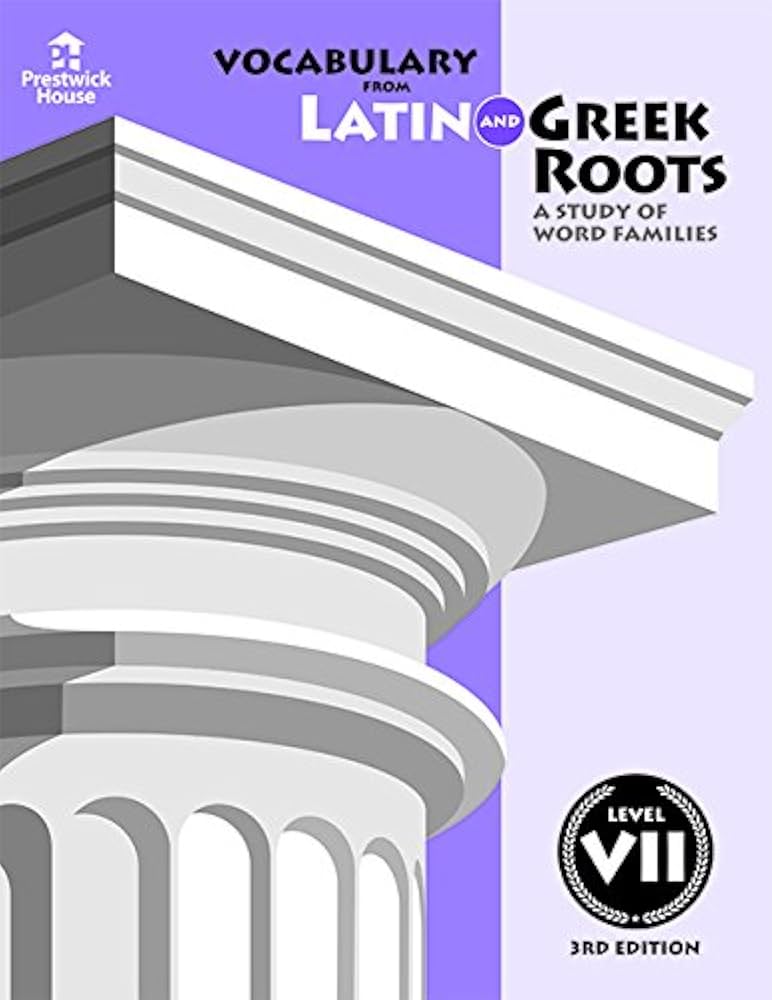
Vocabulary from Latin and Greek Roots, Book 1, Level VII
Vocabulary from Latin and Greek Roots, Book 1, Level VII is a Grade 5 vocabulary program that builds students' word knowledge by teaching them to recognize and interpret common Latin and Greek root words, prefixes, and suffixes. Organized into 20 units, the book guides students through a wide range of roots drawn from classical languages, helping them decode unfamiliar words across subject areas including science, social studies, and literature. By understanding the building blocks of English vocabulary, students develop stronger reading comprehension, spelling skills, and academic language proficiency.
Chapters & Lessons
Unit 1 ~ Unit 4
4 lessonsIn this Grade 5 vocabulary lesson from Vocabulary from Latin and Greek Roots, Book 1, Level VII, students study four Latin root families — FAC/FIC/FECT, ACT/AG, OPER, and FUNCT — all meaning "to make," "to do," or "to work." Students learn to recognize how prefixes and roots combine to form words such as facsimile, deficient, coagulate, inoperable, malfunction, and defunct. Each word is presented with its Latin etymology, definition, synonyms, antonyms, and example sentences to build both vocabulary and word-analysis skills.
Unit 5 ~ Unit 8
4 lessonsUnit 9 ~ Unit 12
4 lessonsGrade 5 students explore vocabulary from Latin and Greek roots in Unit 11 of Vocabulary from Latin and Greek Roots, Book 1, Level VII, learning words derived from the roots MILITA, SOC, HOST, and COMPAN. Students study terms such as militant, militarize, associate, sociable, asocial, hostile, companionship, and accompaniment, understanding how each word's meaning connects to its Latin origin. Exercises reinforce comprehension by asking students to use the vocabulary in context through sentence completion and fill-in-the-blank activities.
Unit 13 ~ Unit 16
4 lessonsIn this Grade 5 lesson from Vocabulary from Latin and Greek Roots, Book 1, Level VII, students explore ten vocabulary words derived from five Latin roots: JUBIL, HILAR, FRUG/FRUI, CELEBER/CELEBR, and LUD/LUS. Words such as jubilant, exhilarating, frugal, celebrant, and illusion are taught through etymology, example sentences, and context-based exercises. Students practice applying each word's precise meaning by completing sentences and fill-in-the-blank activities drawn from Unit 13.
Unit 17 ~ Unit 20
4 lessonsIn this Grade 5 vocabulary lesson from Vocabulary from Latin and Greek Roots, Book 1, Level VII, students explore ten words derived from the Latin roots longus ("long"), brevis ("brief"), densus ("thick"), macer ("thin"), and tendere ("to stretch"), including terms such as elongate, brevity, condense, emaciated, and attentive. Students learn how each root shapes word meaning by studying etymologies, synonyms, antonyms, and context sentences. Exercises reinforce understanding by asking students to complete sentences and fill in blanks using the target vocabulary in context.
In this Grade 5 vocabulary lesson from Unit 18 of Vocabulary from Latin and Greek Roots, Book 1, Level VII, students learn ten words derived from the Latin roots AER/AIR ("air"), FLAT ("to blow"), VENT ("to fan or blow"), and SPIR ("to breathe"), including terms such as aerate, aerial, inflate, deflate, ventilate, hyperventilate, aspire, spirited, and expire. Students practice applying these words in context through sentence-completion and fill-in-the-blank exercises that reinforce both literal and figurative meanings.
Frequently Asked Questions
- Is Vocabulary from Latin and Greek Roots Book 1 Level VII the right vocabulary program for my 5th grader?
- Vocabulary from Latin and Greek Roots Book 1 Level VII is a well-regarded Grade 5 vocabulary program from Prestwick House that builds word knowledge systematically through Latin and Greek root study. With 20 units covering roots like FAC/FIC (make/do), MILITA (military), and SPIR (breathe), it prepares students for the academic vocabulary demands of middle school. It works best for students who are reading at or above grade level and are ready to engage with etymology. If your child struggles with basic reading, address fluency first. This is an excellent program for academically motivated 5th graders heading toward advanced middle school coursework.
- Which units in Vocabulary from Latin and Greek Roots Level VII are most challenging for 5th graders?
- The units with limited lesson descriptions - particularly Units 2-4, 5-8, and the latter half of the book - tend to be harder to self-study since they rely entirely on the physical textbook without supplemental context. Unit 1 (roots FAC/FIC, ACT/AG, OPER, FUNCT) is demanding because all four root families mean similar things, and students confuse words like malfunction, defunct, and coagulate. Unit 11 (MILITA, SOC, HOST, COMPAN) is conceptually rich but requires students to distinguish subtle social nuances between words like antisocial, asocial, and sociable.
- My child struggles with vocabulary in science and social studies - where should they start?
- Start with Unit 1, which covers roots meaning to make and to do - words like facsimile, deficient, inoperable, and defunct are high-frequency academic terms that appear across science, history, and ELA. Unit 13 (JUBIL, HILAR, FRUG, LUD/LUS) and Unit 17 (longus, brevis, densus) are also good early targets because the root meanings are intuitive and the vocabulary appears in both literary and informational texts. Building confidence with a few high-frequency root families first gives students the pattern-recognition tools to tackle harder units. Pengi can quiz your child on each unit to identify which roots have clicked and which need more practice.
- What should my child study after completing Vocabulary from Latin and Greek Roots Level VII?
- After Level VII, students are ready for Level VIII (also published by Prestwick House), which continues the 20-unit root-based format at a higher complexity appropriate for Grade 6. The same methodology transfers directly, so students who have internalized how to analyze root + prefix combinations will find Level VIII more approachable than Level VII felt at first. Supplementing with challenging independent reading is also critical - the more your child encounters these roots in authentic texts, the deeper the retention. Middle school literature and nonfiction science articles are natural reading pairings.
- How can Pengi help my child with Vocabulary from Latin and Greek Roots Level VII?
- Pengi can make each unit in this program more effective by turning passive reading into active practice. For units where the lesson context is thin, Pengi can provide additional examples and explanations for the root families. Whether your child is working through Unit 1's FAC/FIC roots, Unit 11's social vocabulary, or Unit 18's breathing and air roots like aerate and ventilate, Pengi can quiz them, explain etymology, and help them use each word in original sentences. This kind of active retrieval practice significantly improves retention compared to re-reading definitions alone.
Ready to start learning?
Jump into your first lesson for Vocabulary from Latin and Greek Roots, Book 1, Level VII. Free, no account required.
Start Learning