
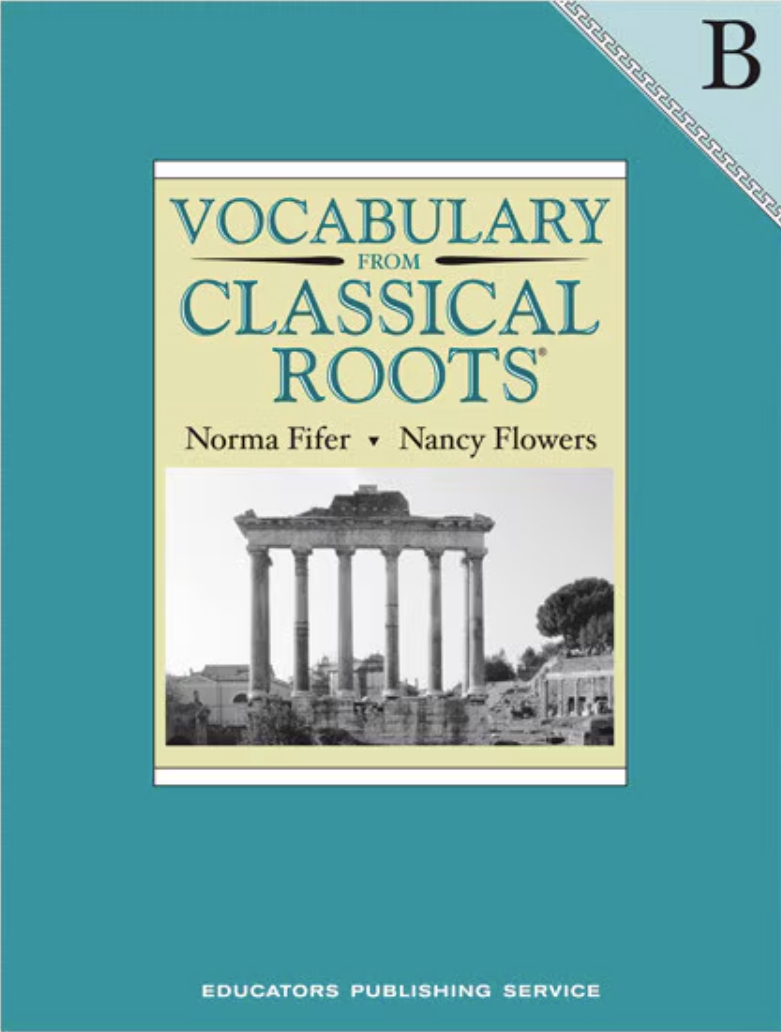
Vocabulary from Classical Roots (Book B)
Vocabulary from Classical Roots Book B, published by Educators Publishing Service (EPS), is a Grade 5 vocabulary program that builds word knowledge through the study of Latin and Greek roots. The book is organized into eight thematic lessons covering concepts such as motion, position, joining, separation, sight, the other senses, emotions, and the shapes of things, helping students recognize and understand hundreds of English words derived from classical origins. By connecting new vocabulary to familiar root words, the program strengthens reading comprehension, spelling, and writing skills across all subject areas.
Chapters & Lessons
Chapter 1: Motion (Lesson 1-2)
2 lessonsIn this Grade 5 lesson from Vocabulary from Classical Roots Book B, students explore nine key vocabulary words — including percussion, perennial, permeate, persevere, defer, dilatory, elation, and infer — by tracing their meanings back to the Latin roots PER and FERO. Students learn how understanding roots like per ("through") and ferre ("to carry") reveals connections across multiple words and their varied forms. The lesson builds both vocabulary knowledge and critical thinking skills through definitions, example sentences, and guided exercises.
In this Grade 5 lesson from Vocabulary from Classical Roots Book B, students learn ten vocabulary words built from three Latin roots: SUB ("under"), TORQUEO ("to twist or bend"), and VERSO ("to turn"). Words covered include subvert, subservient, contort, distort, retort, tortuous, adversity, avert, introvert, perverse, and prose, with each term defined through its root components. Students practice recognizing how Latin roots convey meaning and appear across related word forms such as subversive, contortion, and perversity.
Chapter 2: Position (Lesson 3-4)
2 lessonsIn Grade 5 Vocabulary from Classical Roots Book B, Lesson 3 of Chapter 2 covers the Latin roots EX (meaning "from" or "out of") and PONO/PONERE (meaning "to place" or "to put"), teaching students the meanings and usage of key vocabulary words including excerpt, exhilarate, exonerate, exorbitant, compound, exposition, expound, impose, and impostor. Students explore how these classical roots combine with other word parts to build meaning, using real-world examples to understand each term in context. This lesson strengthens both vocabulary knowledge and etymology skills essential for academic reading and writing at the fifth-grade level.
Grade 5 students in Vocabulary from Classical Roots Book B explore position-related Latin roots in Lesson 4, learning key terms such as extraneous, extraterrestrial, extrovert, mediate, mediocrity, non sequitur, obsequious, subsequent, and sequester. The lesson traces meanings through three Latin roots — extra ("on the outside"), medius ("middle"), and sequor ("to follow") — building students' understanding of how word origins shape definitions. Practice exercises reinforce recognition of synonyms and antonyms for each vocabulary word in context.
Chapter 3: Joining (Lesson 5-6)
2 lessonsIn this Grade 5 vocabulary lesson from Vocabulary from Classical Roots Book B, students explore ten words derived from the Latin roots cum (meaning "with" or "together with") and teneo (meaning "to hold" or "to keep"), including terms such as coherent, colloquial, commiserate, pertinacious, and tenacity. The lesson explains how cum transforms into prefixes like co-, col-, com-, con-, and cor- depending on the following consonant, giving students a foundation for decoding unfamiliar words. Part of Chapter 3's focus on joining and connection, this lesson builds both vocabulary depth and classical root recognition skills.
In this Grade 5 lesson from Vocabulary from Classical Roots Book B, students explore words derived from three Latin roots — apo/apere (to fasten), jungo/jungere (to join), and stringo/stringere (to draw together tightly) — building understanding of terms such as aptitude, inept, adjunct, conjugate, injunction, juncture, subjugate, astringent, strait, and stringent. Learners practice identifying synonyms and antonyms to deepen their grasp of each word's precise meaning and usage. The lesson connects classical word origins to real-world contexts, strengthening both vocabulary and reading comprehension skills.
Chapter 4: Separation (Lesson 7-8)
2 lessonsIn this Grade 5 lesson from Vocabulary from Classical Roots Book B, students study eleven key vocabulary words rooted in Latin prefixes and roots, including ab-, cerno, and frango, learning terms such as abhor, abstemious, discern, infraction, and suffrage. The lesson explores how Latin meanings like "away from," "to separate," and "to break" shape the definitions and usage of each word in context. Students practice identifying synonyms and understanding nuanced distinctions between similar words like discreet and discrete.
In this Grade 5 vocabulary lesson from Vocabulary from Classical Roots Book B, students study the Latin and Greek roots SUPER ("above"), CAEDO ("to cut"), LUEIN ("to loosen"), and SOLVO ("to untie") as part of the Separation theme. Students learn key terms including superlative, superfluous, concise, precise, herbicide, analyze, catalyst, and absolve, along with their forms and usage in context. Fill-in-the-blank exercises reinforce accurate word choice and understanding of each word's meaning and origin.
Chapter 5: Sight (Lesson 9-10)
2 lessonsIn this Grade 5 lesson from Vocabulary from Classical Roots Book B, students explore key vocabulary words including refute, reiterate, repartee, repertoire, repose, reticent, ostensible, and ostentatious by tracing their meanings back to Latin roots such as RE ("back" or "again") and OSTENDO ("to exhibit"). Students practice determining how each root connects in meaning and spelling to the key word, then apply the words through exercises and sentence examples. The lesson also introduces the concept of connotation versus denotation, using repartee and retort as examples to show how words with similar definitions can carry different implied meanings.
In Lesson 10 of Chapter 5 from Vocabulary from Classical Roots Book B, Grade 5 students study ten vocabulary words rooted in the Latin verbs specto ("to look at") and vigilo ("to watch"), including terms such as introspection, retrospect, spectrum, specter, speculate, surveillance, and vigilant. Students learn each word's etymology, part of speech, and meaning through example sentences, then practice identifying synonyms and antonyms and recognizing correct and incorrect usage in context. This lesson builds classical word-root skills that strengthen both vocabulary comprehension and academic reading across subjects.
Chapter 6: The Other Senses (Lesson 11-12)
2 lessonsIn this Grade 5 lesson from Vocabulary from Classical Roots Book B, students explore words derived from Latin roots related to the senses, including OLEO (to smell), SONO (to sound), and VOCO (to call), building vocabulary such as olfactory, redolent, sonic, resonate, evoke, and vociferous. Students also learn how the Latin prefix AD changes form before certain consonants, a spelling rule that applies to words like assimilate, admonish, and advocate. The lesson draws on classical roots and real-world examples to deepen word knowledge and contextual understanding.
Grade 5 students studying Vocabulary from Classical Roots Book B explore the Latin roots SENTIO ("to feel with the senses") and TANGO ("to touch") in Lesson 12 of Chapter 6. Students learn key vocabulary terms including assent, dissent, presentiment, sensuous, sentinel, contiguous, tangible, tactile, and tangent, understanding their precise meanings and relationships through synonym and antonym exercises. This lesson builds students' ability to decode and apply Latin-derived words commonly found in academic and literary contexts.
Chapter 7: Emotions (Lesson 13-14)
2 lessonsIn this Grade 5 vocabulary lesson from Vocabulary from Classical Roots, Book B, students explore eleven words drawn from Latin roots including PRO, JOCUS, SUAVIS, and FESTUS, learning terms such as procrastinate, prodigal, profuse, jeopardy, assuage, and festoon. The lesson builds understanding of each word's meaning, part of speech, and related forms through example sentences and synonym and antonym exercises. Students strengthen their grasp of emotion- and celebration-related vocabulary by tracing word origins back to classical Latin.
In Grade 5 Vocabulary from Classical Roots Book B, Lesson 14 introduces students to nine emotion-related vocabulary words drawn from Latin and Greek roots, including condole, doleful, irascible, irate, ire, malevolent, volition, zeal, and zealot. Students learn how roots such as doleo meaning to grieve, ira meaning anger, volo meaning to wish, and zelos meaning zeal form the basis of each word's meaning. Practice exercises build skills in identifying synonyms, antonyms, and correct word usage in context.
Chapter 8: The Shapes of Things (Lesson 15-16)
2 lessonsIn Lesson 16 of Vocabulary from Classical Roots Book B, Grade 5 students explore words derived from Latin and Greek roots meaning "to shape," "wheel/round," and "hollow," including terms such as feign, feint, effigy, ideology, rotund, concave, and excavate. Students learn each word's meaning, part of speech, and connotations through contextual examples drawn from history, literature, and everyday life. This lesson builds vocabulary depth and classical root recognition skills as part of Chapter 8's focus on the shapes of things.
Frequently Asked Questions
- Is Vocabulary from Classical Roots Book B the right vocabulary program for my 5th grader?
- Vocabulary from Classical Roots Book B is a strong choice if your child is a capable reader ready to tackle advanced vocabulary through etymology. The program organizes lessons around thematic Latin and Greek roots — Motion, Position, Joining, Separation, Sight, the Other Senses, Emotions, and Shapes — giving students a powerful strategy for decoding unfamiliar words they will encounter in academic reading. It is well-suited for students heading into middle school who want vocabulary that transfers across subjects. If your child is already using Book A or C in the series, Book B fits naturally between them in terms of difficulty and thematic progression.
- Which lessons in Vocabulary from Classical Roots Book B are typically the hardest?
- Chapter 4 (Separation, Lessons 7-8) is often the most challenging section because the vocabulary — words like abstemious, suffrage, superfluous, and concise — is both abstract and less commonly encountered in everyday reading. The roots caedo (to cut) and solvo (to untie) produce words that look very different from each other, making them harder to group mentally. Chapter 7 (Emotions, Lessons 13-14) also challenges students because the emotional nuance of words like procrastinate, irascible, and malevolent requires understanding both meaning and connotation, not just root definitions.
- My child is new to Latin roots vocabulary — where should they start in Book B?
- Begin with Chapter 1 (Motion, Lessons 1-2), which introduces the accessible Latin roots PER, FERO, TORQUEO, and VERSO through words like persevere, distort, and subvert. These roots produce verbs students encounter regularly, making the connections feel immediate. Chapter 5 (Sight, Lessons 9-10) is also a great entry point because the roots re (again/back) and ostendo (to show) generate very recognizable words. Avoid starting with Chapter 4 (Separation) before your child has built the root-recognition habit, as those lessons are more difficult and could be discouraging early on.
- What should my child study after finishing Vocabulary from Classical Roots Book B?
- After completing Book B, your child is ready for Vocabulary from Classical Roots Book C if they have not already covered it, which extends the root-based study to vocabulary connected to the human body and the natural world. The Latin and Greek root decoding skills built in Book B directly support success in middle school science — where words like dorsal, gastric, and sanguine appear — and in English literature where words like ostensible, reticent, and vigilant are common. Continuing to read widely in academic and literary texts will reinforce retention of the vocabulary from all 16 lessons.
- How can Pengi help my child with Vocabulary from Classical Roots Book B?
- Pengi can transform the fill-in-the-blank and synonym exercises into interactive learning sessions tailored to your child's weak spots. After your child works through Chapter 4 on Separation roots, Pengi can quiz them on words like abstemious and restitution in novel sentence contexts rather than the same practice sentences from the book. For the emotionally nuanced vocabulary in Chapter 7, Pengi can discuss the precise differences between words like irascible and ire, or between zeal and zealot, using age-appropriate examples. Pengi can also generate personalized review sets for any lesson, focusing on the roots and words your child has not yet mastered across their previous sessions.
Ready to start learning?
Jump into your first lesson for Vocabulary from Classical Roots (Book B). Free, no account required.
Start Learning