
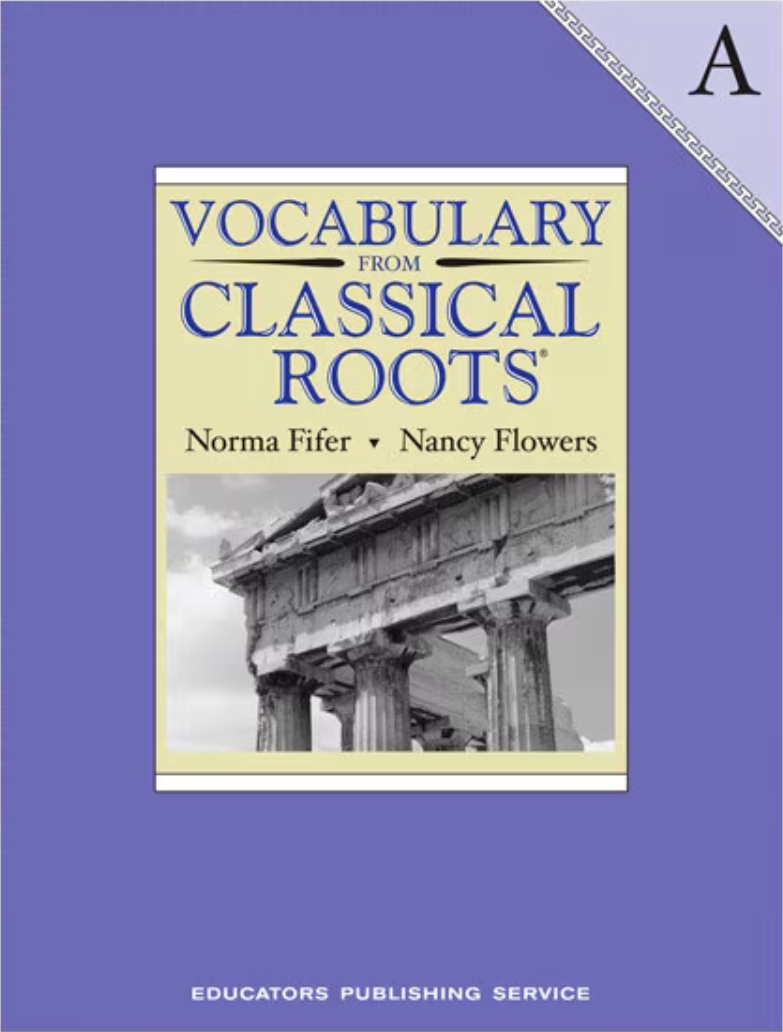
Vocabulary from Classical Roots (Book A)
Vocabulary from Classical Roots (Book A) is a Grade 4 vocabulary program designed to build word knowledge by teaching Greek and Latin roots, prefixes, and suffixes through thematic lessons. The book organizes its sixteen lessons into eight chapters exploring topics such as numbers, opposites, time, creativity, travel, sports, and animals, helping students recognize and decode unfamiliar words across subject areas. By connecting English vocabulary to its classical origins, the program gives young learners a lasting strategy for understanding word meanings and expanding their reading and writing skills.
Chapters & Lessons
Chapter 1: Numbers (Lesson 1-2)
2 lessonsIn this Grade 4 lesson from Vocabulary from Classical Roots Book A, students explore the Latin and Greek roots MONOS, UNUS, DUO, and DUPLEX to understand how the concept of numbers shapes word meaning. Key vocabulary terms including monologue, monarch, monopoly, unanimous, unilateral, and duplex are introduced with definitions, example sentences, and related word forms. Students practice connecting root meanings to spelling and usage, building a foundation for recognizing number-based roots across a wide range of English words.
In this Grade 4 lesson from Vocabulary from Classical Roots Book A, students learn number-based Latin and Greek roots including tri-, quad-/quart-, and dec- to unlock the meanings of words like trilogy, triumvirate, quadrant, quatrain, and decathlon. The lesson connects each root to its numeric value through real-world and literary examples, building vocabulary within the context of classical language study. Students also explore related roots for numbers five through nine, broadening their understanding of how ancient languages shape modern English.
Chapter 2: All or Nothing (Lesson 3-4)
2 lessonsGrade 4 students in Vocabulary from Classical Roots Book A explore the Latin and Greek roots PAN, OMNIS, HOLOS, TOTUS, and CLAUDO, all meaning "all," "whole," or "close," to build understanding of words like omnipotent, omnivorous, panacea, pandemonium, totalitarian, holocaust, cloister, preclude, and recluse. Students learn how these classical roots connect to meaning across a range of vocabulary words used in historical, scientific, and everyday contexts. The lesson develops both word recognition skills and deeper comprehension of how root words shape the English language.
In this Grade 4 vocabulary lesson from Vocabulary from Classical Roots Book A, students explore words derived from Latin roots meaning "to begin," "nothing," "to deny," and "empty," including terms such as inception, annihilate, nihilism, negate, renegade, vacuous, vanity, and aperture. Students learn to recognize how these classical roots shape word meaning and usage across a range of contexts. The lesson builds the skills needed to decode unfamiliar vocabulary using knowledge of Latin origins.
Chapter 3: More or Less (Lesson 5-6)
2 lessonsIn Lesson 5 of Chapter 3 from Vocabulary from Classical Roots Book A, Grade 4 students learn eleven vocabulary words rooted in Latin and Greek, including microbe, microcosm, minuscule, minutia, attenuate, tenuous, satiate, comply, implement, replete, and expletive. The lesson traces each word back to its classical root, such as mikros meaning small, tenuis meaning thin, and plenus meaning full, helping students understand how ancient languages shape modern English. This foundation in etymology builds both vocabulary depth and word-recognition skills across reading and writing contexts.
Grade 4 students studying Vocabulary from Classical Roots Book A explore eight key vocabulary words in Lesson 6, including copious, macrocosm, magnanimous, magnate, magnitude, megalomania, polygamy, and polygon, all derived from Latin and Greek roots meaning "plenty," "large," "great," and "many." The lesson teaches students to understand word meanings through classical roots and practice identifying synonyms and antonyms in context. This chapter builds essential vocabulary skills aligned with the "More or Less" theme introduced in Chapter 3.
Chapter 4: Before and After (Lesson 7-8)
2 lessonsIn this Grade 4 vocabulary lesson from Vocabulary from Classical Roots Book A, students explore the Latin prefixes ANTE and PRE, both meaning "before," through eleven key terms including antebellum, antecedent, premonition, predestination, and preposterous. Students learn each word's Latin root, part of speech, and meaning, then practice identifying synonyms and antonyms in context. The lesson builds classical word analysis skills to help students decode unfamiliar vocabulary across subjects.
In this Grade 4 vocabulary lesson from Vocabulary from Classical Roots Book A, students explore two Latin roots — primus meaning "first" and post meaning "after" — to build understanding of words like premier, primeval, primordial, posterior, posterity, and posthumous. Students learn how these roots shape meaning across contexts, from describing ancient ecosystems to recognizing works published after an author's death. Practice exercises reinforce the words through synonyms, antonyms, and sentence-level usage.
Chapter 5: Creativity (Lesson 9-10)
2 lessonsIn this Grade 4 lesson from Vocabulary from Classical Roots Book A, students explore the Latin root ars, artis meaning "art" and the Greek root aoide meaning "song" to build understanding of key vocabulary words including artifact, artifice, artisan, artless, ode, parody, and rhapsody. Students learn how each word's spelling and meaning connect back to its classical root, using sentence examples and word forms to reinforce comprehension. The lesson is part of Chapter 5's focus on creativity and prepares students to recognize these roots across a wide range of literary and everyday contexts.
In this Grade 4 lesson from Vocabulary from Classical Roots Book A, students study three Latin roots — cresco (to grow), facio (to make), and texo (to weave) — and learn key vocabulary words derived from them, including accrue, crescendo, excrescence, beneficence, efficacious, facile, facsimile, faction, mollify, and context. Students explore how recognizing these roots helps decode the meaning of unfamiliar words across a wide range of contexts. The lesson is part of Chapter 5's focus on creativity and builds foundational vocabulary skills through etymology and word study.
Chapter 6: Travel (Lesson 11-12)
2 lessonsIn this Grade 4 lesson from Vocabulary from Classical Roots Book A, students build vocabulary by exploring words derived from Latin and Greek roots meaning "across," "to go," "to wander," and "journey." Key terms include transgress, transitory, translucent, ambience, erratic, aberration, exodus, and episode, each studied through their classical origins and real-world examples. Students also practice grammar concepts such as transitive and intransitive verbs as part of Chapter 6's focus on travel-themed language.
In this Grade 4 vocabulary lesson from Vocabulary from Classical Roots Book A, students explore ten key words derived from Latin and Greek roots including ITER ("journey"), VENIO ("to come"), TELE ("at a distance"), and VIA ("road"), learning terms such as itinerant, itinerary, advent, circumvent, convene, intervene, deviate, devious, impervious, and telepathy. Students study how these classical roots shape word meanings related to travel and movement, building skills to recognize and decode unfamiliar words across subjects.
Chapter 7: Sports (Lesson 13-14)
2 lessonsIn this Grade 4 vocabulary lesson from Vocabulary from Classical Roots Book A, students learn 11 key words derived from Latin roots including CELER (swift), CURRO (to run), GLOMUS (ball), and JACIO (to throw). Words such as accelerate, celerity, concur, precursor, conjecture, and interjection are introduced with definitions, example sentences, and grammatical forms. The lesson builds vocabulary skills by connecting word meanings to their classical origins within the context of a sports-themed chapter.
In this Grade 4 lesson from Vocabulary from Classical Roots Book A, students learn ten vocabulary words — including assail, resilient, salient, valor, and evolve — derived from three Latin roots meaning "to jump," "to be strong," and "to revolve." The lesson connects word meanings to their classical origins, helping students understand how roots like salio, valeo, and volvo appear across related English words. Practice exercises from Chapter 7's sports-themed unit reinforce correct usage in context.
Chapter 8: Animals (Lesson 15-16)
2 lessonsIn this Grade 4 lesson from Vocabulary from Classical Roots Book A, students learn ten animal-related vocabulary words derived from Latin roots, including apis (bee), avis (bird), bos/bovis (cow), canis (dog), caper/capra (goat), and equus (horse). Students study words such as apiary, aviary, bovine, canine, caper, caprice, capricious, equine, equitation, and equestrian, building both vocabulary and an understanding of how Latin roots shape English word meanings. The lesson is part of Chapter 8 and develops students' ability to recognize and use classical root words across a range of animal-related contexts.
In Lesson 16 of Vocabulary from Classical Roots Book A, Grade 4 students learn nine animal-related vocabulary words derived from Latin and Greek roots, including feline, leonine, piscine, porcine, serpentine, simian, ursine, and zoology. Each word is traced to its classical origin, such as felis for cat and ursa for bear, helping students understand how root words shape meaning. This chapter-closing lesson builds on the animal theme of Chapter 8, strengthening students' ability to recognize and use descriptive adjectives drawn from the natural world.
Frequently Asked Questions
- Is Vocabulary from Classical Roots Book A the right vocabulary program for my 4th grader?
- Vocabulary from Classical Roots Book A is an excellent choice for a 4th grader who is a strong reader and ready to start learning vocabulary strategically through Latin and Greek roots. The sixteen lessons are organized around engaging themes — numbers, opposites, time, creativity, travel, sports, and animals — which makes the content feel interesting rather than dry. The program teaches roots like MONO, DUO, PAN, ANTE, PRE, ARS, and CELER so students can decode unfamiliar words on their own rather than just memorizing individual definitions. If your child is above grade level in reading or heading into a rigorous school environment, this book gives them a genuine vocabulary edge.
- Which lessons in Vocabulary from Classical Roots Book A are typically the hardest for 4th graders?
- Chapter 2 (All or Nothing, Lessons 3-4) tends to be challenging because the vocabulary is quite abstract — words like nihilism, annihilate, totalitarian, and recluse are conceptually heavy for 4th graders even if the roots are clearly explained. Chapter 5 (Creativity, Lesson 10) covering roots cresco, facio, and texo produces words like beneficence, efficacious, and mollify that are difficult to remember because the root connections are less intuitive than, say, animal roots in Chapter 8. Lesson 7 and 8 on ANTE and PRE prefixes can also confuse students who mix up which prefix means what.
- My child has not studied Latin roots before — where should they start in Book A?
- Start with Chapter 8 (Animals, Lessons 15-16), which teaches roots for common animals like apis (bee), canis (dog), and equus (horse) — the concrete imagery makes root-to-word connections very easy to remember and builds confidence quickly. Then go back to Chapter 1 (Numbers, Lessons 1-2) which covers MONO, UNO, DUO, TRI, QUAD, and DEC with familiar words like monopoly, trilogy, and decathlon. Starting with these tangible, intuitive roots helps your child understand the method before tackling the more abstract Chapter 2 vocabulary. Work forward from there following the book's natural sequence.
- What should my child study after finishing Vocabulary from Classical Roots Book A?
- After completing Book A, your child is ready for Vocabulary from Classical Roots Book B (Grade 5), which continues with thematic root-based vocabulary at a higher level covering concepts like motion, position, joining, separation, and the senses. The root-decoding skill your child develops in Book A will transfer across every academic subject — the Greek and Latin roots that appear in Book A also underpin a huge portion of the vocabulary in 5th grade science, social studies, and literature. Reading widely in books slightly above your child's current comfort level will reinforce retention and put the new vocabulary to work in natural contexts.
- How can Pengi help my child with Vocabulary from Classical Roots Book A?
- Pengi can make each Book A lesson more active and personalized. After your child works through Lesson 13 on roots CELER, CURRO, and JACIO, Pengi can quiz them on words like accelerate and precursor in novel sentences rather than the same fill-in-the-blank exercises from the book. For the abstract Chapter 2 vocabulary like nihilism and totalitarian, Pengi can explain the concepts using age-appropriate examples before drilling the root-to-word connections. Pengi can also create cumulative review sets — testing words from Lessons 1 through 8 together — which is important because the program builds on prior lessons and spaced review is the key to long-term retention.
Ready to start learning?
Jump into your first lesson for Vocabulary from Classical Roots (Book A). Free, no account required.
Start Learning