
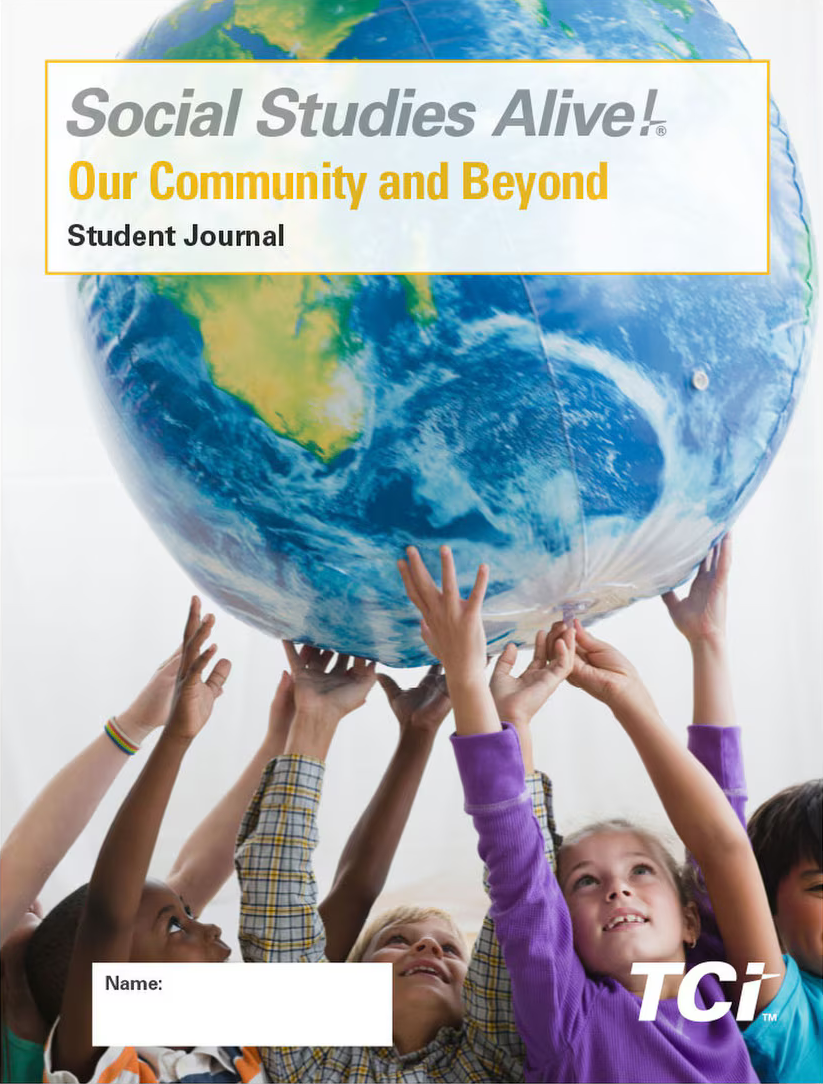
Social Studies Alive! Our Community and Beyond
Social Studies Alive! Our Community and Beyond, published by Teachers' Curriculum Institute (TCI), is a Grade 3 social studies textbook that introduces young learners to the world around them through four core areas: geography, history, economics, and civics. Students explore how communities are shaped by their physical environments, learn about local and regional history, develop foundational economic concepts such as goods, services, and trade, and discover how civic participation and government work at the community level. The program uses active, inquiry-based learning to help third graders connect classroom concepts to their everyday lives and the wider world beyond their neighborhoods.
Chapters & Lessons
Chapter 1: Geography
4 lessonsIn this Grade 3 Social Studies Alive! lesson, students learn foundational geography vocabulary including hemispheres, continents, oceans, the equator, and the prime meridian, and how these concepts describe the structure of Earth. Students explore how the equator and prime meridian divide Earth into the Northern, Southern, Western, and Eastern hemispheres, and identify the seven continents and five oceans. A hands-on activity has students build a balloon globe to apply these geography terms to real maps of the world and the United States.
In this Grade 3 lesson from Social Studies Alive! Our Community and Beyond, students learn how to use maps to locate their community and famous U.S. landmarks by applying cardinal and intermediate directions, map keys, symbols, and map scales. Students build and use a compass to identify the directional position of landmarks such as the Grand Canyon, Statue of Liberty, and Golden Gate Bridge from the geographic center of the continental United States. The lesson also introduces key geography vocabulary including canyon, symbol, and scale within the context of Chapter 1: Geography.
In this Grade 3 lesson from Social Studies Alive! Our Community and Beyond, students explore how physical geography — including physical features like mountains, rivers, and plains, as well as climate and natural resources — shapes the way people live in different communities across the United States. Students learn key terms such as adapt, natural hazard, conservation, and pollution while examining how four distinct communities respond to their geographic environments. The lesson connects map skills to real-world community life, helping students understand that geography is not just about locating places but about how the land itself influences daily living.
In this Grade 3 Social Studies Alive! lesson on Chapter 1: Geography, students explore how Native American groups including the Chinook and Ute adapted to their specific environments across North America roughly 600 years ago. Students learn key concepts such as environment, tribe, and trade, examining how each group used local resources for food, shelter, and goods. The lesson also introduces how the arrival of European colonists changed Native American ways of life.
Chapter 2: History
4 lessonsIn this Grade 3 lesson from Social Studies Alive! Our Community and Beyond, students explore the history of people settling in the United States, from the first Americans who arrived from Asia over 11,500 years ago to European colonizers, enslaved Africans, and later immigrants. Students learn key vocabulary including citizen, immigrant, and discriminate, and examine why and how different groups came to the Americas before and after 1800. The lesson also covers the challenges immigrants faced upon arrival and how people become citizens and members of American society.
In this Grade 3 Social Studies lesson from Social Studies Alive! Our Community and Beyond, students explore the concepts of culture and diversity, learning how immigrants from Europe, Africa, Asia, and Latin America each brought their own foods, languages, holidays, traditions, and arts to shape American society. Students examine what makes the United States a diverse nation and investigate cultural contributions within their own communities through research and a team-based brainstorming game.
In this Grade 3 lesson from Social Studies Alive! Our Community and Beyond, students explore the concepts of citizenship and the common good, learning how individuals can improve their communities through responsible actions and civic participation. Students study key vocabulary including boycott, strike, and disabilities while examining the real-life contributions of historical figures like Rosa Parks. The lesson connects good citizenship to everyday behaviors such as treating others with respect, following laws, and working toward what benefits everyone in a community.
In this Grade 3 lesson from Social Studies Alive! Our Community and Beyond, students explore how culture, environment, and geography shape the daily lives of children in six different countries around the world. Students learn how factors like climate, food, clothing, and physical geography influence cultural practices, using examples such as rice farming in Asia and coastal settlement in Japan. The lesson builds understanding of cultural similarities and differences by comparing these global examples to students' own environments and everyday experiences.
Chapter 3: Economics
4 lessonsIn this Grade 3 lesson from Social Studies Alive! Our Community and Beyond, students learn the key concepts of economics including goods, services, markets, scarcity, and free market economy. Students explore how buyers and sellers interact in a market, why sellers compete by lowering prices, and how scarcity affects the cost of items. The lesson uses a farmers' market as a real-world example to help students understand how everyday buying and selling activities make up an economy.
In this Grade 3 lesson from Social Studies Alive! Our Community and Beyond, students explore how a free market economy works, learning how people earn income, why prices change, and how the concepts of supply and demand affect what goods and services cost. Students examine the roles of buyers and sellers and discover how incentives and profit motivate people to provide goods and services. The lesson builds foundational economics vocabulary within the context of everyday purchasing decisions familiar to third graders.
In this Grade 3 lesson from Social Studies Alive! Our Community and Beyond, students explore why people and businesses save money, learning key concepts like interest and investing. Students examine real-world scenarios such as managing allowance and birthday money to understand the trade-offs between spending and saving. The lesson also introduces budgeting as a tool for making thoughtful economic choices.
In this Grade 3 lesson from Social Studies Alive! Our Community and Beyond, students learn what global trade is and how countries exchange goods and services they have for things they want. Using real-world examples like bananas from Ecuador and tractors from the United States, students explore why nations depend on each other and how manufactured products from around the world reach their communities.
Chapter 4: Civics
4 lessonsIn this Grade 3 lesson from Social Studies Alive! Our Community and Beyond, students learn to distinguish between private services and public services, exploring how governments at the city, state, and national level provide services like clean water, education, and first responders to all community members. Students also examine how taxes fund public services and investigate the reasons people form communities, including security, laws, acceptance, and access to jobs and services.
In this Grade 3 lesson from Social Studies Alive! Our Community and Beyond, students learn how government in the United States is organized across three levels: local, state, and federal. They explore key civics vocabulary including city hall, Constitution, legislature, and public works, and examine the specific services each level of government provides to communities. The lesson also introduces tribal government, helping students understand the full range of governing bodies that shape life in the United States.
In this Grade 3 Social Studies Alive! Our Community and Beyond lesson, students explore the concepts of citizenship and civic participation, learning how citizens make their voices heard through voting, demonstrations, and public meetings. Students examine key vocabulary including ballot, candidate, republic, and civil rights while discovering how the United States government functions as a republic where citizens elect leaders to represent them. The lesson connects personal experiences of having a voice in decisions to broader responsibilities of active citizenship at the community, state, and federal levels.
In this Grade 3 lesson from Social Studies Alive! Our Community and Beyond, students explore how individuals can make a difference in the global community by taking actions to protect the environment. Students learn key concepts including reducing air pollution, applying the three R's of reduce, reuse, and recycle, and conserving energy and water resources. The lesson also introduces vocabulary terms like habitat and inclusive while guiding students through a community service project using the inquiry process.
Frequently Asked Questions
- Is Social Studies Alive! Our Community and Beyond right for my third grader?
- If your child is in third grade and their class uses this TCI textbook, it is a great program. It covers four core areas - geography, history, economics, and civics - through hands-on activities and inquiry-based learning, which works well for 8-9 year olds. It is strong for introducing goods and services, community government, and how physical geography shapes where people live. If you are a homeschooling parent looking for a structured Grade 3 social studies curriculum, this is one of the most widely adopted options available.
- Which topics in this textbook are hardest for third graders?
- The economics chapters tend to be the trickiest. Concepts like supply and demand, scarcity, and the difference between wants and needs are abstract for 8-year-olds. The civics lessons on how local government works - mayors, city councils, laws - also challenge students because most kids have no direct frame of reference. Geography Lesson 2 on map scales and latitude and longitude trips up students who have not developed spatial reasoning yet. Expect to spend extra time on any lesson requiring chart or map interpretation.
- My child struggles with economics concepts like goods and services. Where should they start?
- Start at the very beginning of the economics chapter - the lesson introducing the difference between goods and services. Make sure your child can give three examples of each from their own life before moving forward. Then work through lessons on needs vs. wants and spending vs. saving. Real-world examples from your family - grocery shopping, paying for a haircut - make these abstract ideas concrete. Avoid jumping to supply and demand until needs and wants feel solid.
- My child just finished this textbook. What social studies topics should they tackle next?
- Fourth grade social studies typically shifts to state history. In California that means California geography, Native American history, the mission era, the Gold Rush, and state government. TCI Social Studies Alive! California Promise is the Grade 4 companion to this book. For kids who loved the geography unit, learning all 50 states and capitals is great enrichment. The civics foundation from this book also sets them up well for deeper government content in grades 4 and 5.
- How can Pengi help my child with Social Studies Alive! Our Community and Beyond?
- Pengi can make abstract social studies concepts tangible for third graders. If your child is confused about scarcity or why communities have rules, Pengi explains it with simple examples drawn from the textbook content. Pengi is also great for test review - it can quiz your child on geography terms from Chapter 1 like hemispheres and continents, or economics vocabulary, and give immediate feedback. For the civics chapters on local government, Pengi can answer follow-up questions in plain language that a static textbook page cannot.
Ready to start learning?
Jump into your first lesson for Social Studies Alive! Our Community and Beyond. Free, no account required.
Start Learning