
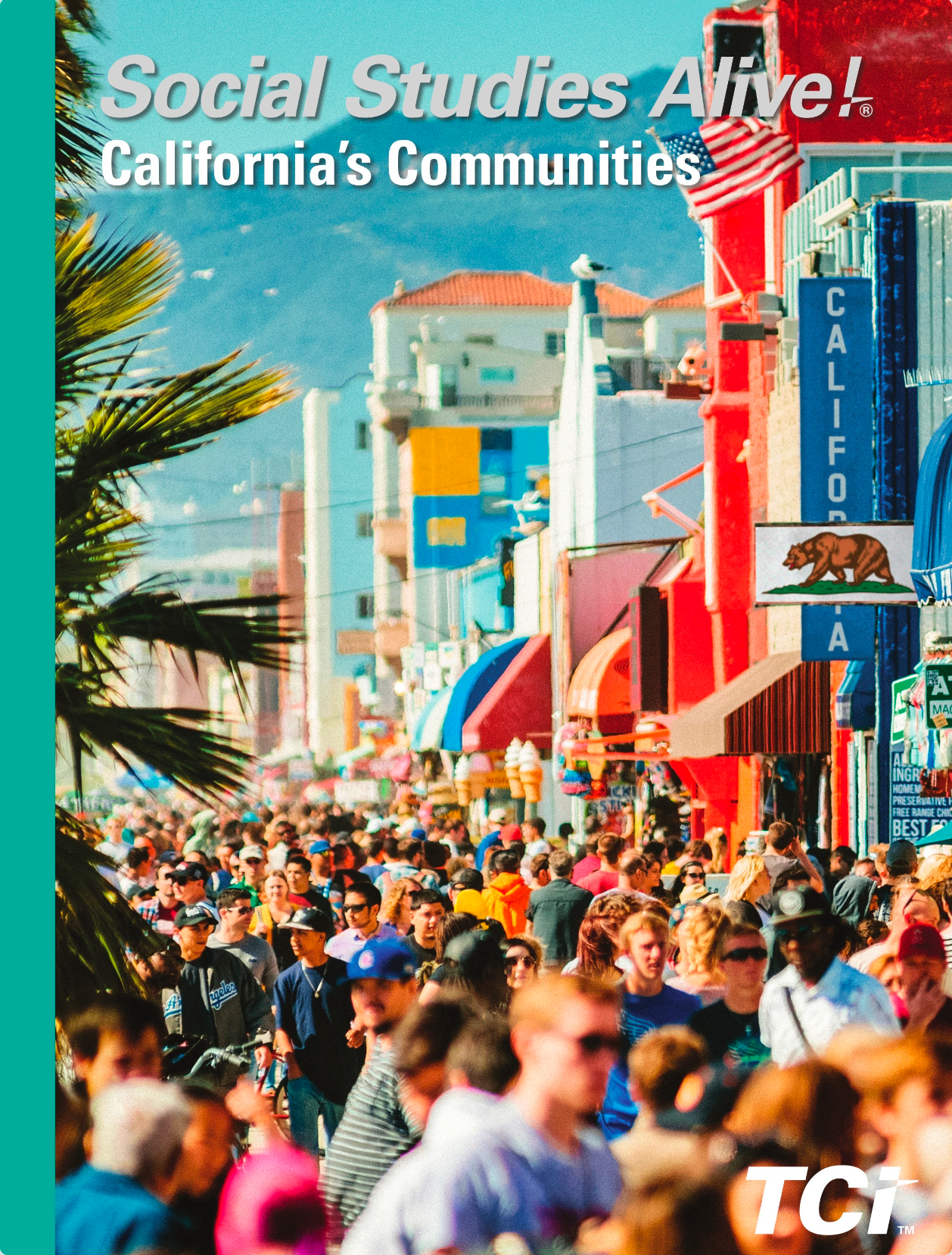
Social Studies Alive! California's Communities
Social Studies Alive! California's Communities is a Grade 3 social studies textbook that introduces young learners to the history, geography, and culture of California and its diverse communities. The curriculum covers foundational topics including California's physical geography, the lives and traditions of American Indians, the settling of California, basic principles of government and citizenship, and introductory economics concepts. Through engaging, activity-based lessons, students build a broad understanding of how communities form, function, and connect across the Golden State.
Chapters & Lessons
Chapter 1: Geography
3 lessonsIn this Grade 3 lesson from Social Studies Alive! California's Communities, students learn foundational geography vocabulary and concepts, including how Earth is divided into hemispheres using the equator and prime meridian, and how it is further organized into continents, countries, and states. Students explore the five oceans, seven continents, and the role of borders and governments in defining countries. The lesson builds spatial awareness skills that help students locate their own community within the broader context of Earth's geography.
In this Grade 3 lesson from Social Studies Alive! California's Communities, students learn how to use key map tools — including cardinal directions, the map key, and map scale — to locate their community and famous California landmarks such as the State Capitol in Sacramento and the Golden Gate Bridge. Students practice reading a compass rose to identify north, east, south, and west, and use a map's scale to measure distances between places like San Francisco and Los Angeles. The lesson builds foundational geography skills by connecting California's 50 states context to real-world map reading within Chapter 1: Geography.
In this Grade 3 lesson from Social Studies Alive! California's Communities, students explore how physical geography — including climate, topography, natural resources, and natural hazards — shapes the way people live in their communities. Students learn key concepts such as adaptation, conservation, and pollution as they examine how people respond to and alter their physical surroundings. The lesson uses four California locations to show how geography directly influences daily life across the state's mountain, coastal, valley, and desert regions.
Chapter 2: History - American Indians
1 lessonsIn this Grade 3 lesson from Social Studies Alive! California's Communities, students learn how California's physical geography shaped the cultures and ways of life of different American Indian groups, including the Hupa, Chumash, and Miwok. Students explore how each group used local natural resources for food, shelter, and trade, and examine key vocabulary such as culture, historian, and shaman. The lesson establishes foundational knowledge of California's first peoples and their connections to the regions where they lived.
Chapter 3: History - Settling California
2 lessonsIn this Grade 3 lesson from Social Studies Alive! California's Communities, students explore why and how different groups settled California, from American Indian communities and Spanish explorers like Juan Rodríguez Cabrillo and Father Junípero Serra to immigrants drawn by the Gold Rush, railroad construction, and job opportunities. Students learn key vocabulary including immigrant, mission, citizen, and discriminate while examining the challenges settlers faced and the lasting impact of the mission system on California's development.
In this Grade 3 lesson from Social Studies Alive! California's Communities, students learn what it means to practice good citizenship and work toward the common good in their communities. The lesson introduces key vocabulary such as boycott, strike, and citizenship through the real-life examples of community leaders like Clara Barton and César Chávez, who took action to solve problems and improve lives. Students explore how individual effort and civic responsibility can bring lasting benefits to entire communities.
Chapter 4: Government and Citizenship
4 lessonsIn this Grade 3 lesson from Social Studies Alive! California's Communities, students learn how local government is structured by exploring the roles of the mayor, city council, city manager, city clerk, and city departments in a fictional city called Pleasantville. Students discover key concepts including how taxes fund public services, how laws are made and enforced, and how different levels of government — local, state, and federal — each serve distinct functions. The lesson introduces essential vocabulary such as local government, public works, legislature, and Constitution within the context of Chapter 4: Government and Citizenship.
In this Grade 3 lesson from Social Studies Alive! California's Communities, students learn what it means to be an active citizen in a republic, including how voting, attending public meetings, and participating in peaceful demonstrations give people a voice in their community. The lesson introduces key civics vocabulary such as ballot, candidate, civil rights, and republic while explaining how citizens consent to be governed and hold leaders accountable. Students also explore the civil rights movement of the 1950s and 1960s as a real-world example of peaceful civic participation.
In this Grade 3 Social Studies Alive! California's Communities lesson, students explore how everyday activities like driving cars and running factories cause air pollution, oil spills, and climate change. They examine real community responses, including how the Tree Musketeers planted over one million trees near Los Angeles to reduce air pollution and absorb carbon dioxide, and how a 1969 oil spill off Santa Barbara prompted public action. Students learn how individuals and communities can identify environmental problems and work together to protect the air, water, and soil around them.
In this Grade 3 lesson from Social Studies Alive! California's Communities, students learn specific ways they can protect the environment and improve their communities, including fighting air pollution, practicing the three R's (reduce, reuse, recycle), conserving energy and water, and safeguarding animal habitats. The lesson introduces vocabulary terms such as habitat and tolerant while connecting civic responsibility to real-world actions in California. Students explore how individual choices, from carpooling to avoiding products made from endangered animals, contribute to healthier communities for both people and wildlife.
Chapter 5: Economics
3 lessonsIn this Grade 3 Social Studies Alive! lesson from Chapter 5 on Economics, students learn the foundational concepts of how an economy works, including the roles of buyers and sellers in a market, the difference between goods and services, and the concept of scarcity. Using a farmers' market as a real-world example, students explore how sellers compete by lowering prices and how limited resources mean people cannot always get everything they want. The lesson introduces key vocabulary such as economy, free market economy, goods, services, and scarcity within the context of California's communities.
In this Grade 3 lesson from Social Studies Alive! California's Communities, students learn how a free market economy works, including how people earn money, how businesses pursue profit, and how incentives influence economic choices. Students explore key vocabulary such as supply, demand, profit, and incentive to understand why prices for goods and services rise and fall. The lesson uses relatable examples like running a lemonade stand to show how buyers and sellers interact to set prices in Chapter 5: Economics.
In this Grade 3 Social Studies Alive! California's Communities lesson from Chapter 5, students learn why people and businesses save money, exploring concepts such as interest, savings accounts, and capital resources. Students discover different methods of saving, from piggy banks to bank accounts, and examine how businesses reduce costs through machines and resource choices to build savings. The lesson connects personal financial decisions like earning an allowance to broader economic principles of spending, saving, and investing.
Frequently Asked Questions
- Is Social Studies Alive! California's Communities right for my child?
- Social Studies Alive! California's Communities is a TCI curriculum designed for California third graders. It covers five essential areas — geography, American Indian history, California settlement history, government and citizenship, and economics — in a highly visual and activity-based format. TCI's approach uses cooperative learning and big-picture images that help young learners engage with abstract social studies concepts. It is a great fit for third graders in California who learn well from visual storytelling and hands-on classroom activities. The curriculum is accessible for average readers and includes strong visual scaffolding.
- Which chapters are hardest in Social Studies Alive! California's Communities?
- Chapter 4 (Government and Citizenship) is typically the most abstract for third graders — understanding the three branches of government, voting, and civic responsibility requires reasoning about systems that children rarely experience directly. Chapter 5 (Economics) introduces concepts like supply, demand, trade, and producers vs. consumers that are intuitive in daily life but hard to reason about formally. Chapter 2 (History — American Indians) involves sensitive cultural content and complex time-period thinking that benefits from careful classroom discussion. Chapter 3 (Settling California) requires tracking multiple waves of settlers across different historical periods.
- My child struggles with social studies concepts. Where should they start?
- Start with Chapter 1 (Geography), which introduces maps, compass directions, landforms, and regions. Geographic literacy is the backbone of all social studies — without it, history and civics chapters are harder to anchor spatially. Once your child can read a basic map and understand California's major regions, Chapter 2 (American Indians) will make much more geographic sense. For economics concepts in Chapter 5, use everyday examples — the school store, a lemonade stand — to make abstract terms like producer, consumer, and market feel real before diving into the textbook text.
- What should my child study after finishing Social Studies Alive! California's Communities?
- After Social Studies Alive! in Grade 3, California fourth graders move into full California state history, covered in Pengi Social Studies Grade 4 or comparable California-adopted curricula. The geography skills, civic literacy, and understanding of community economics from Grade 3 are direct prerequisites for the more complex historical narratives in Grade 4. Students who showed strong interest in the American Indian chapters in Grade 3 may enjoy supplemental books about specific California tribes to deepen their understanding before the Grade 4 curriculum revisits those topics.
- How can Pengi help my child with Social Studies Alive! California's Communities?
- Social Studies Alive! uses a lot of images and classroom discussion activities that work great in school but can be hard to recreate at home. Pengi bridges that gap by explaining the core concepts from each chapter in simple, age-appropriate language. If your child is fuzzy on why the government has three branches (Chapter 4) or cannot explain the difference between goods and services (Chapter 5), Pengi gives clear, concrete examples. Pengi can also quiz your child on vocabulary and key ideas before tests, using the kinds of questions third graders typically encounter on California social studies assessments.
Ready to start learning?
Jump into your first lesson for Social Studies Alive! California's Communities. Free, no account required.
Start Learning