
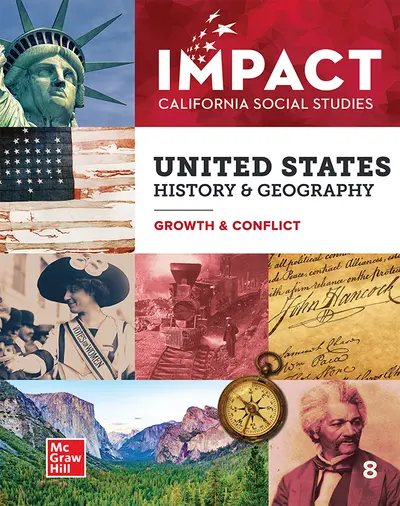
IMPACT California Social Studies, Grade 8
IMPACT California Social Studies for Grade 8 is a history textbook designed to guide eighth-grade students through the full arc of American history, from the Enlightenment ideas that shaped the colonial era through the Industrial Age and the social changes of the late 19th century. The text covers foundational topics including the American Revolution, the drafting and ratification of the Constitution, the early republic under presidents Jefferson and Jackson, Manifest Destiny and westward expansion, the causes and consequences of the Civil War, and the Reconstruction Era. Published to align with California's eighth-grade history and social science standards, it emphasizes primary sources, civic understanding, and the social, economic, and political forces that defined the development of the United States.
Chapters & Lessons
Chapter 1: Changing Ideas and a Changing World
5 lessonsGrade 8 students explore the factors that sparked Europe's era of exploration, including the role of the Crusades in opening Asian trade routes, the influence of Marco Polo's Travels on European curiosity about Asia, and key technological advances such as the astrolabe. The lesson is part of Chapter 1 in IMPACT California Social Studies, Grade 8, and examines how new ideas from the Renaissance and contact with the wider world transformed European ambitions. Students analyze primary sources and identify the causes and unplanned consequences that set the stage for European voyages of discovery.
In this Grade 8 lesson from IMPACT California Social Studies, students examine how Portugal built a trading empire by pioneering Atlantic exploration and searching for a sea route to Asia around Africa. Students analyze the roles of Prince Henry the Navigator, Bartolomeu Dias, and Vasco da Gama, as well as the caravel's importance to Portuguese navigation. The lesson also introduces the early Spanish-sponsored explorers and the economic motivations — including the gold and ivory trade — that drove European expansion into Africa, Asia, and the Americas.
In this Grade 8 lesson from IMPACT California Social Studies, students explore the Commercial Revolution and the economic changes that transformed Europe in the 1500s and 1600s, including the rise of capitalism, the expansion of banking through families like the Medici and Fuggers, and the development of new financial tools to fund overseas trade. Students examine Adam Smith's critique of mercantilism and analyze how competition, free markets, and capital investment shaped modern economic systems. The lesson also connects shifts in trade and banking to broader patterns of European settlement and colonial exploitation.
In this Grade 8 lesson from IMPACT California Social Studies, students explore the religious rivalries and colonial competition that shaped European exploration, including Martin Luther's role in launching the Protestant Reformation and how the resulting Catholic-Protestant conflict fueled tensions between England and Spain. Students examine how Spain's 1588 Armada was defeated by England, shifting control of the seas and opening the path for English colonization of North America. The lesson also introduces the search for a Northwest Passage as part of broader European competition for overseas territories.
In this Grade 8 lesson from IMPACT California Social Studies, students explore the intellectual foundations of the Enlightenment, examining how ancient Greek democracy, Roman republicanism and the rule of law, and Judeo-Christian traditions shaped modern political thought. Students analyze key thinkers such as Jean-Jacques Rousseau and his concept of the social contract to understand how Enlightenment ideas influenced American colonial governance. The lesson builds critical thinking skills by having students identify major changes in science and politics and connect the concept of reason to those developments.
Chapter 2: Colonial America
5 lessonsGrade 8 students explore England's earliest attempts to establish colonies in North America, examining the failed Roanoke settlements of 1585 and 1587 and the enduring mystery of the lost colonists who disappeared, leaving only the word "Croatoan" carved on a tree. This lesson is part of Chapter 2: Colonial America in IMPACT California Social Studies and asks students to analyze how geographic challenges, conflicts with Spain, and supply difficulties contributed to the collapse of early English settlements.
In this Grade 8 lesson from IMPACT California Social Studies, Chapter 2, students examine why the Pilgrims and Puritans left England to seek religious freedom in North America, tracing the distinctions between Separatists and Puritans and the founding of Plymouth Colony in 1620. Students analyze the Mayflower Compact as a foundational step toward representative, democratic government in colonial America. The lesson also explores cooperation and conflict between English colonists and Native Americans, using primary sources and visual evidence to develop critical thinking skills.
In this Grade 8 lesson from IMPACT California Social Studies, students examine how the Middle Colonies formed as England took control of the Dutch territory of New Netherland, transforming New Amsterdam into New York and eventually dividing the region into four distinct colonies. Students learn key concepts including proprietary colonies, the patroon system, and the role of geography — particularly the Hudson River and Atlantic coastline — in shaping colonial settlement and growth. The lesson connects to Chapter 2's broader focus on Colonial America and uses primary sources like Pastorius's Description of Pennsylvania to illustrate the diversity and expansion of British rule along the mid-Atlantic coast.
In this Grade 8 lesson from IMPACT California Social Studies, students examine the development of Virginia and Maryland as Southern Colonies, exploring how geography and the tobacco economy drove the use of indentured servants and enslaved Africans as labor. Students also analyze the founding of Maryland as a proprietary colony, the Mason-Dixon Line boundary dispute, and the Act of Toleration of 1649. The lesson builds toward understanding Bacon's Rebellion and how geography shaped colonial life in the South.
In this Grade 8 lesson from IMPACT California Social Studies, students examine how regional geography shaped the economic development of the original thirteen colonies, exploring key differences between New England's subsistence farming and commercial industries, the Middle Colonies' cash crop agriculture, and the role of triangular trade routes in connecting colonial America to the wider world. Students analyze primary sources and visual evidence to understand how colonists adapted to local climates, terrain, and resources to build distinct regional economies. The lesson also introduces the concept of exploited enslaved labor in the Southern economy as part of the broader development of an American colonial identity.
Chapter 3: The Spirit of Independence
5 lessonsIn this Grade 8 lesson from IMPACT California Social Studies, students examine the rivalry between Britain and France over the Ohio River valley that sparked the French and Indian War, including the military significance of Fort Duquesne and George Washington's early role commanding colonial militia forces. Students also analyze why Native Americans generally allied with the French over the British, exploring differences in land ambitions, fur trading relationships, and the role of the Iroquois Confederacy. The lesson is part of Chapter 3: The Spirit of Independence and builds foundational context for understanding colonial conflicts leading to American independence.
In this Grade 8 lesson from IMPACT California Social Studies Chapter 3, students examine the British policies that fueled colonial resistance after the French and Indian War, including the Proclamation of 1763, the Sugar Act, and the use of writs of assistance. Students analyze why Parliament imposed new taxes and trade restrictions on the colonies and how colonists responded by arguing these policies violated their rights as British citizens. Primary sources, maps, and charts help students connect specific British actions to the growing tension that would drive the American independence movement.
In this Grade 8 lesson from IMPACT California Social Studies Chapter 3, students examine how the Boston Massacre of 1770 escalated tensions between colonists and British troops and how colonial leaders used propaganda, boycotts, and committees of correspondence to unite resistance against British rule. Students analyze the effects of the Intolerable Acts on colonial life and trace how events like the killing of Crispus Attucks shaped colonial opinion and spurred organized opposition to Parliament.
In this Grade 8 lesson from IMPACT California Social Studies, students examine the formation of the First Continental Congress in 1774, including key delegates such as Samuel Adams, John Adams, George Washington, and Patrick Henry, and the Congress's decisions to issue a statement of grievances, boycott British trade, and endorse the Suffolk Resolves. Students also explore the role of colonial militias as citizen-soldier organizations and analyze why the battles at Lexington and Concord marked a turning point in the conflict with Britain. The lesson connects to the essential question of what motivates people to act by tracing how British oppression pushed divided colonies toward unified resistance.
Grade 8 students in IMPACT California Social Studies examine the key events and decisions leading to American independence, including the role of the Second Continental Congress, the Olive Branch Petition, and the formation of the Continental Army under George Washington. The lesson focuses on how colonial leaders such as Benjamin Franklin, John Hancock, and Thomas Jefferson worked to govern the colonies and respond to British aggression ahead of the formal drafting of the Declaration of Independence. Students analyze the four parts of the Declaration and explore what motivated the colonists to pursue a complete break from Great Britain.
Chapter 4: The American Revolution
4 lessonsIn this Grade 8 lesson from IMPACT California Social Studies Chapter 4, students examine the opposing sides of the American Revolution, comparing British military advantages — including a powerful navy, trained army, and larger population — against Patriot strengths such as fighting on home ground. Students also analyze the roles of Loyalists, neutral colonists, and African Americans in the conflict, identifying how internal divisions shaped the early years of the war.
In this Grade 8 lesson from IMPACT California Social Studies, students examine how the American Patriots gained critical foreign allies during the Revolutionary War, including France's formal declaration of war on Britain in 1778 and Spain's entry in 1779 following the turning-point victory at Saratoga. Students also analyze the hardships of the Continental Army's winter at Valley Forge, exploring Washington's challenges with supply shortages, troop morale, and the threat of mutiny. Primary source analysis and text evidence skills are practiced using Washington's letter to Governor Clinton and accounts of Benjamin Franklin's diplomatic mission to France.
In this Grade 8 lesson from IMPACT California Social Studies, students examine how the American Revolution expanded beyond the original thirteen colonies, analyzing the war in the western frontier and at sea. Students learn how George Rogers Clark led Patriot forces against British posts at Kaskaskia and Vincennes, why many Native Americans allied with the British, and how Britain used a naval blockade to cut off Patriot supply lines. The lesson builds understanding of how shifting battlegrounds and new forms of frontier warfare shaped the broader outcome of the Revolutionary War.
In this Grade 8 lesson from IMPACT California Social Studies Chapter 4, students examine the events leading to the American victory at Yorktown, including Washington's secret strategy, the Franco-American alliance with Rochambeau, and the siege tactics that trapped Cornwallis. Students analyze how Lafayette pinned British forces on the Yorktown peninsula while the French fleet blocked Chesapeake Bay, cutting off British supply and escape routes. The lesson builds understanding of how military strategy, alliances, and geography combined to end the Revolutionary War.
Chapter 5: A More Perfect Union
3 lessonsGrade 8 students explore the Articles of Confederation in this lesson from IMPACT California Social Studies, Chapter 5, examining how the newly independent states created their first plan of national government after the Revolutionary War. Students analyze the specific powers granted to the national government, the structure of early state constitutions, and why Americans deliberately limited central authority through concepts such as bicameral legislatures and separation of powers. The lesson addresses the essential question of why people form governments and how the 13 states balanced state independence with the need for national unity.
Grade 8 students in IMPACT California Social Studies explore the weaknesses of the Articles of Confederation, including the post-Revolutionary War economic depression, the collapse of trade, and Shays's Rebellion, as context for understanding why a new constitution was needed. The lesson examines the roles of key founders such as James Madison, Roger Sherman, and Gouverneur Morris in drafting and shaping the U.S. Constitution. Students also analyze the tension between American ideals of liberty and the institution of slavery during the founding era.
In this Grade 8 lesson from IMPACT California Social Studies, Chapter 5, students examine the intellectual and historical sources behind the U.S. Constitution, including the influence of the Magna Carta, the English Bill of Rights, and Enlightenment thinkers John Locke and Baron de Montesquieu. Students analyze how concepts such as natural rights, separation of powers, and federalism shaped the document the Framers drafted at the Constitutional Convention of 1787. The lesson also introduces the structure of the three branches of the federal government and how their powers interact through a system of checks and balances.
Chapter 6: The Constitution
2 lessonsIn this Grade 8 lesson from IMPACT California Social Studies, students identify and analyze the seven major principles of the U.S. Constitution, including popular sovereignty, federalism, separation of powers, checks and balances, limited government, republicanism, and individual rights. Students examine primary sources such as the Madison Debates to understand how Framers like Gouverneur Morris shaped these principles, and explore key concepts like enumerated powers and the Preamble's role in establishing the authority of the people.
Grade 8 students explore the structure of the U.S. federal government in this lesson from IMPACT California Social Studies, Chapter 6, learning how the Constitution divides power into three branches: the legislative, executive, and judicial. Students examine the specific roles of Congress, the president, and the courts, including key concepts such as separation of powers, bicameral legislature, and judicial review as established in Marbury v. Madison. The lesson connects to the broader question of how new ideas about democracy and self-governance transformed the way people live.
Chapter 7: The Federalist Era
3 lessonsIn this Grade 8 lesson from IMPACT California Social Studies Chapter 7, students learn how George Washington shaped the presidency by establishing precedents, including forming the first cabinet with figures like Thomas Jefferson, Alexander Hamilton, and Henry Knox. Students analyze how Washington and the early Congress built the executive branch, set up the court system, and added the Bill of Rights to the Constitution. The lesson also examines the significance of John Adams's tie-breaking vote that granted the president power to dismiss cabinet officers without Senate approval.
In this Grade 8 lesson from IMPACT California Social Studies, students explore the early challenges facing the Washington administration, including the Whiskey Rebellion, frontier conflicts with Native Americans aided by British and Spanish forces, and the significance of the Treaty of Greenville. Students analyze how these domestic and international pressures tested the new federal government's authority and ability to maintain order. The lesson connects to Chapter 7's broader focus on the Federalist Era by examining how conflict shaped early U.S. policy decisions.
In this Grade 8 lesson from IMPACT California Social Studies, students examine how the ideological conflict between Alexander Hamilton and Thomas Jefferson led to the formation of America's first two political parties during the Federalist Era. Students compare the Federalists, who supported a strong federal government and broad implied powers under the Constitution, with the Democratic-Republicans, who opposed centralized power. The lesson uses primary source letters and key vocabulary such as partisan, enumerated powers, and implied powers to help students understand how political disagreement drives governmental change.
Chapter 8: The Jefferson Era
4 lessonsGrade 8 students explore the election of 1800 in this lesson from IMPACT California Social Studies, examining how the tied Electoral College vote between Thomas Jefferson and Aaron Burr led to a House of Representatives decision and the eventual passage of the Twelfth Amendment. Students analyze how the transfer of power from the Federalist to the Democratic-Republican Party marked a significant shift in government, as Jefferson sought to reduce the federal government's role and strengthen states' rights. The lesson draws on Jefferson's Inaugural Address and the mechanics of the Electoral College to show how political conflict shapes constitutional change.
In this Grade 8 lesson from IMPACT California Social Studies, Chapter 8, students examine the Louisiana Purchase and how it expanded U.S. territory westward from the Mississippi River to the Rocky Mountains. Students analyze the economic significance of controlling the Mississippi River and New Orleans, the secret Spain-to-France transfer of the Louisiana Territory, and Napoleon Bonaparte's ambitions for a Western empire. The lesson also prepares students to describe the explorations of Lewis and Clark and Zebulon Pike as outcomes of the purchase.
In this Grade 8 lesson from IMPACT California Social Studies, Chapter 8: The Jefferson Era, students explore the causes and consequences of conflicts that tested the early United States, including the Barbary Wars, the attack on the USS Chesapeake, and Tecumseh's Confederation. Students analyze how Jefferson's administration responded to Barbary pirate demands for tribute, British violations of neutral rights, and tensions with Native American nations on the frontier. The lesson builds skills in analyzing point of view, determining meaning from primary sources, and drawing conclusions about why and how conflicts develop.
In this Grade 8 lesson from IMPACT California Social Studies, students examine the conflicts that drew the early United States into international confrontations, including the Barbary Pirates' demands for tribute, the naval blockade of Tripoli, and Stephen Decatur's raid on Tripoli Harbor. Students analyze how Jefferson responded to threats against American merchant ships and neutral rights on the high seas. Part of Chapter 8: The Jefferson Era, the lesson builds understanding of how foreign policy decisions shaped the young nation's identity and set the stage for the War of 1812.
Chapter 9: Growth and Expansion
3 lessonsIn this Grade 8 lesson from IMPACT California Social Studies, Chapter 9, students explore how the Industrial Revolution transformed the American economy, examining key inventions such as the cotton gin, water frame, spinning jenny, and power loom. Students analyze how New England's geography — its poor farmland, river-powered waterways, and port access — made it the center of early U.S. industrialization and factory wage labor. The lesson also introduces the free enterprise system and its relationship to capitalism as foundational concepts in understanding economic growth and expansion.
In this Grade 8 lesson from IMPACT California Social Studies, students explore the westward migration of Americans in the early 1800s and the major transportation developments that made it possible, including Daniel Boone's Wilderness Road, the construction of turnpikes and corduroy roads, and the building of the National Road. Students analyze how geography shaped settlement patterns and trace the sequence of key transportation milestones on a timeline. The lesson connects physical features like the Cumberland Gap and Appalachian Mountains to the broader question of how geography influences the way people live.
In this Grade 8 lesson from IMPACT California Social Studies Chapter 9, students examine how the United States shifted toward national unity after the War of 1812, exploring key developments such as Henry Clay's American System, the Era of Good Feelings, and the establishment of the Second Bank of the United States. Students also analyze how sectionalism emerged as a divisive force, including the causes and effects of the Missouri Compromise on different regions of the country. The lesson builds understanding of tariffs, inflation, and federal versus states' rights debates that shaped early nineteenth-century American politics.
Chapter 10: The Jackson Era
3 lessonsGrade 8 students in IMPACT California Social Studies examine the rise of Jacksonian Democracy, focusing on the contested 1824 presidential election, the concept of plurality versus majority in the Electoral College, and the emergence of new political parties. The lesson traces how the "corrupt bargain" accusation against Adams and Clay fueled Jackson's successful 1828 campaign and reshaped American political campaigning. Students also analyze primary sources, including Jackson's First Annual Message to Congress, to understand his argument for majority rule in presidential elections.
In this Grade 8 lesson from IMPACT California Social Studies Chapter 10, students examine the forced relocation of Native Americans during the Jackson Era, focusing on the Indian Removal Act of 1830 and the establishment of Indian Territory. Students analyze how the Five Civilized Tribes — including the Cherokee, Seminole, Choctaw, Chickasaw, and Creek — resisted removal and the consequences of that resistance. Primary sources from Chief John Ross and Choctaw leader George Hawkins help students evaluate competing perspectives on federal policy and Native American sovereignty.
Grade 8 students in IMPACT California Social Studies explore President Andrew Jackson's campaign to dismantle the Second Bank of the United States, examining his veto of the Bank's charter renewal and his order to withdraw federal deposits. The lesson covers key concepts such as the Bank's role as a government-chartered institution, the political rivalry between Jackson, Henry Clay, and Daniel Webster, and the constitutional debate sparked by McCulloch v. Maryland. Students analyze how Jackson's actions during the Election of 1832 and beyond ultimately led to the Bank's closure.
Chapter 11: Manifest Destiny
4 lessonsIn this Grade 8 lesson from IMPACT California Social Studies, Chapter 11: Manifest Destiny, students examine the competing claims over the Oregon Country in the early 1800s, including the roles of the Adams-Onís Treaty, joint occupation with Great Britain, and the fur trade economy in drawing Americans westward. Students trace key events on a timeline from 1819 to 1846 and analyze how geography and economic demand for beaver pelts shaped expansion into the Pacific Northwest. The lesson also connects the Oregon boundary dispute to the 1844 presidential campaign and the broader concept of Manifest Destiny.
In this Grade 8 lesson from IMPACT California Social Studies, Chapter 11, students examine how Florida and Texas pursued statehood in the 1830s and 1840s, analyzing key events such as Florida's constitutional convention of 1839 and the political obstacles created by the slavery debate in Congress. Students learn how the institution of slavery complicated both territories' bids for statehood, as Congress worked to maintain the balance between slave and free states. The lesson also traces Florida's growth from a sparsely populated territory after the 1821 transfer from Spain to a slave-holding plantation economy that shaped its path to becoming the 27th state in the Union.
In this Grade 8 lesson from IMPACT California Social Studies, students examine the causes and events of the U.S.-Mexican War, exploring how President James K. Polk used border disputes to justify declaring war in 1846 and how the United States sought to acquire the New Mexico and California territories as part of Manifest Destiny. Students analyze the Santa Fe Trail's role as a trade and settlement route, tracing the contributions of key figures such as William Becknell, John C. Frémont, and Winfield Scott. The lesson also covers the Spanish and Mexican colonial roots of both New Mexico and California, helping students understand the cultural and political context that shaped westward expansion.
Grade 8 students explore how the California Gold Rush and Mormon settlement shaped the American West in this lesson from IMPACT California Social Studies, Chapter 11 on Manifest Destiny. Students analyze the roles of the forty-niners, Californios, and Brigham Young's Mormon followers, examining how mass migration transformed California's population, economy, and land ownership. The lesson also addresses the impact of the Land Law of 1851 on Californio land rights and the rapid growth of boomtowns like San Francisco.
Chapter 12: North and South
4 lessonsIn this Grade 8 lesson from IMPACT California Social Studies Chapter 12, students examine how industrialization transformed the Northern United States during the 1800s by analyzing its three phases: division of labor, factory systems, and machine-powered production leading to mass production. Students also explore how advances in transportation, including steamboats, canals, and railroads, along with communications breakthroughs, reshaped the Northern economy and daily life. The lesson connects technological innovation to broader social and economic change in the decades before the Civil War.
In this Grade 8 lesson from IMPACT California Social Studies, Chapter 12, students examine the factory system of the antebellum North, including working conditions, child labor, and the rise of trade unions. Students analyze how industrialization shaped daily life for workers, with a focus on long hours, workplace hazards, and early labor reform efforts. The lesson also connects 19th-century factory conditions to modern child labor laws, helping students understand how economic and social factors drive calls for workplace reform.
In this Grade 8 lesson from IMPACT California Social Studies Chapter 12, students examine how the invention of the cotton gin in 1793 transformed the Southern economy, fueling the rapid expansion of cotton production and the domestic slave trade across the Deep South. Students analyze the economic choices that made cotton the dominant crop by 1860, while exploring why industrial growth lagged behind in the South compared to the North. The lesson connects agricultural productivity, regional economic differences, and the strengthening of slavery as interconnected consequences of the Cotton Kingdom's rise.
In this Grade 8 lesson from IMPACT California Social Studies, Chapter 12, students examine the social and economic structure of the antebellum South, including the distinct classes of white Southerners such as yeomen, tenant farmers, the rural poor, and plantation owners. Students analyze how slavery underpinned the Southern economy and study population data from 1860 to understand the scale of enslavement, with nearly 4 million enslaved African Americans representing 32 percent of the South's total population. Primary source accounts, including the narrative of William and Ellen Craft, help students connect lived experiences to broader historical patterns of resistance and escape.
Chapter 13: The Spirit of Reform
3 lessonsIn this Grade 8 lesson from IMPACT California Social Studies, Chapter 13, students examine how the Second Great Awakening sparked social reform movements in early 19th-century America. They explore the temperance movement, studying how religious leaders like Lyman Beecher used revivals and pamphlets to campaign against alcohol consumption, and analyze how reformers like Thomas Gallaudet and Dorothea Dix contributed to broader social change. Students also practice key skills such as identifying central ideas, analyzing primary source quotes, and evaluating how reform movements affected American society.
In this Grade 8 lesson from IMPACT California Social Studies, students trace the growth of the abolitionist movement in the early 1800s, examining how figures like Benjamin Lundy and Amos Dresser worked to end slavery through antislavery societies, newspapers like the Genius of Universal Emancipation, and the Underground Railroad. Students analyze primary sources to understand the religious and moral motivations that drove abolitionists to act, while also exploring early efforts to limit the slave trade and the compromises reached at the Constitutional Convention of 1787. The lesson is part of Chapter 13: The Spirit of Reform and builds students' skills in tracing the development of a reform movement and its key contributors.
In this Grade 8 lesson from IMPACT California Social Studies, students examine the women's rights movement of the mid-1800s, including the causes women fought for such as woman suffrage, legal equality, and access to trades and professions. Students analyze key figures like Lucretia Mott, Elizabeth Cady Stanton, and Susan B. Anthony, and study landmark events such as the 1848 Seneca Falls Convention and the Declaration of Sentiments and Resolutions. The lesson also explores how the abolitionist movement and the women's rights movement were closely linked through shared reformers and ideals.
Chapter 14: Toward Civil War
3 lessonsGrade 8 students examine the political conflicts over slavery in the decades before the Civil War, focusing on key compromises and legislative debates including the Missouri Compromise, the Wilmot Proviso, and the formation of the Free-Soil Party. The lesson, from IMPACT California Social Studies Chapter 14, explores how the annexation of Texas, the Mexican War, and the acquisition of new territories intensified the national struggle over whether slavery would expand. Students analyze how pro-slavery and antislavery forces clashed over these issues, setting the stage for the Kansas-Nebraska Act and the breakdown of compromise.
In this Grade 8 lesson from IMPACT California Social Studies, students examine the factors that led to the formation of the Republican Party following the Kansas-Nebraska Act, including the realignment of the Whig and Democratic parties along sectional lines over slavery. Students analyze the 1856 presidential election, comparing the platforms and candidates of the Republican, Democratic, and American (Know-Nothing) parties and tracing how the vote divided along regional lines. The lesson also explores John Brown's raid on Harpers Ferry as an example of radical abolitionist action and the escalating tensions over slavery in the late 1850s.
In this Grade 8 lesson from IMPACT California Social Studies, students examine the chain of events leading to Southern secession and the outbreak of the Civil War, focusing on the divisive 1860 presidential election and failed compromise attempts like the Crittenden Compromise. Students analyze how Lincoln's electoral victory, the split of the Democratic Party, and Southern distrust of Republican intentions prompted South Carolina to secede in December 1860. The lesson builds chronological thinking skills as students trace the sequence from Lincoln's election through the early months of 1861.
Chapter 15: The Civil War
5 lessonsIn this Grade 8 lesson from IMPACT California Social Studies, students examine the contrasting strengths, weaknesses, goals, and strategies of the Union and Confederacy at the start of the Civil War. Using a Venn diagram, students compare the two sides across key factors including population, resources, military leadership, and geographic advantages, while also analyzing the critical role of the border states in Union strategy. Primary sources from Stonewall Jackson and Abraham Lincoln give students direct insight into how leaders on both sides understood the stakes of the conflict.
In this Grade 8 lesson from IMPACT California Social Studies, students examine the early battles of the Civil War, including the First Battle of Bull Run and the Union campaign to control the Mississippi River and its tributaries. Students analyze key military outcomes such as the Confederate victory at Bull Run, the emergence of generals like Stonewall Jackson and Ulysses S. Grant, and the strategic significance of capturing Fort Henry and Fort Donelson. The lesson develops skills in sequencing events on a timeline and evaluating how early battlefield results shaped both Northern resolve and broader Union strategy.
In this Grade 8 lesson from IMPACT California Social Studies, students examine how the Civil War transformed civilian life on the home front, with particular focus on the hardships faced by Southern refugees, school closures, and widespread supply shortages. Students also analyze the new roles women took on in both the Union and Confederacy, including contributions as nurses, surgeons, and farm and factory managers. Primary source accounts from figures like Cornelia Peake McDonald and Kate Cumming help students understand how conflict disrupted everyday life for those who never served in battle.
In this Grade 8 lesson from IMPACT California Social Studies, students examine the major battles of the Civil War's middle phase, analyzing why Confederate forces under Generals Robert E. Lee and Stonewall Jackson achieved early success against larger Union armies at Fredericksburg and Chancellorsville. Students also explore the problems Lincoln faced with Union leadership in the East and how key victories at Vicksburg began to shift the momentum of the war. The lesson builds understanding of military tactics such as entrenchment and flanking maneuvers within the broader context of Chapter 15's study of the Civil War.
In this Grade 8 lesson from IMPACT California Social Studies, students examine the chain of events that brought the Civil War to its end, focusing on General Grant's military strategy, including the Battles of the Wilderness, Spotsylvania Court House, and Cold Harbor, and General Sherman's campaigns across the Deep South. Students analyze how Union forces closed in on the Confederacy through naval blockades, control of the Mississippi River, and relentless pressure on Richmond. The lesson also explores the devastating human cost of the war's final stages and the national mood of mourning that followed.
Chapter 16: The Reconstruction Era
4 lessonsIn this Grade 8 lesson from IMPACT California Social Studies, students examine the competing plans for Reconstruction following the Civil War, including Lincoln's Ten Percent Plan, the Radical Republicans' approach, and Andrew Johnson's proposal. Students analyze why political leaders disagreed over the terms for readmitting former Confederate states to the Union and the role of amnesty in rebuilding the nation. The lesson also introduces key concepts such as the Freedmen's Bureau and the broader debate over how to restore the South's society and economy after the war.
In this Grade 8 lesson from IMPACT California Social Studies, students examine how Radical Republicans took control of Reconstruction policy following the Civil War, exploring the conflict between Congress and President Johnson over the rights of freed African Americans. Students analyze the black codes passed by Southern states, the Civil Rights Act of 1866, and the roles of the Thirteenth and Fourteenth Amendments in shaping federal authority and citizenship. The lesson also develops skills in analyzing point of view and constitutional structure as students trace how new legislation challenged discriminatory laws in the post-war South.
In this Grade 8 lesson from IMPACT California Social Studies, students examine the political and social changes of the Reconstruction Era in the South, including the roles African Americans played as voters and elected officials in Southern legislatures and the U.S. Congress. Students analyze how groups such as carpetbaggers and scalawags shaped Republican control of Southern state governments, and how resistance movements like the Ku Klux Klan worked to discourage African American civic participation. The lesson also draws on primary sources, including Frederick Douglass's speeches, to help students evaluate competing perspectives on race and politics during Reconstruction.
In this Grade 8 lesson from IMPACT California Social Studies, students examine the end of Reconstruction, exploring how the Panic of 1873, Republican scandals, and Democratic "Redeemer" governments dismantled Reconstruction-era gains for African Americans in the South. Students analyze the contested Election of 1876 and the concept of the "New South," tracing the causes and effects that shifted political power back to Southern Democrats. The lesson draws on primary sources, including firsthand accounts from freedmen, to help students understand how post-Reconstruction conditions shaped migration and daily life.
Chapter 17: Opening the West
4 lessonsGrade 8 students explore the economic and social effects of the Western mining booms in this lesson from IMPACT California Social Studies, Chapter 17. Students examine how gold and silver discoveries, including the Comstock Lode in Nevada, created boomtowns, drove population growth, and led to the formation of new states. The lesson also explains why large mining companies had economic advantages over individual prospectors when extracting ore from deep underground deposits.
Grade 8 students explore how the cattle industry shaped the American West in this lesson from IMPACT California Social Studies, Chapter 17. Students learn how Texas ranchers used long drives along trails like the Chisholm Trail to move longhorn cattle to railroad towns and northern markets, and how the open range system supported the growth of ranching. The lesson also examines how geography and economic opportunity drove settlers to the Great Plains despite its harsh conditions.
In this Grade 8 lesson from IMPACT California Social Studies, Chapter 17, students examine how westward settlement threatened the culture and survival of Native American peoples of the Great Plains, focusing on the decline of the buffalo herds, the forced relocation onto reservations, and U.S. government actions against tribes such as the Lakota Sioux. Students analyze primary sources, including a quote from Sitting Bull, to understand the human impact of these conflicts. The lesson builds historical thinking skills by asking students to identify and diagram specific government policies that disrupted Native American ways of life.
In this Grade 8 lesson from IMPACT California Social Studies, Chapter 17, students examine how American farmers responded to economic hardships in the late 1800s by forming political organizations, including the National Grange, the Farmers' Alliances, and the Populist Party. Students analyze the successes and failures of these movements, exploring how falling crop prices, high railroad shipping rates, and exploitative lending practices drove farmers to seek cooperative solutions and political power. The lesson develops students' understanding of populism as a force for government change and uses primary sources from figures like Ignatius Donnelly and Senator William Peffer to illustrate the era's conflicts between farmers and powerful economic interests.
Chapter 18: The Industrial Age
5 lessonsIn this Grade 8 lesson from IMPACT California Social Studies, Chapter 18: The Industrial Age, students explore how railroad expansion transformed the U.S. economy and geography in the late 1800s. They examine key concepts including consolidation, the rise of railroad barons like Cornelius Vanderbilt and James J. Hill, and how railroad growth drove economic efficiency and monopoly formation. The lesson uses primary sources, folk songs, and data on track mileage to help students analyze the effects of railroad expansion on American life and work.
In this Grade 8 lesson from IMPACT California Social Studies, Chapter 18, students explore how key inventions of the late 1800s transformed American communications and daily life. Students examine the development and societal effects of the telegraph, Morse code, and the telephone, tracing how figures like Samuel Morse, Cyrus Field, and Alexander Graham Bell reshaped how people exchanged information across long distances. The lesson also introduces the broader concept of how technology drives economic growth and national unity.
Grade 8 students explore the rise of big business in late 19th-century America through IMPACT California Social Studies, focusing on the factors of production — land, labor, and capital — and how entrepreneurs used corporations to raise capital for industrial expansion. The lesson examines key developments such as Edwin Drake's 1859 oil discovery in Titusville, Pennsylvania, and the business practices that led Congress to pass the Sherman Antitrust Act of 1890 to curb monopolies.
In this Grade 8 lesson from IMPACT California Social Studies, students examine how industrialization transformed working conditions in the late 1800s and early 1900s, exploring harsh realities such as sweatshops, child labor, and wage inequality. Students analyze the rise of trade unions and the American Federation of Labor as workers organized to demand better pay and safer conditions. The lesson also connects to key labor conflicts, including the Haymarket Riot, Homestead Strike, and Pullman Strike, building students' understanding of how industrial-age workers fought for reform.
In this Grade 8 lesson from IMPACT California Social Studies, students examine the causes and consequences of American imperialism in the late 1800s and early 1900s, including the debate between isolationism and empire-building. Students identify key territories the United States acquired during this era, such as Alaska and Hawaii, and analyze how the search for foreign markets, naval power, and ideological beliefs drove U.S. expansion. The lesson also explores opposing viewpoints, including the Anti-Imperialist League's arguments against using military force to gain territory.
Chapter 19: A Changing Society
5 lessonsIn this Grade 8 lesson from IMPACT California Social Studies, students examine the late 19th and early 20th century wave of "new" immigration to the United States, exploring the push and pull factors that drove millions of people from eastern and southern Europe, Asia, and Mexico to seek new lives in America. Students analyze the shift in immigration patterns after 1865, the challenges immigrants faced including poverty, ethnic discrimination, and difficult ocean crossings, and the role of key immigration laws and agreements between 1882 and 1907. The lesson also develops students' understanding of related vocabulary such as emigrate and immigrate while building chronological thinking skills through a timeline of immigration policy.
Grade 8 students explore the rapid urbanization of the United States in the late 1800s and early 1900s, examining the key factors that drove city growth, including immigration, railroad expansion, access to natural resources, and the decline of farm labor. The lesson covers the social consequences of urbanization, such as tenement living conditions and the migration of African Americans to Northern cities seeking economic opportunity. This content is part of Chapter 19 in IMPACT California Social Studies, Grade 8.
In this Grade 8 lesson from IMPACT California Social Studies, Chapter 19, students examine how American culture and education transformed during the late 1800s and early 1900s. Students analyze the expansion of public high schools, the progressive education philosophy championed by John Dewey — including his "learn by doing" approach — and the unequal access to education faced by African Americans in segregated schools. The lesson also explores cultural shifts in entertainment and the achievements of figures such as Booker T. Washington, Edith Wharton, and Paul Laurence Dunbar.
Grade 8 students explore the rise of the Progressive movement in late 19th and early 20th century America, examining how reformers like Jane Addams and political cartoonist Thomas Nast challenged urban corruption, political machines, and the spoils system. The lesson covers key reform efforts including the dismantling of Boss Tweed's Tammany Hall ring, the shift to commission-style city governments, and the significance of the Seventeenth Amendment in making the political process more democratic. Part of Chapter 19 in IMPACT California Social Studies, this lesson helps students understand why and how American society pushed for political and economic accountability during the Progressive Era.
Grade 8 students explore the Progressive Era presidents and their landmark reforms in this lesson from IMPACT California Social Studies, Chapter 19. Students examine Theodore Roosevelt's trust-busting policies, the Square Deal, and conservation efforts, then compare his approach to William Howard Taft's presidency and analyze why some progressives grew disappointed with Taft. The lesson also covers key legislation such as the Sherman Antitrust Act, the Meat Inspection Act, and the Pure Food and Drug Act, helping students understand how government regulation of business and natural resources expanded during this period.
Frequently Asked Questions
- Is IMPACT California Social Studies Grade 8 the right textbook for my child?
- IMPACT California Social Studies Grade 8 is the state-aligned US history textbook used in most California 8th-grade classrooms. It covers American history from European exploration and the Enlightenment (Chapter 1) through the colonial era, the American Revolution, the founding of the Constitution, and all the way to Reconstruction and the Industrial Age. If your child attends a California public school, they are likely already using this exact book. It is a rigorous primary-source-heavy curriculum that also builds the civic literacy skills tested on the 8th-grade state assessments.
- Which chapters in IMPACT California Social Studies Grade 8 are hardest for students?
- Chapter 3 on the Spirit of Independence is demanding because students have to track a cascade of events — the Proclamation of 1763, the Sugar Act, the Boston Massacre, the Intolerable Acts — and understand how each one escalated tensions. The Civil War and Reconstruction chapters later in the year are also conceptually heavy, requiring students to analyze competing political positions and economic systems simultaneously. Primary source analysis is a persistent challenge for students who struggle with reading complex 18th- and 19th-century language.
- My child is struggling with understanding the Constitution — where should they start?
- Go straight to Chapter 2, Lessons 3 through 6, which walk through the ideas that influenced the Constitution (Magna Carta, Roman republicanism), the debate between Federalists and Antifederalists, and the structure of the document itself including the Preamble and the Bill of Rights. Lesson 5 (Understanding the Constitution) is especially important — it breaks down popular sovereignty, separation of powers, and checks and balances in plain terms. Reading Lesson 3 before Lesson 5 gives important context about why the founders made the choices they did.
- What does my child study in social studies after Grade 8?
- In California, 9th and 10th graders typically take World History and Geography (ancient through modern), followed by US History in 11th grade and Government/Economics in 12th grade. The deep civic vocabulary and primary source skills your child builds in 8th grade — understanding federalism, the amendment process, checks and balances — directly prepares them for 12th-grade Government and for the AP US History exam if they take it in 11th grade.
- How can Pengi help my child with IMPACT California Social Studies Grade 8?
- Pengi is particularly helpful for this course because 8th-grade US history requires students to connect lots of events, dates, causes, and effects. If your child needs to understand why the Intolerable Acts mattered (Chapter 3, Lesson 3) or how the Great Compromise resolved the conflict between the Virginia Plan and New Jersey Plan (Chapter 2, Lesson 2), Pengi can explain it conversationally and check comprehension with follow-up questions. Pengi can also help your child practice analyzing primary sources and writing historical arguments.
Ready to start learning?
Jump into your first lesson for IMPACT California Social Studies, Grade 8. Free, no account required.
Start Learning