
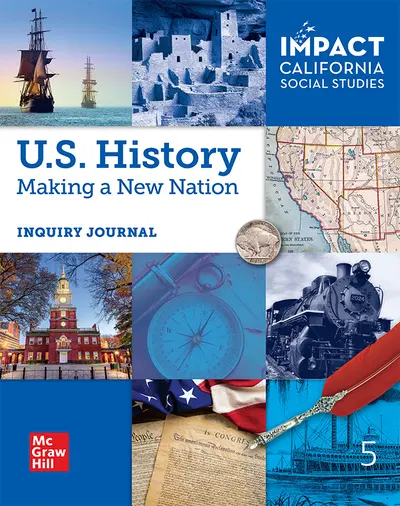
IMPACT California Social Studies, Grade 5
IMPACT California Social Studies for Grade 5, published by McGraw-Hill, is a history-focused textbook designed to guide fifth-grade students through the story of America from its earliest peoples to the era of westward expansion. The textbook covers key topics including pre-Columbian civilizations, the Age of Exploration, European colonization, the causes and events of the American Revolution, the founding of the new government, and the growth of the young republic. Students explore how the United States developed its identity, institutions, and territory through a chronological journey that builds both historical knowledge and civic understanding.
Chapters & Lessons
Chapter 1: The Land and People Before Columbus
5 lessonsIn this Grade 5 lesson from IMPACT California Social Studies Chapter 1, students explore how early American Indian groups developed by examining the migration of hunter-gatherers across the Beringia land bridge from Asia into the Americas. Students learn key concepts including the role of archaeologists and artifacts, the transition from hunter-gatherer societies to farming cultures, and the rise of the Olmec and Maya civilizations through food surpluses, trade networks, and achievements like hieroglyphs and calendar systems. The lesson builds foundational knowledge of pre-Columbian peoples and the geographic and environmental factors that shaped their cultures.
In this Grade 5 lesson from IMPACT California Social Studies, students explore how the Pueblo peoples — including the Hopi and Zuni — met their needs in the Desert Southwest through adobe construction, irrigation farming, and division of labor. Students also learn about key cultural practices such as kiva ceremonies and kachina traditions, as well as the Navajo people's migration from Athabascan regions and their adoption of Pueblo techniques. The lesson is part of Chapter 1's examination of Native American societies before European contact.
Grade 5 students explore how geography and natural resources shaped the cultures of American Indian peoples in California and the Pacific Northwest, including the Pomo, Miwok, Cahuilla, and Tlingit. This lesson from IMPACT California Social Studies Chapter 1 examines how distinct environments, from coastal forests to desert basins, led to unique practices such as Pomo basket weaving, Miwok acorn harvesting, and Cahuilla irrigation systems. Students learn how cultural regions, resource use, and adaptation to landscape defined pre-Columbian ways of life across the American West.
In this Grade 5 lesson from IMPACT California Social Studies Chapter 1, students explore how the geography of the Great Plains shaped the culture and daily life of Native peoples, including the Lakota, Cheyenne, and Pawnee. Students learn how Plains Indians relied on buffalo for food, shelter, and spiritual practice, and how the introduction of horses transformed their nomadic lifestyle. The lesson also covers the roles of men, women, and children within Plains communities and the use of teepees and lodges as homes.
In this Grade 5 lesson from IMPACT California Social Studies, students explore how the terrain, climate, and natural resources of the Eastern Woodlands shaped the daily lives of early peoples including the Cherokee, Creek, Natchez, and other tribes. Students examine key concepts such as slash-and-burn farming, seasonal hunting and harvesting cycles, and the "Three Sisters" crops of corn, beans, and squash. The lesson also covers how geography divided the region into distinct Northeast and Southeast cultures with different farming practices, food sources, housing styles, and traditions.
Chapter 2: The Age of Exploration
3 lessonsIn this Grade 5 lesson from IMPACT California Social Studies, students explore the causes of the Age of Exploration, including how the Ottoman Turks' capture of Constantinople disrupted Silk Road trade routes and pushed European nations to fund new voyages. Students learn how merchants, navigation technology like the astrolabe and compass, and events such as the Reconquista motivated Spain and Portugal to seek overseas expansion. The lesson also introduces key figures like Marco Polo and Prince Henry of Portugal and their roles in sparking European interest in distant lands.
In this Grade 5 lesson from IMPACT California Social Studies, students explore how Spanish exploration transformed life in the Americas through the Columbian Exchange, examining the transfer of plants, animals, diseases, and peoples between Europe, the Americas, Africa, and Asia. Students learn how conquistadors like Hernán Cortés and Juan Ponce de León expanded Spanish conquest and how the exchange brought both benefits, such as new foods and crops, and devastating consequences, including deadly diseases and the enslavement of native peoples like the Taíno.
In this Grade 5 lesson from IMPACT California Social Studies Chapter 2, students learn how European nations including England, France, and the Netherlands explored North America in search of the Northwest Passage, a hoped-for water route to Asia. Students examine the voyages of explorers such as John Cabot, Giovanni da Verrazzano, and Henry Hudson, and trace how these expeditions led to early colonial settlements like New Netherland. The lesson helps students understand the broader effects of European exploration on the Americas beyond Spanish conquest.
Chapter 3: A Changing Continent
5 lessonsIn this Grade 5 lesson from IMPACT California Social Studies, Chapter 3, students examine the founding of Jamestown in 1607, exploring why England's first permanent North American colony nearly failed due to poor site selection, starvation, and lack of leadership. Students learn how Captain John Smith's leadership, the Virginia Company's supply ships, and John Rolfe's introduction of tobacco helped the colony survive. The lesson also introduces the relationships between the English settlers and the Powhatan Indians, setting the stage for understanding both cooperation and conflict on a changing continent.
In this Grade 5 lesson from IMPACT California Social Studies, students examine how Spain, France, and England competed for land, trade, and power in colonial North America and how each nation interacted with American Indians. Students learn about key systems and institutions such as encomiendas, missions, and the fur trade, as well as the contrasting colonial strategies of New Spain, New France, and the English settlement at Jamestown. The lesson also explores the devastating impact of Spanish conquest and forced labor on American Indian populations.
In this Grade 5 lesson from IMPACT California Social Studies Chapter 3, students explore why the Pilgrims sought religious freedom in the New World and how they established the Plymouth Colony in 1620. Students examine key concepts including the Mayflower Compact as an early framework for self-government in colonial North America, the role of Squanto in the Pilgrims' survival, and the hardships colonists faced during their first winter. The lesson also introduces the broader New England colonial timeline, including Puritan settlement, the Pequot War, and King Philip's War.
In this Grade 5 lesson from IMPACT California Social Studies, students explore what shaped life in the Middle Colonies — New York, New Jersey, Pennsylvania, and Delaware — examining how ethnic and religious diversity, commerce, and fertile farmland made the region the "breadbasket" of colonial America. Students learn key concepts including tolerance, surplus agriculture, and the colonies' role as a center of trade and influential ideas. The lesson also covers the English takeover of New Netherland in 1664 and the treatment of enslaved people under Dutch and English rule.
In this Grade 5 lesson from IMPACT California Social Studies, students explore how the agricultural economy of the Southern Colonies was shaped by cash crops like tobacco, rice, cotton, and indigo, and why the region's fertile soil and long growing season made large-scale farming central to colonial life. Students also examine the founding of Virginia and Maryland, including the role of the tobacco trade, plantation farming, and the Maryland Toleration Act of 1649. The lesson connects economic factors to broader social and religious developments in the Southern Colonies during the colonial period.
Chapter 4: The Road to War
3 lessonsIn this Grade 5 lesson from IMPACT California Social Studies, students explore the causes of the French and Indian War, examining how competition over the Ohio River Valley drew Great Britain, France, and American Indian groups like the Iroquois Confederacy, Algonquin, and Huron into conflict. Students learn how competing economic interests — British farming expansion versus French fur trading — and shifting alliances led to key events like the Battle at Fort Duquesne and George Washington's early military role. The lesson builds understanding of colonial rivalries and the territorial disputes that set the stage for war.
In this Grade 5 lesson from IMPACT California Social Studies, Chapter 4, students explore the causes of colonial unrest by examining British tax laws including the Sugar Act and Stamp Act, and how those laws led colonists to argue against taxation without representation. Students learn how different groups — Patriots, Loyalists, and British officials — viewed Parliament's authority to tax the colonies following the French and Indian War. The lesson also introduces key figures like Samuel Adams and colonial protest groups such as the Sons of Liberty.
In this Grade 5 lesson from IMPACT California Social Studies, students explore the key events that escalated tensions between Great Britain and the colonists, including the Boston Massacre, the Townshend Acts, and the Boston Tea Party. Students learn how figures like Samuel Adams used the Committees of Correspondence to unite colonists against British taxation and control, and how acts of vandalism like dumping 342 tea chests into Boston Harbor led to serious consequences. The lesson connects to Chapter 4's broader examination of the colonial road to revolution.
Chapter 5: The American Revolution
5 lessonsIn this Grade 5 lesson from IMPACT California Social Studies, students learn how the American Revolution began with the Battles of Lexington and Concord in April 1775, including the roles of Paul Revere's midnight ride, the colonial militia, and the first shots fired against British troops. Students also explore how the Second Continental Congress responded to these events and what it meant for the colonies' path toward independence.
In this Grade 5 lesson from IMPACT California Social Studies, students explore why the Declaration of Independence remains significant by examining Enlightenment philosophy, including John Locke's social contract theory, and how those ideas shaped the document's core principles. Students also analyze Thomas Paine's pamphlet Common Sense, the role of the Committee of Five, and the debates within the Second Continental Congress over issues such as slavery that influenced the Declaration's final wording. The lesson helps students connect seventeenth- and eighteenth-century political thought to the founding of the United States.
In this Grade 5 lesson from IMPACT California Social Studies, students examine the defining moments of the American Revolution, including the strengths and weaknesses of both the British and Continental armies, key battles such as Trenton and Saratoga, and the strategic decisions that shaped the war's outcome. Students learn vocabulary terms like mercenaries, deserting, profiteers, and hoarding while analyzing how geography, morale, and foreign alliances influenced the fight for independence.
In this Grade 5 lesson from IMPACT California Social Studies Chapter 5, students explore the roles of women, African Americans, Loyalists, and spies during the American Revolution. Students learn about key figures such as Abigail Adams, Mary Ludwig Hays, Benedict Arnold, Nathan Hale, and James Armistead, examining how the war affected civilians beyond the battlefield. The lesson highlights concepts like loyalty, treason, and the tension between the ideals of the Declaration of Independence and the reality of slavery in the colonies.
In this Grade 5 lesson from IMPACT California Social Studies, students explore how the American Revolution ended, examining the British southern strategy under General Cornwallis, the pivotal Battle of Yorktown in 1781, and the role of key figures like Francis Marion and spy James Armistead. Students analyze how the Continental Army's tactical advantages and the Franco-American alliance led to British surrender, and what the colonists ultimately gained through the Peace of Paris in 1783.
Chapter 6: Forming a New Government
3 lessonsIn this Grade 5 lesson from IMPACT California Social Studies, students explore the Articles of Confederation as the first governing document of the United States, examining how it created a Confederation Congress while allowing states to retain independent powers like taxation and printing money. Students learn why the Articles ultimately proved too weak to unite the nation, including key events like Shays's Rebellion and the passage of the Northwest Ordinance. The lesson also covers how the Northwest Territory was organized and the impact of early U.S. expansion on American Indian peoples.
In this Grade 5 lesson from IMPACT California Social Studies, students learn how the Constitutional Convention of 1787 led to the creation of the U.S. Constitution, replacing the Articles of Confederation. Students examine key conflicts between the Virginia Plan and New Jersey Plan over legislative representation, and how the Great Compromise resolved disagreements between large and small states. The lesson covers foundational concepts including the two-house legislature, delegate representation, and the ratification process.
In this Grade 5 lesson from IMPACT California Social Studies, students explore the debate over ratification of the U.S. Constitution, examining the arguments made by Federalists and Antifederalists and key figures like James Madison, Alexander Hamilton, and Patrick Henry. Students learn how Antifederalist objections led to the creation of the Bill of Rights as constitutional amendments protecting citizens' liberties. The lesson uses primary sources such as The Federalist Papers and Patrick Henry's speech to help students understand how this compromise shaped American government.
Chapter 7: Life in the Young Republic
3 lessonsIn this Grade 5 lesson from IMPACT California Social Studies Chapter 7, students explore how early decisions shaped the United States government, including the creation of the Cabinet, the founding of Washington D.C., and the rise of the Federalist and Democratic-Republican parties. Students also learn about the landmark Supreme Court case Marbury v. Madison and the principle of judicial review, which established the Court's power to declare laws unconstitutional. The lesson uses a timeline of key events from 1789 to 1823 to help students connect these foundational decisions to the development of the young republic.
In this Grade 5 lesson from IMPACT California Social Studies, students explore the diverse groups living in the early United States, including westward-moving pioneers, frontier figures like Daniel Boone, and American Indian nations such as the Shawnee. Students examine key concepts like westward expansion, the Northwest Ordinance, the Battle of Fallen Timbers, and the Treaty of Greenville to understand how land conflict shaped the young republic. The lesson is part of Chapter 7, Life in the Young Republic, and asks students to analyze primary sources and consider the causes and consequences of settler migration into lands west of the Appalachians.
Chapter 8: The Westward Expansion
3 lessonsIn this Grade 5 lesson from IMPACT California Social Studies, students explore what settlers experienced during westward expansion, including the concept of Manifest Destiny and the Oregon Treaty that extended the U.S. border to the Pacific. Students learn how families traveled in wagon trains along the Oregon Trail, facing hardships such as extreme weather, disease, and rugged terrain while managing specific roles and limited supplies. The lesson also introduces primary source analysis through firsthand accounts of life on the trail.
In this Grade 5 lesson from IMPACT California Social Studies, students examine how westward expansion affected American Indians, focusing on the Indian Removal Act of 1830 and President Andrew Jackson's policy of forcibly relocating Native peoples from their homelands to "Indian Territory." Students also explore the Age of Jackson, including how a surge of new voters shaped American politics and how Jackson's controversial use of the veto and federal power sparked conflict across the nation. The lesson connects treaty violations, the Cherokee relocation, and the Seminole Wars to the broader consequences of U.S. expansion in Chapter 8.
In this Grade 5 lesson from IMPACT California Social Studies, students explore how Texas and California became part of the United States through events including American settlement in Mexican Texas, the Texas Revolution and the Battle of the Alamo, and the Mexican-American War. Students learn key concepts such as the Republic of Texas, the Bear Flag Republic, the Treaty of Guadalupe Hidalgo, and how westward expansion shaped the nation's boundaries in the mid-1800s.
Frequently Asked Questions
- Is IMPACT California Social Studies Grade 5 the right textbook for my child?
- IMPACT California Social Studies Grade 5 is specifically designed for California fifth graders and aligns with the California History-Social Science Framework. It covers the full scope of required content: pre-Columbian civilizations, European exploration, all three colonial regions, the road to revolution, the American Revolution, forming the new government, the young republic, and westward expansion. The inquiry-based format uses essential questions at the start of each lesson, which helps students engage with content more deeply than a traditional read-and-recall approach. If your child is in a California school, this is almost certainly the correct text.
- Which chapters or topics in IMPACT California Social Studies Grade 5 tend to be the hardest?
- Chapter 6 (Forming a New Government) is consistently the most challenging because students must understand why the Articles of Confederation failed, follow the Constitutional Convention debates including the Virginia Plan, New Jersey Plan, and Great Compromise, then distinguish between Federalist and Anti-Federalist arguments. Chapter 4 (The Road to War) is also difficult because there are many overlapping events — the French and Indian War, Proclamation of 1763, multiple tax acts, the Boston Massacre, Boston Tea Party — that students easily confuse or mis-sequence. Chapter 5's coverage of the Revolution requires students to track both military events and political developments simultaneously.
- My child is weak on the early American history topics — where should they start?
- Start with Chapter 1, especially Lesson 1 on how early American Indian groups developed through migration and the rise of civilizations. This lesson establishes the geographic and cultural foundation that the rest of the book builds on. Then work through Chapter 2 on the Age of Exploration carefully — the Columbian Exchange lesson is particularly important because the concept of first contact and its consequences reappears in every colonial chapter. Students who understand why Europeans came to the Americas and what happened to Native peoples upon contact have a much easier time following the cause-and-effect chains in Chapters 3 through 8.
- What should my child study after finishing IMPACT California Social Studies Grade 5?
- After completing Grade 5, California students typically move to Grade 6 World History, which steps back to examine ancient civilizations before returning to the modern era in later grades. The civics and government foundations built in Chapter 6 — the Constitution, Bill of Rights, federalism, checks and balances — also directly support the 8th grade U.S. History and Government course, which revisits these concepts in depth. If your child became particularly interested in the Revolution or the Constitution, consider having them read accessible primary sources like the Declaration of Independence or simplified Federalist Papers to deepen their understanding.
- How can Pengi help my child with IMPACT California Social Studies Grade 5?
- Pengi can help your child navigate the high information density of this course without getting overwhelmed. If your child cannot keep the sequence of events leading to the Revolution straight across Chapter 4, Pengi can build a step-by-step timeline through dialogue and help your child understand why each event led to the next. For the difficult Chapter 6 constitutional debates, Pengi can explain the difference between the Virginia Plan and New Jersey Plan using modern analogies, then quiz your child on the key terms. Pengi is also excellent for lesson vocabulary review — your child can describe a term and Pengi can confirm or clarify the definition, turning passive re-reading into active recall.
Ready to start learning?
Jump into your first lesson for IMPACT California Social Studies, Grade 5. Free, no account required.
Start Learning