
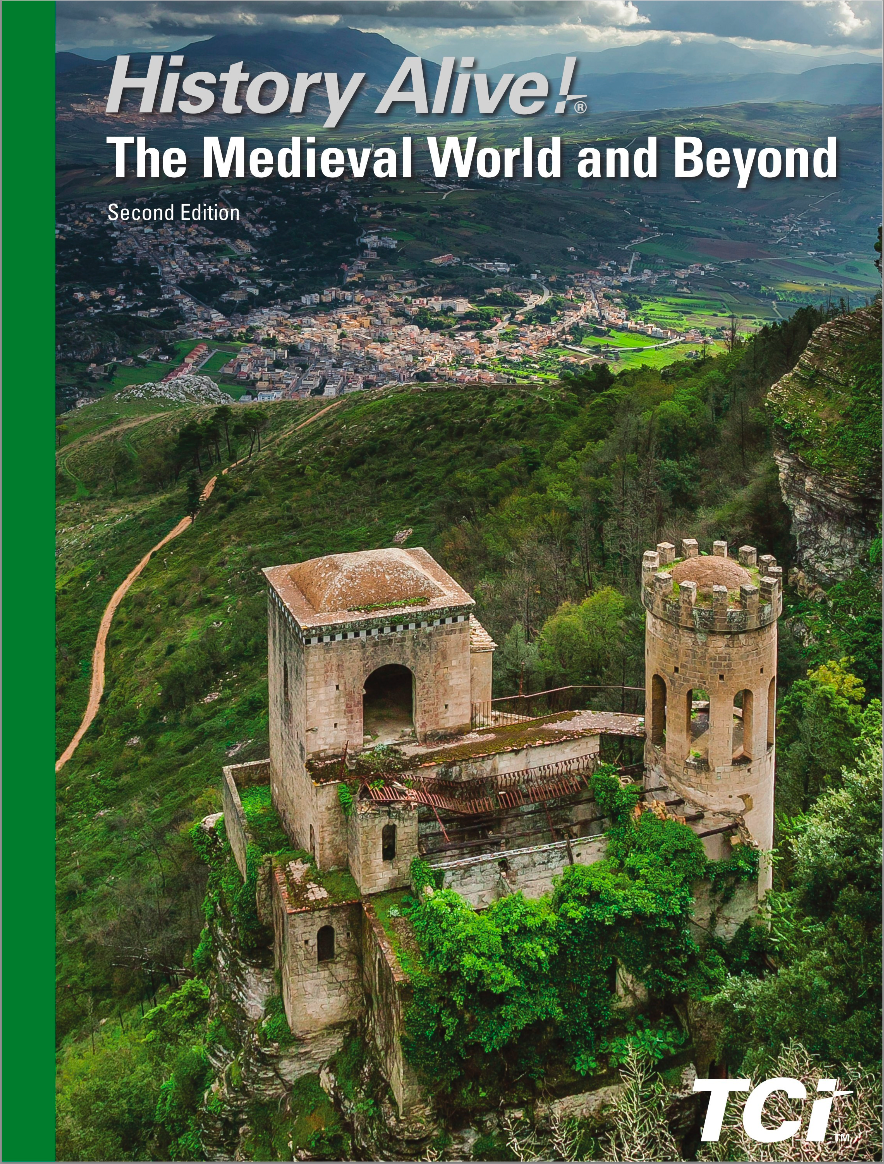
History Alive! The Medieval World and Beyond
History Alive! The Medieval World and Beyond, published by Teachers' Curriculum Institute (TCI), is a Grade 7 history textbook that takes students on a broad survey of world civilizations from roughly 300 to 1500 CE. The curriculum covers medieval Europe, the rise and spread of Islam, South Asia, West African kingdoms, Imperial China, feudal Japan, and the civilizations of the Americas, giving students a genuinely global perspective on the medieval period. It concludes by examining the European Renaissance, Reformation, and the early transition into the modern age.
Chapters & Lessons
Chapter 1: Europe During Medieval Times
8 lessonsIn this Grade 7 lesson from History Alive! The Medieval World and Beyond, students trace Rome's transformation from a republic to an empire across four major periods of expansion, from 509 B.C.E. to 14 C.E. Students learn key concepts including the Punic Wars, the role of Julius Caesar as dictator, the rise of Augustus, and the establishment of the Pax Romana. The lesson also examines the costs of Roman expansion for both Romans and conquered peoples, encouraging students to weigh the benefits and consequences of imperial growth.
Grade 7 students explore the origins and spread of Christianity in this lesson from History Alive! The Medieval World and Beyond, learning how the faith emerged in the Roman-controlled territory of Judea and expanded across the empire. Students examine key concepts including the life and teachings of Jesus, the role of the Messiah prophecy, and how Emperor Constantine's conversion led to Christianity becoming the official religion of Rome by 380 C.E. The lesson also introduces vocabulary such as Gospel, disciple, missionary, parable, and Resurrection to build a foundational understanding of early Christian history.
Grade 7 students explore the fall of the Western Roman Empire and its lasting legacy in this lesson from History Alive! The Medieval World and Beyond. Students examine key causes of Rome's decline, including political instability, economic hardship, corruption, and weakening frontiers, before analyzing how Roman contributions in art, architecture, engineering, language, law, and philosophy continue to shape modern society. The lesson connects ancient history to the beginning of the Middle Ages, helping students evaluate the long-term influence of the Roman Empire on the medieval and contemporary world.
Grade 7 students explore the rise of feudalism in Western Europe using History Alive! The Medieval World and Beyond, learning how the collapse of the Roman Empire in 476 C.E. created conditions that led to this political and economic system. The lesson covers key concepts including lords, serfs, fiefs, knights, and chivalry, as well as the role of Charlemagne in unifying Europe and laying the groundwork for feudal order. Students examine how feudalism established defined roles and relationships that brought security and structure to a fragmented medieval society.
In this Grade 7 History Alive! The Medieval World and Beyond lesson, students explore the influential role of the Roman Catholic Church in medieval Europe during the High Middle Ages (c. 1000–1300 C.E.). Students learn how the Church developed its hierarchical organization — from pope and cardinals to archbishops, bishops, and parish priests — and how it accumulated economic and political power through land ownership, tithing, and control of literacy. The lesson also covers key vocabulary such as clergy, sacrament, religious order, and pilgrimage within the context of the "Age of Faith."
Grade 7 students studying History Alive! The Medieval World and Beyond explore daily life in medieval European towns during the Late Middle Ages, learning how agricultural surpluses, the revival of trade, and royal charters drove urban growth and shifted power from feudal lords to merchants and craftspeople. The lesson examines specific aspects of town life including guilds, commerce, housing conditions, disease, crime, and leisure. Students gain a concrete understanding of how and why medieval towns emerged as centers of trade and industry between approximately 1300 and 1450 C.E.
In this Grade 7 lesson from History Alive! The Medieval World and Beyond, students examine the key factors that led to the decline of feudalism in medieval Europe, including the Magna Carta, the bubonic plague, and the Hundred Years' War. Students learn how political reforms under King Henry II and King John shifted power away from feudal lords, how the Black Death caused sweeping social and economic changes, and how the Hundred Years' War transformed warfare and governance. The lesson also introduces foundational democratic concepts such as habeas corpus and the Model Parliament as outcomes of feudalism's collapse.
In this Grade 7 lesson from History Alive! The Medieval World and Beyond, students explore the Byzantine Empire, tracing its origins as the eastern continuation of the Roman Empire and the rise of Constantinople as its capital. Students learn how Emperor Justinian I shaped the empire and examine key developments in the Eastern Orthodox Church, including the growing conflict with the Roman Catholic Church that led to a permanent split. The lesson introduces essential vocabulary such as patriarch, Byzantine Empire, and Constantinople within the broader context of medieval European history.
Chapter 2: Islam in Medieval Times
4 lessonsGrade 7 students explore the origins and spread of Islam in this lesson from History Alive! The Medieval World and Beyond, learning how Muhammad founded the faith in 7th-century Arabia and how it grew from Mecca across the Arabian Peninsula and beyond. Students examine key concepts including monotheism, polytheism, the significance of the Ka'bah, and the social and cultural conditions of 6th-century Arabia that shaped Islam's emergence.
In this Grade 7 lesson from History Alive! The Medieval World and Beyond, students explore the core beliefs and practices of Islam, including the Five Pillars of Islam, the Qur'an, the Sunnah, jihad, and shari'ah. Students examine how Islam originated with the prophet Muhammad in the 7th century and how it connects to Judaism and Christianity through shared monotheistic roots and the concept of the ummah. The lesson builds understanding of how these foundational teachings shape the daily lives of Muslims around the world.
In this Grade 7 History Alive! The Medieval World and Beyond lesson, students explore the key innovations and adaptations made by medieval Muslims across fields including mathematics, medicine, astronomy, architecture, and geography. The lesson introduces concepts such as cultural diffusion and examines how Islamic civilization preserved and advanced ancient Greek, Persian, and Indian knowledge while spreading ideas along major trade routes connecting Asia, Europe, and Africa. Students also study the growth of major Muslim cities like Baghdad and the lasting influence of Islamic contributions on modern language, science, and daily life.
In this Grade 7 lesson from History Alive! The Medieval World and Beyond, students examine the Crusades — the series of religious wars launched by European Christians beginning in 1096 to reclaim Jerusalem and the Holy Land from the Seljuk Turks. The lesson explores how the Seljuk conquest of Palestine, the Battle of Manzikert, and Pope Urban II's call to arms set the conditions for these conflicts, and how Christians, Muslims, and Jews were each affected. Students also investigate the rise of new Muslim empires that emerged in the aftermath and the continued spread of Islam to new regions.
Chapter 3: South Asia 300-1200
2 lessonsGrade 7 students explore the Gupta Empire's golden age in this lesson from History Alive! The Medieval World and Beyond, learning how Chandragupta I united northern India through conquest and alliances beginning in 320 C.E. Students examine seven major achievements of the Gupta Empire across areas such as universities, literature, mathematics, and astronomy, and understand why historians consider this period India's Classical Age of prosperity and advancement.
In this Grade 7 lesson from History Alive! The Medieval World and Beyond, students explore how Hinduism, Buddhism, and Islam evolved as they spread across South and Southeast Asia during the medieval period. Students examine key concepts including the Bhakti movement, the rise of devotional sects such as Vaishnavism and Shaivism, the role of poet-saints in vernacular religious literature, and the development of Mahayana Buddhism. The lesson connects trade networks like the Silk Road to the exchange of religious and cultural ideas across Asia.
Chapter 4: The Culture and Kingdoms of West Africa
4 lessonsIn this Grade 7 lesson from History Alive! The Medieval World and Beyond, students examine how geography, trade, and iron-working shaped the development of early societies in West Africa between 500 and 1600 C.E. Students explore how West Africa's distinct vegetation zones — the Sahara, Sahel, savanna, and forest — influenced settlement patterns and trade networks along the Niger River. The lesson also introduces key vocabulary such as smelting, tribute, and artifact as students trace how family-based communities grew into the kingdoms of Ghana, Mali, and Songhai.
In this Grade 7 lesson from History Alive! The Medieval World and Beyond, students explore how trans-Saharan trade drove the wealth and power of the West African kingdom of Ghana, which flourished from before 500 C.E. until the 1200s. Students examine Ghana's government structure, including the king's control of the gold trade, the matrilineal system of royal inheritance, and the organization of its military. The lesson also introduces key vocabulary such as trans-Saharan trade and matrilineal as students analyze the political and economic foundations of Ghana's empire.
Grade 7 students in History Alive! The Medieval World and Beyond explore how Islam spread to West Africa through trans-Saharan trade beginning in the 8th century and the impact it had on West African society. This lesson covers key concepts including the role of Muslim merchants in Ghana, the rise of Mali under Mansa Musa, and Islam's influence on religious practices, government, education, language, and architecture. Students examine how West Africans blended Islamic customs with local traditions, creating a distinctive cultural transformation still visible in the region today.
In this Grade 7 lesson from History Alive! The Medieval World and Beyond, students explore the cultural legacy of medieval West Africa, focusing on oral traditions, griots, folktales, and visual arts such as kente cloth and terra-cotta sculpture. Students learn how griots served as poet-musicians and record keepers who preserved genealogies and historical accounts for the Mande people, and how West African traditions like trickster tales and call-and-response music spread to the Americas. The lesson connects these medieval cultural achievements to their lasting influence on world culture today.
Chapter 5: Imperial China
4 lessonsIn this Grade 7 lesson from History Alive! The Medieval World and Beyond, students examine the political development of Imperial China from 220 to 1644 C.E., focusing on key concepts such as dynasty, the Mandate of Heaven, bureaucracy, and meritocracy. Students explore how emperors selected government officials through methods ranging from aristocracy to civil service examinations, and analyze how the rise and fall of dynasties like the Han, Sui, and Tang shaped medieval China. The lesson also introduces the role of warlords and Mongol conquest in transforming Chinese imperial government.
In this Grade 7 lesson from History Alive! The Medieval World and Beyond, students explore how China developed one of the world's most advanced economies during the Tang and Song dynasties (618–1279 C.E.). The lesson focuses on key drivers of economic growth including the introduction of champa rice, new farming techniques such as terracing and chain pump irrigation, and the expansion of trade and commerce along the Grand Canal. Students also examine how agricultural surpluses fueled urbanization and raised China's standard of living above that of any other civilization at the time.
In this Grade 7 lesson from History Alive! The Medieval World and Beyond, students explore how medieval Chinese innovations between 200 and 1400 C.E. shaped the modern world, focusing on advances in exploration, industry, military technology, and medicine. Students examine specific inventions such as the magnetic compass, watertight ship compartments, paddlewheel boats, and canal locks, tracing how each improved travel and trade during the Tang and Song dynasties. The lesson also introduces key vocabulary including gunpowder, movable type, and inoculation to build understanding of China's broader technological influence.
In this Grade 7 lesson from History Alive! The Medieval World and Beyond, students examine how foreign-contact policies of the Tang, Yuan (Mongol), and Ming dynasties shaped medieval China, exploring concepts such as cultural exchange along the Silk Road, the spread of Buddhism, and the tributary system. Students analyze how China alternately welcomed outside influence — adopting goods, religions, and customs from Persia, India, and Central Asia — and sought to limit or close off foreign contact entirely, including the maritime expeditions of Zheng He under the Ming dynasty.
Chapter 6: Japan During Medieval Times
3 lessonsIn this Grade 7 lesson from History Alive! The Medieval World and Beyond, students explore how cultural diffusion shaped medieval Japan as neighboring civilizations introduced Buddhism, Confucianism, bronze casting, and new styles of art and architecture between the 6th and 9th centuries C.E. Students examine the roles of Empress Suiko and Prince Shotoku in actively seeking contact with China and Korea, and how Japan absorbed and blended elements of mainland culture into its own unique civilization. The lesson also introduces key vocabulary including pagoda, cultural diffusion, uji, and Shinto within the context of Japan's government, arts, and religious development.
Grade 7 students explore daily life and culture during Japan's Heian period in this lesson from History Alive! The Medieval World and Beyond, examining how aristocrats in the imperial capital of Heian-kyo shaped Japan's golden age through new forms of literature, art, and court customs. Students learn how Emperor Kammu established the capital in 794, how the Fujiwara family rose to political dominance, and how Heian aristocrats valued beauty, elegance, and formal manners in every aspect of their lives.
Grade 7 students explore the rise of the samurai warrior class in medieval Japan through this lesson from History Alive! The Medieval World and Beyond, examining how the shogunate system replaced imperial rule following the Heian period. Students learn key concepts including the roles of the shogun, daimyo, and samurai within Japan's lord-vassal military hierarchy, as well as the code of Bushido and the influence of Zen and Amida Buddhism on samurai culture. The lesson traces the warrior class from Minamoto Yoritomo's rise to power in 1185 through the Tokugawa shogunate of 1603.
Chapter 7: Civilizations of the Americas
5 lessonsGrade 7 students explore the rise, flourishing, and fall of Maya civilization in this lesson from History Alive! The Medieval World and Beyond. Students examine key developments including the Olmec origins, three historical periods (Pre-Classic, Classic, and Post-Classic), hieroglyphic writing, ceremonial centers, and slash-and-burn agriculture across Mesoamerica. The lesson also covers Maya social structure, religious practices, and the agricultural techniques that sustained one of the ancient world's most advanced civilizations.
In this Grade 7 lesson from History Alive! The Medieval World and Beyond, students explore how the Aztecs rose to power in the Valley of Mexico, tracing their origins as nomadic Mexica hunter-gatherers through their settlement on Lake Texcoco and the founding of Tenochtitlán. Students examine the influence of earlier civilizations, including the Teotihuacáns and Toltecs, and learn how the Aztecs used mercenary warfare and political alliances to establish dominance in the region.
In this Grade 7 lesson from History Alive! The Medieval World and Beyond, students explore daily life in the Aztec capital of Tenochtitlán during the 1400s C.E. The lesson covers Aztec class structure, including the roles of the semidivine ruler, the noble class of priests and government officials, commoners such as the pochteca traders, and enslaved people, as well as how social mobility worked within this hierarchy. Students also examine Aztec marriage customs, family life, food, markets, religious practices, and recreation in one of the largest cities of the medieval world.
Grade 7 students examine how the Inca Empire was built and governed, exploring key concepts such as the role of the Sapa Inca, the quipu communication system, and the chasqui messenger relay network. The lesson also covers the empire's origins in Cuzco, the conquests of rulers like Pachacuti, and the cultural influences of earlier Andean civilizations like the Moches and Chimus. This content is part of Chapter 7 in History Alive! The Medieval World and Beyond.
In this Grade 7 lesson from History Alive! The Medieval World and Beyond, students explore the major achievements of the Maya, Aztecs, and Incas across three cultural areas: science and technology, arts and architecture, and language and writing. Key concepts include the Maya solar calendar and base-20 number system, the use of glyphs and pictographs, Aztec temple construction, and Inca engineering, along with vocabulary terms such as stele, solar year, and trephination. Students gain a comparative understanding of how each civilization contributed to Mesoamerican and Andean history from ancient times through the 1500s.
Chapter 8: The Medieval World, 1200-1490
2 lessonsGrade 7 students studying History Alive! The Medieval World and Beyond explore how Genghis Khan united nomadic tribes into the Mongol Empire and expanded its territory across Eurasia through military conquest. The lesson covers key concepts including the roles of khagan, khan, and khanate, as well as how the empire was divided among Genghis Khan's successors into four khanates such as the Golden Horde and Il-Khanate. Students also examine how Mongol rule, despite its brutal methods, fostered increased trade and cultural exchange across Afroeurasia between 1200 and 1490.
In this Grade 7 lesson from History Alive! The Medieval World and Beyond, students explore how the global spice trade drove the development of long-distance trade networks across Africa, Europe, and Asia between 500 and 1500 C.E. Students examine how regional imbalances of goods — including silk, cotton, gold, and spices — motivated civilizations like China, India, and the Italian city-states of Venice and Genoa to establish overland and sea trade routes. The lesson also introduces key vocabulary such as portolan charts and analyzes how expanding trade sparked both cultural exchange and new religious and political conflicts.
Chapter 9: Europe's Renaissance and Reformation
5 lessonsIn this Grade 7 lesson from History Alive! The Medieval World and Beyond, students explore the origins of the Renaissance in 14th-century Italy and examine how it differed from the Middle Ages. The lesson covers key concepts including humanism, individualism, classical art, and the humanities, tracing how renewed interest in ancient Greek and Roman culture transformed European thinking and creativity. Students also analyze how changes such as increased trade, growing cities, and wealthy merchant patrons helped create the conditions that sparked the Renaissance.
In this Grade 7 lesson from History Alive! The Medieval World and Beyond, students explore why Florence became the cradle of the Renaissance, examining how its location on the Arno River, the wool trade, and the banking wealth of the Medici family fueled an extraordinary cultural flowering. Students learn how humanism shaped advances in architecture, engineering, painting, sculpture, literature, science, and mathematics across 14th- to 16th-century Florence. Key figures including Dante Alighieri, Leonardo da Vinci, Michelangelo, Donatello, and Niccolò Machiavelli are introduced as central contributors to this pivotal era in Western history.
Grade 7 students studying Chapter 9 of History Alive! The Medieval World and Beyond examine ten influential Renaissance figures, including Leonardo da Vinci, Michelangelo, and Johannes Gutenberg, and explore how their contributions in art, science, and technology continue to shape modern society. The lesson covers the diffusion of Renaissance ideas from Italy throughout Europe through trade, travel, and education, and explains how Gutenberg's invention of the movable-type printing press transformed the spread of knowledge. Students also learn the meaning of the term "Renaissance person" and how humanism and new methods of observation influenced culture across multiple fields.
In this Grade 7 lesson from History Alive! The Medieval World and Beyond, students examine the factors that weakened the Roman Catholic Church leading up to the Reformation, including worldliness, corruption, the selling of indulgences, simony, and political conflicts between popes and European monarchs. Students learn how Renaissance humanism contributed to a spirit of questioning Church authority and how these conditions set the stage for Martin Luther and the emergence of Protestantism.
Grade 7 students explore the spread and impact of the Reformation in this lesson from History Alive! The Medieval World and Beyond, examining how major Protestant denominations — including Lutheranism, Calvinism, and Anglicanism — developed distinct beliefs around justification by faith and biblical authority. Students also learn how the Catholic Church responded through the Counter-Reformation and how religious divisions fueled wars and persecutions across Europe.
Chapter 10: Europe Enters the Modern Age
3 lessonsIn this Grade 7 lesson from History Alive! The Medieval World and Beyond, students explore the causes and key voyages of the Age of Exploration (1418–1620), examining why European nations sought new ocean trade routes to Asia and how motives such as mercantilism, the spread of Christianity, and the pursuit of fame drove explorers like Columbus and Magellan. Students also learn how Renaissance advances in cartography and navigation technology made these daring voyages possible, and how discoveries like the Americas reshaped European understanding of the world.
In this Grade 7 lesson from History Alive! The Medieval World and Beyond, students explore the Scientific Revolution (1500–1700) and how it transformed European understanding of the natural world by replacing reliance on Aristotle and religious texts with rationalism and the scientific method. Students examine key concepts including the geocentric and heliocentric theories, hypothesis, mass, and gravity through the discoveries of scientists like Galileo, Copernicus, and Kepler. The lesson traces the roots of the Scientific Revolution through the Renaissance, the Age of Exploration, and the development of direct observation and logical reasoning as tools for scientific inquiry.
In this Grade 7 lesson from History Alive! The Medieval World and Beyond, students explore the origins and core ideas of the Enlightenment, examining how the Scientific Revolution, Renaissance, and Reformation shaped Enlightenment thinking about reason, natural rights, and government. Students learn key concepts such as the social contract, separation of powers, constitutional monarchy, and religious tolerance, and study how philosophers applied rational inquiry to challenge accepted beliefs about politics and society.
Frequently Asked Questions
- Is History Alive! The Medieval World and Beyond right for my seventh grader?
- History Alive! The Medieval World and Beyond is an excellent choice for seventh-grade world history. Its 10 chapters cover medieval Europe, Islam, South Asia, West Africa, Imperial China, medieval Japan, the Americas, the Renaissance, the Reformation, and the early modern transition—a genuinely global scope that matches most seventh-grade state standards. Teachers Curriculum Institute designed it around interactive learning: students use maps, primary sources, and comparative analysis rather than passive reading. It is widely used in California and other states. If your child's school uses this textbook, it is the right resource. Students who completed History Alive! The Ancient World in sixth grade will find the transition natural since this book picks up chronologically where that one ends.
- Which chapters in History Alive! The Medieval World and Beyond are hardest for seventh graders?
- Chapter 2 (Islam in Medieval Times) and Chapter 8 (The Medieval World, 1200-1490) are consistently the most challenging. Chapter 2 requires students to understand the Five Pillars, the spread of Islam, and the political fragmentation of the caliphate as interconnected phenomena—unfamiliar religious and political vocabulary creates barriers. Chapter 8 is a synthesis chapter that asks students to connect developments across multiple regions, which demands broader retention than individual chapter study typically builds. Chapter 9 (Europe's Renaissance and Reformation) is also demanding because students must track how economic, religious, and intellectual forces interact simultaneously across a century and a half. Chapter 3 (South Asia 300-1200) is content-dense with terminology unfamiliar to most American students.
- My child is struggling with medieval history—where should they start?
- Start with Chapter 1 (Europe During Medieval Times) because it is the most familiar starting point for US students—feudalism, knights, the Catholic Church, and the Crusades connect to prior knowledge from elementary school and popular culture. Once your child has the medieval European framework in mind, Chapter 2 (Islam) makes more sense because much of the Islamic empire's story unfolds in relation to Europe and Byzantium. From there, working through the non-European chapters (3 through 7) in order builds a comparative picture: by the time students reach Chapter 8's synthesis, they have frameworks for Africa, China, Japan, and the Americas that allow cross-regional comparison. Review the maps at the start of each chapter before reading the text.
- What should my child study after finishing History Alive! The Medieval World and Beyond?
- Eighth-grade US history is the standard next course in most school sequences. Students who have completed the Renaissance and Reformation chapters (9 and 10) are well prepared because those topics directly connect to the colonization of the Americas, which is often the starting point for eighth-grade US history. Pengi Social Studies Grade 8 picks up exactly at the Revolutionary Era, which follows logically from the European transformations covered in this book's final chapters. Students interested in going deeper on any region—Islamic civilization, Imperial China, or West Africa—will find additional textbook resources on Pengi that extend those specific chapters.
- How can Pengi help my child with History Alive! The Medieval World and Beyond?
- Pengi can help your child prepare for the interactive components that are central to this curriculum—socratic seminars, structured debates, and document-based questions. Before a class discussion on whether the Crusades were justified, Pengi can help your child develop evidence-based arguments from Chapter 1 and Chapter 2 perspectives. For the dense terminology chapters like Chapter 2 (Islam) or Chapter 3 (South Asia), Pengi can create glossaries, explain interconnections between terms, and generate practice questions that mirror what shows up on chapter tests. When your child needs to write a comparative essay across two chapters—say, comparing Imperial China and medieval Japan—Pengi can help structure the argument and identify relevant evidence.
Ready to start learning?
Jump into your first lesson for History Alive! The Medieval World and Beyond. Free, no account required.
Start Learning