
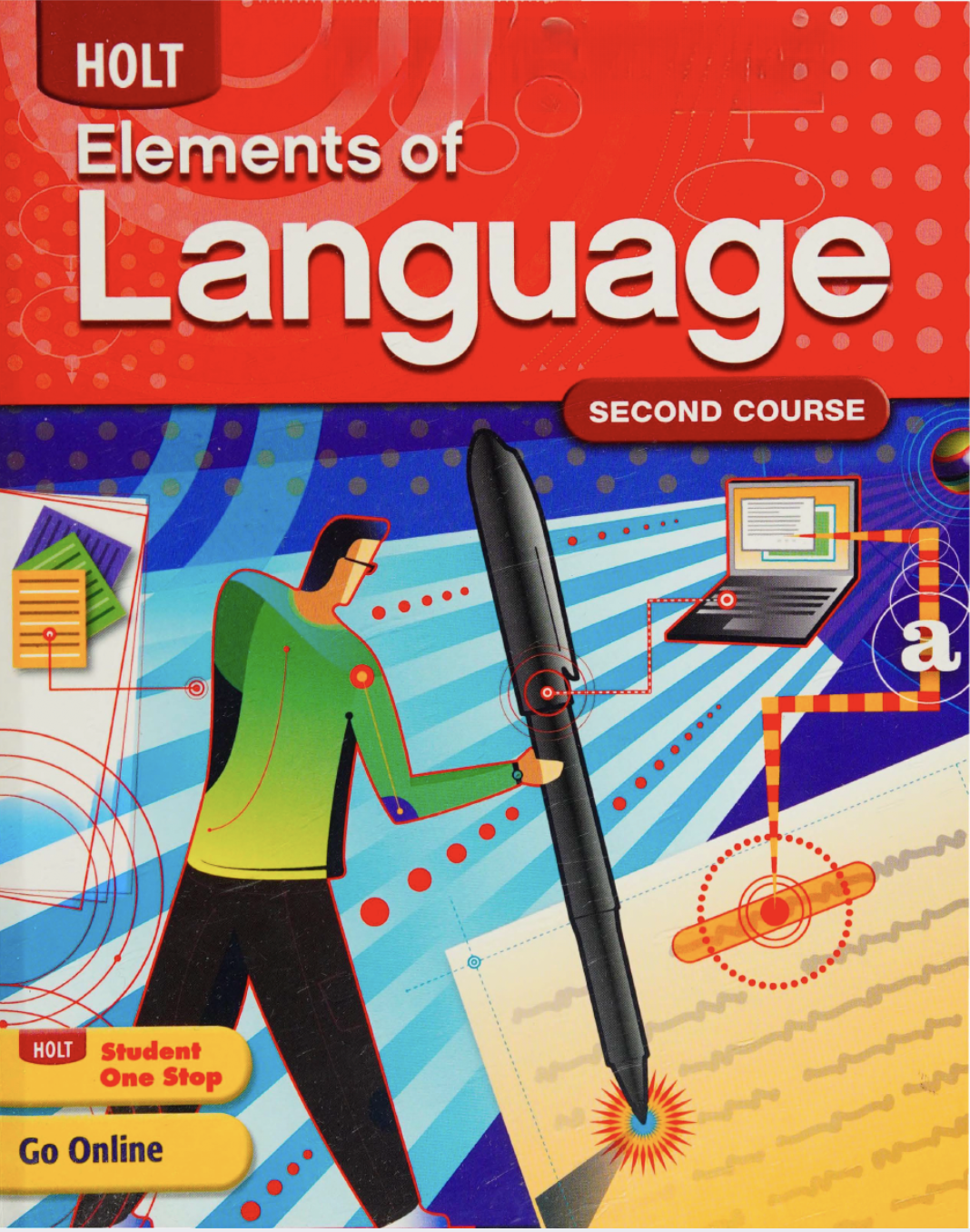
Elements of Language, 2nd Course
Elements of Language, 2nd Course, published by Holt, Rinehart and Winston, is a comprehensive grammar and language arts textbook designed for Grade 7 students, though it is sometimes used in advanced Grade 5 settings. The book covers the full range of foundational grammar skills, including parts of speech, sentence structure, phrases and clauses, subject-verb agreement, and correct pronoun and modifier usage. It also addresses essential writing conventions such as capitalization, punctuation, spelling, and common usage problems, giving students a thorough grounding in standard written English.
Chapters & Lessons
Chapter 1: The Parts of a Sentence: Subject and Predicate, Kinds of Sentences
4 lessonsIn this Grade 5 grammar lesson from Elements of Language, 2nd Course, students learn to distinguish between a complete sentence and a sentence fragment by identifying whether a word group contains both a subject and a verb and expresses a complete thought. The lesson covers key concepts such as understood subjects, proper capitalization, and end punctuation. Students practice through exercises that require them to classify word groups, correct fragments, and apply sentence rules to real examples.
In this Grade 5 grammar lesson from Elements of Language, 2nd Course, students learn to identify the subject of a sentence, including complete subjects, simple subjects, and compound subjects. The lesson explains that the simple subject is the main word in the complete subject and is never found after a preposition. Students practice locating subjects in varied sentence structures through three sets of exercises.
In this Grade 5 grammar lesson from Elements of Language, 2nd Course, students learn to identify the complete predicate, simple predicate (verb), and compound verb in sentences. The lesson covers how predicates can appear at the beginning, end, or divided positions within a sentence, and explains that words like "not" and "never" are not verbs even when attached to them. Students practice underlining complete predicates and verbs through exercises involving statements, questions, and commands.
In this Grade 5 lesson from Elements of Language, 2nd Course, students learn to classify sentences by purpose into four types: declarative, imperative, interrogative, and exclamatory. The lesson covers how each sentence type functions — making statements, giving commands, asking questions, or expressing strong feeling — along with the correct end punctuation for each. Students practice identifying all four sentence types through two sets of guided exercises.
Chapter 2: Parts of Speech Overview: Noun, Pronoun, Adjective
5 lessonsIn this Grade 5 grammar lesson from Elements of Language, 2nd Course, students learn to identify and classify nouns as words that name persons, places, things, or ideas. The lesson covers compound nouns, common and proper nouns, and the distinction between concrete and abstract nouns, with guided exercises for each concept. Students practice recognizing all four noun types in sentences and applying capitalization rules for proper nouns.
In this Grade 5 grammar lesson from Elements of Language, 2nd Course, students learn what a pronoun is and how it replaces nouns to avoid awkward repetition. The lesson covers personal pronouns across first, second, and third person, as well as the concept of antecedents — the nouns that pronouns stand for. Practice exercises guide students in identifying pronouns, classifying them by person, and tracing each pronoun back to its antecedent.
In this Grade 5 grammar lesson from Elements of Language, 2nd Course, students learn to identify and use reflexive pronouns, intensive pronouns, demonstrative pronouns, and interrogative pronouns. The lesson explains how reflexive pronouns refer back to the subject while intensive pronouns emphasize a noun or pronoun, and introduces demonstrative pronouns such as this, that, these, and those alongside interrogative pronouns like who, whom, which, whose, and what. Students practice distinguishing between these pronoun types through sentence-level exercises.
In this Grade 5 grammar lesson from Elements of Language, 2nd Course, students learn to identify and use relative pronouns (that, which, who, whom, whose) and indefinite pronouns (such as many, each, someone, and nothing). The lesson explains how relative pronouns introduce subordinate clauses and how indefinite pronouns refer to people, places, things, or ideas that are not specifically named. Practice exercises guide students in distinguishing indefinite pronouns from adjectives that look identical.
In this Grade 5 grammar lesson from Elements of Language, 2nd Course, students learn how adjectives modify nouns and pronouns by answering the questions what kind, which one, how much, and how many. The lesson also covers the three articles — a, an, and the — explaining the difference between indefinite and definite articles, including rules for choosing a versus an based on consonant and vowel sounds. Students practice identifying adjectives through exercises that reinforce placement before or after the words they describe.
Chapter 3: Parts of Speech Overview: Verb, Adverb, Preposition, Conjunction, Interjection
5 lessonsIn this Grade 5 grammar lesson from Elements of Language, 2nd Course, students learn to identify verbs as words that express action or a state of being. The lesson also covers the distinction between main verbs and helping verbs, including how they combine to form verb phrases using auxiliary verbs such as forms of be, do, and have. Practice exercises guide students through recognizing verbs and complete verb phrases in context.
In this Grade 5 grammar lesson from Elements of Language, 2nd Course, students learn to distinguish between action verbs, which express physical or mental action, and linking verbs, which connect the subject to a word that identifies or describes it. The lesson covers how to identify verb phrases that include helping verbs and introduces common linking verbs such as forms of "be" along with words like appear, become, feel, and seem. Practice exercises guide students through recognizing and underlining both verb types in context.
In this Grade 5 grammar lesson from Elements of Language, 2nd Course, students learn what an adverb is and how adverbs modify verbs, adjectives, and other adverbs to answer questions such as where, when, how, how often, how long, and to what extent. The lesson covers adverb placement within sentences and includes the special case of not and contractions like hadn't as adverbs. Practice exercises reinforce identifying adverbs and the specific words they modify, including all parts of a verb phrase.
Grade 5 students learn about prepositions in this lesson from Elements of Language, 2nd Course, part of the broader Parts of Speech unit. The lesson defines a preposition as a word that shows the relationship between a noun or pronoun (the object of the preposition) and another word, covering common prepositions such as in, beside, above, and on, as well as compound prepositions like in front of, instead of, and according to. Practice exercises ask students to identify both single and compound prepositions within sentences.
In this Grade 5 grammar lesson from Elements of Language, 2nd Course, students learn to identify and use conjunctions and interjections as parts of speech. The lesson covers coordinating conjunctions such as and, but, or, and so, as well as correlative conjunction pairs like both...and and either...or, explaining how each type joins words, phrases, or clauses. Students also explore interjections like wow and hooray, learning how punctuation differs based on whether the emotion expressed is strong or mild.
Chapter 4: Complements: Direct and Indirect Objects, Subject Complements
4 lessonsIn this Grade 5 grammar lesson from Elements of Language, 2nd Course, students learn to identify complements — nouns, pronouns, or adjectives that complete the meaning of a verb in a sentence. The lesson covers how to distinguish complements from adverbs and prepositional phrases, which can never serve as complements. Students practice recognizing complements through exercises involving direct identification and arrow-drawing activities.
In this Grade 7 lesson from Elements of Language, 2nd Course, students learn to identify direct objects and indirect objects of verbs, understanding how direct objects answer the questions "Whom?" or "What?" after a verb and how indirect objects answer "To whom?", "To what?", "For whom?", or "For what?". The lesson also clarifies the important distinction between indirect objects and objects of prepositions following "to" or "for". Students practice locating both types of objects through sentence analysis exercises.
In this Grade 5 grammar lesson from Elements of Language, 2nd Course, students learn to identify predicate nominatives — nouns, pronouns, or word groups that follow a linking verb and identify or refer to the subject. The lesson covers how to locate predicate nominatives in both statements and questions, and introduces compound predicate nominatives where two or more words together identify the subject.
In this Grade 5 grammar lesson from Elements of Language, 2nd Course, students learn to identify predicate adjectives — adjectives that appear in the predicate and describe the subject by completing the meaning of a linking verb. The lesson covers common linking verbs such as is, appear, seem, and feel, and introduces compound predicate adjectives, where two or more adjectives together describe the subject. Practice exercises guide students to recognize predicate adjectives in statements, questions, and exclamatory sentences across a variety of contexts.
Chapter 5: The Phrase: Prepositional, Verbal, and Appositive Phrases
5 lessonsIn this Grade 5 grammar lesson from Elements of Language, 2nd Course, students learn the definition of a phrase as a group of related words functioning as a single part of speech without both a subject and a verb. The lesson covers key types including verb phrases, prepositional phrases, and infinitive phrases, and teaches students to distinguish phrases from word groups that do contain a subject-verb pair. Practice exercises ask students to identify whether given word groups are phrases or not a phrase using real sentence examples.
In this Grade 5 grammar lesson from Elements of Language, 2nd Course, students learn to identify and use prepositional phrases, including the structure of a preposition, its object, and any modifiers. The lesson covers two key types: adjective phrases, which modify nouns or pronouns to tell what kind or which one, and adverb phrases, which modify verbs, adjectives, or adverbs to tell how, when, where, or to what extent. Students practice recognizing all three phrase types through exercises with real sentences.
In this Grade 5 grammar lesson from Elements of Language, 2nd Course, students learn how participles function as adjectives and distinguish between present participles (ending in –ing) and past participles (ending in –ed, –en, –t, or other forms). The lesson then extends to participial phrases, showing how a participle with its modifiers or complements acts as an adjective and can be placed at the beginning, middle, or end of a sentence. Practice exercises guide students to identify both individual participles and full participial phrases in context.
In this Grade 5 grammar lesson from Elements of Language, 2nd Course, students learn to identify and use infinitives and infinitive phrases, understanding how a verb form beginning with "to" can function as a noun, adjective, or adverb in a sentence. The lesson also teaches students to distinguish infinitives from prepositional phrases and to recognize the complete infinitive phrase, including any modifiers or complements. Practice exercises guide students through identifying infinitives and infinitive phrases in context.
In this Grade 5 grammar lesson from Elements of Language, 2nd Course, students learn what an appositive is — a noun or pronoun placed beside another noun or pronoun to identify or describe it — and how to recognize appositive phrases, which include an appositive along with its modifiers. The lesson explains when commas are required to set off appositives and when they are omitted due to close grammatical relationship. Practice exercises ask students to identify both single-word appositives and full appositive phrases within sentences.
Chapter 6: The Clause: Independent and Subordinate Clauses
2 lessonsIn this Grade 5 grammar lesson from Elements of Language, 2nd Course, students learn to identify and use subordinate clauses and adjective clauses, including how relative pronouns such as who, which, that, whom, and whose connect an adjective clause to the noun or pronoun it modifies. The lesson explains that subordinate clauses cannot stand alone as complete sentences and that adjective clauses tell which one or what kind about a person, place, thing, or idea. Practice exercises guide students through recognizing adjective clauses in context and distinguishing them from independent clauses.
In this Grade 5 grammar lesson from Elements of Language, 2nd Course, students learn to identify and use adverb clauses, a type of subordinate clause that modifies a verb, adjective, or adverb. The lesson covers how subordinating conjunctions such as before, until, since, because, and so that signal the start of an adverb clause and connect it to the rest of the sentence. Students practice recognizing adverb clauses and determining what question each clause answers, such as when, where, why, or under what conditions.
Chapter 7: Sentence Structure: The Four Basic Sentence Structures
2 lessonsIn this Grade 5 grammar lesson from Elements of Language, 2nd Course, students learn to identify and distinguish between simple sentences and compound sentences. They practice recognizing independent clauses, compound subjects, and compound verbs within simple sentences, then explore how coordinating conjunctions and semicolons join two or more independent clauses to form compound sentences. The lesson includes exercises in which students underline subjects and verbs and classify sentence structures using examples from everyday language.
In this Grade 5 grammar lesson from Elements of Language, 2nd Course, students learn to identify and construct complex sentences, which contain one independent clause and at least one subordinate clause, as well as compound-complex sentences, which combine two or more independent clauses with at least one subordinate clause. Students practice recognizing connecting words such as after, because, when, and who that link subordinate clauses to independent clauses. The lesson includes exercises where students distinguish between complex and compound-complex sentence structures in context.
Chapter 8: Agreement: Subject and Verb, Pronoun and Antecedent
5 lessonsIn this Grade 7 grammar lesson from Elements of Language, 2nd Course, students learn how to make subjects and verbs agree in number by identifying singular and plural subjects and matching them with the correct verb forms. The lesson covers singular verbs ending in -s, plural verbs, and subject-verb agreement within verb phrases that include helping verbs. Practice exercises guide students through choosing the correct verb form in sentences where the subject may appear before or after the verb.
In this Grade 5 grammar lesson from Elements of Language, 2nd Course, students learn how to make verbs agree with compound subjects joined by and, or, and nor. The lesson covers key rules: compound subjects joined by and take a plural verb, singular subjects joined by or or nor take a singular verb, and when a singular and plural subject are joined by or or nor, the verb agrees with the nearer subject. Students practice applying these rules through exercises that reinforce correct verb agreement in a variety of sentence structures.
In this Grade 5 grammar lesson from Elements of Language, 2nd Course, students learn how to make verbs agree with indefinite pronouns as subjects, covering singular pronouns like each and everyone, plural pronouns like both and several, and pronouns like all, some, and none that can be either singular or plural depending on the noun they refer to. Students practice identifying the correct verb form through exercises that reinforce the rule that pronouns such as all, any, and most take their number from the noun in the phrase that follows them.
In this Grade 5 grammar lesson from Elements of Language, 2nd Course, students learn how pronouns must agree in number and gender with their antecedents, covering singular pronouns (feminine, masculine, and neuter), plural pronouns, and the rules for antecedents joined by and, or, or nor. The lesson introduces key terms such as antecedent, neuter pronoun, and pronoun-antecedent agreement through examples and three sets of fill-in-the-blank exercises. Students practice identifying whether an antecedent is singular or plural and selecting the correct pronoun to match it.
In this Grade 5 grammar lesson from Elements of Language, 2nd Course, students practice pronoun-antecedent agreement when the antecedent is an indefinite pronoun. The lesson covers three categories: indefinite pronouns that are always singular (such as everyone, nobody, and each), those that are always plural (both, few, many, several), and those that can be either singular or plural depending on the noun in the following phrase (all, any, most, none, some). Students complete exercises choosing the correct pronoun or pronoun group that matches the antecedent in number and gender.
Chapter 9: Using Verbs Correctly: Principal Parts, Regular and Irregular Verbs, Tense, Voice
3 lessonsIn this Grade 5 grammar lesson from Elements of Language, 2nd Course, students learn to distinguish between regular verbs, which form their past and past participle by adding –d or –ed to the base form, and irregular verbs, which change vowels, consonants, or both. Students practice identifying and using correct verb forms through exercises covering common irregular verbs such as sing/sang/sung and buy/bought/bought. The lesson also addresses a common spoken-language error of dropping the –ed ending in words like supposed and prejudiced.
In this Grade 5 lesson from Elements of Language, 2nd Course, students learn to identify and use all six verb tenses — present, past, future, present perfect, past perfect, and future perfect — to express different points in time. The lesson also introduces the progressive form of each tense, which combines a form of "be" with the present participle to show ongoing action. Students practice recognizing and applying these tense forms through sentence-level exercises.
In this Grade 5 grammar lesson from Elements of Language, 2nd Course, students learn to correctly use three commonly confused verb pairs: sit and set, rise and raise, and lie and lay. The lesson explains that one verb in each pair takes a direct object while the other does not, and provides a practical substitution tip using the word "put" to help choose the right verb. Students practice applying these distinctions through exercises covering various sentence contexts and verb tenses.
Chapter 10: Using Pronouns Correctly: Case Forms of Pronouns, Special Pronoun Problems
3 lessonsIn this Grade 5 grammar lesson from Elements of Language, 2nd Course, students learn the three case forms of personal pronouns — nominative, objective, and possessive — and how each form reflects a pronoun's role in a sentence. The lesson covers specific rules for using nominative case pronouns as subjects and predicate nominatives, with guidance on linking verbs and compound pronoun constructions. Practice exercises challenge students to identify pronoun cases and select the correct pronoun form in context.
In this Grade 5 grammar lesson from Elements of Language, 2nd Course, students practice using personal pronouns in the objective case as direct objects, indirect objects, and objects of prepositions, as well as using possessive case pronouns to show ownership. Through guided exercises, learners identify when to choose forms such as him, her, them, us, and me in context. The lesson builds accuracy in pronoun case selection across a variety of sentence structures covered in Chapter 10.
In this Grade 5 grammar lesson from Elements of Language, 2nd Course, students tackle special pronoun problems including when to use who versus whom based on nominative and objective case, how to determine pronoun case when an appositive is present, and the correct reflexive pronoun forms himself and themselves in formal standard English. Through guided exercises, students practice identifying how a pronoun functions in a clause to choose the correct form. The lesson builds precision in pronoun usage that is essential for clear, formal writing.
Chapter 11: Using Modifiers Correctly: Comparison and Placement
5 lessonsIn this Grade 5 grammar lesson from Elements of Language, 2nd Course, students learn to distinguish between adjectives and adverbs as modifiers, including how to choose the correct form based on whether a verb is a linking verb or an action verb. The lesson also covers how phrases and clauses function as adjectives and adverbs to make meaning more specific. Practice exercises guide students in identifying modifier types in sentences using both single words and word groups.
Grade 5 students learn about the three degrees of comparison — positive, comparative, and superlative — for adjectives and adverbs in this lesson from Chapter 11 of Elements of Language, 2nd Course. The lesson explains when to use each degree based on how many things are being compared, and covers the rules for forming comparative and superlative forms by adding -er/-est or using more/most depending on the number of syllables in the modifier.
In this Grade 5 grammar lesson from Elements of Language, 2nd Course, students learn how to correctly place modifying words, phrases, and clauses in sentences by identifying and fixing misplaced modifiers and dangling modifiers. The lesson covers how the position of a modifier changes sentence meaning, with a focus on prepositional phrases used as adjectives and adverbs. Students practice revising sentences to ensure each modifier clearly and logically connects to the word it is meant to describe.
In this Grade 5 grammar lesson from Elements of Language, 2nd Course, students learn how to correctly place participial phrases and adjective clauses to avoid misplaced and dangling modifiers. The lesson explains how a participial phrase placed too far from the noun or pronoun it modifies creates a misplaced modifier, and how a participial phrase with no logical word to modify creates a dangling modifier. Students practice identifying and correcting both errors, as well as repositioning misplaced adjective clauses that begin with relative pronouns such as who, whose, and that.
Chapter 12: A Glossary of Usage: Common Usage Problems
3 lessonsGrade 5 students studying grammar in Elements of Language, 2nd Course learn to correctly use commonly confused words and expressions covered in the first section of the Chapter 12 usage glossary. The lesson addresses specific pairs and problem words including a/an, accept/except, between/among, bring/take, and expressions such as ain't, a lot, could of, and at after where. Students practice applying formal standard English conventions through exercises that require selecting the correct word choice in context.
In this Grade 5 grammar lesson from Elements of Language, 2nd Course, students practice correct usage of commonly confused words and expressions, including fewer vs. less, good vs. well, its vs. it's, and nonstandard forms like theirselves and hisself. The lesson also covers when to prefer formal alternatives such as why over how come and somewhat or rather over kind of or sort of. Through guided exercises, students identify and apply standard English usage in sentences to strengthen their writing and speaking skills.
Grade 5 students using Elements of Language, 2nd Course practice correct usage of commonly confused words covered in Chapter 12's Glossary of Usage C, including than vs. then, their/there/they're, whose vs. who's, and your vs. you're. The lesson also addresses nonstandard forms such as them used as an adjective, this here/that there, and try and vs. try to, with exercises requiring students to select the standard English form in context.
Chapter 13: Capital Letters: Rules for Capitalization
7 lessonsIn this Grade 5 grammar lesson from Elements of Language, 2nd Course, students learn three foundational capitalization rules: capitalizing the first word of every sentence and directly quoted sentences, capitalizing the first word in letter salutations and closings, and always capitalizing the pronoun I including in contractions like I've and I'd. The lesson covers Chapter 13 and includes guided practice exercises identifying which letters require capitalization in sentences, letters, and quoted speech.
In this Grade 5 grammar lesson from Elements of Language, 2nd Course, students learn to distinguish between proper nouns and common nouns and apply the rules for capitalizing proper nouns, including names of specific people, places, animals, and things. The lesson covers key details such as capitalizing all important words in multi-word proper nouns and capitalizing initials within names. Practice exercises guide students in identifying and correcting capitalization errors in word groups and sentences.
In this Grade 5 grammar lesson from Elements of Language, 2nd Course, students learn Rule 13e for capitalizing proper nouns, focusing on two categories: geographical names such as continents, countries, states, cities, bodies of water, and parks, and the names of teams, organizations, institutions, and government bodies. Students also practice the important distinction between capitalizing directional words when they refer to a named region versus leaving them lowercase when indicating compass directions. Practice exercises reinforce these capitalization rules through sentence-level editing tasks.
In this Grade 5 grammar lesson from Elements of Language, 2nd Course, students learn the capitalization rules for proper nouns including historical events and periods, calendar items such as days, months, and holidays, nationalities and peoples, and names of businesses, brand names, and vehicles like ships and spacecraft. The lesson clarifies key distinctions, such as why seasons are not capitalized but holidays are, and why a product type like "truck" remains lowercase while a brand name like "Chevrolet" is capitalized. Practice exercises guide students in identifying and applying correct capitalization across a variety of real-world examples.
In this Grade 5 grammar lesson from Elements of Language, 2nd Course, students learn the capitalization rules for proper nouns covering buildings, monuments, and awards (such as the Golden Gate Bridge and the Caldecott Medal), as well as religions, holy days, sacred writings, deities, and astronomical bodies like planets, stars, and constellations. The lesson also clarifies special cases, including when earth, sun, and moon are and are not capitalized. Practice exercises reinforce correct capitalization through sentence-level application of each rule.
In this Grade 5 grammar lesson from Elements of Language, 2nd Course, students learn two capitalization rules: when to capitalize school subjects — including languages like French and Spanish and course names followed by numerals like Orchestra 101 — and how to capitalize proper adjectives formed from proper nouns, such as Egyptian from Egypt or Roman from Rome. Practice exercises have students identify and correct capitalization errors in sentences and convert between proper nouns and their adjective forms.
In this Grade 5 grammar lesson from Elements of Language, 2nd Course, students learn the rules for capitalizing titles of persons and titles of creative works. The lesson covers when to capitalize personal titles such as Dr., President, Uncle, and Grandma based on their position in a sentence and whether a possessive precedes them. Students also practice capitalizing the first word, last word, and all important words in titles of books, poems, films, songs, and other creative works while leaving articles and short prepositions lowercase unless they appear first or last.
Chapter 14: Punctuation: End Marks, Commas, Semicolons, and Colons
3 lessonsIn this Grade 5 grammar lesson from Elements of Language, 2nd Course, students learn how to use a comma before a coordinating conjunction (and, but, for, nor, or, so, or yet) to join independent clauses in a compound sentence. The lesson explains the difference between independent clauses and compound sentences, then provides guided practice through two exercises where students identify clause boundaries and insert commas correctly.
In this Grade 5 grammar lesson from Elements of Language, 2nd Course, students learn how to use commas to set off sentence interrupters and introductory elements. They practice identifying interrupters — such as appositives, nouns of direct address, and transitional expressions — and introductory words, phrases, and clauses that begin a sentence. The lesson includes guided exercises where students correctly punctuate real sentences using both rules.
In this Grade 5 grammar lesson from Elements of Language, 2nd Course, students learn how to use semicolons to join closely related independent clauses and colons to introduce lists of items. The lesson also covers conventional colon usage, including writing times, business letter salutations, Biblical references, and titles with subtitles. Practice exercises guide students in applying these punctuation rules in real sentence contexts.
Chapter 15: Punctuation: Underlining (Italics), Quotation Marks, Apostrophes, Hyphens, Parentheses, Brackets, and Dashes
5 lessonsIn this Grade 5 grammar lesson from Elements of Language, 2nd Course, students learn the rules for underlining and italics as they apply to titles of books, plays, films, periodicals, television series, and long musical works. The lesson also covers when to italicize names of ships, trains, aircraft, and spacecraft, as well as words, letters, and numerals referred to as such. Students practice applying these conventions through exercises that reinforce correct usage across all three rules.
In this Grade 5 grammar lesson from Elements of Language, 2nd Course, students learn how to use quotation marks to enclose direct quotations, including split quotations where an explanation of the speaker interrupts the quoted words. The lesson covers rules for capitalization and punctuation within direct quotes, and students practice identifying when to apply quotation marks through sentence exercises. Students also learn to distinguish between direct quotations, which require quotation marks, and indirect quotations, which reword a speaker's words and do not.
In this Grade 5 grammar lesson from Elements of Language, 2nd Course, students practice three advanced quotation mark rules: starting a new paragraph each time the speaker changes in dialogue, using double quotation marks around titles of short works such as poems, songs, short stories, and articles, and using single quotation marks to enclose a quotation within a quotation or a title within a quoted statement. The lesson covers rules 15j, 15l, and 15m through guided exercises in punctuating dialogue and correctly formatting titles. Students apply these skills by identifying paragraph breaks in conversations and adding appropriate quotation marks to sentences involving titles and nested quotes.
In this Grade 5 grammar lesson from Elements of Language, 2nd Course, students learn how to use apostrophes correctly across three main applications: forming possessive nouns (both singular and plural), writing possessive indefinite pronouns, and creating contractions. The lesson covers key rules such as adding an apostrophe and s to singular nouns, adding only an apostrophe to plural nouns ending in s, and omitting apostrophes with possessive personal pronouns like his, hers, and theirs. Practice exercises guide students in applying each rule to real sentences and word examples.
In this Grade 5 grammar lesson from Elements of Language, 2nd Course, students learn the rules for using hyphens with compound numbers, fractions used as modifiers, and specific prefixes and suffixes such as all-, self-, ex-, and -elect. The lesson also covers how to use parentheses to enclose non-essential information, brackets to add explanations within quoted or parenthetical material, and dashes to signal an abrupt break in thought. Practice exercises guide students in applying each punctuation mark correctly in context.
Chapter 16: Spelling: Improving Your Spelling
6 lessonsIn this Grade 5 lesson from Elements of Language, 2nd Course, students learn the spelling rules for adding prefixes and suffixes to base words, including when to drop a final silent e, when to keep it, and when to double the final consonant. The lesson covers specific rules such as keeping base word spelling unchanged when adding prefixes like un-, dis-, and mis-, and applying consonant-doubling rules based on syllable accent and vowel patterns. Practice exercises guide students through forming words like misspell, biting, hopeless, and beginner using these conventions.
Grade 5 students learn the rules for forming noun plurals in this lesson from Elements of Language, 2nd Course. The lesson covers adding -s or -es, changing -y to -ies, f-to-v spelling changes, and irregular or unchanged plurals such as sheep and mice. Students practice identifying and applying the correct plural form through exercises that include both forming plurals and converting them back to singular.
In this Grade 5 grammar lesson from Elements of Language, 2nd Course, students learn to distinguish between commonly confused words including homonyms and words with similar spellings but different meanings, such as already versus all ready, altogether versus all together, brake versus break, choose versus chose, and cloths versus clothes. Students practice identifying the correct word based on meaning and context through guided exercises.
In this Grade 5 grammar lesson from Elements of Language, 2nd Course, students practice distinguishing commonly confused words including homonyms and look-alike words such as coarse/course, desert/dessert, hear/here, lead/led, and loose/lose. The lesson explains the distinct meanings and spellings of each word pair, then reinforces understanding through two exercises where students choose the correct word to complete sentences based on context. Students learn memory tips, such as associating the extra "s" in dessert with "sweet," to help them remember correct usage.
In this Grade 5 grammar lesson from Elements of Language, 2nd Course, students practice distinguishing between commonly confused words including passed/past, peace/piece, principal/principle, and to/too/two. The lesson explains how some of these words are homonyms with identical pronunciations but different spellings and meanings, while others share similar spellings but carry distinct definitions. Students apply their understanding through exercises that require selecting the correct word based on context and meaning.
Chapter 17: Correcting Common Errors: Key Language Skills Review
1 lessonsIn this Grade 5 lesson from Elements of Language, 2nd Course, students review and correct common usage errors including subject-verb agreement, pronoun case, irregular verb forms, and modifier placement. The lesson also covers mechanics errors such as capitalization of proper nouns, comma usage, end punctuation, and spelling. Through two proofreading exercises, students practice identifying and marking corrections in sentences and a paragraph using standard proofreading marks.
Frequently Asked Questions
- Is Elements of Language 2nd Course right for my child?
- Elements of Language 2nd Course is typically used in fifth grade and serves as a solid grammar reference and skills builder. It covers the full range of language mechanics—parts of speech, sentence structure, verb tenses, pronoun case, and punctuation—across 17 chapters. It is particularly well suited for students who need a systematic, rule-based approach to grammar rather than immersive writing practice. If your child's school emphasizes writing workshop or literature-based instruction, this book provides the grammatical backbone that supports those programs. Compare it to Holt McDougal's grammar series if you see the same publisher's textbooks in your child's classroom.
- Which chapters in Elements of Language 2nd Course are hardest for students?
- Chapter 6 (The Clause) and Chapter 8 (Agreement) are where most fifth graders struggle. Understanding independent versus subordinate clauses requires students to recognize sentence relationships they can feel intuitively but struggle to label precisely. Chapter 8's subject-verb agreement rules become complex when dealing with compound subjects, collective nouns, and indefinite pronouns. Chapter 9 (Using Verbs Correctly) covers irregular verb principal parts—students must memorize forms like wrote/written and rang/rung—and Chapter 10 (Pronouns) introduces case forms that confuse students who have never distinguished between nominative and objective pronouns. Chapter 11 on modifier placement also produces persistent errors on writing assignments.
- My child struggles with sentence structure—where should they start?
- Begin with Chapter 1 (Parts of a Sentence), which establishes the subject-predicate foundation. Once your child can reliably identify the simple subject and simple predicate, move to Chapter 4 (Complements) to understand what completes a verb's meaning. Chapter 5 (The Phrase) introduces prepositional phrases, which are the most common sentence-level element students misidentify as subjects. Then Chapter 6 (The Clause) builds directly on all of that. This sequential path—Chapters 1, 4, 5, 6—addresses most sentence structure confusion systematically rather than jumping to grammar rules in isolation.
- What should my child study after finishing Elements of Language 2nd Course?
- The 3rd Course (for sixth grade) is the natural follow-on in the Elements of Language series—it revisits the same grammar concepts at a higher level with more complex sentences and longer writing applications. Students who have completed the 2nd Course are ready to focus more on the writing process: paragraph organization, transitions, essay structure, and revision. Grammar knowledge becomes most valuable when applied to real writing, so pairing the next grammar course with a composition program or increased writing practice will accelerate growth. If your child is strong in grammar, a focus on vocabulary building through a program like Vocabulary Workshop will complement these skills.
- How can Pengi help my child with Elements of Language 2nd Course?
- Pengi can act as an on-demand grammar tutor for any chapter. When your child encounters a confusing rule—like the difference between who and whom in Chapter 10 or how to punctuate a compound sentence in Chapter 14—Pengi can explain it in plain language, give additional examples, and quiz your child until the rule sticks. For irregular verb memorization in Chapter 9, Pengi can run targeted drills. Pengi is also useful when your child's teacher marks a grammar error on an essay but the explanation isn't clear—paste the sentence in and Pengi can identify which rule applies and how to fix it.
Ready to start learning?
Jump into your first lesson for Elements of Language, 2nd Course. Free, no account required.
Start Learning