
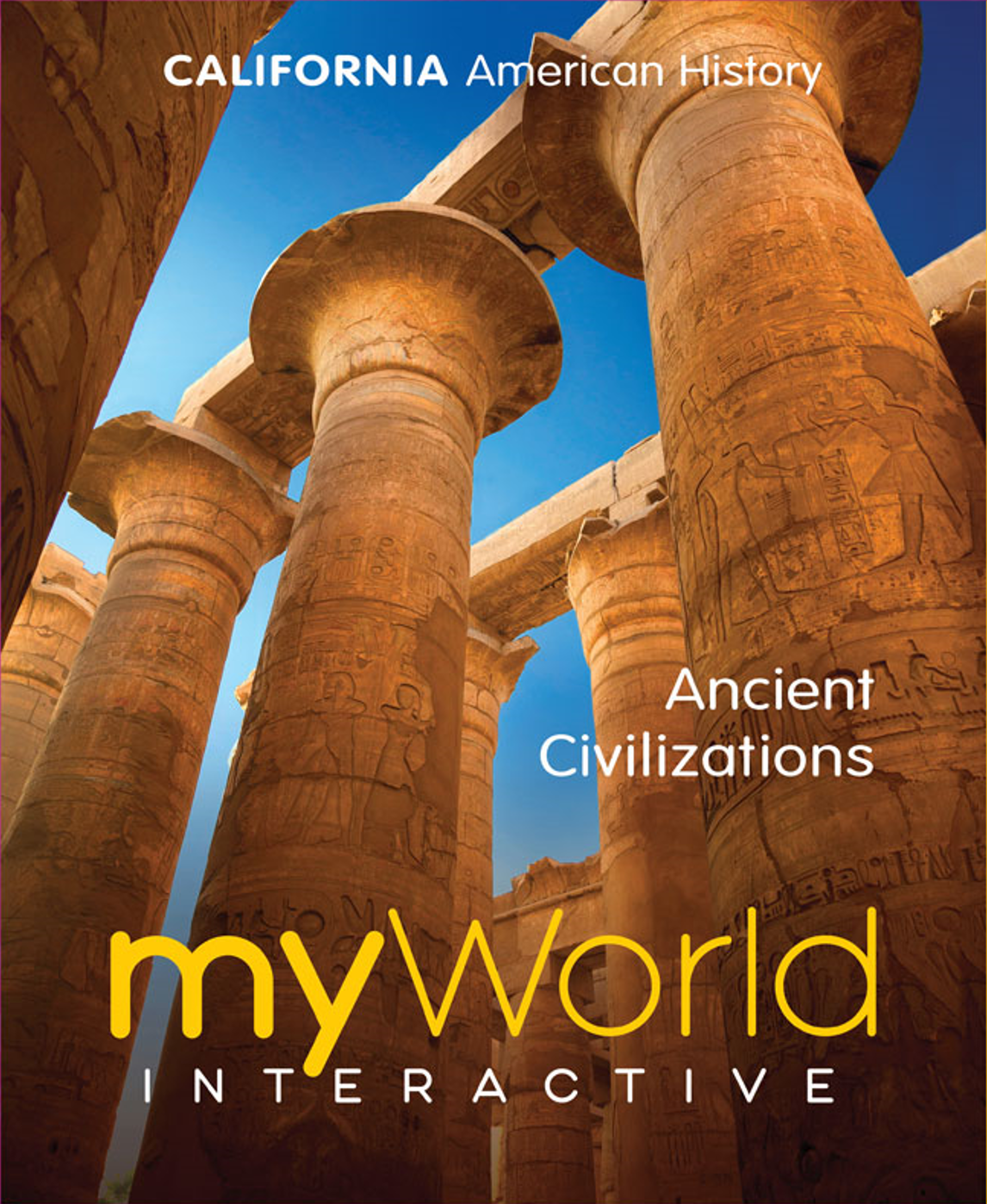
California myWorld Interactive, Grade 6
California myWorld Interactive Grade 6, published by Savvas Learning Company (formerly Pearson), is a history textbook designed for sixth-grade students following California's social studies standards. It covers the ancient world from prehistory through the fall of the Byzantine Empire in 1453 CE, exploring the origins of civilization, the Fertile Crescent and Mesopotamia, Ancient Egypt and Kush, early civilizations of India and China, Ancient Greece, and the rise and fall of the Roman Republic and Empire. Students examine key themes such as government, culture, religion, trade, and the development of written language across these foundational world civilizations.
Chapters & Lessons
Chapter 1: Origins of Civilization (Prehistory–4000 BCE)
5 lessonsIn this Grade 6 history lesson from California myWorld Interactive, students explore how anthropologists and archaeologists use fossils, artifacts, and scientific dating methods — including radioactive dating and DNA analysis — to study prehistory, the period before written records. The lesson examines archaeological evidence showing that human ancestors originated in East Africa and introduces the hunter-gatherer way of life. Students practice identifying main ideas as they learn key terms such as anthropology, geologist, and artifact within the context of Chapter 1: Origins of Civilization.
In this Grade 6 lesson from California myWorld Interactive, students explore how Homo sapiens developed complex language and other adaptations that allowed them to outlast Neanderthals and migrate across the globe during the Paleolithic Era. Students examine the "out of Africa" theory of early human migration and analyze how environment shaped where and how prehistoric populations spread and adapted. The lesson builds key vocabulary including migration, adapt, and environment within the context of prehistory through 4000 BCE.
In this Grade 6 lesson from California myWorld Interactive, students explore how Paleolithic societies developed complex cultures through evidence such as cave paintings, carved statues, and burial practices. They examine key concepts including animism, the domestication of plants and animals, and the transition from nomadic hunter-gatherer lifestyles to early agriculture. The lesson also addresses how early Homo sapiens populated the world and modified their environments over thousands of years.
In this Grade 6 lesson from California myWorld Interactive, students explore how the shift from hunter-gatherer life to farming during the Neolithic Era enabled people to build permanent settlements and develop specialization and surplus economies. The lesson examines the first centers of agriculture in regions like southwestern Asia, China, and the Americas, analyzing the costs and benefits of domestication and crop cultivation. Students use cause-and-effect literacy skills to understand how early farming villages gradually evolved into more complex communities.
In this Grade 6 lesson from California myWorld Interactive Chapter 1, students explore how early farming villages grew into the world's first civilizations, examining the role of food surpluses, river valleys, and resource management in that development. Students learn to identify the eight defining features shared by early civilizations — including organized government, job specialization, social classes, established religion, and writing — and analyze how cities like those in Sumer, Mesopotamia, and the Indus Valley became centers of complex society. The lesson also addresses how early civilizations shaped and were shaped by their surrounding environments.
Chapter 2: Civilizations and Peoples of the Fertile Crescent (3400 BCE–70 CE)
4 lessonsIn this Grade 6 lesson from California myWorld Interactive, students explore how civilization first emerged in Mesopotamia, focusing on the role of the Tigris and Euphrates rivers, the development of irrigation canals, and the rise of Sumerian city-states around 3400 BCE. Students examine key concepts including the Fertile Crescent, cuneiform writing, polytheism, and the ziggurat as they analyze how geography and agricultural advances shaped early urban societies. The lesson also addresses how Sumerian technology, such as the seed funnel and irrigation systems, transformed the environment and supported population growth in southern Mesopotamia.
In this Grade 6 lesson from California myWorld Interactive, students explore how Sargon of Akkad built the world's first empire in Mesopotamia during the 2300s BCE and examine how the Akkadian and Sumerian civilizations shared and spread cultural traits through conquest and trade. Students also analyze cause-and-effect relationships, including how prolonged conflict among Sumerian city-states like Umma and Lagash weakened the region and enabled foreign conquest. Key vocabulary covered includes empire, ally, cultural trait, and the concept of rule of law introduced through Ur-Nammu's early law code.
In this Grade 6 lesson from California myWorld Interactive Chapter 2, students examine how the Assyrian Empire used cavalry, iron weapons, a standing army, and a provincial government system to build and control a vast empire stretching from the Persian Gulf to Egypt. Students also explore how the Neo-Babylonian Empire under Nebuchadnezzar II and later the Persian Empire rose to power across Mesopotamia. The lesson develops skills in summarizing and analyzing how ancient empires balanced military conquest with political organization.
In this Grade 6 lesson from California myWorld Interactive, students explore the Phoenician civilization of the eastern Mediterranean, examining how geography shaped their economy and their dominance of sea trade through navigation and the exchange of imports and exports. Students learn how Phoenician city-states developed from the earlier Canaanites and how trade networks connected Mesopotamia, Africa, and Europe. The lesson also addresses the Phoenicians' lasting cultural contributions, including the development of an alphabet and the spread of their influence through colonization and cultural diffusion.
Chapter 3: Ancient Egypt and Kush (3000 BCE–600 BCE)
3 lessonsIn this Grade 6 lesson from California myWorld Interactive, students explore how the Nile River's geography — including its cataracts, delta, and annual flooding — shaped the development of ancient Egyptian civilization. Students learn key concepts such as irrigation, food surplus, and the formation of the Black Land and Lower Egypt, while examining how pharaohs, dynasties, and bureaucracy organized Egyptian society. The lesson also introduces how religion influenced daily life in ancient Egypt and how complex cities emerged from agricultural surplus.
Grade 6 students studying California myWorld Interactive explore the major achievements of ancient Egyptian civilization, including the development of hieroglyphic writing, the invention of papyrus, and the construction of iconic structures such as pyramids and the Sphinx. The lesson also covers Egyptian literature, sculpture, and advances in science and mathematics that influenced later civilizations. Students examine how writing systems and architectural feats shaped Egypt's complex society during the period of 3000–600 BCE.
In this Grade 6 lesson from California myWorld Interactive, students explore the trade relationship between ancient Egypt and Kush, learning key concepts such as commerce, interdependence, ivory, and ebony. Students examine how Egypt's lack of natural resources drove trade with neighboring lands, and how Kush's geography, location along the upper Nile, and access to gold and other goods shaped the growth of Kushite civilization. The lesson also introduces Meroitic script and Kush's broader cultural achievements as part of Chapter 3's coverage of ancient northeastern Africa from 3000 to 600 BCE.
Chapter 4: Early Civilizations of India (3100 BCE–540 CE)
7 lessonsIn this Grade 6 lesson from California myWorld Interactive, students explore how the Indian subcontinent's geography, river systems, and monsoon climate shaped the rise of the Indus Valley civilization between roughly 3000 and 1700 BCE. Students examine key terms such as subcontinent, monsoon, citadel, and granary while analyzing archaeological discoveries at Harappa and Mohenjo-Daro to understand the civilization's urban planning and achievements. The lesson also addresses why the politics, religion, and written language of the Indus Valley civilization remain largely a mystery to historians today.
In this Grade 6 lesson from California myWorld Interactive, students explore India's Vedic Age by examining the origins and migration of the Indo-Aryans and the sacred hymns known as the Vedas, including the Rig-Veda, Sama-Veda, Yajur-Veda, and Atharva-Veda. Students analyze how the Vedas document both Vedic religion and daily life, and how Sanskrit connected Indo-Aryan culture across the Indian subcontinent. The lesson also introduces the concepts of varnas, jatis, and the development of the caste system in ancient India.
In this Grade 6 lesson from California myWorld Interactive, students explore how Hinduism developed from the Vedas and Vedic Age rituals into classical Hinduism, examining key concepts such as Brahman, reincarnation, karma, dharma, ahimsa, and moksha. Students trace how gurus and sacred texts like the Upanishads, the Ramayana, and the Mahabharata shaped Hindu beliefs and practices in ancient India. The lesson is part of Chapter 4 on Early Civilizations of India and helps students understand Hinduism's lasting impact across South and Southeast Asia.
In this Grade 6 lesson from California myWorld Interactive's Chapter 4, students explore the origins of Buddhism by examining the life of Siddhartha Gautama, including his sheltered upbringing, his renunciation of wealth, and his achievement of enlightenment through meditation under the Bodhi Tree. Students learn key Buddhist concepts such as enlightenment, nirvana, and the role of monasteries, while comparing Theravada and Mahayana Buddhism and tracing how the faith spread from ancient India.
In this Grade 6 lesson from California myWorld Interactive, students learn how Chandragupta Maurya used military strategy and the advice of Kautilya to unite northern India and establish the Maurya Empire around 321 BCE. Students also examine how Chandragupta governed his vast empire by creating a bureaucracy, dividing it into provinces, and implementing a tax system to fund his government and army. The lesson covers key vocabulary including strategy, province, bureaucracy, and subject within the context of Chapter 4 on Early Civilizations of India.
In this Grade 6 lesson from California myWorld Interactive, students learn how Emperor Asoka transformed his rule after the devastating conquest of Kalinga by adopting Buddhist values, including the principles of ahimsa, tolerance, and the people's well-being. Students examine how Asoka replaced rule by force with dharma, or moral law, and how he used stone pillars and missionary outreach to spread his ideas and expand Buddhism across India and into neighboring regions. The lesson is part of Chapter 4 on early civilizations of India, covering the Maurya Empire from roughly 3100 BCE to 540 CE.
In this Grade 6 lesson from California myWorld Interactive, students learn how the Gupta dynasty reunited northern India and built its second major empire through conquest and strategic alliances, comparing its system of local governance and citizenship to the earlier Maurya empire. Students also explore the cultural achievements of the Gupta period, including advances in literature, music, and dance, as well as key contributions to mathematics and science such as the decimal system and Hindu-Arabic numerals.
Chapter 5: Early Civilizations of China (1700 BCE–220 CE)
6 lessonsIn this Grade 6 lesson from California myWorld Interactive's Chapter 5, students explore how the geography of ancient China — including the Huang River, loess deposits, and surrounding deserts and mountains — shaped early settlement patterns and the rise of civilization. Students examine why fertile floodplains along the North China Plain supported China's first large communities and how physical barriers like the Gobi Desert, Taklimakan Desert, and Himalayas isolated China from other civilizations. The lesson also introduces the Shang dynasty, the earliest Chinese dynasty with a written record, and key vocabulary such as loess, oracle bone, pictograph, and logograph.
In this Grade 6 lesson from California myWorld Interactive, students explore the rise and fall of the Zhou dynasty, learning how the concept of the Mandate of Heaven justified dynastic power and its transfer. Students examine how the Zhou governed their vast kingdom through regional nobles, and how the spread of iron weapons contributed to the breakdown of central authority and the chaos of the Warring States period. The lesson covers key vocabulary including Mandate of Heaven, warlord, and chaos within the context of early Chinese civilization from 1050 to 221 BCE.
In this Grade 6 lesson from California myWorld Interactive, students explore the major belief systems of ancient China, including animistic spiritual traditions, ancestor veneration, Confucianism, and Daoism, as they developed during the Zhou dynasty. Students examine the five Confucian relationships and the concept of filial piety, analyzing how Confucius's teachings in the Analects shaped social order and ethical conduct in Chinese society. The lesson is part of Chapter 5, which covers early Chinese civilizations from 1700 BCE to 220 CE.
In this Grade 6 lesson from California myWorld Interactive, Chapter 5, students explore how King Zheng of Qin unified China in 221 BCE and declared himself Shi Huangdi, the First Emperor. Students examine the key steps he took to consolidate power, including constructing the Great Wall, standardizing written language, currency, and weights and measures, and organizing the empire into a centralized system of provinces and counties. The lesson also introduces students to the principles of Legalism and how they shaped the policies and structure of the Qin dynasty.
In this Grade 6 lesson from California myWorld Interactive's Chapter 5 on Early Civilizations of China, students learn how the Han Dynasty unified and expanded China through strong central government, Confucian principles, and a merit-based civil service system. The lesson examines how Emperor Wudi extended Han territory into Central Asia, Korea, and Vietnam, and how the Silk Road drove trade and the spread of Buddhism across Afroeurasia.
In this Grade 6 lesson from California myWorld Interactive, students examine how Confucian teachings shaped the social order and family life of Han dynasty China, including the roles of scholars, farmers, merchants, and women. Students also explore the economic foundations of Han China, including agriculture, silk production, and state monopolies on key industries like iron and salt. The lesson is part of Chapter 5 on Early Civilizations of China and introduces key terms such as monopoly, calligraphy, lacquer, and acupuncture alongside Han achievements in the arts, science, and technology.
Chapter 6: Ancient Greece (2000 BCE–300 BCE)
8 lessonsIn this Grade 6 lesson from California myWorld Interactive's Chapter 6, students explore how the physical geography of ancient Greece — its mountains, peninsulas, and seas — shaped the development of independent communities and a seafaring culture. Students also examine the influence of the Minoans and Mycenaeans on early Greek civilization and learn how geographic isolation contributed to the rise of the polis, or city-state. Key vocabulary includes polis, citizen, acropolis, and aristocracy.
In this Grade 6 lesson from California myWorld Interactive, students explore how ancient Greek city-states experimented with different forms of government, including oligarchy, tyranny, and democracy. They examine key developments such as the introduction of the phalanx military formation, the reforms of Solon and Cleisthenes, and how Athenian direct democracy functioned in practice. The lesson also asks students to evaluate both the benefits and limitations of Athenian democracy, including who was and was not granted citizenship.
In this Grade 6 lesson from California myWorld Interactive, students examine Sparta's mixed government — including its dual monarchy, oligarchical council of elders, and the role of ephors — and compare it to Athenian democracy. Students also explore how Sparta's military conquests, reliance on helot labor, and decision to become a military state shaped every aspect of Spartan society, from government to daily life. The lesson builds key skills in comparing and contrasting ancient Greek city-states using primary vocabulary such as ephor, helot, and military state.
In this Grade 6 lesson from California myWorld Interactive, students explore the social structure of ancient Greek society, examining the roles and rights of women in city-states like Athens and Sparta, and the class hierarchy that ranged from aristocrats to tenant farmers, metics, and enslaved people. Students also investigate why the Greeks expanded through trade, conquest, and colonization and how that expansion shaped connections across the ancient world. Key vocabulary includes tenant farmer, metic, and slavery.
In this Grade 6 lesson from California myWorld Interactive, students examine warfare in ancient Greece, focusing on how Greek city-states defeated the Persian Empire in the Battle of Marathon and Battle of Salamis. Students analyze the causes and effects of both the Persian Wars and the Peloponnesian War, exploring how Athens rose to dominance through the Delian League after the Persian threat ended. The lesson builds literacy skills in comparing and contrasting key events, alliances, and turning points from 490 BCE to the late 400s BCE.
In this Grade 6 lesson from California myWorld Interactive's Chapter 6 on Ancient Greece, students explore how polytheism and mythology shaped Greek society, examining major gods and goddesses such as Zeus, Athena, and Poseidon alongside famous myths and epic poems like Homer's Odyssey. Students analyze the role of religious rituals in everyday Greek life and consider how ancient Greek literature, art, and architecture continue to influence the modern world.
In this Grade 6 lesson from California myWorld Interactive's Chapter 6 on Ancient Greece, students explore the enduring intellectual contributions of Greek scholars, including the Socratic method, Plato's Academy, and the Stoics' philosophy of reason and self-control. Students learn how ancient Greek thinkers used logic and structured reasoning to investigate questions about knowledge, reality, and the nature of a good life. The lesson also introduces key vocabulary such as hypothesis and the Hippocratic oath as students examine how Greek thought shaped philosophy, science, and medicine.
In this Grade 6 lesson from California myWorld Interactive's Chapter 6 on Ancient Greece, students examine how Macedonia's King Philip II used the sarissa and disciplined phalanx tactics to defeat the Greek city-states, and how his son Alexander the Great expanded those conquests across Persia and central Asia. Students also explore how Alexander's campaigns spread Greek culture and gave rise to Hellenistic civilization, blending classical Greek traditions with the customs of conquered peoples.
Chapter 7: The Roman Republic (800 BCE–30 BCE)
4 lessonsIn this Grade 6 lesson from California myWorld Interactive, students explore how Rome's geography — including the Italian Peninsula's fertile plains, the Alps, the Apennines, and the Tiber River — shaped the city's growth and military expansion. Students examine the founding legend of Romulus and Remus, the role of the Roman Forum as the center of civic life, and how Rome established a republican form of government. The lesson also introduces key vocabulary such as forum, republic, maniple, and legion within the context of Roman civilization's rise from a small village around 800 BCE.
In this Grade 6 lesson from California myWorld Interactive, students explore the structure of the Roman Republic, learning how key principles like separation of powers, checks and balances, the veto, and the rule of law prevented any single person from gaining too much control. Students also examine the roles of Roman government branches — the assemblies, senate, and magistrates — alongside the distinction between patricians and plebeians and the rights and responsibilities of Roman citizenship. The lesson connects these ancient institutions to the foundations of modern democratic government.
In this Grade 6 lesson from California myWorld Interactive's Chapter 7 on the Roman Republic, students examine the structure of Roman society by analyzing the roles of men and women, the differences between wealthy and poor Romans, and the institution of slavery. Key concepts include the patriarchal society, the authority of the paterfamilias, and how class determined daily life for free citizens, tenant farmers, and enslaved people. Students practice classifying and categorizing social groups as they explore how gender, wealth, and legal status shaped life in ancient Rome.
In this Grade 6 lesson from California myWorld Interactive's Chapter 7, students examine the fall of the Roman Republic by analyzing the causes and consequences of the Punic Wars, including Hannibal's invasion of Italy and Rome's defeat of Carthage. Students explore how Rome's expansion created an empire of provinces while generating internal pressures such as the widening gap between rich and poor, political corruption, and civil war. Key vocabulary including empire, province, civil war, and Augustus helps students understand why the Roman Republic's government ultimately could not survive its own conquest of the Mediterranean world.
Chapter 8: The Roman and Byzantine Empires (30 BCE–1453 CE)
7 lessonsIn this Grade 6 lesson from California myWorld Interactive, students learn how the Roman Empire was established after the fall of the Roman republic, focusing on Augustus as the first emperor and the concept of succession in imperial rule. Students examine how Rome gained and maintained power across territories and explore key vocabulary terms including deify and Pax Romana. The lesson also connects Rome's Mediterranean geography to its agricultural economy and early growth.
Grade 6 students explore the origins of Christianity in this lesson from California myWorld Interactive, examining the political tensions between Rome and Judea, the life and teachings of Jesus of Nazareth, and key vocabulary including crucifixion, resurrection, and baptism. Students learn how different Jewish groups such as the Zealots, Pharisees, and Sadducees responded to Roman rule, and how Jesus's ministry and execution laid the foundation for a new religion. The lesson also traces how early Christianity developed and spread throughout the Roman Empire during the Pax Romana.
In this Grade 6 history lesson from California myWorld Interactive, students explore the core beliefs and scripture of Christianity, focusing on the structure of the New Testament, including the Gospels, epistles, and the Book of Revelation. Students learn key vocabulary such as parable, epistle, and Trinity as they examine what early Christians believed about Jesus as the Son of God and how those beliefs were recorded and spread by figures like Paul the Apostle. The lesson is part of Chapter 8, which covers the Roman and Byzantine Empires from 30 BCE to 1453 CE.
In this Grade 6 lesson from California myWorld Interactive Chapter 8, students explore how ancient Rome functioned as a site of encounter where cultures exchanged goods, ideas, and beliefs through trade networks like the Silk Road and interactions with the Han, Parthian, and Kushan empires. Students examine the development of Greco-Roman culture and how Roman colonies, citizenship, and the military spread Latin language, mosaics, public architecture, and Roman law across the empire. The lesson also covers Rome's lasting legacy on modern government, language, and ideas of citizenship.
In this Grade 6 lesson from California myWorld Interactive, students examine the key factors that caused the decline of the Roman Empire, including inflation, civil wars, the Imperial Crisis (235–284 CE), economic collapse, and threats from Germanic tribes and the Sassanian Persians. Students analyze how internal problems such as corruption, military dependence, and depopulation combined with external pressures to unravel the Pax Romana after the death of Marcus Aurelius in 180 CE. The lesson builds cause-and-effect literacy skills as students trace how these interconnected forces ultimately led to the empire's fragmentation and fall.
In this Grade 6 lesson from California myWorld Interactive, students examine how the Byzantine Empire emerged from the eastern Roman Empire and differed from its predecessor in language, religion, and territory. Students analyze Constantinople's strategic location on the Bosporus Strait, Justinian's military conquests and lasting legacy including his law code and rebuilding of Hagia Sophia, and the causes of the empire's eventual decline. The lesson also explores how Byzantine missionaries spread the Cyrillic alphabet and Christianity to early Russia and surrounding cultures.
Grade 6 students explore the religious and cultural history of the Byzantine Empire, learning how theological disputes over the Nicene Creed and the use of icons led to growing tensions between Eastern and Western Christians. The lesson examines key concepts including the roles of patriarchs and the pope, the iconoclast controversy, and the organizational differences that contributed to the Great Schism between the Roman Catholic and Eastern Orthodox churches. This content is part of Chapter 8 in California myWorld Interactive, covering the Roman and Byzantine Empires from 30 BCE to 1453 CE.
Frequently Asked Questions
- Is California myWorld Interactive Grade 6 right for my child?
- California myWorld Interactive Grade 6 is a Pearson textbook adopted by many California districts for sixth-grade world history. It covers ancient civilizations from prehistory through the Byzantine Empire in a highly visual, interactive format with embedded primary sources, maps, and inquiry-based activities. The program is well-suited for sixth graders who engage with images, timelines, and mixed-media content. Compared to traditional textbooks, it is more engaging but also requires active participation with the features. If your child is in a California school using this book, it is a solid, standards-aligned choice.
- Which chapters are hardest in California myWorld Interactive Grade 6?
- Chapter 4 (Early Civilizations of India) and Chapter 5 (Early Civilizations of China) present the most unfamiliar content for American students — Buddhist and Hindu religious concepts, dynastic history, and the philosophical teachings of Confucius and Laozi require substantial background knowledge. Chapter 8 (The Roman and Byzantine Empires) covers the longest time span (over 1,400 years) and the most complex political transitions. Chapter 2 (Civilizations of the Fertile Crescent) involves multiple overlapping empires and cultures — Sumerians, Assyrians, Babylonians, Phoenicians — that are easy to confuse without careful note-taking.
- My child struggles with reading historical texts. Where should they start?
- Start with Chapter 1 (Origins of Civilization), which uses the most accessible reading level and builds the foundational vocabulary needed throughout the course — civilization, agriculture, surplus, specialization, city-state. This chapter also introduces the myWorld Interactive reading and annotation strategies that the program uses throughout. If your child struggles with the primary source documents embedded in each chapter, practice reading short excerpts from Chapter 1 first and asking the three core questions: Who wrote this? When? What is their perspective? These skills apply to every chapter that follows.
- What should my child study after finishing myWorld Interactive Grade 6?
- After myWorld Interactive Grade 6, California seventh graders move to medieval and early modern world history. The myWorld Interactive Grade 7 textbook (also by Pearson) continues the same format. The geographic and historical analysis skills built in Grade 6 — using maps, interpreting timelines, analyzing primary sources — transfer directly to Grade 7 content about the Islamic world, medieval Europe, the Renaissance, and early exploration. Students who want to go deeper on any civilizations covered in Grade 6 will find National Geographic Kids or DK Eyewitness books excellent supplemental reading.
- How can Pengi help my child with myWorld Interactive Grade 6?
- myWorld Interactive Grade 6 is packed with features — Active Journal prompts, primary sources, maps, and vocabulary builders — that can be overwhelming to navigate without support. Pengi can help your child get the most out of each chapter by explaining the historical narrative clearly before your child engages with the text, making the reading much more productive. If your child is working on the Active Journal for Chapter 3 on Ancient Egypt or constructing an argument about which civilization had the greatest impact, Pengi provides structured guidance. Pengi also helps your child review and consolidate knowledge before unit tests.
Ready to start learning?
Jump into your first lesson for California myWorld Interactive, Grade 6. Free, no account required.
Start Learning