
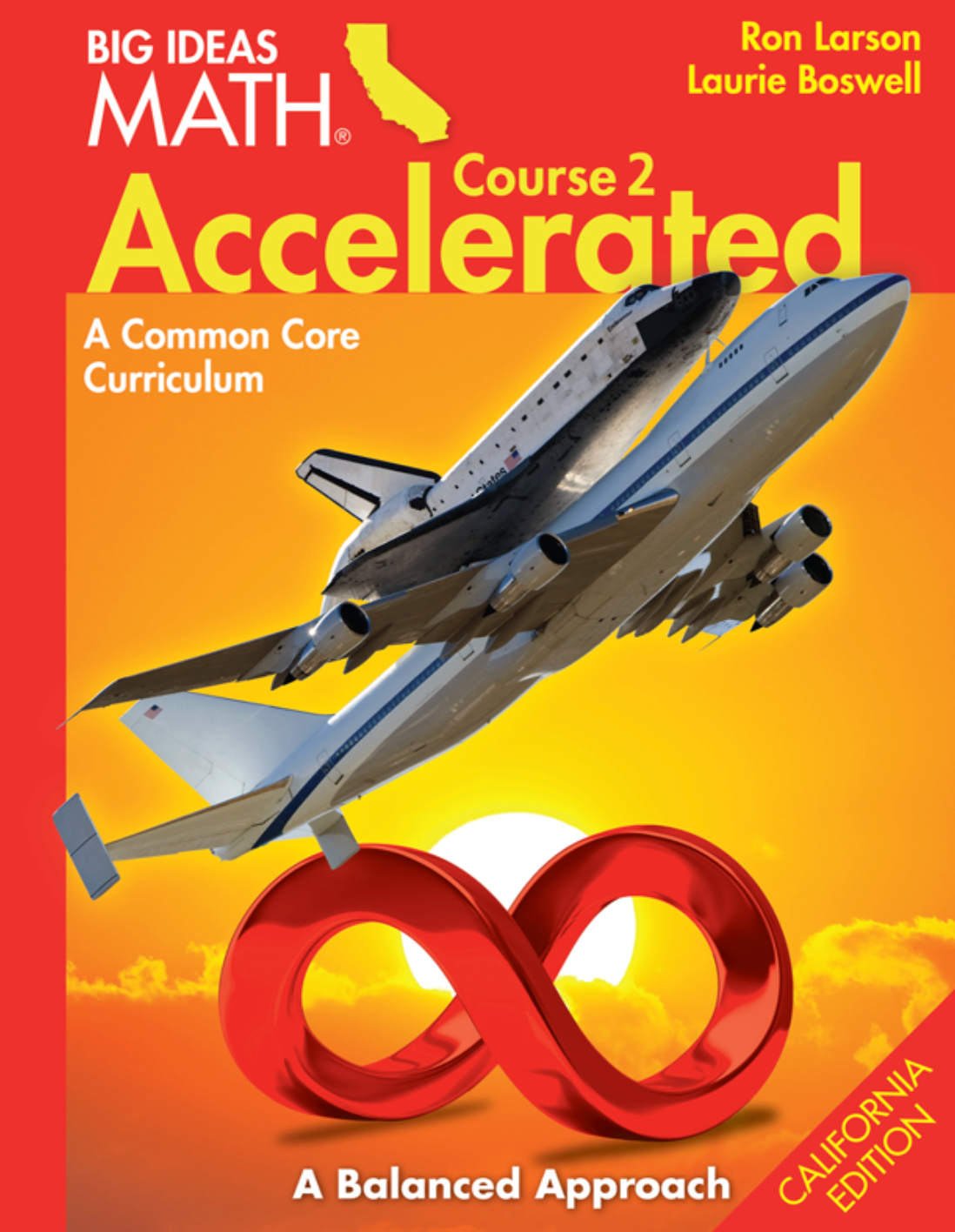
Big Ideas Math, Course 2, Accelerated
Big Ideas Math Course 2 Accelerated, published by Big Ideas Learning LLC, is an advanced Grade 7 mathematics textbook designed to prepare students for algebra and geometry at an accelerated pace. The course covers foundational topics including geometric transformations, angles and triangles, graphing and writing linear equations, real numbers and the Pythagorean theorem, volume and similar solids, and exponents with scientific notation. By blending algebraic reasoning with geometric concepts, this text builds the critical thinking skills students need to succeed in higher-level math courses.
Chapters & Lessons
Chapter 1: Transformations
7 lessonsIn this Grade 7 lesson from Big Ideas Math Course 2 Accelerated, students learn how to identify translations and perform them in the coordinate plane by sliding figures a given distance and direction without changing their size, shape, or orientation. Students explore how repeated translations of a single tile can produce tessellations, patterns that cover a plane with no gaps or overlaps. The lesson also has students compare corresponding vertices, side lengths, and angle measures of original and translated figures to establish congruence.
In this Grade 7 lesson from Big Ideas Math, Course 2 Accelerated, students learn how to identify reflections and reflect figures across the x-axis and y-axis in the coordinate plane. Students explore how reflections produce congruent mirror images by analyzing frieze patterns — repeating horizontal designs — to determine whether they reflect onto themselves horizontally or vertically. The lesson connects geometric transformations to real-world contexts while building understanding of symmetry, congruence, and coordinate geometry aligned to standards 8.G.1–8.G.3.
In this Grade 7 lesson from Big Ideas Math, Course 2 Accelerated (Chapter 11), students learn how to identify and perform rotations in the coordinate plane, distinguishing them from translations and reflections. They practice rotating two-dimensional figures around the origin across quadrants and use coordinates to describe the effect of rotations on vertices. The lesson also addresses congruence, exploring how rotated figures preserve dimensions, angle measures, and parallel sides.
In this Grade 7 lesson from Big Ideas Math Course 2 Accelerated, students learn to identify similar figures by naming corresponding angles and corresponding sides, and to determine whether figures are similar by testing if their side lengths are proportional. Students also practice setting up and solving proportions to find unknown measures of similar figures, using real-world contexts like resizing photographs and creating scaled designs.
In this Grade 7 lesson from Big Ideas Math, Course 2 Accelerated (Chapter 11), students explore how the perimeters and areas of similar figures change when dimensions are scaled by a constant factor. Through hands-on activities, students discover that when side lengths are multiplied by a scale factor, the perimeter changes by the same factor while the area changes by the square of that factor. Students also practice finding and comparing ratios of perimeters and areas of similar figures on a coordinate grid.
In this Grade 7 lesson from Big Ideas Math Course 2 Accelerated (Chapter 11), students learn how to perform dilations in the coordinate plane by multiplying vertex coordinates by a scale factor to enlarge or reduce figures. Students identify dilations, compare similar figures produced by different scale factors, and explore how dilations relate to other transformations such as translations, reflections, and rotations. The lesson builds on students' understanding of coordinate plotting and integer multiplication to develop skills aligned with Common Core standards 8.G.3 and 8.G.4.
Chapter 2: Angles and Triangles
4 lessonsIn this Grade 7 lesson from Big Ideas Math Course 2 Accelerated, students learn how parallel lines and transversals interact to form special angle pairs, including corresponding angles, alternate interior angles, and alternate exterior angles. Students practice identifying these angle relationships and applying the properties that corresponding, alternate interior, and alternate exterior angles are congruent when lines are parallel. The lesson also covers using supplementary angle relationships to calculate unknown angle measures.
In this Grade 7 lesson from Big Ideas Math Course 2 Accelerated, students explore the interior and exterior angle relationships of triangles, learning that the sum of a triangle's interior angles is always 180° and that an exterior angle equals the sum of the two nonadjacent interior angles. Students apply these properties to write and solve algebraic equations to find missing angle measures. The lesson connects geometric reasoning with algebra through hands-on activities and real-world problems like the Bermuda Triangle example.
In this Grade 7 lesson from Big Ideas Math Course 2 Accelerated, Chapter 2, students learn how to find the sum of interior angle measures of polygons using the relationship between the number of sides and the number of triangles formed, expressed by the formula S = (n - 2) × 180°. Students also discover that the sum of the exterior angle measures of any convex polygon is always 360°. The lesson develops these concepts through hands-on exploration with quadrilaterals, pentagons, hexagons, and octagons before applying the patterns to find angle measures in polygons with more sides.
In this Grade 7 lesson from Big Ideas Math Course 2 Accelerated, students learn to identify similar triangles using the Angle-Angle (AA) criterion, understanding that two triangles are similar when two pairs of corresponding angles are congruent. Students construct and compare triangles with matching angle measures, explore dilations using geometry software, and apply proportional reasoning with corresponding sides. The lesson also introduces indirect measurement, showing how similar triangles formed by parallel sun rays can be used to calculate real-world distances such as the height of a flagpole.
Chapter 3: Graphing and Writing Linear Equations
7 lessonsIn this Grade 7 lesson from Big Ideas Math, Course 2 Accelerated, students learn how to graph linear equations by generating solution points from a table of values and plotting them on a coordinate grid. Students explore the relationship between equations in the form y = ax + b and their graphs, discovering that every point on a line is a solution to its corresponding linear equation. The lesson also introduces using a graphing calculator to graph linear equations and interpret viewing window settings.
Grade 7 students in Big Ideas Math Course 2 Accelerated learn how to calculate the slope of a line by finding the ratio of vertical change to horizontal change between two points. The lesson covers finding slope using coordinates, tables, and similar triangles, and explores why the slope remains constant regardless of which two points on a line are chosen. This aligns with Common Core standard 8.EE.6 on graphing equations.
In this Grade 7 lesson from Big Ideas Math Course 2 Accelerated, students learn to identify, graph, and write proportional relationships using the direct variation equation y = mx. Students explore how the slope m represents the unit rate and use similar triangles to derive why every proportional relationship passes through the origin. The lesson connects ratio tables, coordinate graphs, and algebraic equations to build a complete understanding of proportional relationships.
In this Grade 7 lesson from Big Ideas Math, Course 2 Accelerated (Chapter 13), students learn to identify the slope and y-intercept of a linear equation written in slope-intercept form (y = mx + b) and use them to graph the line. By analyzing multiple equations, students discover that the coefficient m represents the slope and the constant b represents the y-intercept, the point where the graph crosses the y-axis. This lesson builds toward graphing nonproportional linear relationships and aligns with Common Core standard 8.EE.6.
In this Grade 7 lesson from Big Ideas Math Course 2 Accelerated, students learn to graph linear equations written in standard form (ax + by = c) by identifying the x-intercept and y-intercept and plotting them to draw a line. Using a real-world ticket sales scenario, students discover how the equation 4x + 2y = 16 produces a linear pattern of solutions. The lesson also connects standard form to slope-intercept form, helping students recognize that the same line can be expressed in multiple equivalent forms.
In this Grade 7 lesson from Big Ideas Math Course 2 Accelerated, students learn how to write equations of lines in slope-intercept form (y = mx + b) by identifying the slope and y-intercept from a graph. The lesson covers interpreting the meaning of slope and y-intercept in real-world contexts, such as a car trip, and applies these skills to geometric figures like parallelograms. Aligned with Common Core Standard 8.EE.6, this lesson is part of Chapter 3 on Graphing and Writing Linear Equations.
Chapter 4: Real Numbers and the Pythagorean Theorem
5 lessonsIn this Grade 7 lesson from Big Ideas Math, Course 2 Accelerated (Chapter 4), students learn how to find square roots of perfect squares using the radical sign and apply them to solve for unknown dimensions. Students practice evaluating expressions involving square roots and using square roots to solve equations of the form x² = p, including cases with fractions and decimals. Real-world applications include finding the side length of a square and the radius of a circle when given the area.
In this Grade 7 lesson from Big Ideas Math, Course 2 Accelerated, students learn how to find cube roots of perfect cubes using the cube root symbol and prime factorization. The lesson covers evaluating expressions involving cube roots and solving equations, building on students' prior knowledge of square roots to understand how cubing and taking a cube root are inverse operations. Students also explore why negative numbers can have cube roots, unlike square roots, aligning with the 8.EE.2 standard.
In this Grade 7 lesson from Big Ideas Math Course 2 Accelerated, students explore the Pythagorean Theorem, learning how the relationship a² + b² = c² connects the leg lengths and hypotenuse of a right triangle. Through hands-on activities, students construct a geometric proof using squares drawn on each side of a right triangle, then apply the theorem to find missing side lengths. The lesson also extends to real-life problems, including three-dimensional scenarios such as calculating the length of a guy wire attached to a telephone pole.
In this Grade 7 lesson from Big Ideas Math, Course 2 Accelerated, students learn to define irrational numbers and distinguish them from rational numbers within the broader set of real numbers. Students practice classifying real numbers and approximating square roots of non-perfect squares, such as finding that the value of the square root of 3 falls between 1.731 and 1.732. The lesson also connects to the Pythagorean Theorem as a geometric method for approximating irrational square roots on a number line.
In this Grade 7 lesson from Big Ideas Math, Course 2 Accelerated, students learn to apply the converse of the Pythagorean Theorem to determine whether a triangle is a right triangle given its side lengths. The lesson also covers using the Pythagorean Theorem to find distances in a coordinate plane and solve real-life problems. It is part of Chapter 4: Real Numbers and the Pythagorean Theorem and addresses Common Core standards 8.G.6, 8.G.7, and 8.G.8.
Chapter 5: Volume and Similar Solids
4 lessonsIn this Grade 7 lesson from Big Ideas Math Course 2 Accelerated, students learn how to find the volume of a cone using the formula V = (1/3) × Area of Base × Height, discovering through hands-on experimentation that a cone holds exactly one-third the volume of a cylinder with the same base and height. The lesson builds on students' prior knowledge of prism and pyramid volume relationships, then extends to solving real-life problems and finding the height of a cone when the volume is known.
In this Grade 7 lesson from Big Ideas Math Course 2 Accelerated, students learn how to calculate the volume of a sphere using the formula V = (4/3)πr³, derived by exploring the relationship between a sphere and a cylinder with equal diameter and height. Through a hands-on activity, students discover that the volume of a sphere equals two-thirds the volume of its surrounding cylinder, then apply this understanding to find volumes, solve for radii given volumes, and tackle real-life problems.
In this Grade 7 lesson from Big Ideas Math Course 2 Accelerated, students explore how surface area and volume of similar solids change when dimensions are scaled by a factor of k, discovering that surface area scales by k² and volume scales by k³. Students learn to identify similar solids using proportional corresponding dimensions and apply these relationships to solve problems involving cylinders and pyramids. The lesson directly supports Standard 8.G.9 and builds fluency with scale factor reasoning across three-dimensional figures.
Chapter 6: Exponents and Scientific Notation
7 lessonsIn this Grade 7 lesson from Big Ideas Math Course 2 Accelerated, students learn to identify and work with powers, bases, and exponents by writing repeated multiplication in exponential form and evaluating expressions with positive, negative, and fractional bases. The lesson also covers applying order of operations with exponents and using powers in real-life contexts such as calculating volumes of spheres.
In this Grade 7 lesson from Big Ideas Math Course 2 Accelerated, students learn three key exponent properties: the Product of Powers Property (a^m · a^n = a^(m+n)), the Power of a Power Property ((a^m)^n = a^(mn)), and the Power of a Product Property ((ab)^m = a^m·b^m). Using inductive reasoning, students discover each rule by exploring patterns in repeated multiplication before applying the properties to simplify expressions with numeric and variable bases. The lesson aligns with standard 8.EE.1 and builds the foundational exponent skills needed for scientific notation.
In this Grade 7 lesson from Big Ideas Math Course 2 Accelerated, students learn the Quotient of Powers Property, which states that dividing two powers with the same base is equivalent to subtracting their exponents (a^m ÷ a^n = a^(m−n)). Through hands-on activities, students practice simplifying expressions like 2^6 ÷ 2^4 by applying this rule to bases that include integers, decimals, and variables. The lesson builds toward the 8.EE.1 standard by helping students recognize patterns in repeated multiplication and generalize a reliable method for simplifying quotients of powers.
In this Grade 7 lesson from Big Ideas Math Course 2 Accelerated, students learn how to evaluate expressions with zero exponents and negative integer exponents by applying the Quotient of Powers and Product of Powers properties. Using repeated reasoning, students derive the definitions that any nonzero number raised to the power of zero equals 1, and that a^(-n) equals the multiplicative inverse of a^n. The lesson also connects negative powers of 10 to decimal place value and expanded notation.
In this Grade 7 lesson from Big Ideas Math, Course 2, Accelerated, students learn to identify numbers written in scientific notation, convert between scientific notation and standard form, and compare numbers expressed in scientific notation. The lesson uses calculator exploration with very large and very small numbers to build understanding of positive and negative exponents in expressions like 6.0e+18 and 6.0e−18. It aligns with Common Core standards 8.EE.3 and 8.EE.4, making it part of the accelerated curriculum's early introduction to these concepts.
In this Grade 7 lesson from Big Ideas Math, Course 2, Accelerated, students learn how to convert numbers into scientific notation by moving the decimal point and applying positive or negative exponents of powers of 10. The lesson covers writing both large numbers and small decimals in the form a × 10^n, using real-world examples such as large financial figures and microscopic measurements. Students practice identifying when to use positive versus negative exponents based on whether the original number is greater than or less than 1.
In this Grade 7 lesson from Big Ideas Math Course 2 Accelerated, students learn how to add, subtract, and multiply numbers written in scientific notation by applying the Distributive Property and aligning powers of 10. Activities guide students to rewrite numbers so that exponents match before combining coefficients, a key step when the powers of 10 differ. This lesson builds directly on prior knowledge of scientific notation and prepares students for the operations with very large and very small quantities required by standards 8.EE.3 and 8.EE.4.
Frequently Asked Questions
- Is Big Ideas Math Course 2 Accelerated right for my seventh grader?
- Big Ideas Math Course 2 Accelerated is designed for seventh graders on an accelerated math track—students who completed Course 1 or its equivalent and are on a path to take Algebra 1 in eighth grade. Its six chapters cover transformations, angles and triangles, linear equations, real numbers and the Pythagorean theorem, volume and similar solids, and exponents and scientific notation. This is a compressed pre-algebra curriculum that moves quickly; it is the right fit for students who are mathematically confident and ready for a challenge. If your child is in a standard seventh-grade program, Big Ideas Math Course 2 (non-accelerated) covers similar topics at a more measured pace. Check with your child's school about which track they are on.
- Which chapters in Big Ideas Math Course 2 Accelerated are hardest for students?
- Chapter 4 (Real Numbers and the Pythagorean Theorem) is typically the most difficult—students encounter irrational numbers for the first time and must connect square roots to the side lengths of right triangles, which demands both algebraic and geometric thinking simultaneously. Chapter 1 (Transformations) challenges students who struggle with coordinate plane work, since reflections, rotations, and dilations all require precise attention to coordinates. Chapter 3 (Graphing and Writing Linear Equations) moves quickly through slope and y-intercept content that many students in a standard course spend several weeks on; the accelerated pace means gaps in understanding compound rapidly. Chapter 6 (Exponents and Scientific Notation) introduces negative and zero exponents, which are counterintuitive for students used to exponents always making numbers larger.
- My child is weak on linear equations—where should they start?
- Start with Chapter 3 (Graphing and Writing Linear Equations), which is the linear algebra core of this course. If your child struggles with the slope concept, review the meaning of rate of change before attempting to graph lines—understanding that slope is rise over run as a real-world rate (miles per hour, cost per item) makes the algebra concrete. If Chapter 3 is too difficult, the prerequisite is strong proportional reasoning, which should have been covered in Course 1. Identifying whether the difficulty is in graphing coordinates, computing slope from two points, or writing an equation from a graph will pinpoint exactly what to address. Pengi can run a short diagnostic to figure out where the gap is.
- What should my child study after finishing Big Ideas Math Course 2 Accelerated?
- The intended next course is Big Ideas Math Algebra 1 (Course 3 or the standalone Algebra 1 textbook), typically taken in eighth grade. Students who complete Course 2 Accelerated with strong performance are well prepared for Algebra 1's full treatment of linear functions, systems, and quadratic equations. Mastering the Pythagorean theorem from Chapter 4 and the exponent rules from Chapter 6 before starting Algebra 1 is important since both appear in the early chapters of that course. Students on this accelerated path who sustain strong performance through Algebra 1 are on track for Geometry in ninth grade and potentially AP Calculus by eleventh or twelfth grade.
- How can Pengi help my child with Big Ideas Math Course 2 Accelerated?
- Because this is an accelerated course, students occasionally encounter a chapter where the pace outstrips their current understanding—Pengi is ideal for catching those gaps quickly before they compound. For the Pythagorean theorem chapter, Pengi can explain the relationship between the theorem and irrational numbers in multiple ways until the concept clicks. For transformations in Chapter 1, Pengi can walk through each transformation type—translation, reflection, rotation, dilation—with step-by-step coordinate examples. When your child needs to prepare for a unit test on linear equations or exponents, Pengi can generate targeted review problems focused on the specific subtopics where they lost points on previous quizzes.
Ready to start learning?
Jump into your first lesson for Big Ideas Math, Course 2, Accelerated. Free, no account required.
Start Learning