
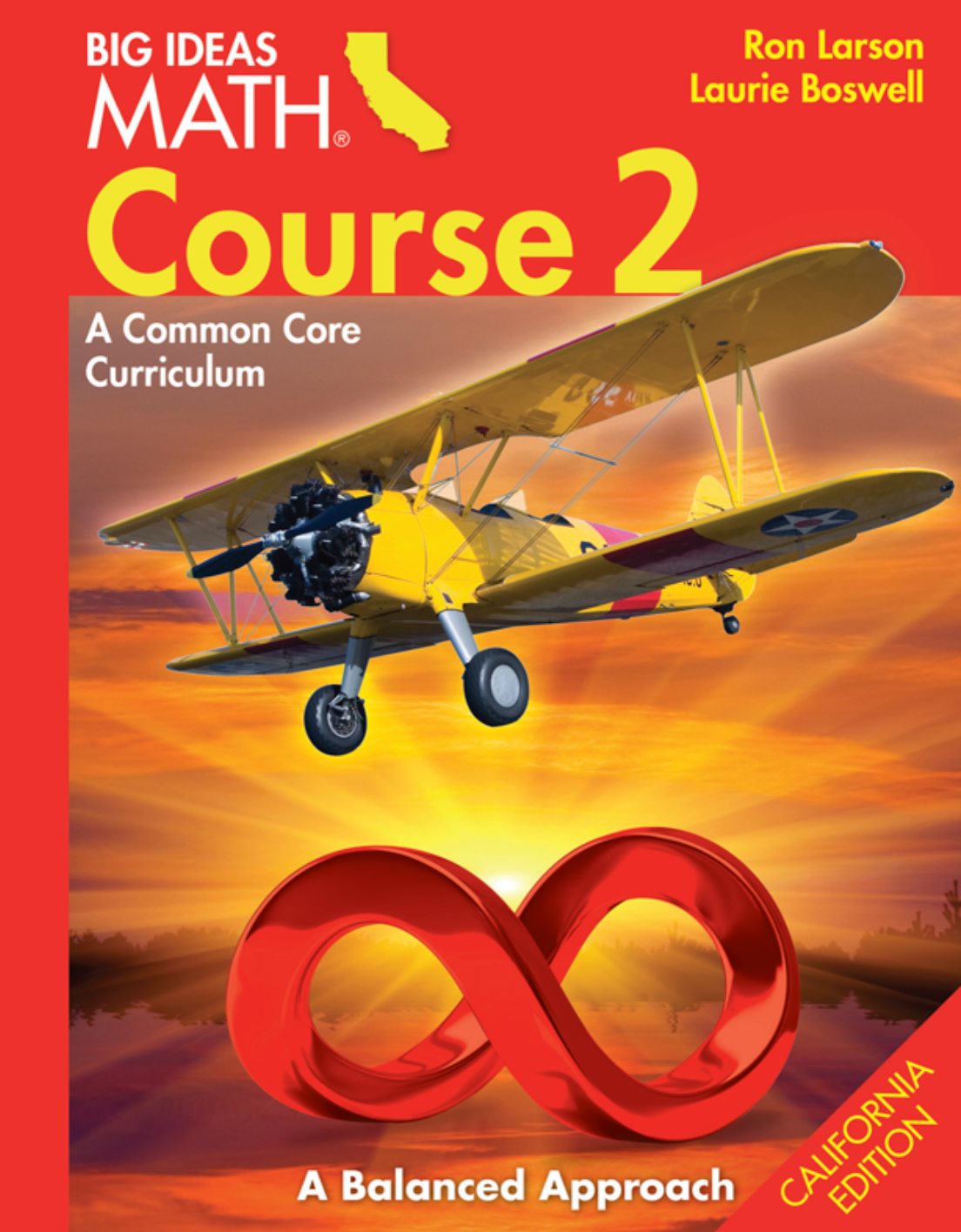
Big Ideas Math, Course 2
Big Ideas Math, Course 2, published by Big Ideas Learning LLC, is a Grade 7 mathematics textbook designed to build core middle school math skills through a rigorous, balanced approach. The curriculum covers a broad range of topics including integers, rational numbers, expressions and equations, inequalities, ratios and proportions, percents, constructions and scale drawings, circles and area, surface area and volume, and probability and statistics. Aligned with Common Core standards, the program emphasizes conceptual understanding, procedural fluency, and real-world problem-solving to prepare seventh-grade students for advanced mathematics.
Chapters & Lessons
Chapter 1: Integers
5 lessonsIn this Grade 7 lesson from Big Ideas Math Course 2, students learn to define and find the absolute value of integers and explore how positive and negative integers represent velocity and speed in real-world contexts. Through activities involving falling parachutes and rising balloons, students discover that the absolute value of velocity equals speed and practice comparing integers on a number line.
In this Grade 7 lesson from Big Ideas Math, Course 2, students learn how to add integers with the same sign, different signs, and opposite signs using integer counters and number lines. The lesson covers key rules for determining whether a sum is positive, negative, or zero, including the Additive Inverse Property, which states that an integer and its opposite always sum to zero. Students practice applying absolute values to find sums and develop general rules for all cases of integer addition.
In this Grade 7 lesson from Big Ideas Math, Course 2, students learn how to subtract integers by applying the rule of adding the opposite, expressed as a - b = a + (-b). The lesson covers subtracting positive and negative integers, evaluating multi-term integer expressions, and solving real-life problems such as finding ranges of elevation using integer subtraction.
In this Grade 7 lesson from Big Ideas Math Course 2, Chapter 1, students learn the rules for multiplying integers, discovering that the product of two integers with the same sign is positive and the product of two integers with different signs is negative. Using repeated addition, number lines, and pattern tables, students practice multiplying positive and negative integers and apply those rules to expressions involving exponents such as evaluating (-2)² and (-4)³.
In this Grade 7 lesson from Big Ideas Math, Course 2, Chapter 1, students learn the rules for dividing integers, including how to determine whether a quotient is positive, negative, or zero based on the signs of the two integers. Students discover that dividing two integers with the same sign yields a positive quotient, while dividing integers with different signs yields a negative quotient. The lesson connects integer division to multiplication and applies these rules to solving real-life problems, aligning with standards MAFS.7.NS.1.2b and MAFS.7.NS.1.3.
Chapter 2: Rational Numbers
4 lessonsIn this Grade 7 lesson from Big Ideas Math Course 2, students learn to define rational numbers as any number expressible as a ratio of two integers, and practice converting fractions and mixed numbers into terminating or repeating decimals using long division. Students also use a number line to compare and order rational numbers, including negative fractions, mixed numbers, and decimals. The lesson aligns with Florida Standards MAFS.7.NS.1.2b and MAFS.7.NS.1.2d.
In this Grade 7 lesson from Big Ideas Math, Course 2 (Chapter 2: Rational Numbers), students learn how to add rational numbers — including fractions, mixed numbers, and decimals — by applying the same sign rules used for integers. The lesson covers finding sums using a least common denominator, adding positive and negative decimals, and evaluating algebraic expressions with rational number values. Students also apply these skills to real-life problems involving gains and losses represented as rational numbers.
In this Grade 7 lesson from Big Ideas Math Course 2, students learn to subtract rational numbers — including fractions, mixed numbers, and decimals — by applying the same sign rules used for subtracting integers, such as adding the opposite. Activities use number lines to visualize differences and explore how absolute value relates to distance between two rational numbers. Students also apply subtraction of rational numbers to real-life financial literacy problems involving positive and negative decimal amounts.
In this Grade 7 lesson from Big Ideas Math, Course 2, Chapter 2, students learn how to multiply and divide rational numbers — including fractions, mixed numbers, and decimals with negative values — using the same sign rules that apply to integers. The lesson also explores why the product of two negative rational numbers is positive, using the Additive Inverse Property and properties of multiplication such as the Commutative and Associative properties to build a formal justification.
Chapter 3: Expressions and Equations
5 lessonsIn this Grade 7 lesson from Big Ideas Math, Course 2 (Chapter 3), students learn to add and subtract linear expressions by combining like terms using both vertical and horizontal methods. The lesson introduces the definition of a linear expression, where the variable has an exponent of 1, and builds understanding through algebra tile models before applying properties of operations to simplify expressions such as (2x − 6) + (3x + 2) or (4x + 3) − (2x − 1). Students also practice distributing coefficients before combining like terms in multi-step problems.
Grade 7 students learn how to solve one-variable addition and subtraction equations by applying the Addition Property of Equality and Subtraction Property of Equality to produce equivalent equations. The lesson uses algebra tiles to model isolating the variable through zero pairs, then connects that hands-on method to solving equations using inverse operations. This is covered in Lesson 3.3 of Chapter 3: Expressions and Equations in Big Ideas Math, Course 2, aligned to standard MAFS.7.EE.2.4a.
In this Grade 7 lesson from Big Ideas Math, Course 2, students learn to solve one-step equations using the Multiplication Property of Equality and the Division Property of Equality, including equations with fractions solved by multiplying by the reciprocal. The lesson covers equations of the form x/a = b and ax = b with integers, decimals, and fractions, and applies these skills to real-life problems. Part of Chapter 3: Expressions and Equations, it aligns with Florida standard MAFS.7.EE.2.4a.
In this Grade 7 lesson from Big Ideas Math, Course 2, students learn to solve two-step equations by applying the Addition, Subtraction, Multiplication, and Division Properties of Equality in sequence. Using algebra tiles and algebraic steps, they work through equations involving integers and fractions, such as isolating the variable by first adding or subtracting a constant and then dividing or multiplying. The lesson also connects two-step equations to real-life problem-solving strategies like working backwards, meeting Florida Standard MAFS.7.EE.2.4a.
Chapter 4: Inequalities
4 lessonsIn this Grade 7 lesson from Big Ideas Math, Course 2, students learn to write and graph inequalities using the symbols <, >, ≤, and ≥, and to identify the solution set of an inequality on a number line. Students practice translating real-world word phrases such as "at least," "no more than," and "fewer than" into algebraic inequalities, and distinguish between open and closed circles when graphing. The lesson also covers using substitution to check whether a given value is a solution of an inequality.
In this Grade 7 lesson from Big Ideas Math, Course 2, Chapter 4, students learn how to solve one-variable inequalities using the Addition Property of Inequality and the Subtraction Property of Inequality. Students practice isolating the variable by applying inverse operations, then graphing the solution set on a number line using open and closed circles. Real-life contexts, such as temperature comparisons and age restrictions, are used to reinforce writing and solving inequalities of the form x + c < b and x − c ≥ b.
In this Grade 7 lesson from Big Ideas Math, Course 2, students learn how to solve one-step inequalities using the Multiplication and Division Properties of Inequality, including the critical rule that multiplying or dividing both sides by a negative number reverses the inequality sign. Students practice solving inequalities such as x/5 ≤ −3 and 6x > −18, then graph their solutions on a number line. The lesson aligns with Florida standard MAFS.7.EE.2.4b and builds on students' earlier work with inequality concepts in Chapter 4.
In this Grade 7 lesson from Big Ideas Math, Course 2 (Chapter 4: Inequalities), students learn to solve two-step inequalities by applying inverse operations in sequence, including cases that require reversing the inequality symbol when multiplying or dividing by a negative number. The lesson connects algebraic procedures to real-world contexts such as calculating areas, perimeters, volumes, and weight-loss averages to model conditions using inequality symbols like greater than or equal to and at most. Students also practice graphing solution sets on number lines to represent the range of values satisfying each inequality.
Chapter 5: Ratios and Proportions
6 lessonsIn this Grade 7 lesson from Big Ideas Math Course 2, Chapter 5, students learn to find ratios, rates, and unit rates, including complex fractions involving ratios of fractions. They practice writing and simplifying rates with different units, using ratio tables to find equivalent rates, and applying unit analysis to real-world problems.
In this Grade 7 lesson from Big Ideas Math, Course 2, students learn how to identify and verify proportions by determining whether two ratios are equivalent using simplest form and the Cross Products Property. Through real-world activities involving unit prices, distances, and fairness comparisons, students practice recognizing proportional relationships between quantities. The lesson builds foundational understanding of proportional reasoning aligned with standard MAFS.7.RP.1.2a.
In this Grade 7 lesson from Big Ideas Math, Course 2 (Chapter 5: Ratios and Proportions), students learn how to write proportions by setting up equivalent ratios using tables, then apply that skill to solve real-life problems involving batting averages and recipe scaling. The lesson covers writing proportions from rows or columns of a table and solving them using mental math, aligned with Florida Standards MAFS.7.RP.1.2c and MAFS.7.RP.1.3.
In this Grade 7 lesson from Big Ideas Math Course 2, Chapter 5, students learn to solve proportions using two key methods: the Multiplication Property of Equality and the Cross Products Property. Through hands-on activities and worked examples, students practice finding unknown values in proportions involving fractions, decimals, and real-world contexts such as science solutions and turnpike tolls. This lesson builds on ratio table concepts and aligns with Florida Standards MAFS.7.RP.1.2b and MAFS.7.RP.1.2c.
In this Grade 7 lesson from Big Ideas Math, Course 2 (Chapter 5: Ratios and Proportions), students learn how to find the slope of a line by calculating the ratio of vertical change to horizontal change between two points. The lesson also develops students' ability to interpret slope as a rate of change, using real-world contexts like comparing animal speeds graphed over time to connect steepness of a line to the concept of unit rate.
In Lesson 6 of Chapter 5 from Big Ideas Math Course 2, Grade 7 students learn how to identify and apply direct variation, including recognizing the direct variation equation y = kx, finding the constant of proportionality, and determining whether two quantities vary directly from tables, graphs, or equations. Students explore how the graph of a direct variation relationship is always a line passing through the origin with a slope equal to the constant of proportionality. This lesson aligns with the proportional relationships standards and uses real-world contexts, such as body measurements from Gulliver's Travels, to connect direct variation to everyday situations.
Chapter 6: Percents
7 lessonsIn this Grade 7 lesson from Big Ideas Math Course 2, students learn how to convert between percents and decimals by moving the decimal point two places left or right, and how to express values like fractions, percents, and decimals as equivalent forms. The lesson covers writing percents such as 52% and 7% as decimals, converting decimals like 0.663 and 1.8 to percents, and applying these skills to real-life problems involving proportional comparisons. Aligned to Florida standard MAFS.7.EE.2.3, it builds fluency with percent-decimal conversions as a foundation for solving multi-step problems.
In this Grade 7 lesson from Big Ideas Math Course 2, Chapter 6, students learn how to compare and order fractions, decimals, and percents by converting between all three forms using equivalent fractions and decimal notation. Through real-life examples such as test scores, soccer shot percentages, and sales tax rates, students practice identifying the greatest or least value across mixed number formats. The lesson aligns with Florida standard MAFS.7.EE.2.3 and builds fluency in rational number representation.
In this Grade 7 lesson from Big Ideas Math Course 2, Chapter 6, students learn to apply the percent proportion (a/w = p/100) to solve three types of percent problems: finding a part, finding a percent, and finding a whole. Using bar models and ratio tables, students practice estimating and calculating with the proportion before writing and solving it algebraically. This lesson addresses Florida standard MAFS.7.RP.1.3 and includes real-life applications involving percents greater than 100%.
In this Grade 7 lesson from Big Ideas Math, Course 2, students learn to use the percent equation (a = p × w) as an equivalent form of the percent proportion to solve percent problems. Students practice finding the part, the percent, and the whole by substituting known values into the equation and solving for the missing quantity. Real-life contexts, such as school election results, are used to connect the percent equation to practical applications.
In this Grade 7 lesson from Big Ideas Math, Course 2, Chapter 6, students learn how to calculate percent of change, including percent of increase and percent of decrease, using the formula that divides the amount of change by the original amount. Through real-world scenarios such as salmon population decline at river dams and projected city population growth, students practice identifying whether a change represents an increase or decrease and expressing that change as a percentage. The lesson also introduces the related concept of percent error as part of the broader study of percents.
In this Grade 7 lesson from Big Ideas Math, Course 2, Chapter 6, students learn how to calculate discounts and markups using percent of a number to find sale prices, original prices, and selling prices. Students apply two methods — subtracting the discount amount from the original price and multiplying by the remaining percent — as well as working backward from a sale price to find the original price using the percent proportion. Real-world contexts like retail pricing help students connect the concepts of discount and markup to everyday consumer math.
In this Grade 7 lesson from Big Ideas Math Course 2, Chapter 6 on Percents, students learn how to apply the simple interest formula I = Prt to calculate interest earned on savings accounts and interest owed on loans. Students practice finding principal, annual interest rate, and time by substituting values into the formula and solving for unknown variables. Real-world contexts such as credit card debt and the national debt reinforce how simple interest applies to everyday financial situations.
Chapter 7: Constructions and Scale Drawings
5 lessonsIn this Grade 7 lesson from Big Ideas Math, Course 2, students learn to identify and distinguish between adjacent angles and vertical angles formed by two intersecting lines. Students practice naming angle pairs using proper notation, recognize that vertical angles are congruent, and solve for unknown angle measures using properties of adjacent and vertical angles. The lesson aligns with Florida standard MAFS.7.G.2.5 and also covers constructing angle pairs with a protractor.
In this Grade 7 lesson from Big Ideas Math, Course 2, students learn to classify pairs of angles as complementary (summing to 90°) or supplementary (summing to 180°). Students also practice finding unknown angle measures by setting up and solving equations using these angle relationships. The lesson aligns with Florida standard MAFS.7.G.2.5 within the Chapter 7 unit on Constructions and Scale Drawings.
In this Grade 7 lesson from Big Ideas Math, Course 2 (Chapter 7), students learn to classify triangles by angle type (acute, obtuse, right, and equiangular) and by side length (scalene, isosceles, and equilateral), then apply those classifications while constructing triangles using a protractor and ruler with given angle measures or side lengths. Students practice identifying congruent sides and angles and explore whether specific combinations of side lengths can form a valid triangle.
In this Grade 7 lesson from Big Ideas Math, Course 2, Chapter 7, students learn to classify quadrilaterals — including trapezoids, parallelograms, kites, rectangles, rhombuses, and squares — based on properties of their sides and angles. Students also apply the rule that the sum of interior angle measures of any quadrilateral equals 360° to find missing angle measures. Hands-on activities using geoboards and geometry software reinforce how these shapes are defined and related to one another.
In this Grade 7 lesson from Big Ideas Math Course 2, Chapter 7, students learn how to use scale drawings and scale models to find actual distances, perimeters, and areas by writing and solving proportions. They explore key vocabulary including scale, scale factor, and scale drawing, and practice recreating drawings at a different scale by adjusting the ratio of drawing measurements to actual measurements. The lesson aligns with Florida standard MAFS.7.G.1.1 and builds proportional reasoning skills through real-world contexts like maps and floor plans.
Chapter 8: Circles and Area
4 lessonsIn this Grade 7 lesson from Big Ideas Math, Course 2, students learn to identify the parts of a circle — center, radius, diameter, and circumference — and explore the concept of pi as the constant ratio of circumference to diameter. Using inscribed and circumscribed polygons, students approximate the value of pi and apply the formulas d = 2r and C = πd to calculate circumferences of circles and perimeters of semicircles.
In this Grade 7 lesson from Big Ideas Math, Course 2, students learn how to find the perimeter of composite figures — shapes made up of triangles, rectangles, semicircles, and other two-dimensional figures. Students practice estimating perimeters using grid paper and calculating exact perimeters by combining straight-side measurements with semicircle circumference formulas. The lesson applies Florida standard MAFS.7.G.2.4 and uses real-world contexts like corrals and running tracks to reinforce the concept.
In this Grade 7 lesson from Big Ideas Math Course 2, students learn how to find the area of a circle using the formula A = πr², including how to apply it when given either the radius or the diameter. The lesson covers estimating circle area by comparing it to a surrounding square, deriving the formula by rearranging sectors into a parallelogram, and extending the concept to find the area of semicircles. Real-world problem-solving contexts, such as calculating the area of a semicircular orchestra pit, help students apply the formula in practical situations.
In this Grade 7 lesson from Big Ideas Math, Course 2 (Chapter 8: Circles and Area), students learn how to find the area of composite figures by decomposing them into familiar shapes such as rectangles, triangles, parallelograms, and semicircles. Students apply area formulas for each component and sum the results to find the total area. The lesson includes real-life applications like calculating the area of a portion of a basketball court.
Frequently Asked Questions
- Is Big Ideas Math Course 2 the right textbook for my 7th grader?
- Big Ideas Math Course 2 is a solid, Common Core-aligned Grade 7 math textbook that covers all the essential middle school topics: integers, rational numbers, expressions and equations, inequalities, ratios and proportions, percents, geometry, and probability. It takes a balanced approach between conceptual understanding and procedural fluency. If your child is on a standard 7th-grade math track, this book covers exactly what they need. It is also widely used in Florida and other states, so tutoring resources and teacher materials are readily available. Students targeting accelerated tracks should confirm their school uses Course 2 specifically, as Course 3 covers 8th-grade material.
- Which chapters in Big Ideas Math Course 2 are hardest for 7th graders?
- Chapter 4 (Inequalities) and Chapter 5 (Ratios and Proportions) are where many students struggle. In Chapter 4, the rule about reversing the inequality sign when multiplying or dividing by a negative number is frequently forgotten or misapplied. Chapter 5's Lesson 5 on slope and Lesson 6 on direct variation introduce graphing concepts that feel abstract compared to earlier arithmetic. Chapter 6 (Percents) also trips up students with its percent equation, percent of increase and decrease, and simple interest formula - all requiring multi-step setups that students mix up under test pressure.
- My child struggles with integers and negative numbers - where should they start in this book?
- Start at Chapter 1, Lesson 1 (Integers and Absolute Value), and work through all five lessons in sequence without skipping. The rules for adding, subtracting, multiplying, and dividing integers in Lessons 2-5 build on each other, and gaps here will cause cascading errors in Chapter 2 (Rational Numbers) and beyond. Make sure your child can explain why the rules work, not just recite them - for example, why multiplying two negatives gives a positive. Once Chapter 1 feels solid, Chapter 2's rational number operations follow the same sign rules, so the transition becomes much smoother.
- What should my child study after completing Big Ideas Math Course 2?
- After Course 2, students move to Big Ideas Math Course 3 (Grade 8), which covers linear equations, functions, systems of equations, the Pythagorean theorem, and an introduction to transformations - all direct extensions of Course 2 content. The Chapter 5 work on slope and proportions in Course 2 leads directly into Course 3's focus on linear functions and graphing. Students who excelled in Course 2 may be candidates for an accelerated path into Algebra 1 in 8th grade. Check with your child's school counselor about whether Course 3 or Algebra 1 is the right next step.
- How can Pengi help my child with Big Ideas Math Course 2?
- Pengi can provide targeted, on-demand help for any chapter in Big Ideas Math Course 2. If your child is tangled in the percent equation from Chapter 6, confused by direct variation graphs in Chapter 5, or unsure how to set up a two-step inequality in Chapter 4, Pengi walks through the exact problem type with step-by-step explanations. Pengi also helps with real-world application problems - the type that appear frequently in this textbook - by breaking down what the problem is asking before setting up the equation. Consistent Pengi practice between chapters helps prevent the skill gaps that compound in 7th-grade math.
Ready to start learning?
Jump into your first lesson for Big Ideas Math, Course 2. Free, no account required.
Start Learning