
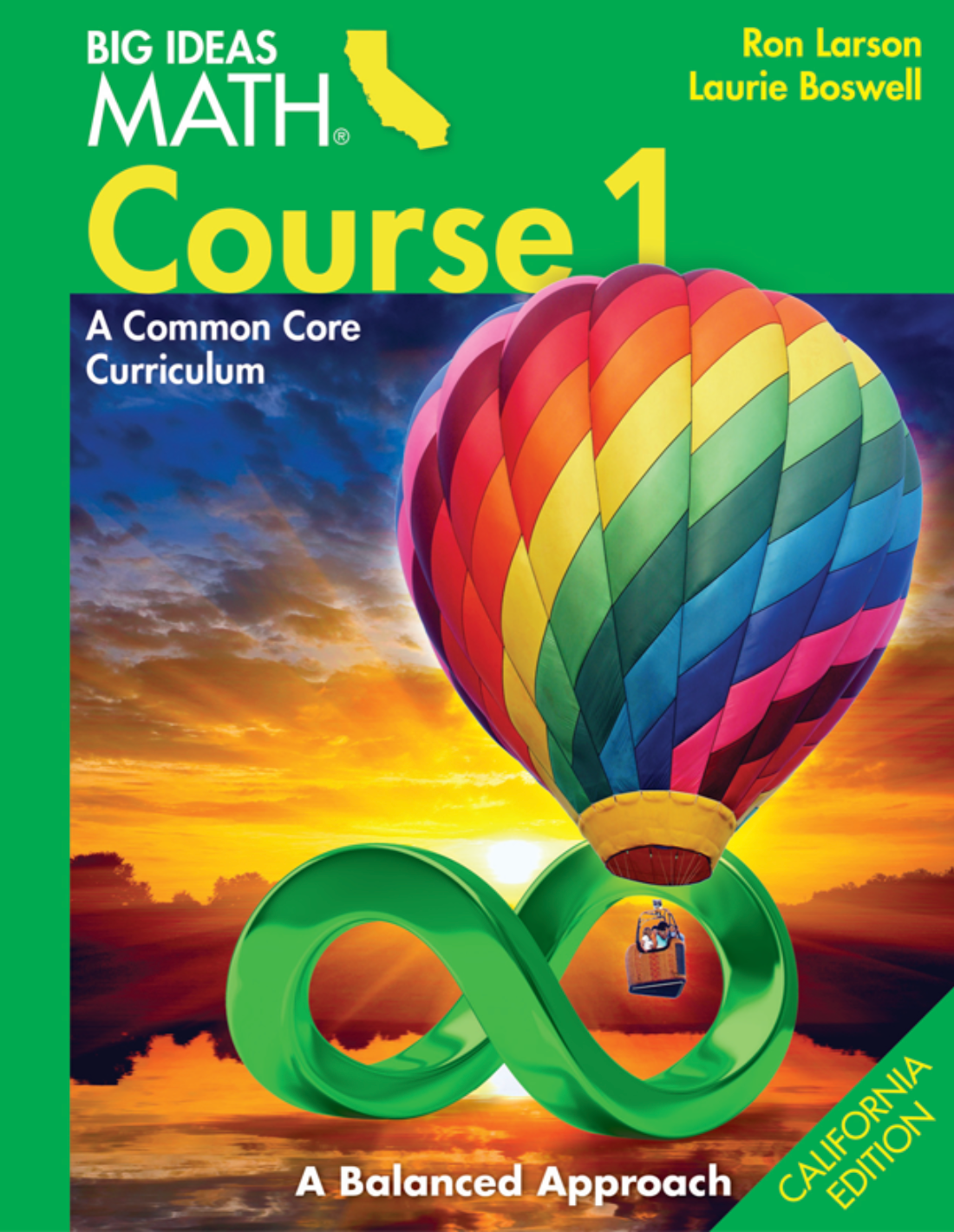
Big Ideas Math, Course 1
Big Ideas Math, Course 1 is a Grade 6 mathematics textbook published by Big Ideas Learning that covers foundational middle school math concepts. The curriculum spans numerical expressions and factors, fractions and decimals, algebraic expressions, ratios and rates, integers and the coordinate plane, equations and inequalities, geometry topics including areas of polygons and surface area and volume, and data analysis through statistical measures and data displays. It is designed to build students' conceptual understanding and problem-solving skills in preparation for more advanced pre-algebra and algebra coursework.
Chapters & Lessons
Chapter 1: Numerical Expressions and Factors
6 lessonsIn this Grade 6 lesson from Big Ideas Math Course 1, Chapter 1, students learn how to identify and apply the four basic whole number operations — addition, subtraction, multiplication, and division — by recognizing key words and phrases in real-life problems. Students practice finding sums, differences, products, and quotients using multi-digit whole numbers, and use estimation and inverse operations to check the reasonableness of their answers.
In this Grade 6 lesson from Big Ideas Math, Course 1, students learn to write repeated multiplication using powers and exponents, identifying the base and exponent in expressions such as 4^5 or 12^3. Students practice finding the values of powers, recognizing perfect squares, and applying exponential notation to real-life area problems. The lesson prepares students for Common Core Standard 6.EE.1 on numerical expressions.
In this Grade 6 lesson from Big Ideas Math Course 1, students learn to evaluate numerical expressions using the order of operations, following the sequence of parentheses, exponents, multiplication or division left to right, and addition or subtraction left to right. The lesson covers key vocabulary including numerical expression and evaluate, and students practice applying these rules to expressions with whole-number exponents as required by standard 6.EE.1. Activities also explore how inserting parentheses changes the value of an expression and why a standard order of operations is necessary for consistent results.
In this Grade 6 lesson from Big Ideas Math, Course 1, Chapter 1, students learn how to find the prime factorization of composite numbers by applying divisibility rules for 2, 3, 5, 6, 9, and 10 and using factor trees. Students practice breaking numbers down into their prime factors and expressing results using exponential notation, such as writing 60 as 2² × 3 × 5. The lesson builds foundational skills for working with common factors and multiples as outlined in Common Core Standard 6.NS.4.
In this Grade 6 lesson from Big Ideas Math, Course 1, students learn how to find the greatest common factor (GCF) of two or more numbers using two methods: listing all factors and comparing them, and using prime factorizations. The lesson introduces key vocabulary including common factors, GCF, and Venn diagrams, which students use to organize and identify shared factors visually.
In this Grade 6 lesson from Big Ideas Math Course 1, students learn how to find the least common multiple (LCM) of two or more numbers using two methods: listing multiples and using prime factorizations. The lesson covers key vocabulary including common multiples and LCM, and connects to the relationship between LCM and greatest common factor. Aligned to Common Core standard 6.NS.4, students use Venn diagrams with prime factors to deepen their understanding of how shared and unique prime factors determine the LCM.
Chapter 2: Fractions and Decimals
6 lessonsIn this Grade 6 lesson from Big Ideas Math, Course 1, students learn how to multiply fractions by multiplying numerators together and denominators together, expressed algebraically as (a/b) × (c/d) = (ac)/(bd). The lesson uses visual models such as number line segments and folded paper grids to build conceptual understanding before introducing the standard procedure, including how to divide out common factors to simplify products. Students practice applying the rule to both numerical exercises and real-life problems involving fractional parts of quantities.
In this Grade 6 lesson from Big Ideas Math, Course 1, Chapter 2, students learn how to divide fractions by fractions and whole numbers by fractions using the key concept of reciprocals and the Multiplicative Inverse Property. Students practice rewriting division expressions as multiplication by the reciprocal, following the rule that dividing by a fraction is equivalent to multiplying by its reciprocal. The lesson aligns with Common Core standard 6.NS.1 and includes both visual models and algebraic methods for solving real-life problems involving fraction division.
In this Grade 6 lesson from Big Ideas Math, Course 1, Chapter 2, students learn how to divide mixed numbers by converting them to improper fractions and multiplying by the reciprocal. The lesson covers dividing a mixed number by a fraction, dividing two mixed numbers, and applying order of operations with mixed number division. Real-world contexts and number line models help students visualize and verify their results.
In this Grade 6 lesson from Big Ideas Math, Course 1, students learn how to add and subtract decimals by lining up decimal points and inserting zeros to match decimal places. The lesson begins with base ten block models and place value charts to build understanding before moving to the standard vertical algorithm. Students also apply these skills to real-life problems involving money and perimeter calculations.
In this Grade 6 lesson from Big Ideas Math, Course 1 (Chapter 2: Fractions and Decimals), students learn how to multiply decimals by whole numbers and by other decimals by first multiplying as whole numbers and then counting and placing decimal places in the product. The lesson uses base ten blocks, area models, and mental math strategies such as moving the decimal point when multiplying by powers of 10. Students also practice evaluating expressions involving decimal multiplication, supported by estimation to check reasonableness.
In this Grade 6 lesson from Big Ideas Math, Course 1, students learn how to divide decimals by whole numbers and by other decimals using base ten block models and standard algorithms. Key skills include placing the decimal point correctly in the quotient, multiplying the divisor and dividend by a power of 10 to create a whole-number divisor, and using estimation to check results. The lesson aligns with Common Core standard 6.NS.3 and covers problems ranging from simple quotients like 7.6 ÷ 4 to more complex cases like 0.273 ÷ 0.39.
Chapter 3: Algebraic Expressions and Properties
4 lessonsIn this Grade 6 lesson from Big Ideas Math, Course 1, students learn to identify the parts of an algebraic expression, including terms, coefficients, constants, and variables. They practice writing expressions using exponents and evaluating algebraic expressions with one or two variables by substituting values and applying the order of operations. Real-life scenarios, such as calculating hourly wages and total costs, help students connect expression writing and evaluation to everyday problems.
In this Grade 6 lesson from Big Ideas Math, Course 1 (Chapter 3), students learn how to write numerical and algebraic expressions to represent unknown quantities using variables. They practice identifying key words and phrases that signal the four operations, such as "more than" for addition, "fewer than" for subtraction, "product of" for multiplication, and "quotient of" for division. The lesson aligns with Common Core standard 6.EE.2a and builds skills in translating real-world phrases into expressions like x + 14 or 3 ÷ z.
In this Grade 6 lesson from Big Ideas Math, Course 1, students learn the Commutative and Associative Properties of Addition and Multiplication, as well as the Addition Property of Zero and the Multiplication Properties of Zero and One. Students apply these properties to simplify algebraic expressions involving variables, such as reordering or regrouping terms to combine constants. The lesson also explores how these properties work in real-life contexts, like calculating a sponsor's total payment for a basketball team.
In this Grade 6 lesson from Big Ideas Math, Course 1, students learn how to apply the Distributive Property to multiply sums and differences, using it as a mental math strategy and to simplify algebraic expressions such as 4(n + 5) = 4n + 20. The lesson covers both numerical examples with whole numbers and fractions and algebraic applications involving expressions like a(b + c) = ab + ac and a(b - c) = ab - ac. Students also connect the property to real-life contexts by writing and simplifying variable expressions.
Chapter 4: Areas of Polygons
4 lessonsIn Big Ideas Math Course 1, Grade 6 students learn how to derive and apply the area formula for a parallelogram using deductive reasoning, connecting it to the known area formula for a rectangle. The lesson covers the formula A = bh, where b is the base and h is the height, and students practice finding areas of parallelograms given whole numbers, fractions, and grid-based dimensions. A real-life application extends the concept to composite figures by subtracting the area of a cut-out shape from the total parallelogram area.
In this Grade 6 lesson from Big Ideas Math, Course 1, Chapter 4, students derive and apply the triangle area formula A = ½bh by cutting rectangles along a diagonal and rearranging triangles into known quadrilaterals. Students practice calculating the area of triangles given the base and height, and solve real-life problems such as comparing proportional areas when dimensions are scaled. The lesson aligns with standard 6.G.1 and builds geometric reasoning alongside accurate calculation skills.
In this Grade 6 lesson from Big Ideas Math Course 1, students learn how to derive and apply the trapezoid area formula A = ½h(b₁ + b₂) using the height and two bases. Through a hands-on grid paper activity, students cut and rearrange a trapezoid into familiar shapes to understand where the formula comes from before practicing with numerical and grid-based examples. The lesson also connects the formula to real-life applications such as estimating geographic area and population density.
In this Grade 6 lesson from Big Ideas Math Course 1, students learn how to draw polygons in the coordinate plane by plotting and connecting ordered pairs that represent vertices. They also discover how to find the lengths of horizontal and vertical line segments by calculating the difference between x-coordinates or y-coordinates of the endpoints. These skills are applied to real-world problems such as finding distances on a city map and calculating the perimeter of polygons using coordinate geometry.
Chapter 5: Ratios and Rates
7 lessonsIn this Grade 6 lesson from Big Ideas Math Course 1, Chapter 5, students learn how to define and write ratios as comparisons of two quantities, including part-to-part, part-to-whole, and whole-to-part relationships. Students practice expressing ratios using multiple formats such as "a to b" and a:b notation through real-world contexts like counting coins and mixing paint colors. Tape diagrams are also introduced as a visual tool for representing the relationship between two quantities.
In this Grade 6 lesson from Big Ideas Math, Course 1 (Chapter 5: Ratios and Rates), students learn how to use ratio tables to find and organize equivalent ratios by applying addition, subtraction, multiplication, and division. Through hands-on activities and worked examples, students practice completing ratio tables and solving real-life problems such as scaling mixtures and calculating ingredient amounts. The lesson addresses standards 6.RP.1 and 6.RP.3a, building foundational skills in proportional reasoning.
In this Grade 6 lesson from Big Ideas Math Course 1, Chapter 5, students learn to define and apply rates, unit rates, and equivalent rates using ratio tables and double number lines. They practice writing rates from real-world situations, finding unit rates by dividing, and scaling equivalent rates to solve problems involving distance, earnings, and cost. The lesson builds foundational ratio reasoning skills essential for proportional thinking in middle school math.
In this Grade 6 lesson from Big Ideas Math, Course 1 (Chapter 5: Ratios and Rates), students learn how to compare two ratios using ratio tables and unit rates, and how to graph ordered pairs from ratio tables in the coordinate plane. Students practice scaling ratios to find equivalent values for direct comparison and interpret the resulting lines on a graph to draw conclusions about proportional relationships. This lesson addresses Common Core standards 6.RP.2 and 6.RP.3a.
In this Grade 6 lesson from Big Ideas Math, Course 1 (Chapter 5: Ratios and Rates), students learn how percents relate to ratios and fractions by writing percents as fractions with a denominator of 100 and converting fractions to percents using equivalent fractions. The lesson covers key skills such as simplifying percent-based fractions, converting values like 35% to 7/20, and applying percent reasoning to real-world problems, aligned to standard 6.RP.3c.
In this Grade 6 lesson from Big Ideas Math, Course 1, students learn how to find the percent of a number and find the whole when given a part and a percent. The lesson covers mental math strategies using 10% and 1% as benchmarks, writing percents as fractions to multiply or divide, and using ratio tables to solve percent problems. Real-world applications such as calculating sales tax, tips, and service charges help students connect these skills to everyday situations.
In this Grade 6 lesson from Big Ideas Math Course 1, students learn how to convert measurements between the U.S. customary system and the metric system using conversion factors and unit analysis. They practice multiplying by conversion factors written as fractions, such as using 1 in. = 2.54 cm to convert between inches and centimeters, and apply unit analysis to change units within rates. The lesson builds on students' prior knowledge of within-system conversions to compare real-world measurements like speed, distance, and height across both systems.
Chapter 6: Integers and the Coordinate Plane
5 lessonsIn this Grade 6 lesson from Big Ideas Math Course 1, Chapter 6, students learn what integers are — the set of whole numbers and their opposites — and how to represent positive and negative integers in real-world contexts such as temperature, elevation, and financial gains or losses. Students practice writing and graphing integers on a number line, identifying opposites, and recognizing that zero is neither positive nor negative.
In this Grade 6 lesson from Big Ideas Math, Course 1, students learn how to compare and order integers using both horizontal and vertical number lines, applying the concepts of greater than and less than with positive and negative values. Students practice using inequality symbols to compare integers such as -5 and -3, and order sets of integers from least to greatest by plotting them on a number line. The lesson also connects integer comparison to real-life contexts like temperature readings and rocket launch countdowns.
In this Grade 6 lesson from Big Ideas Math Course 1, students learn how to graph and compare positive and negative fractions, mixed numbers, and decimals on a number line. The lesson covers finding opposites, using number line position to apply inequality symbols, and ordering rational numbers in real-world contexts such as temperature changes. Students practice placing values like negative mixed numbers and decimals between integer tick marks to build fluency with rational number comparison.
In this Grade 6 lesson from Big Ideas Math, Course 1, students learn the concept of absolute value — defined as the distance between a number and zero on a number line — using real-world contexts like ocean depth and elevation. Students practice finding and comparing absolute values of integers, fractions, and decimals using the notation |a|. The lesson also applies absolute value to determine which of two numbers is closer to zero in problems involving sea level and animal elevations.
In this Grade 6 lesson from Big Ideas Math Course 1, students learn to identify and use the coordinate plane, including its key parts: the x-axis, y-axis, origin, and four quadrants. Students practice plotting ordered pairs with positive and negative coordinates and finding distances between points on the coordinate plane. The lesson addresses Common Core standards 6.NS.6b, 6.NS.6c, and 6.NS.8.
Chapter 7: Equations and Inequalities
7 lessonsIn this Grade 6 lesson from Big Ideas Math, Course 1, students learn how to write one-variable equations by translating word sentences into mathematical statements using key phrases like "decreased by," "the product of," and "the same as." The lesson covers identifying the equal sign placement and defining variables to represent unknown quantities in real-life scenarios. Students also practice simplifying word problems to isolate the essential information needed to set up an equation.
In this Grade 6 lesson from Big Ideas Math Course 1, Chapter 7, students learn to solve one-variable equations using the Addition Property of Equality and the Subtraction Property of Equality by applying inverse operations to isolate the variable. Students also practice checking solutions through substitution to verify whether a given value makes an equation true. The lesson aligns with Common Core standards 6.EE.5 and 6.EE.7 and includes real-life problem-solving applications.
In this Grade 6 lesson from Big Ideas Math Course 1, Chapter 7, students learn how to solve one-variable equations using the Multiplication Property of Equality and the Multiplicative Inverse Property. They practice isolating variables by multiplying or dividing both sides of an equation by the same nonzero number, including cases involving fractions and reciprocals. Real-world problems and geometry contexts reinforce how inverse operations undo each other to find unknown values.
In this Grade 6 lesson from Big Ideas Math, Course 1 (Chapter 7), students learn how to write equations in two variables by exploring real-world situations such as hourly earnings and perimeter formulas. Students identify independent and dependent variables, find solutions of two-variable equations as ordered pairs, and use tables and graphs to analyze the relationship between two related quantities. This lesson addresses Common Core standard 6.EE.9.
In this Grade 6 lesson from Big Ideas Math Course 1, Chapter 7, students learn to write word sentences as inequalities using symbols such as less than, greater than, less than or equal to, and greater than or equal to. Students also identify solutions and solution sets of inequalities by substituting values, and graph inequalities on a number line using open and closed circles with directional arrows. The lesson connects these skills to real-life situations, such as temperature limits and passenger capacity constraints.
In this Grade 6 lesson from Big Ideas Math Course 1, Chapter 7, students learn to solve one-variable inequalities using the Addition Property of Inequality and the Subtraction Property of Inequality. They practice isolating the variable by adding or subtracting the same number from both sides, then graphing the solution set on a number line using open or closed circles. Real-world contexts, such as voting age and manatee growth, help students write and interpret inequalities like x − 3 > 1 or 15 ≥ 6 + x.
In this Grade 6 lesson from Big Ideas Math, Course 1 (Chapter 7: Equations and Inequalities), students learn to solve one-variable inequalities using the Multiplication Property of Inequality and the Division Property of Inequality. They practice isolating the variable by multiplying or dividing both sides of an inequality by the same positive number, then graphing the solution set on a number line. Real-life problems, such as comparing the cost of individual bus fares to a monthly pass, help students apply these skills in context.
Chapter 8: Surface Area and Volume
4 lessonsIn this Grade 6 lesson from Big Ideas Math, Course 1 (Chapter 8), students learn to identify and describe three-dimensional figures, including key vocabulary such as polyhedron, face, edge, vertex, prism, and pyramid. Students practice counting faces, edges, and vertices of solids and draw prisms and pyramids using square dot paper and isometric dot paper. The lesson also covers drawing front, side, and top views of three-dimensional figures.
In this Grade 6 lesson from Big Ideas Math, Course 1 (Chapter 8), students learn how to find the surface area of rectangular and triangular prisms by using nets to identify and calculate the area of each face, then summing those areas. The lesson introduces key vocabulary including surface area and net, and applies the standard formula for triangle area to work with triangular prism faces. Students practice drawing two-dimensional nets, labeling bases and lateral faces, and solving real-life measurement problems aligned with Common Core standard 6.G.4.
In this Grade 6 lesson from Big Ideas Math, Course 1, students learn how to find the surface area of square pyramids and triangular pyramids by using nets to identify and calculate the area of each face, including the base and lateral faces. Students apply the triangle area formula with slant height to find lateral face areas, then sum all faces to determine total surface area. The lesson aligns with standard 6.G.4 and includes real-life problem-solving practice.
In this Grade 6 lesson from Big Ideas Math Course 1, students learn how to find the volume of rectangular prisms with fractional edge lengths using the formulas V = Bh and V = ℓwh. Through hands-on activities, they explore how unit cubes can be subdivided to reason about fractional dimensions, then apply multiplication of fractions to calculate volumes. The lesson also introduces the formula V = s³ for cubes and connects volume concepts to real-world problems.
Chapter 9: Statistical Measures
5 lessonsIn this Grade 6 lesson from Big Ideas Math, Course 1, Chapter 9, students are introduced to statistics by learning to distinguish between statistical and non-statistical questions, understanding that statistical questions anticipate variability in answers. Students also practice collecting and displaying numerical data using dot plots, and learn to identify clusters, peaks, gaps, and outliers within a data set.
In this Grade 6 lesson from Big Ideas Math Course 1, Chapter 9: Statistical Measures, students learn how to calculate the mean of a data set by dividing the sum of all values by the number of values. Through hands-on activities and examples, students practice finding and comparing means in real-world contexts, such as text messages sent and monthly rainfall. The lesson also introduces the concept of an outlier and explores how it can affect the mean of a data set.
In this Grade 6 lesson from Big Ideas Math Course 1, Chapter 9, students learn how to find and interpret two measures of center: the median and the mode. Students practice ordering data sets to locate the middle value, calculating the median for both odd and even numbers of values, and identifying the mode as the most frequently occurring value. The lesson also introduces when a data set can have no mode or multiple modes, and connects these concepts to the broader idea of describing a typical value in a data set.
In this Grade 6 lesson from Big Ideas Math Course 1, Chapter 9, students learn how to describe the spread of a data set using measures of variation, including range, quartiles, and interquartile range (IQR). Students practice finding the range by subtracting the least value from the greatest, identifying the first and third quartiles by finding the medians of the lower and upper halves of ordered data, and calculating the IQR as Q3 minus Q1. These skills help students interpret how spread out or clustered a set of real-world data values are.
In this Grade 6 lesson from Big Ideas Math Course 1, Chapter 9: Statistical Measures, students learn how to calculate mean absolute deviation (MAD) by finding the distance between each data value and the mean, summing those distances, and dividing by the number of values. Students practice interpreting MAD as a measure of the spread of a data set, understanding that a smaller MAD indicates data values clustered closer to the mean. The lesson builds on prior knowledge of mean, dot plots, range, and interquartile range to develop a deeper understanding of statistical variability.
Chapter 10: Data Displays
4 lessonsIn this Grade 6 lesson from Big Ideas Math, Course 1, students learn how to make and interpret stem-and-leaf plots by organizing data values using stems (leading digits) and leaves (remaining digits). The lesson covers constructing single and back-to-back stem-and-leaf plots, writing a key, and analyzing the distribution of a data set. These skills align with Common Core Standard 6.SP.4 from Chapter 10: Data Displays.
In this Grade 6 lesson from Big Ideas Math Course 1, students learn how to organize data using frequency tables and histograms, including how to select equal-sized intervals and plot bar heights that represent the frequency of values within each interval. Students practice making and interpreting histograms using real-world data, such as laps completed in swimming and paper airplane flight distances, while exploring how different interval choices affect the appearance and clarity of a graph. The lesson aligns with Common Core standards 6.SP.2 and 6.SP.4.
In this Grade 6 lesson from Big Ideas Math Course 1, Chapter 10, students learn to identify and describe the shapes of data distributions, including symmetric, skewed left, and skewed right distributions, using dot plots and histograms. Students explore how the position of a distribution's tail determines whether it is skewed and how the shape of a distribution affects the relationship between mean and median. The lesson also guides students in choosing the most appropriate measure of center and variation based on the shape of a given data set.
In this Grade 6 lesson from Big Ideas Math, Course 1, Chapter 10, students learn how to construct and interpret box-and-whisker plots using the five-number summary, which includes the least value, greatest value, median, first quartile, and third quartile. Students practice ordering data sets, identifying quartiles, and drawing plots on a number line to display the variability of real-world data. The lesson also covers comparing two box-and-whisker plots to analyze and contrast data distributions.
Frequently Asked Questions
- Is Big Ideas Math Course 1 the right textbook for my sixth grader?
- Big Ideas Math Course 1 is one of the most widely adopted Grade 6 math textbooks in the U.S., and it is a solid choice for students entering middle school math. It covers the full range of sixth-grade Common Core topics - numerical expressions, fractions, decimals, ratios, integers, algebraic expressions, equations, geometry, and data analysis. Compared to enVision Math or Reveal Math, it has a straightforward, practice-heavy approach that works well for students who learn by doing many problems. If your child's school uses it, it is well-aligned to what they need. It is also a good homeschool option.
- Which chapters in Big Ideas Math Course 1 are hardest for sixth graders?
- Chapter 4 on ratios and rates is where many students first get stuck - the concepts of unit rate, equivalent ratios, and proportional reasoning are new and abstract. Chapter 6 on equations and inequalities is another major hurdle because students often confuse expression simplification with equation solving. Chapter 7 on area of polygons - especially triangles and composite figures - and Chapter 8 on surface area and volume challenge students whose spatial visualization is not yet strong. Chapter 9 on statistical measures trips up students who struggle with mean, median, mode, and interpreting data displays.
- My child is struggling with ratios and rates. Where in this textbook should they start?
- Go back to Chapter 1 first to verify that your child has solid fluency with multiplication, division, and fractions - ratios only click when those are automatic. Then start Chapter 4 at Lesson 1 on writing and comparing ratios before moving to Lesson 2 on rates and unit rates. The most common mistake is rushing to cross-multiplication without truly understanding what a unit rate means. Use grocery store prices and sports statistics as real-world anchors. Do not proceed to Chapter 5 on percent until unit rates feel completely comfortable.
- My child just finished Big Ideas Math Course 1. What should they study next?
- The natural next step is Big Ideas Math Course 2 (Grade 7), which extends ratios into proportional relationships, introduces negative number operations more deeply, covers probability and statistics more rigorously, and begins geometric transformations. If your child did exceptionally well and the school offers it, Big Ideas Math Accelerated compresses Grade 7 and Grade 8 content for students who are ready to reach Algebra 1 early. Building fluency with integers and proportional reasoning over the summer is the best preparation for Course 2.
- How can Pengi help my child with Big Ideas Math Course 1?
- Pengi is especially helpful for the problem types in this textbook where students get stuck mid-problem and have nobody to ask. If your child is lost on a ratio table problem from Chapter 4 or confused about how to find surface area in Chapter 8, Pengi can walk through the specific problem step by step, explain where the thinking went wrong, and generate similar practice problems. Pengi is also useful for checking whether your child truly understands a concept versus just memorizing a procedure - it can ask follow-up questions that expose gaps before the test.
Ready to start learning?
Jump into your first lesson for Big Ideas Math, Course 1. Free, no account required.
Start Learning