
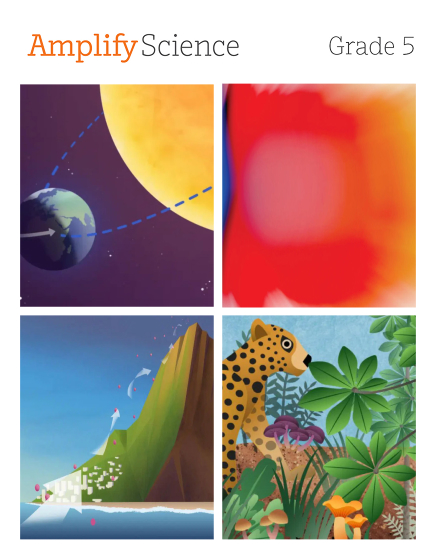
Amplify Science (California) Grade 5
Amplify Science (California) Grade 5, published by Amplify, is a phenomenon-based science curriculum aligned to California's Next Generation Science Standards for fifth graders. The program covers four major units: Earth's place in the universe (exploring why we see the sun, moon, and different stars at different times); the water cycle and weather (investigating how water moves through the atmosphere and why rainfall varies across regions); mixtures and solutions (examining how substances like salad dressing separate and how dyes can be distinguished); and ecosystems (studying why organisms such as jaguars, sloths, and cecropia trees struggle to grow and thrive in a rainforest environment). Students engage with real-world questions and hands-on investigations to build understanding of physical science, life science, and Earth and space science concepts throughout the year.
Chapters & Lessons
Chapter 1: Why don’t we see a lot of stars in the daytime?
3 lessonsChapter 2: Why is the sun up sometimes, but not other times?
3 lessonsChapter 3: Why do we see different stars at different times of year?
3 lessonsChapter 4: How can we investigate why we see different stars on different nights?
3 lessonsChapter 1: Why did the food coloring separate into different dyes?
3 lessonsChapter 2: Why do some salad dressings have sediments, and others do not?
3 lessonsChapter 3: Why can salad-dressing ingredients separate again after being mixed?
3 lessonsChapter 1: Why is East Ferris running out of water while West Ferris is not?
3 lessonsChapter 2: Why does more rain form over West Ferris than East Ferris?
3 lessonsChapter 3: Why is more water vapor getting cold over West Ferris than East Ferris?
3 lessonsChapter 4: Why is there more water vapor high up over West Ferris than East Ferris?
3 lessonsChapter 5: How can East Ferris turn wastewater into clean freshwater?
3 lessonsChapter 1: Why aren’t the jaguars and sloths growing and thriving?
3 lessonsChapter 2: Why aren’t the cecropia trees growing and thriving?
3 lessonsChapter 3: Why aren’t the cecropia trees growing and thriving in the soil?
3 lessonsFrequently Asked Questions
- Is Amplify Science California Grade 5 right for my child?
- Amplify Science Grade 5 is a California-adopted, NGSS-aligned science curriculum that uses story-driven investigations rather than textbook-style instruction. Each unit poses a real mystery — why do stars disappear in daytime? why does salad dressing separate? — and students investigate to find answers. It is ideal for curious, hands-on learners who like asking questions and working through evidence. If your child struggles with open-ended, inquiry-based learning and prefers direct instruction, the program can feel frustrating at first. Overall it is one of the most engaging fifth-grade science programs available in California.
- Which units or chapters are hardest in Amplify Science Grade 5?
- The Earth Science unit on water systems (Why is East Ferris running out of water?) is typically the most conceptually difficult — it requires understanding the water cycle, evaporation, transpiration, and watershed dynamics all together. The Chemistry unit (Why did the food coloring separate?) involves particle-level thinking about mixtures and solutions that is abstract for ten-year-olds. The Life Science unit on ecosystems (Why are the jaguars and sloths not thriving?) is dense with cause-and-effect chains across multiple organisms. All units require strong reading and evidence-based argumentation skills.
- My child struggles with scientific reasoning and evidence. Where should they start?
- The Astronomy unit (Why do we not see stars in the daytime?) is the most accessible entry point — it uses everyday observations and builds scientific reasoning gradually. Start there to help your child practice the evidence-based argument structure that appears in every unit. Once your child is comfortable constructing claims with evidence, the Chemistry and Earth Science units will be less overwhelming. Pengi can also explicitly teach the science argumentation framework — claim, evidence, reasoning — before your child encounters it in a pressured classroom setting.
- What should my child study after finishing Amplify Science Grade 5?
- After Amplify Science Grade 5, your child is well-prepared for Amplify Science Grade 6, which covers microorganisms, body systems, genetics, heat energy, weather, and climate — topics that build directly on the systems thinking developed in Grade 5. The scientific argumentation skills and data analysis habits from Grade 5 also support strong performance in middle school life science, earth science, and physical science courses. If your child wants enrichment, exploring science fair projects independently using the investigation methods from any of the Grade 5 units is a natural extension.
- How can Pengi help my child with Amplify Science Grade 5?
- Amplify Science requires students to read complex non-fiction texts, analyze data, and construct written arguments — skills that many fifth graders find challenging. Pengi can help your child break down the investigation readings in each unit, understand the core science concepts (like why condensation happens in the water unit, or how chromosomes work in the genetics unit), and organize their thinking before writing evidence-based explanations. If your child is behind on a particular unit, Pengi can provide a clear, jargon-free explanation of the key ideas so they can participate confidently in class discussions.
Ready to start learning?
Jump into your first lesson for Amplify Science (California) Grade 5. Free, no account required.
Start Learning