
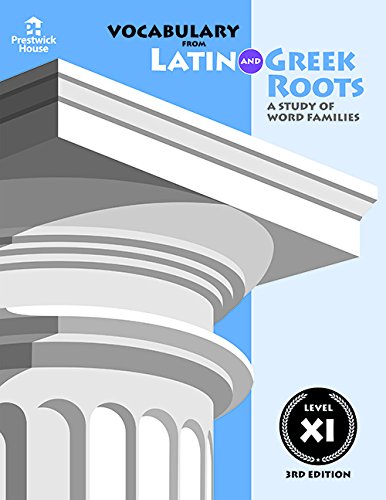
Vocabulary from Latin and Greek Roots, Level XI
Vocabulary from Latin and Greek Roots, Level XI, published by Prestwick House, is a Grade 8 vocabulary program that builds word knowledge by teaching students to recognize and interpret Latin and Greek root words, prefixes, and suffixes across 22 thematic units. Each unit introduces a set of roots alongside derivative English words, helping students decode unfamiliar vocabulary in context across subject areas including literature, science, and social studies. The program develops lasting vocabulary acquisition skills by grounding word study in the classical languages that form the foundation of much of the English lexicon.
Chapters & Lessons
Unit 1 ~ Unit 3
3 lessonsIn this Grade 8 vocabulary lesson from Vocabulary from Latin and Greek Roots, Level XI, students study five Latin roots related to color — VERD/VIRID (green), CAND (white/pure), PALL (pale), LIVID (bluish-black), and NIGR (black) — and learn words such as verdant, candor, pallor, incandescent, and denigrate. Students explore how color symbolism in ancient Rome shaped modern English, including the origins of words like candidate and appall. Practice exercises reinforce understanding of each term's meaning, connotations, and correct usage in context.
Unit 4 ~ Unit 6
3 lessonsIn this Grade 8 vocabulary lesson from Vocabulary from Latin and Greek Roots, Level XI, students explore words derived from four Latin roots: PECCARE (to sin), PEJOR (worse), MALUS (bad), and NEGARE (to deny). Students learn the precise meanings and usage of terms such as peccadillo, impeccable, pejorative, malign, malaise, negligent, and negate, along with their synonyms and antonyms. The lesson also covers how etymology connects related words like impair and renegade to their Latin origins.
In this Grade 8 vocabulary lesson from Vocabulary from Latin and Greek Roots, Level XI (Unit 6), students learn words derived from the Latin roots SOMN, SOPOR, LANG, VIGIL, and QUIES, including terms such as somnolent, soporific, languid, languor, vigilant, vigilante, acquiesce, and requiem. Students explore the original Latin meanings behind each root and practice using the vocabulary in context through sentence-completion exercises. The lesson builds both word recognition and etymological reasoning skills essential for advanced reading and writing.
Unit 7 ~ Unit 9
3 lessonsIn this Grade 8 lesson from Vocabulary from Latin and Greek Roots, Level XI, students explore four classical roots — Latin SOL ("alone"), Greek MONO ("one"), Latin VULG ("crowd"), and Greek POLY ("many") — and the English vocabulary derived from each. Key terms include solipsism, soliloquy, monotonous, monosyllabic, divulge, polymath, and polyglot, with attention to each word's etymological components. Students build word analysis skills by connecting root meanings to definitions and real-world usage examples.
In this Grade 8 lesson from Vocabulary from Latin and Greek Roots, Level XI, students learn vocabulary derived from five Latin roots connected to fate, luck, and fortune: FORT (fortuitus, "happening by chance"), AUSP (auspex, "fortune-teller"), DEST (destinare, "to determine"), SORT (sors, "chance"), and PROPIT (propitius, "favorable"). Key terms include fortuitous, auspicious, predestination, consortium, consort, and propitiate, each explored through etymology, definitions, and contextual examples. Students build both word knowledge and an understanding of how ancient Roman beliefs about fate and omens shaped modern English vocabulary.
Unit 10 ~ Unit 12
3 lessonsIn this Grade 8 vocabulary lesson from Vocabulary from Latin and Greek Roots, Level XI, students study three Latin roots — IT/IANC (IRE, ITUM: "to go, to pass"), CED (CEDERE, CESSUM: "to go, to yield"), and VEN (VENIRE, VENTUM: "to come, to arrive") — and the English words derived from them, including sedition, circuitous, transitory, accede, antecedent, precedent, contravene, adventitious, and parvenu. Each word is presented with its Latin prefix breakdown, definition, and example sentence to reinforce both meaning and etymology. This Unit 12 lesson builds students' advanced vocabulary by connecting word structure to precise, context-rich usage.
Unit 13 ~ Unit 15
3 lessonsUnit 16 ~ Unit 18
3 lessonsIn this Grade 8 vocabulary lesson from Vocabulary from Latin and Greek Roots, Level XI, students study four Latin roots — SEM (seed/sow), FLOR (flower), RAD (root), and GERM (sprout) — and learn to define and use words such as disseminate, seminal, florid, deracinate, irradicable, eradicate, germinate, germinal, and germane. Students explore how each root connects to meaning, practice completing sentences in context, and reinforce their understanding through fill-in-the-blank exercises. The lesson builds advanced vocabulary skills by grounding word meanings in their Latin origins.
Unit 19 ~ Unit 22
4 lessonsIn this Grade 8 vocabulary lesson from Vocabulary from Latin and Greek Roots, Level XI, students study four Latin roots — DECOR, ORN, FORM, and ORD — and the words derived from them, including decorum, adorn, suborn, ornate, formulaic, formulate, inordinate, ordain, and preordained. Students learn each word's meaning, Latin etymology, and usage in context, building precise vocabulary related to beauty, order, decoration, and formal command.
In this Grade 8 lesson from Vocabulary from Latin and Greek Roots, Level XI, students learn the meanings and usage of vocabulary words derived from Latin and Greek roots related to water and washing, including instill, distill, ablution, alluvial, lachrymal, lachrymose, lavish, riparian, meander, fluent, and fluctuate. Students practice applying these terms through sentence-completion and fill-in-the-blank exercises that reinforce both definitions and contextual understanding. The lesson is part of Unit 21 in Chapter 7 of the textbook's eleventh-level vocabulary curriculum.
Frequently Asked Questions
- Is Vocabulary from Latin and Greek Roots Level XI right for my child?
- Vocabulary from Latin and Greek Roots Level XI is designed for eighth graders and is one of the most rigorous vocabulary programs available at the middle school level. It teaches advanced vocabulary by tracing words back to their Latin and Greek roots — a strategy that is far more effective than memorizing word lists because it lets students decode unfamiliar words independently. It is ideal for students preparing for high school honors courses, the SAT/ACT, or competitive writing. Units 1 through 22 introduce hundreds of sophisticated roots and derived words. If your child is a strong reader looking to elevate their academic vocabulary, this program is excellent.
- Which units are hardest in Vocabulary from Latin and Greek Roots Level XI?
- Units 13 through 18 tend to be the most challenging because they introduce roots from specialized domains — medical, legal, and scientific Latin — where the derived words are less likely to appear in everyday reading. Units 19 through 22 have the highest density of new roots per unit and require students to manage a larger cumulative vocabulary. The greatest difficulty for most students is not learning individual words but applying roots flexibly to unfamiliar words — that transfer skill takes sustained practice across multiple units before it becomes automatic.
- My child struggles with vocabulary. Where should they start?
- Start at Unit 1, which introduces foundational Latin roots that recur throughout the entire program. Skipping earlier units means missing roots that appear again in later, more complex words. If your child finds Units 1 through 3 very difficult, they may benefit from Level X first, which covers prerequisite roots. The most important habit to build early is active root analysis — before looking up a word, encourage your child to identify the root and guess the meaning. This habit, established in the first few units, compounds in effectiveness across all 22 units.
- What should my child study after finishing Level XI?
- After completing Vocabulary from Latin and Greek Roots Level XI, students are well-prepared for high school vocabulary demands, including AP English Language, AP Literature, and standardized test prep (PSAT, SAT, ACT). The natural continuation within the same series is Vocabulary from Latin and Greek Roots Level XII, which covers high school-level roots. Students ready to apply their vocabulary skills should read challenging non-fiction and literary works — strong vocabulary only solidifies through encounters with sophisticated texts. SAT vocabulary prep resources will also feel much more manageable after completing this program.
- How can Pengi help my child with Vocabulary from Latin and Greek Roots Level XI?
- Vocabulary from Latin and Greek Roots Level XI requires more than just memorization — students need to internalize root meanings deeply enough to apply them to words they have never seen. Pengi can quiz your child on root definitions and derived words from any unit, explain the etymology of tricky words with memorable examples, and create custom practice sentences that reinforce each new root in context. If your child is preparing for a unit test on Units 7 through 9, Pengi can generate targeted review exercises in minutes. The program is excellent but fast-paced; Pengi ensures no root gets left behind.
Ready to start learning?
Jump into your first lesson for Vocabulary from Latin and Greek Roots, Level XI. Free, no account required.
Start Learning