
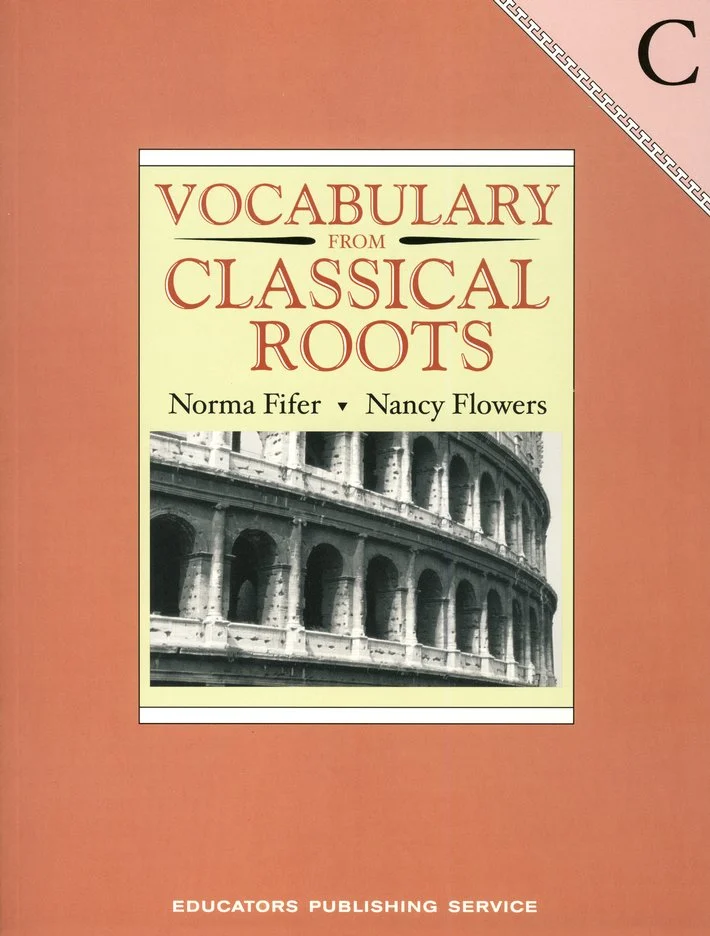
Vocabulary from Classical Roots (Book C)
Vocabulary from Classical Roots (Book C), published by Educators Publishing Service, is a Grade 5 vocabulary program that builds word knowledge through the study of Latin and Greek roots, prefixes, and suffixes. Organized thematically, the book guides students through lessons centered on the human experience, covering topics such as the person and personal relationships, emotions and feelings, the human body (including the head, hands, and feet), and the natural world of creatures. Each lesson connects classical word origins to modern English vocabulary, helping students develop lasting strategies for understanding unfamiliar words across all subject areas.
Chapters & Lessons
Chapter 1: The Person (Lesson 1-2)
2 lessonsIn this Grade 5 lesson from Vocabulary from Classical Roots Book C, students explore Latin and Greek roots related to human beings, learning key terms such as anthropology, humanism, misanthrope, homicide, feminism, and autonomy. Each root — including HUMANUS, ANTHROPOS, HOMI-, VIR, GYNE, and FEMINA — is connected to its meaning and spelling to help students understand word origins and definitions in context. Students practice using varied word forms and build vocabulary knowledge through definitions, example sentences, and related exercises.
In this Grade 5 vocabulary lesson from Vocabulary from Classical Roots Book C, students study fifteen key words derived from the Greek and Latin roots genos, gens, and genus, meaning race, family, or birth, including terms such as genealogy, genocide, genre, heterogeneous, and progenitor. The lesson connects word origins to real-world contexts through literary and historical examples, helping students understand how a shared root gives rise to a family of related words. A fill-in-the-blank exercise at the start reinforces vocabulary from Lesson 1, building cumulative retention across the chapter.
Chapter 2: Personal Relationships (Lesson 3-4)
2 lessonsIn this Grade 5 lesson from Vocabulary from Classical Roots, Book C, students build vocabulary through Latin and Greek roots including PUER, MORIOR, and THANATOS, learning words such as puerile, pedagogue, pedant, entity, essence, moribund, mortify, postmortem, and euthanasia. Each term is defined with its root origin and illustrated through literary and real-world examples to deepen understanding of word meaning and usage. The lesson is part of Chapter 2's exploration of personal relationships and human experience through classical language.
Chapter 3: Feelings (Lesson 5-6)
2 lessonsIn this Grade 5 vocabulary lesson from Vocabulary from Classical Roots Book C, students explore words rooted in Latin and Greek stems related to love, hate, fear, and peace, including terms such as amicable, enamored, odious, philanthropy, phobia, acrophobia, xenophobia, and pacify. Students learn to recognize how classical roots like AMO, PHILOS, PHOBOS, and PAX form the basis of modern English words expressing emotions and attitudes. The lesson builds word analysis skills by connecting each vocabulary term to its root meaning, part of speech, and real-world usage examples.
In this Grade 5 lesson from Vocabulary from Classical Roots Book C, students learn vocabulary words rooted in the Greek stems pathos, miso, and dys, including antipathy, apathy, empathy, pathological, misogamy, misogyny, dysentery, and dyslexia. Students explore how these classical roots convey meanings related to suffering, hatred, and difficulty, and apply the words through fill-in-the-blank exercises using context clues. The lesson builds both word knowledge and root-recognition skills as part of Chapter 3's focus on words expressing feelings and emotional states.
Chapter 4: Creature Comforts (Lesson 7-8)
2 lessonsIn Lesson 8 of the "Creature Comforts" chapter from Vocabulary from Classical Roots Book C, Grade 5 students build vocabulary by exploring Latin roots related to food, eating, and drinking, including COQUO ("to cook") and VORO ("to devour"). Students learn and apply 15 key words such as carnivorous, herbivorous, voracious, concoct, cuisine, and precocious, tracing each term back to its classical origin. This lesson strengthens word analysis skills by showing how Latin roots like -vore and -vorous combine with other roots to form a family of related words.
Chapter 5: The Head (Lesson 9-10)
2 lessonsIn this Grade 5 lesson from Vocabulary from Classical Roots Book C, students build vocabulary by studying 15 key words derived from three Latin roots: CAPUT meaning "head," CEREBRUM meaning "brain," and FACIES meaning "face." Terms such as capitulation, decapitate, recapitulation, cerebral, cerebration, efface, and facade are introduced through definitions, example sentences, and varied word forms. Students learn to connect root meanings to spelling and usage, strengthening both vocabulary and etymological reasoning skills.
In this Grade 5 lesson from Vocabulary from Classical Roots Book C, students learn fifteen key vocabulary words derived from Latin and Greek roots related to the head and body, including os/oris (mouth), dens/dentis (tooth), and gurges/gurgitis (throat). Words such as oration, orifice, orthodontist, indenture, and disgorge are explored through their classical origins, definitions, and real-world examples. The lesson also introduces challenge words like oratorio and peroration to extend understanding of Latin roots connected to speech and anatomy.
Chapter 6: The Body (Lesson 11-12)
2 lessonsIn this Grade 5 vocabulary lesson from Vocabulary from Classical Roots Book C, students learn 15 words derived from four Latin roots — caro/carnis (flesh), collum (neck), corpus/corporis (body), and cor/cordis (heart) — including terms such as carnage, incarnate, corporal, corporeal, corpus, cordial, and concordance. The lesson builds classical root recognition skills by connecting each word's etymology to its modern meaning through example sentences and context. Students develop both vocabulary breadth and an understanding of how Latin forms the foundation of many English words related to the human body and physical existence.
In this Grade 5 vocabulary lesson from Vocabulary from Classical Roots Book C, students learn 15 key words derived from Greek and Latin roots including derma (skin), dorsum (back), gaster (stomach), nervus (nerve), and sanguis (blood). Students study terms such as dermatology, epidermis, dorsal, gastric, enervate, and sanguine, building understanding of how classical roots form modern English words. The lesson also reviews fill-in-the-blank practice with vocabulary from Lesson 11, reinforcing retention of body-related terminology in context.
Chapter 7: The Hands (Lesson 13-14)
2 lessonsIn this Grade 5 lesson from Vocabulary from Classical Roots Book C, students study Latin roots MANUS (hand), DEXTRA (right hand), DIGITUS (finger), and FLECTO (to bend) to build understanding of key vocabulary words including emancipate, manipulate, ambidextrous, dexterity, and digital. Students learn how these classical roots connect the meaning of related English words, strengthening both vocabulary and word analysis skills. The lesson is part of Chapter 7's focus on words derived from terms for the hands and fingers.
In this Grade 5 vocabulary lesson from Vocabulary from Classical Roots Book C, students study words derived from the Latin root plico, plicare, meaning "to fold," learning key terms such as complicity, duplicity, explicate, explicit, exploit, imply, ploy, ply, and supplicate. Students explore how Latin prefixes like ex-, com-, duo-, and sub- combine with the root to shape each word's meaning and part of speech. The lesson builds both vocabulary depth and word-analysis skills through definitions, example sentences, and contextual exercises.
Chapter 8: The Feet (Lesson15-16)
2 lessonsIn this Grade 5 vocabulary lesson from Vocabulary from Classical Roots Book C, students explore Latin and Greek roots related to feet — pes/pedis, pous/podos, and gradior/gressum — to understand the origins and meanings of 15 key words including expedient, impede, pedometer, podiatry, aggression, degradation, and digress. Students learn how these roots connect familiar words like pedestrian and pedal to more advanced terms, building skills in etymology and contextual word analysis.
In Lesson 16 of Vocabulary from Classical Roots Book C, Grade 5 students explore vocabulary derived from the Latin roots ambulo (to walk around), calcitro (to kick), and sto/stare (to stand). Students learn to define and apply words such as ambulatory, recalcitrant, obstinate, destitute, restitution, and constituent by studying their Latin origins and encountering them in contextual sentences. This lesson builds word-analysis skills that help students decode unfamiliar vocabulary across academic subjects.
Frequently Asked Questions
- Is Vocabulary from Classical Roots Book C the right vocabulary program for my 5th grader?
- Vocabulary from Classical Roots Book C is an excellent choice if your child is a strong reader who benefits from understanding why words mean what they mean rather than just memorizing definitions. The program teaches Greek and Latin roots — like HUMANUS, ANTHROPOS, CORPUS, and MANUS — so your child can decode hundreds of unfamiliar words across subjects on their own. It is well-suited for students who enjoy language connections and literary context. If your child struggles with reading comprehension overall, it may be worth pairing this book with a more foundational vocabulary program first.
- Which lessons or roots in Book C are typically hardest for students?
- Chapters 3 and 6 (Feelings, covering roots like pathos, miso, and dys) tend to be tricky because the vocabulary — words like antipathy, dyslexia, and misogamy — is more abstract and less familiar than body-part words. Chapter 5 (The Head, Lessons 9-10) introduces multiple overlapping roots like os/oris, dens/dentis, and gurges/gurgitis, and students often confuse words like orifice and oration. Chapter 7 on the hands (plico, plicare) is challenging because the folding and prefix combinations produce words like duplicity and supplicate that look very different from their roots.
- My child has a weak vocabulary foundation — where should they start in Book C?
- If your child is new to root-based vocabulary study, begin with Chapter 1 (The Person, Lessons 1-2), which introduces foundational roots like HUMANUS and ANTHROPOS with familiar connecting words like humanism and anthropology. These are thematically concrete and the lesson builds cumulative retention through fill-in-the-blank review. Chapter 4 (Creature Comforts, Lesson 8) covering food-related roots like VORO and COQUO is also very accessible and engaging. Avoid jumping ahead to Chapters 5-7 until your child is comfortable identifying root meanings from spelling clues.
- What should my child study after finishing Vocabulary from Classical Roots Book C?
- After completing Book C, the logical next step is Vocabulary from Classical Roots Book D, which continues the Latin and Greek roots program at a higher level. Students who have mastered Book C will have strong decoding skills that directly support reading comprehension in middle school English, science, and social studies. The medical and scientific vocabulary built in Chapters 5, 6, and 7 — dermatology, cerebral, corporal — creates an excellent foundation for life science and biology courses ahead. Continued reading of literature that uses Latinate vocabulary will reinforce retention across all 16 lessons.
- How can Pengi help my child with Vocabulary from Classical Roots Book C?
- Pengi can turn each lesson into an interactive practice session rather than a static worksheet. After your child works through Lesson 9 on roots like CAPUT and CEREBRUM, Pengi can quiz them on words like capitulation and cerebration in fresh contexts they haven't seen before, testing genuine understanding rather than memorization. For roots that your child keeps confusing — like the overlapping mouth and throat roots in Lessons 9 and 10 — Pengi can generate targeted drills focused on exactly those distinctions. Pengi can also help your child build sentences using new vocabulary, which research shows dramatically improves long-term retention.
Ready to start learning?
Jump into your first lesson for Vocabulary from Classical Roots (Book C). Free, no account required.
Start Learning