
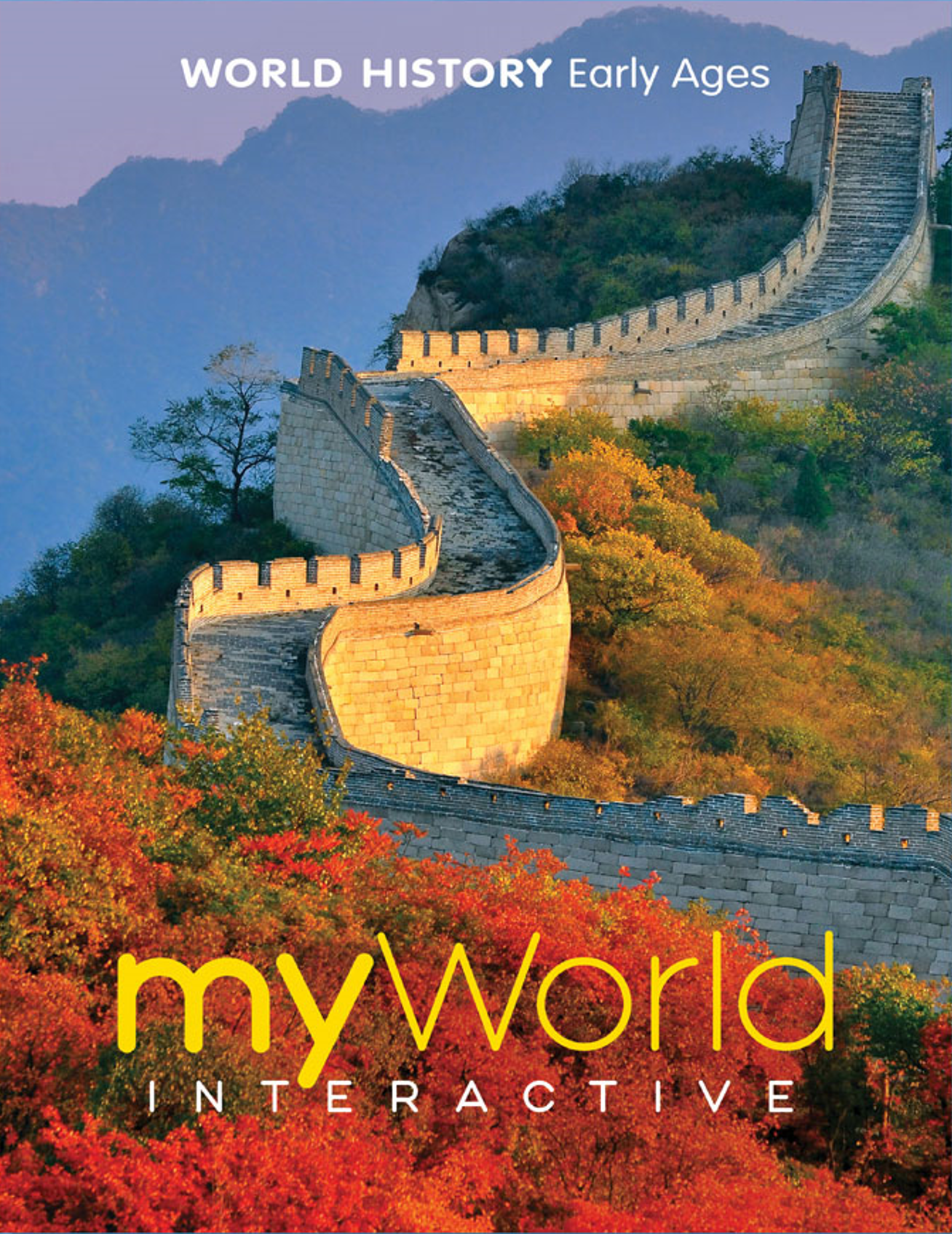
myWorld Interactive, World History, Early Ages
myWorld Interactive, World History, Early Ages is a Grade 6 world history textbook published by Savvas Learning Company that guides students through the full sweep of early human civilization, from prehistoric origins through the Age of Exploration. The course covers foundational societies across the ancient world — including Mesopotamia, Egypt, India, China, Greece, and Rome — before moving into the medieval period with units on Byzantine and Islamic civilizations, feudal Europe, and the kingdoms of Africa and the Americas. It concludes with the Renaissance, the Reformation, and early global convergence, giving students a broad, multicultural understanding of how ancient and medieval societies shaped the modern world.
Chapters & Lessons
Chapter 1: Origins of Civilization (Prehistory–4000 BCE)
5 lessonsIn this Grade 6 lesson from myWorld Interactive World History: Early Ages, students learn how anthropologists and archaeologists use fossils, artifacts, and radioactive dating to study prehistory. The lesson explains how geologists assist in dating ancient remains and how DNA evidence helps trace the origins of early human ancestors called hominins. Students also explore how archaeological evidence points to East Africa as the birthplace of human life.
In this Grade 6 lesson from myWorld Interactive World History: Early Ages, students examine how Homo sapiens developed complex language and other adaptations that allowed them to outlast Neanderthals and migrate across the globe. The lesson explores the "out of Africa" theory and explains how early humans responded to shifting environments during the Paleolithic Era. Key vocabulary includes migration, environment, and adapt.
In this Grade 6 lesson from myWorld Interactive World History: Early Ages, students explore how Paleolithic societies developed complex cultures during the Ice Age, examining cave paintings like those at Lascaux as evidence of early artistic and intellectual ability. Students also learn key concepts including animism, the domestication of plants and animals, and the shift from nomadic hunter-gatherer lifestyles to early agriculture. The lesson draws on primary sources and archaeological evidence to trace how Homo sapiens modified their environment and spread to populate regions across the world during prehistory through 4000 BCE.
In this Grade 6 lesson from myWorld Interactive World History: Early Ages, students explore how the transition from hunter-gatherer life to agriculture roughly 10,000 years ago transformed human society. Students examine the first centers of farming in southwestern Asia, China, and the Americas, analyzing the costs and benefits of domesticating crops and animals. The lesson also introduces key concepts including surplus, specialization, and economy to explain how farming villages eventually grew into cities.
In this Grade 6 lesson from myWorld Interactive: World History, Early Ages, students explore how early farming villages grew into the world's first civilizations, focusing on the role of food surpluses, resource management, and river valley geography. Students learn to identify the eight defining features shared by early civilizations — including organized government, job specialization, social classes, and established religion — and examine why settlements along rivers like the Nile, Tigris-Euphrates, Indus, and Huang developed into complex urban societies. The lesson also covers how early civilizations transformed their surrounding environments through irrigation, land clearing, and construction.
Chapter 2: Civilizations and Peoples of the Fertile Crescent (3400 BCE–70 CE)
4 lessonsIn this Grade 6 lesson from myWorld Interactive World History: Early Ages, students learn how Sargon of Akkad built the world's first empire by conquering Mesopotamian city-states and uniting the region under centralized rule. The lesson examines how ongoing conflict among Sumerian city-states like Umma and Lagash weakened them and enabled conquest, and how Akkadian cultural traits spread through trade and military expansion. Students also explore key vocabulary including empire, ally, and cultural trait within the broader context of Chapter 2 on Fertile Crescent civilizations.
In this Grade 6 lesson from myWorld Interactive World History: Early Ages, students examine how the Assyrian Empire used cavalry, iron weapons, and a provincial government system to build and control one of the ancient world's largest empires. The lesson also traces the rise of the Neo-Babylonian Empire under Nebuchadnezzar II and the emergence of the Persian Empire after 539 BCE. Students analyze how these Mesopotamian civilizations shaped military strategy, political organization, and cultural traditions across the Fertile Crescent.
In this Grade 6 lesson from myWorld Interactive World History: Early Ages, students explore how the Phoenicians of the eastern Mediterranean built a powerful trading civilization through seafaring, navigation, and the exchange of imports and exports across the Mediterranean world. Students also examine how Phoenician city-states spread their culture through colonization and cultural diffusion, and learn about the Phoenicians' landmark contribution to writing: the development of the alphabet.
Chapter 3: Ancient Egypt and Kush (3000 BCE–600 BCE)
3 lessonsIn this Grade 6 lesson from myWorld Interactive: World History, Early Ages, students explore how ancient Egypt's geography — particularly the Nile River's annual floods, silt deposits, and cataracts — shaped the growth of one of the world's earliest civilizations. Students learn key terms such as delta, cataract, pharaoh, dynasty, and bureaucracy as they examine how agricultural irrigation, food surpluses, and centralized rule under the pharaohs developed a complex Egyptian society. The lesson also introduces the relationship between Upper and Lower Egypt and compares Egypt's river-valley civilization to those of Mesopotamia, India, and China.
In this Grade 6 lesson from myWorld Interactive World History: Early Ages, students explore the major achievements of ancient Egyptian civilization, including the development of hieroglyphic writing, the invention of papyrus, and the construction of pyramids and other monumental architecture. Students also examine how advances in science, mathematics, and technology shaped Egyptian society and enabled its complex civilization to flourish. The lesson covers key vocabulary such as hieroglyphic, papyrus, and pyramid within the context of Chapter 3 on Ancient Egypt and Kush.
In this Grade 6 lesson from myWorld Interactive World History: Early Ages, students explore the trade relationship between ancient Egypt and the kingdom of Kush, learning key concepts such as commerce, ivory, ebony, and interdependence. The lesson examines how Egypt's lack of natural resources drove trade across the eastern Mediterranean and up the Nile Valley, and how Kush's geography — including the Nile's cataracts and limited farmland — shaped its development as a civilization. Students also analyze how trade routes and cultural exchange connected Egypt and Kush from the Old Kingdom through the New Kingdom period.
Chapter 4: Early Civilizations of India (3100 BCE–540 CE)
7 lessonsIn this Grade 6 lesson from myWorld Interactive World History: Early Ages, students explore the Indus Valley Civilization, examining how the Indian subcontinent's geography, river systems, and monsoons shaped one of the ancient world's earliest urban societies. Students learn key concepts including subcontinent, river system, and monsoon, and investigate the planned cities of Harappa and Mohenjo-Daro and the civilization's achievements from around 2500 BCE. The lesson also addresses why the Indus Valley civilization's politics, religion, and decline remain largely a mystery to historians and archaeologists.
In this Grade 6 lesson from myWorld Interactive World History: Early Ages, students explore India's Vedic Age by examining the origins and migration of the Indo-Aryans into the Indian subcontinent after 2000 BCE. Students learn about the four Vedas — the Rig-Veda, Sama-Veda, Yajur-Veda, and Atharva-Veda — as sacred collections of hymns composed in Sanskrit and their role in shaping early Hindu beliefs and customs. The lesson also introduces key vocabulary including varna, jati, and caste as students trace how Indo-Aryan society developed its social structure.
In this Grade 6 lesson from myWorld Interactive World History: Early Ages, students explore how Hinduism developed out of the Vedic age, tracing its roots from the Vedas through key concepts such as Brahman, reincarnation, karma, dharma, ahimsa, and moksha. Students examine how gurus and the Upanishads shaped classical Hinduism and how epic poems like the Ramayana and Mahabharata expressed its core beliefs. The lesson also covers how Hinduism supported ancient Indian society and spread across South and Southeast Asia, leaving a lasting religious and cultural impact.
In this Grade 6 lesson from myWorld Interactive World History: Early Ages, students explore how Chandragupta Maurya united much of the Indian subcontinent around 321 BCE through military strategy, including his advisor Kautilya's plan to seize the northwest before conquering Magadha. Students also examine how Chandragupta established an empire-wide bureaucracy, divided his territory into provinces, and implemented a tax system to govern a vast and diverse population. Key vocabulary includes strategy, province, bureaucracy, and subject, with a focus on analyzing cause and effect in the rise of the Maurya Empire.
In this Grade 6 lesson from myWorld Interactive World History: Early Ages, students explore how the Maurya emperor Asoka transformed his rule after the devastating conquest of Kalinga, adopting Buddhist values and governing through three principles of moral law: ahimsa, tolerance, and the well-being of his subjects. Students also examine how Asoka promoted the spread of Buddhism through stone pillars, stupas, and missionary activity across India and into Sri Lanka.
In this Grade 6 lesson from myWorld Interactive World History: Early Ages, students explore how the Gupta dynasty reunited northern India starting around 320 CE and built an empire through conquest, alliances, and a system of local governance that introduced a form of citizenship. Students also examine the cultural and intellectual achievements of the Gupta period, including advances in literature, music, dance, and key academic vocabulary such as numerals, the decimal system, and metallurgy. The lesson connects political history to the lasting influence of Gupta-era arts and sciences on Indian culture.
Chapter 5: Early Civilizations of China (1700 BCE–220 CE)
6 lessonsIn this Grade 6 lesson from myWorld Interactive: World History, Early Ages, students explore how the geography of the Huang River valley — including loess-enriched floodplains and surrounding deserts and mountains — shaped the rise of early Chinese civilization. Students examine why fertile river conditions drew the first large settlements to the North China Plain and how geographic isolation influenced China's development. The lesson also introduces the Shang dynasty, the earliest Chinese dynasty supported by written records, and key vocabulary such as loess, oracle bone, and logograph.
In this Grade 6 lesson from myWorld Interactive World History: Early Ages, students explore the rise and fall of China's Zhou dynasty, examining how the Mandate of Heaven justified dynastic power and the consequences of its perceived loss. Students learn how the Zhou governed a vast kingdom through regional nobles, and trace the weakening of central authority that led to the Warring States period of chaos and conflict from 475 to 221 BCE.
In this Grade 6 lesson from myWorld Interactive: World History, Early Ages, students explore the belief systems of ancient China, including ancestor veneration, Confucianism, and Daoism. Students examine how Confucius's Five Relationships and the concept of filial piety shaped social order during the Zhou dynasty, and how Daoist philosophy offered a contrasting set of values. The lesson builds understanding of how these philosophies grew from earlier spiritual traditions and went on to influence Chinese culture and governance for centuries.
In this Grade 6 lesson from myWorld Interactive, World History, Early Ages, students explore how Shi Huangdi unified China under the Qin dynasty by examining his use of centralized government, standardization of language, currency, and weights, and the construction of the Great Wall. Students also analyze how Legalist principles shaped the First Emperor's rule and why his methods for governing a large empire influenced later Chinese dynasties.
In this Grade 6 lesson from myWorld Interactive World History: Early Ages, students explore how the Han Dynasty governed and expanded China from 206 BCE onward, examining the role of Confucianism in shaping imperial policy and the development of the civil service under Emperor Wudi. Students analyze how Han emperors built a pyramid-structured government staffed by appointed officials selected through merit-based exams rather than hereditary rank. The lesson also covers how the Silk Road facilitated trade, spread Buddhism, and connected China to other regions of Afroeurasia.
In this Grade 6 lesson from myWorld Interactive World History: Early Ages, students examine how Confucian teachings shaped the social order, family roles, and the status of women in Han dynasty China. They explore the economic foundations of Han society, including agriculture, silk production, and state monopolies on iron and salt, and investigate major achievements in the arts, science, and technology such as calligraphy, lacquerware, acupuncture, and the seismometer. The lesson is part of Chapter 5 on Early Civilizations of China, covering the period from 1700 BCE to 220 CE.
Chapter 6: Ancient Greece (2000 BCE–300 BCE)
8 lessonsIn this Grade 6 lesson from myWorld Interactive: World History, Early Ages, students explore how physical geography — including mountain ranges, peninsulas, and the Mediterranean Sea — shaped the development of ancient Greek societies. Students examine the influence of the Minoans and Mycenaeans on early Greek culture and trace how isolated farming communities evolved into independent city-states, or poleis. Key vocabulary includes polis, acropolis, and citizen, alongside concepts such as aristocracy and the origins of Western political thought.
In this Grade 6 lesson from myWorld Interactive World History: Early Ages, students explore how ancient Greek city-states experimented with different political systems, including oligarchy, tyranny, and democracy. Students learn key terms such as phalanx, tyranny, and direct democracy while tracing how reforms by leaders like Solon and Cleisthenes gradually expanded political participation in Athens. The lesson also examines both the strengths and limitations of Athenian democracy, including who held citizenship and who was excluded.
In this Grade 6 lesson from myWorld Interactive World History: Early Ages, students explore Sparta's oligarchic government, examining the roles of the council of elders, ephors, and dual kings within Chapter 6 on Ancient Greece. Students learn how Sparta's reliance on helot labor and military conquest shaped it into a military state, and how its system of barracks training and social control contrasted sharply with Athenian democracy.
In this Grade 6 lesson from myWorld Interactive World History: Early Ages, students examine the social structure of ancient Greece, including the roles of women in Athens versus Sparta, and the class divisions among aristocrats, citizen landowners, tenant farmers, metics, and enslaved people. Students also explore the vocabulary of slavery and resident aliens (metics) to understand how Greek society was organized. The lesson then connects those social foundations to the Greeks' broader economic expansion through trade, conquest, and colonization across the ancient world.
In this Grade 6 lesson from myWorld Interactive: World History, Early Ages, students examine how Greek city-states defeated the Persian Empire through key engagements including the Battle of Marathon, the stand at Thermopylae, and the Battle of Salamis. Students analyze the causes and effects of both the Persian Wars and the Peloponnesian War, exploring how Athens rose to dominance through the Delian League after driving out the Persians. The lesson also develops compare-and-contrast literacy skills as students evaluate the roles of Sparta and Athens in shaping the conflicts of ancient Greece during the 400s BCE.
In this Grade 6 lesson from myWorld Interactive: World History, Early Ages, students explore ancient Greek religion and mythology, learning how polytheism shaped Greek society and how myths about gods such as Zeus, Athena, and Poseidon explained natural phenomena, human behavior, and moral lessons. Students examine how epic works like Homer's Odyssey reflect Greek beliefs and how Greek art, architecture, and lyric poetry have continued to influence culture through the present day.
In this Grade 6 lesson from myWorld Interactive World History: Early Ages, students explore the intellectual achievements of ancient Greece, including the Socratic method of questioning, the founding of Plato's Academy, and the Stoics' philosophy of reason and self-control. Students examine how Greek thinkers used logic and reason to investigate questions about knowledge, reality, and the nature of the universe. The lesson also introduces key vocabulary such as hypothesis and the Hippocratic oath as students consider how Greek philosophy, science, and historical inquiry shaped individuals and societies.
In this Grade 6 lesson from myWorld Interactive World History: Early Ages, students explore how Philip II of Macedonia used the sarissa-equipped phalanx and military discipline to defeat the Greek city-states, and how his son Alexander the Great built one of the ancient world's largest empires. Students examine how Alexander's conquests created the Hellenistic world, spreading Greek classical civilization across Persia, central Asia, and beyond. The lesson also covers how Hellenistic learning blended Greek culture with other traditions to expand its lasting influence on the ancient world.
Chapter 7: The Roman Republic (800 BCE–30 BCE)
4 lessonsIn this Grade 6 lesson from myWorld Interactive World History: Early Ages, students explore how Italy's geography — including the Alps, Apennines, fertile plains, and the Tiber River — shaped Rome's early growth and military expansion. Students learn how Rome developed from hilltop villages around 800 BCE into a city-state, examining key concepts such as the Roman Forum, the founding legend of Romulus and Remus, and the cultural influences of the Etruscans and Greeks. The lesson also introduces vocabulary including forum, republic, and maniple as students begin to understand how Romans established a new form of government and unified the Italian peninsula.
In this Grade 6 lesson from myWorld Interactive World History: Early Ages, students examine the structure of the Roman Republic, including its constitution, separation of powers, checks and balances, and the veto system used by consuls. Students also explore the concept of Roman citizenship, the distinction between patricians and plebeians, and the rights and responsibilities that came with civic membership. The lesson builds understanding of how Roman republican government influenced later democratic systems around the world.
In this Grade 6 lesson from myWorld Interactive World History: Early Ages, students explore the structure of Roman society during the Republic, examining the roles and rights of men and women in a patriarchal system led by the paterfamilias. Students compare daily life across social classes, from wealthy landowners in villas to poor tenant farmers and urban laborers, and analyze the widespread practice of slavery in ancient Rome. The lesson develops skills in classifying and categorizing historical information about gender, class, and citizenship in the Roman Republic.
In this Grade 6 lesson from myWorld Interactive, World History, Early Ages, students examine the fall of the Roman Republic by studying the Punic Wars, Hannibal's invasion of Italy, and Rome's conquest of an empire across the Mediterranean. Students learn how the expansion of Roman territory created social and political crises, including the growing gap between rich and poor, corruption among provincial magistrates, and the breakdown of republican government. Key vocabulary includes empire, province, civil war, and Augustus as students analyze the forces that ultimately ended the republic.
Chapter 8: The Roman and Byzantine Empires (30 BCE–1453 CE)
7 lessonsIn this Grade 6 lesson from myWorld Interactive: World History, Early Ages, students explore how the Roman Republic transitioned into an empire under Augustus, Rome's first emperor, and examine the concept of the Pax Romana and its effects on trade, economy, and everyday life. Students also analyze how Rome gained and maintained power through military strength, diplomacy, and engineering achievements such as aqueducts, while studying key vocabulary including deify and succession.
In this Grade 6 lesson from myWorld Interactive World History: Early Ages, students examine the origins of Christianity by exploring Judea under Roman rule, the life and teachings of Jesus of Nazareth, and key events including his crucifixion and resurrection. Students analyze the roles of groups such as the Zealots, Pharisees, and Sadducees, and learn vocabulary including baptism, conversion, martyr, and crucifixion. The lesson also traces how early Christian beliefs developed from Jewish traditions and began to spread throughout the Roman Empire.
In this Grade 6 lesson from myWorld Interactive World History: Early Ages, students explore the core beliefs and scriptures of Christianity, including the structure of the New Testament, the four Gospels, parables, and epistles written by early church leaders like Paul. Students examine key Christian doctrines such as the Trinity, resurrection, and salvation, and learn how these writings shaped the faith in the centuries following the death of Jesus. The lesson is part of Chapter 8 on the Roman and Byzantine Empires and builds students' understanding of how world religions develop their sacred texts and theological foundations.
In this Grade 6 lesson from myWorld Interactive World History: Early Ages, students explore Roman culture and its lasting legacy, examining how Rome functioned as a site of encounter where Greco-Roman culture blended with influences from across the empire. Students analyze Roman achievements in art, mosaics, Latin language, and literature, as well as how roads, colonies, and expanding citizenship helped spread culture throughout the ancient world. The lesson also covers Rome's influence on modern Romance languages, government, and ideas of citizenship.
In this Grade 6 lesson from myWorld Interactive World History: Early Ages, students examine the political, economic, and military factors that caused the decline of the Roman Empire following the Pax Romana. They analyze how civil wars, inflation, heavy reliance on mercenaries, and invasions by the Sassanian Persians and Germanic tribes destabilized the empire during the Imperial Crisis of 235–284 CE. The lesson builds cause-and-effect literacy skills as students trace how these interconnected pressures ultimately led to the empire's collapse.
In this Grade 6 lesson from myWorld Interactive: World History, Early Ages, students explore how the Byzantine Empire emerged from the eastern Roman Empire, examining key features such as Constantinople's strategic location on the Bosporus Strait and its defensive use of moats and city walls. Students analyze Emperor Justinian's military conquests, legal legacy, and rebuilding of Hagia Sophia, as well as the roles of key vocabulary terms like Byzantine, Greek fire, and the Cyrillic alphabet. The lesson also traces the causes of Byzantine decline and the empire's lasting cultural influence on early Russia and surrounding regions.
In this Grade 6 lesson from myWorld Interactive World History: Early Ages, students explore the religious and cultural divisions that shaped the Byzantine Empire, focusing on key concepts such as the Nicene Creed, the role of icons and the iconoclast controversy, and the authority of the pope versus Eastern patriarchs. Students examine how disagreements over church leadership and religious practice led to the growing split between the Roman Catholic and Eastern Orthodox churches. The lesson also introduces vocabulary including creed, iconoclast, and apostolic succession as students compare and contrast the two branches of Christianity.
Frequently Asked Questions
- Is myWorld Interactive World History Early Ages the right textbook for my 6th grader?
- myWorld Interactive World History: Early Ages is widely used in 6th grade social studies and is a well-designed curriculum that covers the full span of early human civilization from prehistory through the Age of Exploration. Its inquiry-based approach, with reading, mapping, and analysis activities, works well for students who benefit from connecting historical events to broader patterns. The multicultural scope — covering Mesopotamia, Egypt, India, China, Greece, Rome, medieval Europe, Africa, the Americas, the Renaissance, and early global exploration — gives students a genuinely broad view of world history. If your child is in a California or other standards-aligned curriculum, this book is an excellent fit.
- Which chapters or units in myWorld Interactive World History Early Ages are the hardest?
- The early chapters on ancient civilizations — Mesopotamia, Egypt, and India — are where many students struggle because there are a lot of new vocabulary terms, geographic names, and social structures to absorb quickly. The unit on medieval Europe with feudalism, manorialism, the Catholic Church, and the Crusades is consistently challenging because the political and social complexity is high. The chapters on Islamic civilization and Byzantine Empire often confuse students who have not been introduced to non-European world perspectives before. The Renaissance and Reformation unit toward the end of the course is dense with intellectual history that is hard to visualize.
- My child struggles with keeping ancient civilizations straight — where should they start?
- Start with Chapter 1 (Origins of Civilization) to establish the foundational concepts: what a civilization is, how hunter-gatherers transitioned to farming, how cities and writing developed. Then work through the Mesopotamia unit carefully using maps to ground the geography before moving to Egypt. Creating a simple timeline with each civilization's dates, location, and key achievements helps enormously — students who cannot visually distinguish when Rome overlapped with Greece, or when the Islamic Golden Age occurred, will mix up events constantly. The myWorld program's built-in maps and timelines are very useful tools for this.
- What should my child study after finishing myWorld Interactive World History Early Ages?
- After completing this course, students typically move into 7th grade Medieval and Early Modern World History, which picks up from the Renaissance and Reformation covered at the end of this book and continues through the early modern period. The foundations built in the ancient civilization units — understanding geography, government systems, trade networks, and cultural exchange — apply directly to the more complex political and economic history of the medieval and early modern world. Students who are strong in this course and interested in history should consider reading supplementary books on ancient Greece or Rome, which receive relatively brief treatment in any survey textbook.
- How can Pengi help my child with myWorld Interactive World History Early Ages?
- Pengi is especially useful for the vast scope of this course where keeping track of dozens of civilizations, leaders, and events is genuinely difficult. If your child cannot keep the Greek city-states and Roman Republic straight, Pengi can create a structured comparison through guided questions. For the Islamic civilization and Byzantine Empire chapters, which students often find unfamiliar and confusing, Pengi can explain the key concepts using relatable modern parallels. Pengi can also turn the end-of-chapter review vocabulary and key terms into an interactive quiz session, helping your child drill the specific names and concepts that will appear on their tests rather than re-reading entire chapters.
Ready to start learning?
Jump into your first lesson for myWorld Interactive, World History, Early Ages. Free, no account required.
Start Learning