
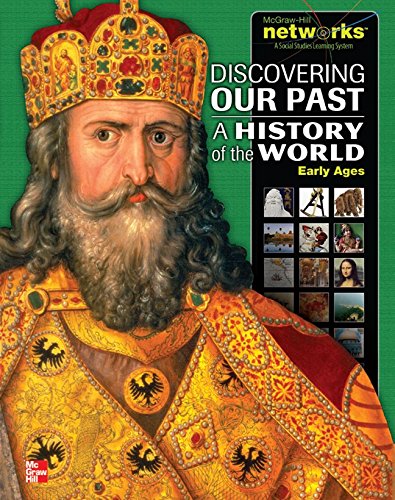
Discovering Our Past: a History of the World
Discovering Our Past: A History of the World is a Grade 4 history textbook that takes students on a comprehensive journey through human civilization from prehistoric times to the modern era. The book covers a wide range of topics including early humans and the Agricultural Revolution, ancient civilizations such as Mesopotamia, Egypt, Greece, Rome, India, and China, as well as African and American civilizations, medieval Europe, the Renaissance, the Age of Exploration, and the Scientific Revolution. It also introduces foundational skills in historical thinking, geography, economics, and citizenship to help young learners understand and analyze the past.
Chapters & Lessons
Chapter 1: What does a Historian do?
3 lessonsIn this Grade 4 history lesson from Discovering Our Past: a History of the World, students learn what history is and why it matters, exploring key concepts such as cause and effect, the roles of historians, and how time is measured using terms like decade, century, millennium, and era. The lesson also introduces major historical periods, from Prehistory through Modern History, and explains how calendars like the Julian and Gregorian systems were developed to track and organize time. Students come away understanding how studying the past helps explain the present and guides future decisions.
This session delves into the methods historians use to understand the past. Students will learn about the different types of evidence historians rely on, including artifacts, documents, and firsthand accounts. The session explains the difference between primary sources (created by people who experienced events) and secondary sources (created after events by others). Students will explore how historians analyze evidence for reliability, recognize point of view, and detect bias. They will understand how historians interpret data, draw conclusions, and present informed interpretations. Examples like the Domesday Book and ancient artifacts help illustrate the historian’s process. Finally, learners will consider why different historians sometimes disagree about historical events and figures.
In this Grade 4 lesson from Discovering Our Past: a History of the World, students learn how to conduct a history research project by selecting a workable topic, creating question cards using who, what, when, where, why, and how, and gathering nonfiction reference materials. The lesson also teaches students to distinguish fact from opinion and evaluate the credibility of sources, including how to assess author credentials and website reliability when researching on the Internet. These research skills are introduced in Chapter 1 as part of understanding what historians do.
Chapter 2: Studying Geography, Economics, and Citizenship
3 lessonsIn this Grade 4 lesson from Discovering Our Past: a History of the World, students explore the Six Essential Elements of Geography and learn how geographers display Earth's surface using globes, maps, and map projections. The lesson covers key concepts including hemispheres, the Equator, the Prime Meridian, and how latitude and longitude lines form a grid system used to find the absolute location of any place on Earth. Students also compare different map types, such as the Winkel Tripel and Mercator projections, to understand the trade-offs between accuracy and practicality.
In this Grade 4 lesson from Discovering Our Past: a History of the World, students explore the basic concepts of economics, including the four key resources — land, labor, capital, and entrepreneurship — and how they drive production. Students also learn the laws of supply and demand, examining how price affects what producers want to sell and what consumers want to buy. The lesson connects these economic principles to early civilizations and introduces vocabulary such as scarcity, opportunity cost, and traditional versus command economies.
In this Grade 4 lesson from Discovering Our Past: a History of the World, students learn the key principles of U.S. government, including representative government, the federal system, separation of powers, and checks and balances. The lesson also explores the rights and civic responsibilities of U.S. citizens, from freedom of expression to the right to a fair trial. Students examine how the three branches of government — legislative, executive, and judicial — work together and limit one another's power.
Chapter 3: Early Humans and the Agricultural Revolution
2 lessonsIn Lesson 1 of Chapter 3 from Discovering Our Past: a History of the World, Grade 4 students explore the Paleolithic Age and learn how early humans survived as nomads by hunting and gathering food. Students examine how Paleolithic people developed technology, including flint tools and spears, and how roles within bands were organized to ensure the group's survival. This lesson builds foundational understanding of how early humans adapted to their environment long before farming or settled villages existed.
In this Grade 4 lesson from Discovering Our Past: a History of the World, students learn how the Agricultural Revolution transformed early human life as Neolithic Age peoples shifted from nomadic hunting and gathering to systematic agriculture and the domestication of animals. Students explore how this permanent shift to settled farming communities, beginning around 8000 B.C., enabled a stable food supply and rapid population growth across regions including Southwest Asia, Egypt, and Africa. The lesson connects geographic conditions to the spread of early crops like wheat, barley, and tubers as farming expanded across continents.
Chapter 4: Mesopotamia
2 lessonsIn this Grade 4 lesson from Discovering Our Past: a History of the World, students explore how the Sumerians built one of the world's earliest civilizations in Mesopotamia, the region between the Tigris and Euphrates Rivers in present-day Iraq. Students learn how geography shaped Sumerian life, including how farmers developed irrigation systems using dams and canals to control seasonal floods and water their crops. The lesson also introduces key Sumerian inventions and the development of social classes, specialized labor, and early government.
Grade 4 students explore the rise and fall of major Mesopotamian empires in this lesson from Discovering Our Past: a History of the World, learning how Sargon of Akkad built the world's first empire by conquering the Sumerian city-states around 2340 B.C. Students also study the Babylonian Empire under Hammurabi and examine the significance of Hammurabi's Code, including its "eye for an eye" principle and its lasting influence on the legal systems of Greece and Rome.
Chapter 5: Ancient Egypt and Kush
4 lessonsGrade 4 students explore the geography and significance of the Nile River in this lesson from Chapter 5 of Discovering Our Past: a History of the World. Students learn how the Nile's fertile valley, annual flooding, and key features such as cataracts, the delta, and the shadoof shaped the development of ancient Egyptian and Kushite civilizations. The lesson also introduces essential vocabulary including hieroglyphics, papyrus, and dynasty as students examine how geography directly influenced the way ancient peoples lived.
In this Grade 4 lesson from Discovering Our Past: a History of the World, students explore how ancient Egypt was governed during the Old Kingdom period, learning key concepts such as theocracy, the role of the pharaoh as both political and religious leader, and the function of bureaucrats in managing the kingdom. Students examine how Egyptians' belief that the pharaoh was the son of the sun god Re shaped their loyalty and daily life, and how this powerful ruler controlled land, taxes, and religious ceremonies.
In this Grade 4 history lesson from Discovering Our Past: a History of the World, students explore Egypt's Middle Kingdom and New Kingdom, learning how pharaohs expanded the empire through military conquests, tribute collection, and trade along the Red Sea. The lesson covers key developments including the growth of Egyptian arts and architecture, the rise of the Valley of the Kings, and the Hyksos invasion that introduced horse-drawn chariots and iron weapons to Egypt. Students examine why the Middle Kingdom is considered a golden age and how Egypt's eventual decline still left a lasting influence on other civilizations.
In this lesson from Discovering Our Past: a History of the World, Grade 4 students learn how the Kingdom of Kush rose from Nubian origins in present-day Sudan, developed a powerful trade economy centered at Napata, and ultimately conquered Egypt under King Kashta and his son Piye around 728 B.C. The lesson traces the sequence of events connecting the early kingdom of Kerma, Egyptian invasion and cultural exchange, and the eventual Kushite conquest of Egypt, exploring why civilizations rise and fall.
Chapter 6: The Israelites
4 lessonsIn this Grade 4 history lesson from Discovering Our Past: a History of the World, students explore the origins of the ancient Israelites and the foundational beliefs of Judaism, including the concepts of monotheism and polytheism. Students learn how figures such as Abraham and Moses shaped early Israelite history and how the Hebrew Bible recorded and preserved these beliefs. The lesson also examines how Judaism's core principles influenced the development of Christianity and Islam.
In this Grade 4 lesson from Discovering Our Past: a History of the World, students learn about the rise of the Israelite Kingdom, examining the reigns of King Saul, King David, and King Solomon and their roles in uniting the Twelve Tribes of Israel. Students explore key concepts such as the anointing of kings, David's establishment of Jerusalem as the capital, and the significance of the Book of Psalms. The lesson builds understanding of how leadership, military conquest, and religious tradition shaped one of history's early kingdoms.
In this Grade 4 lesson from Discovering Our Past: a History of the World, students explore the development of Judaism by learning how Jewish exiles in Babylon established synagogues, observed the Sabbath, and eventually returned to Judah under Persian King Cyrus II to rebuild the Second Temple. Students also examine the roles of scribes and priests in preserving Jewish law through the Torah and the Hebrew Bible, which is composed of three sections: the Torah, the Prophets, and the Writings. The lesson connects ancient Israelite religious practices to traditions still observed in Judaism today.
In this Grade 4 lesson from Discovering Our Past: a History of the World, students learn how Alexander the Great's conquest brought Greek rule to Judah and how the Diaspora spread Jewish ideas across the Mediterranean world. Students explore the Septuagint, the Greek translation of the Hebrew Bible, and examine how the Maccabees revolted against Seleucid king Antiochus IV, leading to the rededication of the Temple and the origins of Hanukkah. The lesson also introduces students to comparing and contrasting Greek and Roman rule over the Jewish homeland.
Chapter 7: The Ancient Greeks
4 lessonsIn this Grade 4 lesson from Discovering Our Past: a History of the World, students explore how the physical geography of the Balkan Peninsula, the Aegean Sea, and surrounding mountains shaped the development of early Greek civilization. The lesson examines the Minoan civilization on the island of Crete, including their trade networks, the palace at Knossos, and theories about their collapse around 1450 B.C. Students also compare the Minoans and Mycenaeans using a Venn diagram to understand how these early cultures laid the foundation for ancient Greece.
In this Grade 4 lesson from Discovering Our Past: a History of the World, students explore the contrasting governments of ancient Greece's two most powerful city-states, Sparta and Athens. Students learn key political concepts including tyranny, oligarchy, and democracy, and examine how Sparta's helot slave system shaped its militaristic society. The lesson helps students understand why Greek citizens moved away from rule by kings and tyrants toward different forms of shared governance.
In this Grade 4 lesson from Discovering Our Past: a History of the World, students explore how the Persian Empire expanded under rulers like Cyrus the Great and Darius I, learning key concepts such as satrapies, satraps, the Royal Road, and the religion of Zoroastrianism. The lesson then examines the military conflict between Persia and the Greek city-states, including the famous battles that shaped the ancient world. Part of Chapter 7 on Ancient Greece, it helps students understand why and how major civilizations came into conflict.
In this Grade 4 lesson from Discovering Our Past: a History of the World, students explore the Age of Pericles and learn how Athens practiced direct democracy, in which all male citizens voted directly on laws and government matters. Students compare direct democracy to representative democracy as used in the United States today, while examining how Pericles expanded citizen participation and made Athens a cultural center. The lesson also covers how the Peloponnesian War led to the decline of Athenian power and Greek culture.
Chapter 8: Greek Civilization
4 lessonsIn this Grade 4 lesson from Discovering Our Past: a History of the World, students explore ancient Greek culture, including the Olympian gods and goddesses, myths, rituals, and the origins of the Olympic Games. Students learn how Greek religious beliefs — such as prophecy, oracles, and city-state patron deities — shaped daily life and ceremonies. The lesson also examines how these cultural traditions continue to influence the modern world today.
This session explores how Greek thinkers contributed to philosophy, science, mathematics, and new ways of understanding the world. The Greeks believed reasoning and observation were key to gaining knowledge. Philosophers like Socrates, Plato, and Aristotle asked questions about truth, government, and ethics. Socrates was known for his method of questioning, Plato for his writings about government and the Academy, and Aristotle for classifying living things and advising moderation. The Greeks also made advances in history, with Herodotus and Thucydides setting new standards for historical writing. The growth of scientific thought was furthered by figures like Thales (astronomy), Pythagoras (mathematics), and Hippocrates (medicine), whose work influences modern science and medicine today.
In this Grade 4 lesson from Discovering Our Past: a History of the World, students learn how Philip II of Macedonia conquered the Greek city-states and how his son Alexander the Great built a vast empire stretching across Persia and beyond. The lesson covers key concepts including the Battle of Chaeronea, the rise of Macedonian military power, and the spread of Greek culture during the Hellenistic Era. Students also examine the characteristics of strong leadership through the accomplishments of both Philip II and Alexander the Great.
In this lesson from Discovering Our Past: a History of the World, Grade 4 students explore how Greek culture spread during the Hellenistic Era, examining how Alexandria became a major center of learning and how artists, writers, and playwrights developed new styles distinct from Greece's Golden Age. Students study specific literary works like the Argonautica and the rise of Greek New Comedy through playwrights like Menander, as well as changes in Hellenistic sculpture that shifted from ideal forms to realistic depictions of emotion and movement. The lesson is part of Chapter 8: Greek Civilization and helps students understand how new ideas shaped life across the ancient world.
Chapter 9: Ancient India
3 lessonsIn this Grade 4 lesson from Discovering Our Past: a History of the World, students explore how the geography of the Indian subcontinent — including the Himalaya, the Indus, Ganges, and Brahmaputra rivers, and the Deccan Plateau — shaped the rise of early civilizations. Students also learn how seasonal monsoon winds influenced agriculture, settlement, and daily life in the Indus Valley. The lesson introduces key vocabulary such as subcontinent, monsoon, and caste as part of Chapter 9's study of Ancient India.
In this Grade 4 lesson from Discovering Our Past: a History of the World, students explore the origins and core beliefs of Hinduism, including the concepts of Brahman, the Vedas, the Upanishads, reincarnation, karma, and dharma. Students learn how Aryan religious traditions evolved into Hinduism and how beliefs like karma and dharma shaped daily life and social structure in ancient India. The lesson is part of Chapter 9: Ancient India and addresses the essential question of how religions develop over time.
Grade 4 students studying Chapter 9 of Discovering Our Past: a History of the World explore the rise of the Mauryan Empire, learning how Chandra Gupta Maurya unified northern India in 321 B.C. and established the Mauryan dynasty. The lesson examines how his grandson Ashoka transformed the empire by embracing Buddhist teachings, promoting nonviolence, and building stupas and hospitals across India. Students analyze how religion shaped the development and culture of ancient India's first great empire.
Chapter 10: Early China
3 lessonsGrade 4 students explore the origins of Chinese civilization in this lesson from Discovering Our Past: a History of the World, learning how geographic features like the Huang He (Yellow River), the Chang Jiang, the Himalaya, and the Gobi Desert shaped early settlement and cultural development. Students examine how loess-rich river valleys supported farming and population growth, while natural barriers like mountains and desert isolated China and fostered a unique identity known as "the Middle Kingdom." The lesson also introduces the Shang dynasty and how its rule transformed life for the early Chinese people.
In this Grade 4 lesson from Discovering Our Past: a History of the World, students explore the three major philosophies that emerged in ancient China between 500 B.C. and 200 B.C. — Confucianism, Daoism, and legalism — and examine how each aimed to restore order and peace during the Period of the Warring States. The lesson focuses especially on Confucius's teachings about duty, filial piety, and civil service, showing how his ideas shaped Chinese government and society for centuries.
In this Grade 4 lesson from Discovering Our Past: a History of the World, students explore how Qin Shihuangdi unified China by appointing censors, creating a standard currency, simplifying the writing system, and ordering construction of the Great Wall to defend against the Xiongnu. The lesson then traces the fall of the Qin dynasty and the rise of the Han dynasty, examining how stable central government shaped the growth of early Chinese civilization. Students use a Venn diagram to compare and contrast the Qin and Han dynasties as part of Chapter 10: Early China.
Chapter 11: Rome : Republic to Empire
4 lessonsIn this Grade 4 lesson from Discovering Our Past: a History of the World, students explore how geography shaped the rise of Roman civilization, examining key physical features such as the Italian Peninsula, the Tiber River, the Alps, and the Apennines. Students learn how Rome's strategic location across seven hills and its access to fertile farmland and Mediterranean trade routes enabled its growth. The lesson also introduces the legendary origins of Rome through the stories of Aeneas and the twin brothers Romulus and Remus.
Grade 4 students explore the structure of the Roman Republic in this lesson from Discovering Our Past: a History of the World, learning how Roman society was divided between patricians and plebeians and how that class conflict shaped the republic's government. Students examine the three branches of Roman government, the roles of consuls, praetors, the Senate, and the Assembly of Centuries, along with the system of checks and balances. The lesson also covers how plebeian strikes led to the creation of the Council of the Plebs and the office of tribune, showing how political conflict can drive governmental change.
In this Grade 4 lesson from Discovering Our Past: a History of the World, students examine the factors that led to the fall of the Roman Republic, including the rise of latifundia, the growing gap between rich and poor, and the breakdown of checks and balances. Students trace how economic hardship, political corruption, and the ambitions of military leaders like Julius Caesar and the formation of the triumvirate undermined republican government. The lesson helps students understand how internal conflict and the concentration of power can transform a republic into an empire.
In this Grade 4 lesson from Discovering Our Past: a History of the World, students explore how Emperor Augustus transformed Rome by establishing the Pax Romana, a roughly 200-year period of peace and prosperity. Students examine Augustus's key reforms, including the creation of a permanent professional army, the Praetorian Guard, a provincial governor system, and a revised tax and legal code. The lesson helps students understand how these achievements shaped the Roman Empire and influenced the Western world for centuries.
Chapter 12: Roman Civilization
3 lessonsIn this Grade 4 lesson from Discovering Our Past: a History of the World, Chapter 12, students explore daily life in ancient Rome, including the layout of the city, the role of the Forum, and the contrast between wealthy and poor Roman citizens. Students learn key vocabulary such as gladiator, atrium, and villa while examining how Romans were entertained through chariot racing at the Circus Maximus and gladiatorial combat at the Colosseum. The lesson also introduces the structure of the Roman family and the social roles of men, women, and children in Roman society.
In this Grade 4 lesson from Discovering Our Past: a History of the World, students explore the causes of Rome's decline, including political confusion, economic weaknesses such as inflation and barter, and invasions by Germanic tribes and Persian armies. Students also examine the reforms introduced by Emperor Diocletian, such as dividing the empire and setting maximum prices, and why these efforts ultimately failed. The lesson connects to the essential question of why civilizations rise and fall, helping students understand the complex forces that ended the Pax Romana.
In this Grade 4 lesson from Discovering Our Past: a History of the World, students learn how the Byzantine Empire grew out of the eastern Roman Empire and became a powerful civilization under Emperor Justinian. The lesson explores how Constantinople's strategic location at the crossroads of European and Asian trade routes made it wealthy and easy to defend. Students also examine how Roman, Greek, Egyptian, and Persian cultural influences blended together to shape Byzantine civilization.
Chapter 13: The Rise of Christianity
3 lessonsIn this Grade 4 lesson from Discovering Our Past: a History of the World, students explore the origins of Early Christianity, beginning with the Jewish response to Roman rule in Judaea and Galilee, including the Zealot revolts and the significance of Masada. Students then examine the life of Jesus of Nazareth and how his teachings gave rise to a new faith that would become one of the world's major religions. The lesson connects political history with religious development, helping students understand the context in which Christianity emerged.
In this Grade 4 lesson from Discovering Our Past: a History of the World, students examine how Christianity spread throughout the Roman Empire, exploring key factors such as Roman roads, shared languages, and the religion's message of comfort and community. Students also learn why Romans mistreated early Christians, including the role of emperors like Nero and Diocletian, and how the faith survived persecution to gain imperial acceptance under Constantine. Vocabulary terms including martyr, clergy, hierarchy, and doctrine are introduced within the context of the early church's development.
In this Grade 4 lesson from Discovering Our Past: a History of the World, students explore how Christianity split into the Roman Catholic and Eastern Orthodox churches, examining the key disputes over papal authority and the use of icons. Students learn the meaning of terms like iconoclast and understand how Byzantine emperors controlled the Eastern Orthodox Church by appointing leaders and defining worship practices. The lesson helps students analyze how religious and political disagreements shaped Christian Europe following the decline of the Western Roman Empire.
Chapter 14: Islamic Civilization
3 lessonsIn this Grade 4 lesson from Discovering Our Past: a History of the World, students explore the origins of Islam and the geographic and cultural conditions of the Arabian Peninsula that shaped early Arab civilization. Students learn key vocabulary including oasis, sheikh, bedouin, and caravan, and examine how the harsh desert climate influenced tribal life and trade. The lesson sets the foundation for understanding how the religion of Islam emerged and spread across Asia, Africa, and Europe beginning in the A.D. 630s.
In this Grade 4 lesson from Discovering Our Past: a History of the World, Chapter 14, students learn how Islam spread beyond the Arabian Peninsula after the death of Muhammad through the leadership of the caliphs, including the Umayyads, who expanded the Arab Empire into southwest Asia, northeast Africa, and Spain. Students explore the military, religious, and political factors that drove this expansion, including the Arab soldiers' sense of religious duty and the Muslim policy of allowing conquered peoples to practice their own faiths. The lesson helps students understand how the growth of Islamic civilization shaped societies across multiple continents during the seventh and eighth centuries A.D.
In this Grade 4 lesson from Discovering Our Past: a History of the World, students explore daily life and trade in the Islamic world, learning how Muslim merchants used caravans and trade routes across Asia and Africa and how practices like record-keeping gave rise to banking. Students also examine the structure of Muslim cities, the role of bazaars as early marketplaces, and how Islamic society was organized by social class and gender roles. The lesson connects Muslim contributions in commerce, agriculture, and urban life to the development of modern society.
Chapter 15: African Civilizations
3 lessonsIn this Grade 4 lesson from Discovering Our Past: a History of the World, students explore how Africa's four geographic zones — rain forests, savannas, the Sahel, and deserts — shaped the development of early civilizations, including Egypt and Kush. Students learn how hunters and gatherers settled into farming villages around 3000 B.C. and how geographic features like the Equator, the Great Rift Valley, and the Sahara influenced trade and interaction across the continent. The lesson is part of Chapter 15: African Civilizations and builds foundational knowledge of African history and physical geography.
In this Grade 4 lesson from Discovering Our Past: a History of the World, students explore how ancient African kingdoms like Ghana, Mali, and Songhai structured their governments, including the roles of kings, provincial rulers, and district chiefs. Students examine specific governing practices such as Ghana's matrilineal succession and Mansa Musa's use of rewards to secure loyalty, as well as how Islam shaped society across the region. The lesson builds understanding of central government, clan-based organization, and the relationship between rulers and their subjects in African civilizations.
In this lesson from Discovering Our Past: a History of the World, Grade 4 students explore the social structure and cultural practices of early African civilizations, including the role of extended families, lineage groups, and matrilineal descent in Bantu societies. Students learn how the Bantu migrations spread farming, iron-working, and languages across sub-Saharan Africa starting around 3000 B.C. The lesson also covers how oral history, griots, and proverbs were used to preserve and pass down cultural knowledge across generations.
Chapter 16: The Americas
2 lessonsIn this Grade 4 history lesson from Discovering Our Past: a History of the World, students explore how geography shaped the settlement and ways of life of the First Americans, including prehistoric hunters who migrated from northeastern Asia roughly 15,000 years ago. The lesson covers the four main geographic areas of the Americas — North America, South America, Central America, and the Caribbean — along with key features such as the Andes, the Rocky Mountains, the Appalachians, and the Great Plains. Students also learn vocabulary terms like isthmus and maize as they examine how climate and physical landscape influenced early Native American cultures.
In this Grade 4 lesson from Discovering Our Past: a History of the World, students explore the complex societies of the Maya, Aztec, and other peoples of the Americas before European arrival. Students learn key concepts including Maya city-states, class systems, religious practices, and notable achievements such as their 260-day and 365-day calendar systems and advances in astronomy. The lesson builds understanding of what makes a culture unique by examining how ancient civilizations like the Maya adapted to challenges in Mesoamerica and developed sophisticated forms of government, agriculture, and trade.
Chapter 17: Imperial China
4 lessonsIn this Grade 4 lesson from Discovering Our Past: a History of the World, students learn how China rebuilt its empire after the fall of the Han dynasty, focusing on the rise of the Sui dynasty under Emperor Wendi and Yangdi's construction of the Grand Canal to unite China's economy. Students explore how the Sui, Tang, and Song dynasties ended centuries of chaos caused by warlords and nomadic invasions to restore centralized imperial rule. The lesson also introduces the concept of neo-Confucianism and examines key figures such as Empress Wu within the broader context of Imperial China.
In this Grade 4 lesson from Discovering Our Past: a History of the World, students explore how Chinese society transformed under the Tang and Song dynasties by examining advances in farming, trade along the Silk Road, and key inventions such as steel production and woodblock printing. Students learn how specific developments — including new rice varieties, the use of coal as fuel, and the creation of porcelain — drove economic growth and technological change in Imperial China.
In this Grade 4 lesson from Discovering Our Past: a History of the World, students learn how the Mongols, led by Genghis Khan, built the world's largest land empire through military organization, cavalry warfare, and the use of terror tactics. The lesson covers key concepts including the nomadic lifestyle of Mongol clans on the steppes, Genghis Khan's rise to power in A.D. 1206, and the Mongol conquest of northern China beginning in A.D. 1211. Part of Chapter 17 on Imperial China, the lesson also explores how the empire continued to expand after Genghis Khan's death as his territory was divided among his sons.
In this Grade 4 lesson from Discovering Our Past: a History of the World, students explore the rise of the Ming dynasty, learning how Emperor Hong Wu ended Mongol rule and Emperor Yong Le established Beijing as China's capital and built the Forbidden City. Students examine how Ming rulers restored the civil service examinations, expanded the Grand Canal, and grew China's economy through agriculture, silk, and cotton production. The lesson also covers key developments in Ming arts and literature, including the emergence of the Chinese novel.
Chapter 18: Civilizations of Korea, Japan, and Southeast Asia
4 lessonsIn this Grade 4 history lesson from Discovering Our Past: a History of the World, students explore Korea's early history and culture, including the origins of the Korean people, the practice of shamanism, and the rise and fall of the Three Kingdoms period — Koguryo, Paekche, and Silla. Students learn how Korea's geographic position as a peninsula between China and Japan shaped its development, as Korean civilization adopted Chinese writing, Buddhism, and Confucianism while also creating its own unique contributions such as cave art and the oldest astronomical observatory in Asia.
Grade 4 students in "Discovering Our Past: a History of the World" explore how Japan's geography as an archipelago shaped its early settlement and isolation, how the Yayoi people introduced farming and metalworking, and how the Yamato clan established imperial rule. The lesson also covers the origins of Shinto, including the concepts of animism and kami, and how these early beliefs continue to influence Japanese culture today.
In this Grade 4 lesson from Discovering Our Past: a History of the World, students explore the rise of military government in medieval Japan, learning how samurai warriors, the Bushido code, shoguns, and the feudal system transformed Japanese society. The lesson covers key figures like Minamoto Yoritomo and explains how power shifted from emperors and court regents to noble warlords known as daimyo. Students also examine how these political and cultural changes from Japan's medieval period continue to influence Japan and the world today.
In this Grade 4 lesson from Discovering Our Past: a History of the World, students explore the geography, early civilizations, and cultural development of Southeast Asia, including the region's mainland peninsulas, archipelago islands, and natural hazards like tsunamis and volcanoes. Students learn how early peoples practiced animism, created art forms such as batik and shadow puppet theater, and how contact with Hindu traders from India and Chinese civilization shaped the region's unique cultural traditions. The lesson also introduces the rise of kingdoms and empires from A.D. 500 to 1500 and examines why Southeast Asia developed as a region of diverse ethnic groups, languages, and religions rather than a single unified state.
Chapter 19: Medieval Europe
5 lessonsIn this Grade 4 lesson from Discovering Our Past: a History of the World, students explore the Early Middle Ages by examining how Europe's physical geography — including peninsulas, navigable rivers like the Rhine and Danube, mountain ranges like the Alps and Pyrenees, and surrounding seas — shaped the development of independent kingdoms after the fall of the Western Roman Empire in A.D. 476. Students also learn how Germanic groups, including the Anglo-Saxons and the Franks under King Clovis, established new kingdoms and blended Roman and Germanic traditions across medieval Western Europe. The lesson connects geography, political power, and cultural change to help students understand why conflict and fragmentation defined this 1,000-year era.
In this Grade 4 lesson from Discovering Our Past: a History of the World, students explore feudalism as the political and social order that shaped medieval Europe after the fall of Charlemagne's empire, learning how relationships between lords, vassals, and knights were built on loyalty, land grants called fiefs, and military service. The lesson also covers the code of chivalry, the role of castles as centers of feudal territories, and how serfs and guilds contributed to the rise of towns.
In this Grade 4 lesson from Discovering Our Past: a History of the World, students explore how royal power in medieval England was shaped and limited, tracing key events from William the Conqueror's victory at the Battle of Hastings to King Henry II's establishment of common law and circuit courts. Students also examine how King John's abuses of power led English nobles to demand the Magna Carta in 1215, a document that restricted the king's authority to collect taxes and required fair trials. The lesson connects the origins of grand juries, trial juries, and representative government to the political systems students live under today.
In this Grade 4 lesson from Discovering Our Past: a History of the World, students explore how religion shaped medieval European culture through the development of Romanesque and Gothic cathedral architecture, the founding of early universities, and the rise of scholasticism. Students learn key vocabulary including theology, flying buttresses, and vernacular as they examine how the Church influenced education, literature, and daily life during the Middle Ages.
In this Grade 4 lesson from Discovering Our Past: a History of the World, Chapter 19, students learn how the Black Death bubonic plague spread from central Asia across Europe in the 1300s, killing nearly half the population in some regions. Students also explore how the great famine of 1315–1322 and the plague's devastating death toll weakened feudalism by raising wages, expanding serf rights, and disrupting trade across medieval Europe.
Chapter 20: Renaissance and Reformation
4 lessonsGrade 4 students exploring Chapter 20 of Discovering Our Past: a History of the World learn how the Renaissance began in Italy between 1350 and 1650, examining key concepts such as the rebirth of classical Greek and Roman ideas, the rise of secular thinking, and the growth of wealthy Italian city-states. The lesson explains why urban centers like Florence, Venice, and Milan became the leading cultural hubs of the Renaissance, supported by powerful merchant families who funded artists and scholars. Students also study vocabulary terms including Renaissance, secular, urban, and mercenary as they analyze the economic and political conditions that allowed Italian states to flourish.
In this Grade 4 lesson from Discovering Our Past: a History of the World, students explore Renaissance humanism and how European scholars revived ancient Greek and Roman ideas to emphasize reason, the individual, and human achievement. Students learn how writers like Petrarch, Dante, and Chaucer pioneered vernacular literature in languages such as Italian and English, and how Johannes Gutenberg's movable-type printing press helped spread these new ideas across Europe.
In this Grade 4 lesson from Discovering Our Past: a History of the World, students explore the causes of the Protestant Reformation, learning how criticism of Catholic Church practices such as the sale of indulgences and corruption among Church officials fueled calls for reform. Students examine key figures including John Wycliffe, Erasmus, and Martin Luther, and trace how their challenges to Church authority led to the rise of Protestantism by 1600.
In this Grade 4 lesson from Discovering Our Past: a History of the World, students learn how the Catholic Church responded to the spread of Protestantism through the Catholic Reformation, including the reforms established by the Council of Trent, the founding of the Jesuits by Ignatius of Loyola, and the role of the Spanish Inquisition under Ferdinand and Isabella. Students explore key vocabulary such as seminary and heresy while examining how religious conflict shaped Catholic and Protestant churches. The lesson helps students understand the causes and effects of the struggle between Catholics and Protestants during the Reformation era.
Chapter 21: Age of Exploration and Trade
3 lessonsIn this Grade 4 history lesson from Discovering Our Past: a History of the World, students explore why Europeans began long-distance ocean voyages during the Age of Exploration, examining how demand for Asian spices and luxury goods motivated the search for new trade routes. Students learn how key navigational tools such as the astrolabe and compass, improved mapmaking based on Ptolemy's Geography, and advances in ship design using triangular sails made overseas exploration possible. The lesson also explains how powerful Atlantic kingdoms like Portugal, Spain, France, and England emerged as the driving forces behind early exploration.
In this Grade 4 lesson from Discovering Our Past: a History of the World, students explore how Spanish conquistadors Hernán Cortés and Francisco Pizarro conquered the Aztec and Inca empires in Central and South America. Students examine the key factors behind Spain's victories, including the use of guns and horses, the role of interpreter Malintzin in building alliances, and the devastating impact of diseases like smallpox on native populations. The lesson addresses the essential question of why civilizations rise and fall within the broader context of Chapter 21's Age of Exploration and Trade.
In this Grade 4 lesson from Discovering Our Past: a History of the World, Chapter 21, students learn how European nations built colonial empires in the Americas through plantations, cash crops, and the forced labor of enslaved Africans. The lesson covers key vocabulary including mercantilism, commerce, and cottage industry, while examining how Spain, Portugal, France, England, and the Netherlands competed for wealth and territory after the Treaty of Tordesillas. Students also explore how the Columbian Exchange and worldwide trade networks transformed economies and cultures across continents.
Chapter 22: The Scientific Revolution and the Enlightenment
2 lessonsIn this Grade 4 history lesson from Discovering Our Past: a History of the World, students learn how early civilizations, ancient Greeks, and medieval Islamic scholars contributed to the development of science, including key concepts like geocentric theory, astronomy, and the transition from Roman to Indian-Arabic numerals. The lesson introduces the Scientific Revolution by tracing how scientific ideas were preserved and passed down through generations before the modern scientific method emerged. Students also explore vocabulary terms such as geocentric, heliocentric, and theory as they categorize major advances related to the universe and the human body.
In this Grade 4 lesson from Discovering Our Past: a History of the World, students explore the Age of Enlightenment and how European thinkers applied reason and natural law to questions of government. They examine the contrasting political philosophies of Thomas Hobbes and John Locke, including Hobbes's theory of absolutism as presented in Leviathan. Students also learn key vocabulary such as social contract and constitutional monarchy while analyzing how Enlightenment ideas shaped modern governments, including that of the United States.
Frequently Asked Questions
- Is Discovering Our Past: A History of the World right for my child?
- Discovering Our Past: A History of the World is a McGraw-Hill textbook used widely in middle school world history courses. It covers an extraordinarily broad sweep — from prehistoric humans through the Enlightenment — across 22 chapters. It is well-suited for students in sixth or seventh grade taking a world history survey course. The writing is clear and accessible, with strong map and primary source features. Because the scope is so wide, depth varies by chapter, but the book provides excellent breadth as a foundation. It is particularly strong on ancient civilizations (Chapters 3-13) and medieval through early modern periods (Chapters 14-22).
- Which chapters are hardest in Discovering Our Past?
- Chapter 9 (Ancient India) and Chapter 10 (Early China) involve the most unfamiliar cultural and religious content for American students — Vedic society, the caste system, Confucianism, and dynastic cycles require careful scaffolding. Chapter 13 (The Rise of Christianity) and Chapter 14 (Islamic Civilization) address religious history that benefits from sensitive, contextual explanation. Chapters 19 through 22 (Medieval Europe, Renaissance, Age of Exploration, Scientific Revolution) are the most reading-intensive and require students to trace connected intellectual and political transformations across several centuries simultaneously.
- My child has little background in world history. Where should they start?
- Start with Chapter 1 (What Does a Historian Do?), which teaches the analytical tools — primary vs. secondary sources, timelines, historical thinking — used throughout the book. This chapter is often skipped but is essential. Chapter 2 (Geography, Economics, and Citizenship) builds the geographic and civic vocabulary that appears in every subsequent chapter. Chapters 3 (Early Humans) and 4 (Mesopotamia) are the most accessible ancient history chapters and build confidence before your child encounters the denser civilizations in Chapters 9, 10, and beyond.
- What should my child study after finishing Discovering Our Past?
- After completing Discovering Our Past: A History of the World, students typically move into a US History course (often in eighth grade) or continue with a more advanced world history course. History Alive! The United States Through Industrialism is a common next step for California students. The historical thinking skills — analyzing primary sources, evaluating causation, comparing civilizations — built across 22 chapters of world history directly support US History coursework. Students who found the Enlightenment chapter (Chapter 22) especially interesting may want to explore AP World History or AP European History as high school options.
- How can Pengi help my child with Discovering Our Past?
- Discovering Our Past covers 22 chapters across thousands of years of human history — one of the broadest single-textbook assignments any middle schooler faces. Pengi helps by making each chapter digestible: explaining the essential story, identifying the most important people and turning points, and showing how each civilization connects to those before and after it. If your child has a test on Chapters 7 and 8 about ancient Greece or needs to compare Roman governance to earlier Mesopotamian city-states for a writing assignment, Pengi provides organized, specific support. Pengi also generates chapter-specific quiz questions so your child studies actively and efficiently.
Ready to start learning?
Jump into your first lesson for Discovering Our Past: a History of the World. Free, no account required.
Start Learning