
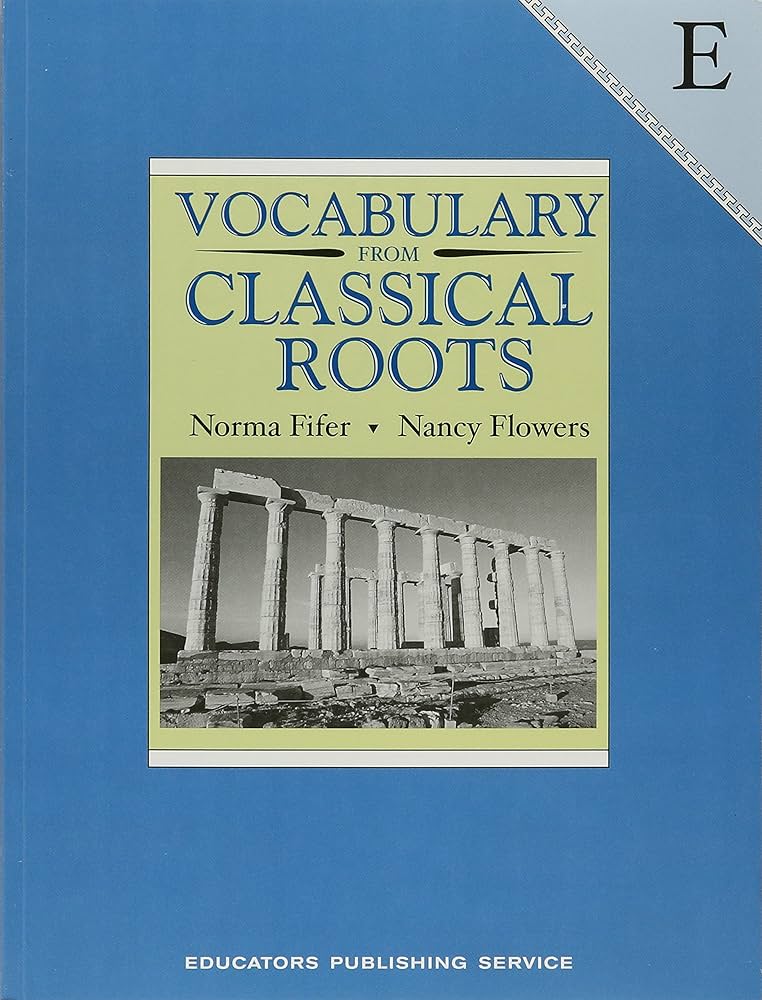
Vocabulary from Classical Roots (Book E)
Vocabulary from Classical Roots Book E, published by Educators Publishing Service, is a Grade 6 vocabulary program that builds word knowledge through the study of Latin and Greek roots. The book covers eight thematic units exploring roots related to topics such as government, law, military matters, business, and contrasting concepts like light and dark, good and bad, and up and down. Students develop a deeper understanding of word origins and meanings across a wide range of academic and real-world subject areas, strengthening their reading and writing skills through classical language study.
Chapters & Lessons
Chapter 1: Here and There (Lesson 1-2)
2 lessonsIn this Grade 6 vocabulary lesson from Vocabulary from Classical Roots Book E, students explore Latin and Greek roots including INTER, PONO, PROPE, QUIES, and TRUDO to build understanding of 15 advanced words such as interpolate, juxtapose, quiescent, acquiesce, and obtrude. Learners practice identifying synonyms and antonyms through structured exercises that reinforce each word's precise meaning and usage. The lesson supports vocabulary development through classical root analysis, helping students decode unfamiliar words across academic subjects.
In this Grade 6 lesson from Vocabulary from Classical Roots Book E, students learn 15 vocabulary words derived from the classical roots ALTER, EPI, PARA, PERI, and TITHEMAI, mastering terms such as altruism, paradox, epitome, paradigm, and peripatetic. Students practice identifying synonyms and antonyms through structured exercises that reinforce each word's precise meaning and usage. The lesson builds foundational vocabulary skills by connecting word meanings back to their Latin and Greek origins.
Chapter 2: Government (Lesson 3-4)
2 lessonsIn this Grade 6 vocabulary lesson from Vocabulary from Classical Roots Book E, students study 15 words derived from the roots ARKHEIN, ARKHOS, DEMOS, GREX/GREGIS, and EIKON, including terms like anarchy, oligarchy, demagogue, pandemic, and iconoclastic. The lesson connects classical Greek and Latin roots to modern concepts in government, population studies, and social behavior. Exercises reinforce understanding through synonym and antonym identification in context.
In this Grade 6 vocabulary lesson from Vocabulary from Classical Roots, Book E, students learn 15 words related to government and power, including hegemony, polity, potentate, viceroy, and regency, along with the Latin and Greek roots that form them such as DUCO, POLIS, and REX. Students practice distinguishing synonyms and antonyms through exercises using words like conducive, traduce, puissant, and renunciation in political contexts. The lesson builds academic vocabulary tied directly to concepts of governance, authority, and political organization.
Chapter 3: Up and Down (Lesson 5-6)
2 lessonsIn this Grade 6 lesson from Vocabulary from Classical Roots Book E, students explore 15 vocabulary words derived from Latin roots including BASIS/BASSUS, LEVIS, PENDO, and SCALA, all connected to the theme of up and down. Students learn to recognize and use words such as levity, ponderous, declivity, transcendent, and legerdemain by tracing their meanings back to classical roots like "to weigh," "light," and "to climb." Exercises focus on identifying synonyms and antonyms in context to reinforce precise word meaning and usage.
In this Grade 6 lesson from Vocabulary from Classical Roots Book E, students explore fourteen vocabulary words built from Latin and Greek roots meaning "to lie down," "under," and "truth," including words like hypothesis, cataclysm, subterfuge, and verisimilitude. Students practice identifying synonyms and antonyms to deepen their understanding of each word's precise meaning. The lesson builds classical root literacy by connecting prefixes such as sub-, kata-, and hypo- to their modern English derivatives.
Chapter 4: Business (Lesson 7-8)
2 lessonsIn this Grade 6 vocabulary lesson from Vocabulary from Classical Roots, Book E, students explore 15 words rooted in Latin and Greek origins including QUAERO, MITTO, MEREO, and DUNAMIS, learning terms such as acquisitive, meretricious, meritorious, dynamo, and presumption. The lesson connects classical roots to their modern English meanings through synonym and antonym exercises that reinforce understanding of word relationships and precise usage. Part of Chapter 4's focus on business-related vocabulary, this lesson builds the advanced word knowledge students need for academic reading and writing.
In this Grade 6 vocabulary lesson from Vocabulary from Classical Roots Book E, students study Latin and Greek roots including ACER, ACUS, EMO, KRATOS, PECUNIA, and PORTO to unlock the meanings of fifteen business and social vocabulary words. Students learn terms such as acerbic, exacerbate, acrimony, acumen, pecuniary, impecunious, technocracy, plutocrat, and peremptory through synonym and antonym exercises. The lesson builds both language precision and contextual reading skills within the Chapter 4 Business unit.
Chapter 5: Light and Dark, Open and Shut (Lesson 9-10)
2 lessonsIn this Grade 6 lesson from Vocabulary from Classical Roots Book E, students explore 15 vocabulary words derived from Latin roots meaning light, shadow, dark, and pale, including lucid, luminescence, pellucid, umbrage, denigrate, and pallid. Students learn how classical roots such as LUX, UMBRA, and NIGER connect to modern English words and their meanings. Practice exercises reinforce understanding through synonym and antonym identification tied directly to each root family.
In this Grade 6 vocabulary lesson from Vocabulary from Classical Roots Book E, students study the Latin and Greek roots APO, CASTUS, CLAUDO, CLAVIS, and DIA to unlock the meanings of fifteen words including apocalypse, apocryphal, occlusion, conclave, enclave, diatribe, and diaspora. Exercises focus on identifying synonyms and antonyms to reinforce each word's precise definition and usage. This lesson builds the advanced vocabulary skills sixth graders need to interpret complex texts across subjects.
Chapter 6: Military Matters (Lesson 11-12)
2 lessonsIn this Grade 6 vocabulary lesson from Vocabulary from Classical Roots Book E, students study 15 words rooted in Latin and Greek terms for war, fighting, strength, and writing, including bellicose, belligerent, pugnacious, indomitable, and carte blanche. Learners trace each word back to roots such as BELLUM, PUGNO, FORTIS, and KHARTES to understand how meaning is built from classical origins. Exercises reinforce skills in identifying synonyms, antonyms, and correct usage in context.
In Lesson 12 of Chapter 6 from Vocabulary from Classical Roots Book E, Grade 6 students study 15 vocabulary words derived from four Latin roots meaning "to fall," "to yield," "plunder," and "to prick," including terms like recidivism, cadence, punctilious, and expunge. Students practice identifying synonyms and antonyms through structured exercises that reinforce both word meanings and root connections. This lesson builds advanced vocabulary skills within a military and classical context aligned with the Book E curriculum.
Chapter 7: Good and Bad (Lesson 13-14)
2 lessonsIn this Grade 6 lesson from Vocabulary from Classical Roots Book E, students learn 15 vocabulary words derived from the Latin and Greek roots BENE, BONUS, EU, and AISTH/ANESTHARI, all related to concepts of goodness, beauty, and well-being. Words covered include aesthetic, beatitude, benign, euphemism, euphony, bona fide, and eugenics, with attention to their precise meanings and usage. Practice exercises build skills in identifying synonyms and antonyms in context.
In this Grade 6 lesson from Vocabulary from Classical Roots Book E, students explore 15 vocabulary words derived from the Latin roots MALUS, MENDUM, LICENTLA, and PECCATUM, all connected to themes of bad character, wrongdoing, and moral fault. Students learn terms such as malfeasance, malevolent, mendacious, impeccable, and peccadillo, along with their precise meanings and proper usage. Exercises reinforce understanding by asking students to identify synonyms, antonyms, and correct contextual usage for each word.
Chapter 8: The Law (Lesson 15-16)
2 lessonsIn this Grade 6 vocabulary lesson from Vocabulary from Classical Roots Book E, students explore 15 law-related words derived from Latin roots including censeo, poena, probo, and vindico. Learners study terms such as subpoena, vindicate, impunity, approbation, and vendetta, tracing each word back to its classical origin to understand meaning and usage. Exercises reinforce skills in identifying synonyms and antonyms and applying vocabulary in context.
In this Grade 6 vocabulary lesson from Vocabulary from Classical Roots Book E, students learn 15 law-related words derived from Latin roots including ARBITER, JUDEX, JURO, and ROGO. Terms such as arbitrate, adjudicate, perjury, abrogate, and prerogative are taught with definitions and reinforced through synonym, antonym, and usage exercises. The lesson builds precise legal vocabulary by connecting word meanings directly to their classical Latin origins.
Frequently Asked Questions
- Is Vocabulary from Classical Roots Book E the right program for my 6th grader?
- Vocabulary from Classical Roots Book E is an excellent choice for 6th graders, particularly those in accelerated language arts or preparing for gifted and honors programs. It teaches sophisticated vocabulary — words like hegemony, bellicose, and verisimilitude — through Latin and Greek roots organized by real-world themes: government, business, military, light and dark, and more. If your child reads above grade level or needs vocabulary preparation for middle school standardized tests, this program delivers both breadth and depth far beyond typical classroom word lists.
- Which lessons in Vocabulary from Classical Roots Book E are hardest for 6th graders?
- Chapter 1 (Lessons 1–2) is the most difficult starting point because words like interpolate, juxtapose, acquiesce, and peripatetic are genuinely college-level. Chapter 5 on light and dark (Lessons 9–10) also introduces abstract and literary vocabulary like pellucid, umbrage, and verisimilitude that students rarely encounter in everyday speech. Chapter 2 on government (Lessons 3–4) is challenging conceptually because the words require students to understand political ideas alongside their root meanings.
- My child struggles with reading comprehension because of hard vocabulary — where should they start?
- Start with Chapter 2, Lessons 3 and 4 on government vocabulary, because many of these words — democracy, oligarchy, potentate, hegemony — appear frequently in history and social studies readings and will give your child an immediate payoff in school. Chapter 4 on business vocabulary (Lessons 7–8) is also very practical. Beginning with thematic chapters that connect to subjects your child already studies builds confidence and shows clear value before moving to more abstract chapters like Chapter 1.
- What should my child study after completing Vocabulary from Classical Roots Book E?
- Book E is designed for Grade 6, and the series continues with Books F and beyond for grades 7 and 8. Students who complete Book E have built a strong enough root-recognition foundation to tackle more advanced programs like Vocabulary for the College Bound Student or to begin SAT/ACT vocabulary preparation in middle school. The Latin and Greek root knowledge from this program also directly supports performance in science and history courses throughout middle and high school.
- How can Pengi help my child with Vocabulary from Classical Roots Book E?
- Pengi can quiz your child on any lesson from Book E in a conversational way — asking them to explain the meaning of a root, use a word in a sentence, or identify synonyms and antonyms. For a lesson like Chapter 6 on military matters, Pengi can give context for why words like bellicose and indomitable appear in historical writing your child will encounter. Pengi can also help your child distinguish between tricky near-synonyms like meritorious versus meretricious from Chapter 4.
Ready to start learning?
Jump into your first lesson for Vocabulary from Classical Roots (Book E). Free, no account required.
Start Learning