
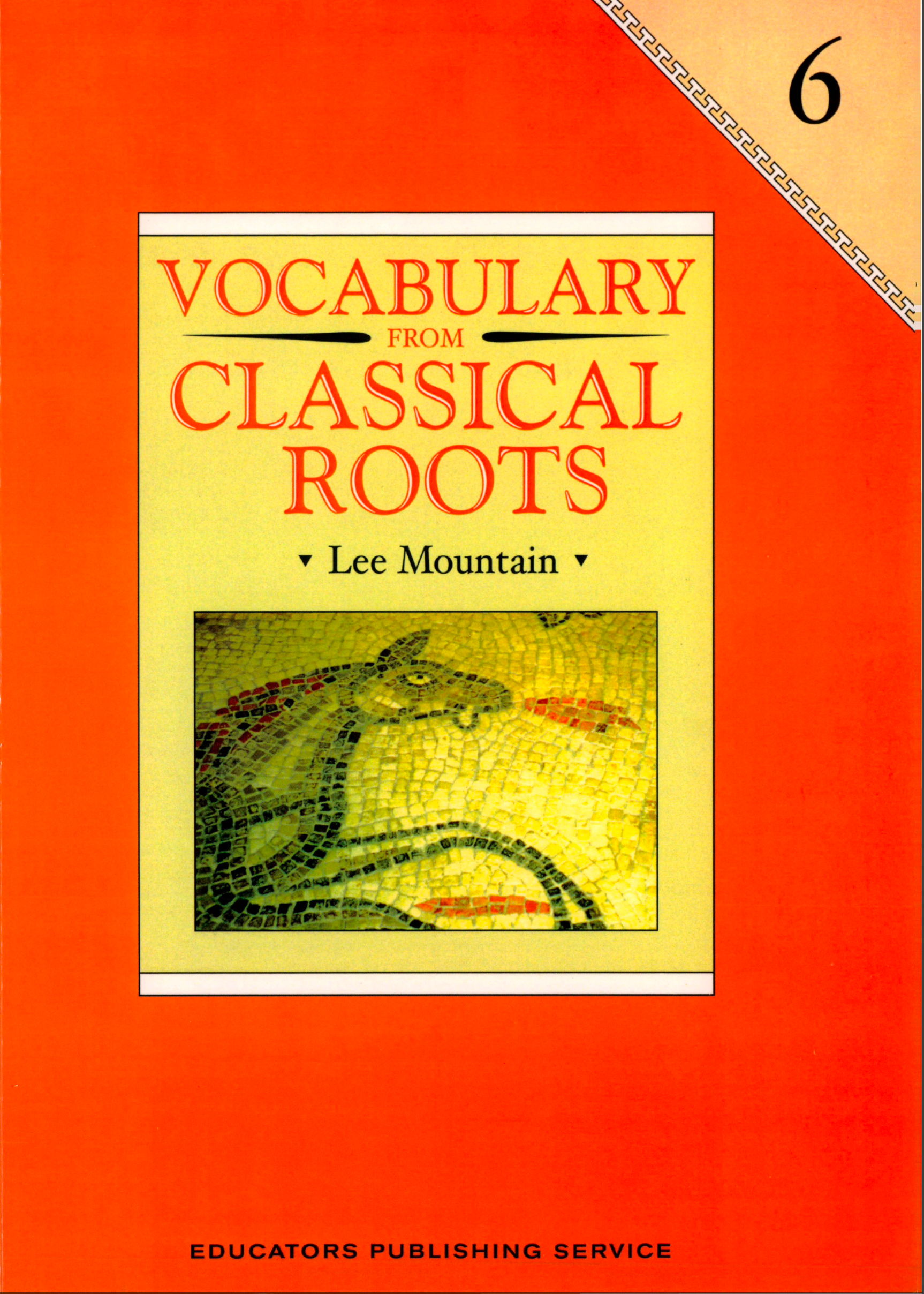
Vocabulary from Classical Roots (Book 6)
Vocabulary from Classical Roots (Book 6), published by Educators Publishing Service (EPS), is a Grade 4 vocabulary program that builds word knowledge by teaching Latin and Greek roots, prefixes, and suffixes common to English. The book is organized into lessons grouped across four chapters, guiding students through classical roots connected to themes such as numbers, nature, human traits, and abstract ideas, with each lesson introducing a set of related words derived from those roots. By understanding the building blocks of language, students develop strategies for decoding unfamiliar words and strengthening vocabulary across all academic subjects.
Chapters & Lessons
Chapter 1: Lessons 1-3
3 lessonsIn this Grade 4 lesson from Vocabulary from Classical Roots Book 6, students explore the Latin roots vis and spect, both meaning "to see," to unlock the meanings of ten vocabulary words including envision, supervise, spectator, and spectacular. Through exercises in root clues, synonyms, and context-based fill-in-the-blank activities, learners build word recognition skills tied to the concept of sight and observation. The lesson also introduces the prefix super- to extend vocabulary beyond the core word list.
In this Grade 4 vocabulary lesson from Vocabulary from Classical Roots Book 6, students learn ten words built from the Latin root audi and the Greek root phon, both meaning "hear" or "sound," including terms such as audible, inaudible, auditorium, phonics, and stereophonic. Exercises guide students to use root clues, identify synonyms, and apply words in context to deepen understanding of how these roots shape meaning. The lesson also introduces the suffix -orium/-arium to help students recognize place-related words like aquarium, terrarium, and planetarium.
Grade 4 students explore the Latin roots voc (voice, to speak) and dict (to say) through ten vocabulary words including vocal, vocation, contradict, predict, and verdict, drawn from Chapter 1 of Vocabulary from Classical Roots Book 6. Lessons build word knowledge through synonym matching, context clues, and fill-in-the-blank exercises, while also introducing the prefix pre- with words like preview, prehistoric, and prevent.
Chapter 2: Lessons 4-6
3 lessonsIn this Grade 4 vocabulary lesson from Vocabulary from Classical Roots Book 6, students explore the Latin and Greek roots scrib/scrip and graph, both meaning "write or record," to build understanding of words like prescription, autobiography, biography, and geography. Through synonym exercises and context-based fill-in-the-blank activities, students practice recognizing how these roots combine with prefixes such as auto- and bio- to form new words. The lesson also extends vocabulary by connecting familiar roots to terms like biochemistry and biosphere.
Grade 4 students explore the Latin roots soci (group) and mem (remembering) in Lesson 6 of Vocabulary from Classical Roots Book 6, learning words such as antisocial, dissociate, commemorate, memorandum, and remembrance. The lesson builds vocabulary through synonym exercises and context-based fill-in-the-blank activities. Students also extend their learning by examining the suffixes -logy and -logist to identify names of scientific fields like biology, geology, and paleontology.
Grade 4 students explore the Latin prefixes de- (down) and sub- (under) through ten vocabulary words including decrease, demote, submerge, and subside in Lesson 7 of Vocabulary from Classical Roots Book 6. Students practice recognizing how these prefixes signal downward or beneath meanings across contexts ranging from math terms like denominator to everyday words like dejected. Exercises build skills in identifying antonyms, using words in context, and extending knowledge to the related prefix pro-.
Chapter 3: Lessons 7-9
3 lessonsIn this Grade 4 vocabulary lesson from Vocabulary from Classical Roots Book 6, students explore the Latin roots port (to carry) and mis/mit (to send) through ten key words including portable, deportation, missile, and submit. Learners practice identifying synonyms, using words in context, and applying the noun suffix -ion to transform verbs like emit and omit into their noun forms emission and omission. The lesson builds both vocabulary depth and word-formation skills within the broader Chapter 3 unit on sending and carrying.
Grade 4 students explore the Latin roots vers/vert (turn) and contra (against) in Lesson 10 of Vocabulary from Classical Roots Book 6. Students learn ten vocabulary words including divert, versatile, vertebrate, controversial, and contradictory, practicing them through antonym identification, context-based paragraph completion, and prefix analysis of di-/dis-. This lesson is part of Chapter 3 and builds word knowledge essential for advanced reading and writing.
In this Grade 4 vocabulary lesson from Vocabulary from Classical Roots Book 6, students explore the Latin roots man (to handle) and sol/solv (to loosen, to release) through ten words including manuscript, maneuver, manual, dissolve, solvent, and soluble. Exercises build skills in synonym recognition, context-based usage, and word analysis using a hands-on science passage about dissolving food coloring. A vocabulary extension section introduces the root ped, teaching words like pedestrian, biped, and impede.
Chapter 4: Lessons 10-12
3 lessonsIn this Grade 4 lesson from Vocabulary from Classical Roots Book 6, students learn ten vocabulary words built from the Greek and Latin roots poli (city/government), gen (family/race), and nat (born), including words like cosmopolitan, nationality, and naturalize. Students practice identifying synonyms, using words in context, and exploring how suffixes like -ician, -er, and -or form words that describe people in various roles.
In Lesson 14 of Chapter 4 from Vocabulary from Classical Roots Book 6, Grade 4 students explore the Latin and Greek roots spir (breath/alive), photo (light), and flam (fire) to build vocabulary. Students learn ten words including respiration, photosynthesis, flammable, and inflammation, practicing how root meanings unlock word definitions. Exercises reinforce skills through synonym matching, context clues, and a paragraph completion activity using the lesson vocabulary.
Grade 4 students explore the Latin suffix -ible/-able ("able to be") and the Greek suffix -ize ("to cause to be") in Lesson 15 of Vocabulary from Classical Roots Book 6. Students learn ten vocabulary words built from these suffixes, including illegible, identifiable, predictable, colonize, generalize, and vocalize. Exercises guide students to use suffix clues to decode meaning, identify antonyms, apply words in context, and distinguish when to spell the suffix as -ible versus -able.
Frequently Asked Questions
- Is Vocabulary from Classical Roots Book 6 the right vocabulary program for my 4th grader?
- Vocabulary from Classical Roots Book 6, published by Educators Publishing Service, is a strong choice for Grade 4 students ready to move beyond memorizing word lists. It teaches Latin and Greek roots like vis (see), audi (hear), and port (carry) so your child can decode unfamiliar words across all subjects. It works especially well for strong readers who enjoy patterns. If your child is still building basic reading fluency, pair it with simpler comprehension support first. It is widely used in both classroom and homeschool settings and aligns well with advanced vocabulary expectations for middle school readiness.
- Which lessons in Vocabulary from Classical Roots Book 6 are most difficult for 4th graders?
- Chapter 2 Lesson 7 (Lowering with Prefixes de- and sub-) and Chapter 3 Lesson 10 (Turning, with vers/vert and contra) tend to be the hardest. The prefix lessons ask students to combine two layers of meaning at once, which is cognitively demanding at this age. Chapter 4 Lesson 14 (Illuminating) covers words like photosynthesis and respiration that overlap with science content many 4th graders are still learning. Antonym exercises throughout all chapters can also trip up students who confuse related roots that have opposite meanings.
- My child struggles with word meaning and context - where should they start in this book?
- Start with Chapter 1, Lesson 1 (Seeing), which introduces the most concrete, intuitive roots - vis and spect - and builds accessible vocabulary like envision, supervise, and spectator. These are words children already encounter in everyday life, making the root-to-meaning connection easier to grasp. Once your child gains confidence with Lessons 1-3, the abstract lessons in later chapters become much more manageable. Pengi can practice root-word associations interactively with your child, reinforcing the pattern recognition that is the core skill this program builds.
- What should my child study after completing Vocabulary from Classical Roots Book 6?
- After Book 6 (Grade 4), students naturally progress to Vocabulary from Classical Roots Book 7, which continues the root-based methodology at a higher complexity level appropriate for Grade 5. The same EPS series also offers a Grade 6 Book E that introduces more advanced roots and academic vocabulary for middle school readiness. Supplementing with wide independent reading is the best accelerator - the more your child encounters the roots from this book in real texts, the stronger the vocabulary retention. Consider pairing it with a grade-level novel study that provides rich contextual exposure.
- How can Pengi help my child with Vocabulary from Classical Roots Book 6?
- Pengi turns vocabulary study into an interactive experience rather than rote memorization. For any lesson in the book - whether it is the writing roots in Chapter 2 (scrib/scrip, graph) or the carrying roots in Chapter 3 (port, mis/mit) - Pengi can quiz your child, explain each root with examples, and help them create original sentences using new words. If your child is confused by an antonym exercise or stumped by a fill-in-the-blank passage, Pengi walks through the reasoning step by step. This kind of patient, on-demand practice is exactly what root-based vocabulary learning needs to stick.
Ready to start learning?
Jump into your first lesson for Vocabulary from Classical Roots (Book 6). Free, no account required.
Start Learning