
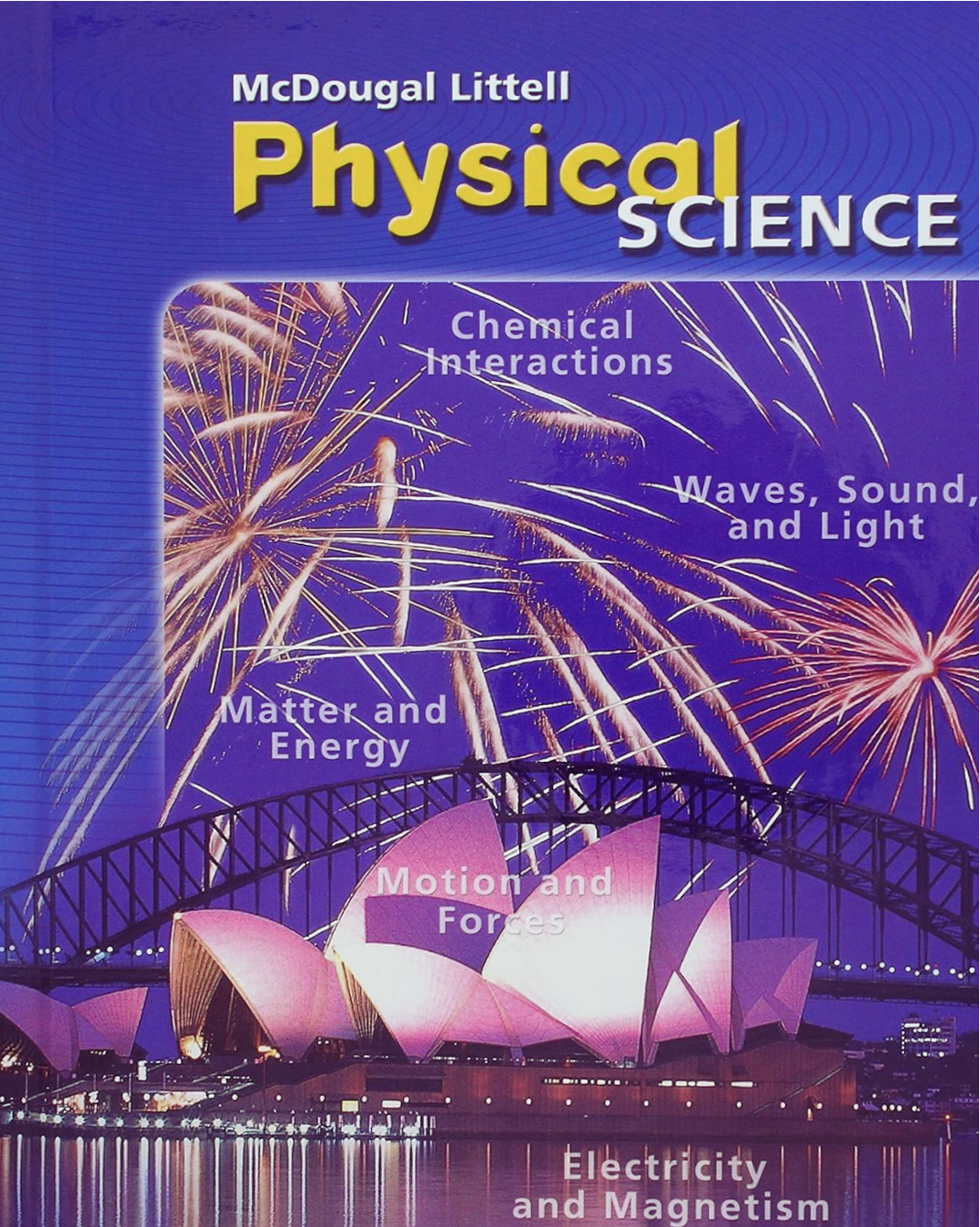
Physical Science (Grade 8)
Physical Science for Grade 8 is a comprehensive middle school science textbook that introduces students to the fundamental principles of the physical world across five units. The course covers matter and energy, including atomic structure, chemical bonds, reactions, and solutions, before moving into mechanics topics such as motion, forces, gravity, work, and simple machines. Students also explore waves, sound, light, optics, electromagnetic waves, and a full unit on electricity, circuits, and magnetism, giving them a broad foundation in both chemistry and physics concepts.
Chapters & Lessons
Chapter 1: Introduction to Matter - Unit 1
4 lessonsIn this Grade 8 Physical Science lesson from Chapter 1, students learn what matter is and how to distinguish it from non-matter such as light and sound. They explore how to measure mass using units like kilograms and grams with tools such as pan balances, and understand the difference between mass and weight. Students also learn how to determine the volume of objects, recognizing that volume measures the space matter occupies.
In this Grade 8 Physical Science lesson from Chapter 1: Introduction to Matter, students learn that atoms are the smallest basic units of matter and explore how atoms combine to form molecules such as water (H₂O). The lesson covers how atoms and molecules move, the historical development of atomic theory, and how to use modeling to estimate the mass of individual atoms. Students also distinguish between atoms and molecules and understand why breaking a molecule apart changes the substance it forms.
Grade 8 students explore how matter combines to form different substances in this Physical Science lesson from Chapter 1. Students learn to distinguish between pure substances and mixtures, understand how elements contain only one type of atom, and discover how atoms bond together to form compounds with properties different from their individual elements. The lesson also covers the difference between heterogeneous and homogeneous mixtures using real-world examples like soil, saltwater, and sugar water.
Grade 8 students explore the three states of matter — solid, liquid, and gas — learning how particle arrangement and motion determine each state's properties, including fixed versus variable volume and shape. The lesson, from Chapter 1 of Physical Science, covers key vocabulary such as states of matter, solid, liquid, and gas, and examines real-world examples like water, ice, and water vapor to illustrate how the same molecules behave differently across states. Students also investigate why ice floats on liquid water and experiment with the behavior of different liquids.
Chapter 2: Properties of Matter - Unit 1
3 lessonsIn this Grade 8 Physical Science lesson from Chapter 2, students learn to distinguish between physical and chemical properties of matter, including measurable properties such as mass, volume, and density. The lesson introduces the density formula (D = m/V) and explains how physical changes alter observable properties without changing a substance's identity, while chemical changes produce new substances. Students also explore how to identify signs of chemical change through hands-on experimentation.
In this Grade 8 Physical Science lesson from Chapter 2, students explore how changes of state — including melting, freezing, evaporation, boiling, sublimation, and condensation — are physical changes because the basic substance remains the same. Students learn key concepts such as melting point, freezing point, and boiling point, and examine how energy affects the movement of particles during each state change. Real-world examples like dew formation, melting ice, and liquid steel help connect these vocabulary terms to observable phenomena.
In this Grade 8 Physical Science lesson from Chapter 2, Unit 1, students learn how physical and chemical properties such as density, color, odor, texture, boiling point, and freezing point can be used to identify unknown substances. The lesson also covers how characteristic properties of matter help distinguish between substances and how those properties can be applied to separate mixtures. Students apply these concepts through hands-on exploration and experiment design, building a foundation for scientific investigation in physical science.
Chapter 3: Energy - Unit 1
3 lessonsIn this Grade 8 Physical Science lesson from Chapter 3, students learn that energy is the ability to cause change and explore six common forms of energy: mechanical, sound, chemical, thermal, electromagnetic, and nuclear. The lesson also introduces the two general types of energy — kinetic energy and potential energy — that describe all forms of energy. Students build foundational understanding of how energy causes change in everyday contexts, from burning gasoline to electromagnetic waves from the Sun.
In this Grade 8 Physical Science lesson from Chapter 3, students learn how energy converts between forms such as chemical, kinetic, potential, light, and heat, and explore the law of conservation of energy. The lesson uses real-world examples like a burning match and a ski jumper to illustrate conversions between potential and kinetic energy. Students also examine the concept of energy efficiency and how energy conversions power everyday systems like hydroelectric dams.
In this Grade 8 Physical Science lesson from Chapter 3, students learn how technology improves energy conversions by examining real-world examples such as LEDs, fuel injectors, and hybrid cars. Students evaluate the advantages and disadvantages of alternative energy sources like solar energy and wind energy compared to fossil fuels, and explore how solar cells convert sunlight into electrical energy. The lesson also includes a hands-on experiment investigating how the color of a solar collector affects the collection of solar energy.
Chapter 4: Temperature and Heat - Unit 1
3 lessonsIn this Grade 8 Physical Science lesson from Chapter 4, students learn how temperature is defined as a measure of the average kinetic energy of particles in matter, building on the kinetic theory of matter. Students explore how particle motion differs across solids, liquids, and gases, and how changes in particle speed relate to changes in temperature. The lesson also introduces how temperature is measured using standard temperature scales.
In this Grade 8 Physical Science lesson from Chapter 4, students learn how heat differs from temperature, how energy flows from warmer to cooler objects, and why thermal energy is measured in calories and joules. The lesson also introduces specific heat to explain why substances like water change temperature more slowly than metals. Students explore real-world examples, such as melting ice and heating pans, to understand these core thermodynamics concepts.
In this Grade 8 Physical Science lesson from Chapter 4, students explore how energy transfer as heat can be controlled through the three processes of conduction, convection, and radiation. Students learn the difference between conductors and insulators and how the physical properties of materials determine how well they transfer or resist heat. This lesson builds on prior knowledge of temperature and kinetic energy to explain real-world applications like insulated containers and layered clothing.
Chapter 5: Atomic Structure and the Periodic Table - Unit 2
3 lessonsIn this Grade 8 Physical Science lesson from Chapter 5, students learn that atoms are the smallest form of elements and explore the structure of atoms, including the roles of protons, neutrons, and electrons within the nucleus and electron cloud. Students also study atomic number, atomic mass number, and isotopes to understand how atoms of different elements are distinguished from one another. The lesson further introduces how ions are formed when atoms gain or lose electrons, laying the foundation for understanding the periodic table.
In this Grade 8 Physical Science lesson from Chapter 5, students learn how the periodic table is organized by atomic number and how it displays the properties of elements. The lesson covers key concepts including atomic mass, isotopes, and the historical development of Mendeleev's periodic table, including how he used repeating patterns of chemical and physical properties to arrange the elements. Students also explore how to read the periodic table, identifying groups, periods, atomic number, chemical symbols, and average atomic mass for each element.
In this Grade 8 Physical Science lesson from Chapter 5, students learn to classify elements as metals, nonmetals, and metalloids and explore how an element's position on the periodic table indicates its properties and reactivity. The lesson covers distinct element groups including alkali metals, alkaline earth metals, and transition metals, and introduces radioactivity and the concept of half-life. Students also practice reading the periodic table by identifying periods, groups, and the actinide series.
Chapter 6: Chemical Bonds and Compounds - Unit 2
3 lessonsIn this Grade 8 Physical Science lesson from Chapter 6, students learn how compounds differ from the elements that form them, exploring why substances like water and calcium chloride have properties unlike their component elements. Students discover that atoms combine in predictable ratios and practice reading and writing chemical formulas using symbols and subscripts to represent those ratios. This lesson is part of Unit 2 on Chemical Bonds and Compounds in the Physical Science textbook.
Grade 8 Physical Science students explore how chemical bonds hold compounds together in Chapter 6, Lesson 6.2, learning the differences between ionic bonds and covalent bonds and how electrons are transferred or shared between atoms. The lesson covers how ions form through electron transfer, how opposite charges create ionic bonds as seen in sodium chloride crystals, and introduces polar covalent bonds and molecules. Students also examine how an element's position on the periodic table predicts the types of ions it will form.
In this Grade 8 Physical Science lesson from Chapter 6, Unit 2, students explore how metallic bonds, ionic bonds, and covalent bonds determine the physical and chemical properties of substances. Students learn why metallic bonds make metals good conductors of electricity and heat, why ionic compounds have high melting points and conduct electricity when dissolved in water, and how to distinguish different forms of the same element. This lesson supports the Physical Science textbook's broader unit on chemical bonds and compounds.
Chapter 7: Chemical Reactions - Unit 2
4 lessonsIn this Grade 8 Physical Science lesson from Chapter 7, students learn how chemical reactions rearrange atoms by breaking bonds in reactants and forming new bonds in products. The lesson distinguishes chemical changes from physical changes and introduces key vocabulary including reactant, product, precipitate, and catalyst. Students also explore three types of chemical reactions and how reaction rates can be modified.
In this Grade 8 Physical Science lesson from Chapter 7, students learn about the law of conservation of mass, which states that atoms are neither created nor destroyed in a chemical reaction. The lesson covers how Antoine Lavoisier's experiments demonstrated that the total mass of reactants always equals the total mass of products, and introduces students to chemical equations and the use of coefficients to balance them. Students also conduct a hands-on experiment measuring the mass of reactants and products using baking soda and vinegar to verify conservation of mass.
In this Grade 8 Physical Science lesson from Chapter 7, students learn how energy changes occur during chemical reactions by exploring the concepts of bond energy, exothermic reactions, and endothermic reactions. Students discover that breaking chemical bonds requires energy while forming new bonds releases energy, and that whether a reaction releases or absorbs energy overall depends on the difference in bond energies between reactants and products. Real-world examples like the thermite reaction, combustion of methane, and glow sticks illustrate how these energy changes appear in everyday chemical processes.
Grade 8 students explore how chemical reactions are essential to both living organisms and modern technology in this lesson from Physical Science, Chapter 7. Students learn how cellular respiration uses enzymes as catalysts to break down glucose through combustion, producing carbon dioxide, water, and usable energy, and how this process compares to photosynthesis. The lesson also examines industrial applications, including how catalysts manage combustion reactions in car engines and the production of byproducts like carbon monoxide and nitric oxide.
Chapter 8: Solutions - Unit 2
4 lessonsIn this Grade 8 Physical Science lesson from Chapter 8, students learn what distinguishes a solution from other types of mixtures, including the roles of solute and solvent and how properties of a solution differ from those of its individual components. Students explore how ionic and covalent compounds dissolve differently, and examine various types of solutions made from gases, liquids, and solids. The lesson also includes an experiment on separating the components of a solution.
In this Grade 8 Physical Science lesson from Chapter 8: Solutions, students explore how the concentration of a solution changes as solute is added or removed, and learn to distinguish between dilute, saturated, and supersaturated solutions. The lesson also covers solubility — including how molecular structure, temperature, and pressure affect how much solute can dissolve in a given solvent. Students apply these concepts by designing an experiment to test the effect of temperature on solubility.
In this Grade 8 Physical Science lesson from Chapter 8, students learn to define acids and bases in terms of hydrogen ion donation and acceptance, and explore how to identify them using indicators like litmus paper and the pH scale. The lesson covers the distinct properties of acidic, basic, and neutral solutions, including how compounds like hydrogen chloride and sodium hydroxide ionize in water. Students also discover how acids and bases react with each other, forming the foundation for understanding neutralization chemistry.
In this Grade 8 Physical Science lesson from Chapter 8: Solutions, students learn what metal alloys are, how they are made by mixing molten metals, and why their properties differ from their individual components. The lesson covers common alloys such as bronze, brass, steel, and nitinol, exploring how composition affects hardness, strength, and other characteristics. Students also examine the historical development of alloys from the Bronze Age to modern industrial applications like the Bessemer process.
Chapter 9: Carbon in Life and Materials - Unit 2
3 lessonsIn this Grade 8 Physical Science lesson from Chapter 9, students explore the structure of carbon-based molecules, learning how carbon atoms form single, double, and triple covalent bonds and why this bonding flexibility produces millions of different organic compounds. Students also examine the distinction between organic and inorganic compounds, including exceptions like diamond, graphite, and carbon dioxide, and learn to read both full and simplified structural formulas. The lesson connects to the history of organic chemistry, including Friedrich Wöhler's 1828 synthesis of urea, the first organic compound created outside a living organism.
In this Grade 8 Physical Science lesson from Chapter 9, students explore the four major types of carbon-based molecules found in living things: carbohydrates, lipids, proteins, and nucleic acids. The lesson covers the structures and functions of each macromolecule, including how carbohydrates like glucose and cellulose provide energy and structural support, how lipids store chemical energy, and how nucleic acids carry instructions for building proteins. Students build on prior knowledge of carbon bonding to understand why molecular structure determines biological function.
Grade 8 students explore how carbon-based molecules called hydrocarbons are extracted from petroleum and refined into everyday materials such as gasoline, plastics, and nylon fibers. The lesson covers the petroleum refining process, including how distillation separates hydrocarbon fractions based on boiling points, and introduces key terms including hydrocarbon, polymer, monomer, and plastic. Students also learn how a material's molecular structure — such as chain length and atomic arrangement — determines its physical properties and practical uses.
Chapter 10: Motion - Unit 3
3 lessonsIn this Grade 8 Physical Science lesson from Chapter 10, students learn how to describe an object's position using reference points and coordinate systems like longitude and latitude, and explore how motion is defined as a change in position over time. The lesson introduces key concepts including distance measurement using standard units, speed as a measure of how quickly position changes, and relative motion explained through the concept of a frame of reference. Students examine how an observer's own position and movement affect how they describe the motion of other objects.
In this Grade 8 Physical Science lesson from Chapter 10: Motion, students learn how to calculate speed using the formula S = d/t and how to compare the speeds of objects that travel different distances in the same amount of time. The lesson also introduces velocity and vectors, distinguishing instantaneous speed from average speed. Part of the Unit 3 motion sequence, it builds directly on students' prior understanding of position, distance, and direction.
In this Grade 8 Physical Science lesson from Chapter 10, students learn that acceleration measures how fast velocity changes, including changes in speed, direction, or both. Students explore how acceleration is related to velocity and correct the common misconception that acceleration only means speeding up, understanding that slowing down and turning also qualify. The lesson also covers how to calculate acceleration using the rate of velocity change over time.
Chapter 11: Forces - Unit 3
4 lessonsIn this Grade 8 Physical Science lesson from Chapter 11 of the textbook, students learn what a force is and how to distinguish between balanced and unbalanced forces using the concept of net force. The lesson explains how unbalanced forces change an object's motion and introduces Newton's first law and inertia to help students predict motion. Students also explore types of forces including contact force, gravity, and friction through real-world examples like skating and basketball.
In this Grade 8 Physical Science lesson from Chapter 11, students explore Newton's second law, learning how force, mass, and acceleration are related through the formula F = ma. Students examine how increasing force raises acceleration while increasing mass lowers it, and practice applying the formula to calculate force in real-world scenarios. The lesson also introduces centripetal force as an application of Newton's second law in circular motion.
In this Grade 8 Physical Science lesson from Chapter 11, students learn how Newton's third law describes action and reaction force pairs, where every force exerted on an object produces an equal and opposite force in return. The lesson explains how to distinguish action/reaction pairs from balanced forces and uses real-world examples like jellyfish movement, rocket liftoff, and spring scale experiments to illustrate the concept. Part of the broader unit on forces, this lesson also shows how Newton's third law connects with his first and second laws.
In this Grade 8 Physical Science lesson from Chapter 11, students learn how to calculate momentum using the formula p = mv and explore how mass and velocity affect an object's momentum. The lesson also covers how momentum is transferred between objects during collisions and introduces the principle of conservation of momentum, which states that total momentum in a system remains constant when no outside forces act on it.
Chapter 12: Gravity, Friction, and Pressure - Unit 3
4 lessonsIn this Grade 8 Physical Science lesson from Chapter 12, students learn how gravity works as a universal force between masses, exploring how mass and distance affect gravitational strength using the formula F = mg. The lesson also distinguishes between weight and mass, explaining why weight varies by location while mass remains constant, and examines how gravity keeps objects in elliptical orbits.
Grade 8 students explore friction as a force that resists motion between surfaces in contact, learning how factors such as surface type, the motion state of an object, and the force pressing surfaces together all affect the strength of frictional force. The lesson also introduces related concepts including fluid friction and air resistance. Part of Chapter 12 in Physical Science for Grade 8, this lesson builds on students' prior understanding of gravity and Newton's laws of motion.
In this Grade 8 Physical Science lesson from Chapter 12, students learn how pressure is determined using the formula P = F/A, where pressure is measured in pascals and depends on both the applied force in newtons and the surface area in square meters. The lesson also covers how decreasing area increases pressure and how forces act on objects submerged in fluids. Real-world examples like snowshoes and thumbtacks help students apply pressure calculations to practical situations.
In this Grade 8 Physical Science lesson from Chapter 12, students learn how fluids exert forces on objects by exploring buoyant force, Bernoulli's principle, and Pascal's principle. They discover how an object's density relative to a fluid determines whether it floats or sinks, and how the speed of a moving fluid affects the pressure it exerts on surrounding surfaces. The lesson includes hands-on experimentation to observe how air speed influences air pressure in real-world contexts like airplane wings and chimneys.
Chapter 13: Work and Energy - Unit 3
3 lessonsIn this Grade 8 Physical Science lesson from Chapter 13, students learn the scientific definition of work as the use of force to move an object a distance, distinguishing it from everyday uses of the term. The lesson covers how only the component of force acting in the direction of motion counts as work, and introduces the joule as the standard unit of measurement. Students also practice applying the formula W = Fd to calculate work in newton-meters using real-world examples.
In this Grade 8 Physical Science lesson from Chapter 13, students explore how work transfers energy by examining the relationship between kinetic energy, potential energy, and mechanical energy. Students learn to calculate gravitational potential energy using the formula GPE = mgh and apply the law of conservation of energy to real-world scenarios. The lesson supports hands-on analysis of energy changes, helping students understand how energy is converted and conserved within a system.
Grade 8 students learn how power is defined as the rate at which work is done and explore its relationship to both work and time using the formula P = W/t. This lesson from Chapter 13 of Physical Science covers key units including watts and horsepower, and shows how power can also be calculated from energy transfer over time. Students practice applying the power formula to real-world scenarios such as pulling a sled and operating an elevator.
Chapter 14: Machines - Unit 3
3 lessonsIn this Grade 8 Physical Science lesson from Chapter 14, students learn how machines change the way work is done by altering the size, distance, or direction of an applied force without reducing the total amount of work. Students explore key concepts including mechanical advantage and efficiency, using real-world examples like doorknobs, rakes, and flagpole rope systems to understand input force versus output force. The lesson also introduces the formula for calculating mechanical advantage as output force divided by input force.
In this Grade 8 Physical Science lesson from Chapter 14, students explore the six simple machines — lever, wheel and axle, pulley, inclined plane, wedge, and screw — that form the basis of all mechanical machines. Students examine how each machine works, including the three classes of levers defined by fulcrum position, how a wheel and axle transfers force, and the difference between fixed and movable pulleys. This lesson is part of the Machines unit in the McDougal Littell Physical Science textbook.
In this Grade 8 Physical Science lesson from Chapter 14, students learn how simple machines are combined to form compound machines, exploring real-world examples such as scissors, gears, and the Jaws of Life. Students calculate the mechanical advantage of compound machines by multiplying the mechanical advantages of their component simple machines and examine how gear teeth ratios determine mechanical advantage in gear systems. The lesson also introduces nanotechnology and microtechnology as modern extensions of simple machine principles.
Chapter 15: Waves - Unit 4
3 lessonsIn this Grade 8 Physical Science lesson from Chapter 15, students learn how waves transfer energy by exploring the concepts of disturbance, medium, and mechanical waves, including transverse and longitudinal wave types. The lesson explains how forces cause waves in different materials — such as rope, water, and ground — and how energy travels through a medium without the matter itself traveling the full distance. Students also distinguish between mechanical waves, which require a medium, and waves like light that can travel through empty space.
Grade 8 students learn how to identify and measure key wave properties — amplitude, wavelength, and frequency — using crests and troughs as reference points. The lesson also covers how to calculate wave speed and explores the inverse relationship between frequency and wavelength. This content is part of Chapter 15 in the Physical Science textbook, Unit 4 on Waves.
In this Grade 8 Physical Science lesson from Chapter 15, students learn how waves behave predictably when they encounter barriers or new mediums, exploring the concepts of reflection, refraction, and diffraction. Students discover how waves bounce back through reflection, bend through refraction when entering a new medium at an angle, and spread out through diffraction when passing through openings or around obstacles. The lesson also introduces interference as a way waves interact with one another.
Chapter 16: Sound - Unit 4
4 lessonsIn this Grade 8 Physical Science lesson from Chapter 16, students learn that sound is a mechanical longitudinal wave produced by vibrations and transmitted through matter. The lesson covers how vibrating objects create sound waves, how the human vocal cords produce sound, and how the structures of the ear — including the eardrum, hammer, anvil, stirrup, and cochlea — detect and process sound waves. Students also explore key vocabulary such as vibration and vacuum and examine what factors affect the speed of sound.
In this Grade 8 Physical Science lesson from Chapter 16, students explore how the frequency of a sound wave determines pitch, measured in hertz, and examine the difference between infrasound, audible sound, and ultrasound. Students also learn how natural frequencies and resonance work together to strengthen sound waves. This lesson is part of Unit 4's study of sound in the standard Grade 8 Physical Science textbook.
In this Grade 8 Physical Science lesson from Chapter 16, students explore how the intensity of a sound wave — measured in decibels (dB) — determines loudness, and how amplitude directly affects the amount of energy a wave carries. Students also learn how distance and other forces reduce sound intensity, and how amplification and acoustics can be used to control it. A hands-on experiment with a rubber band reinforces the relationship between amplitude and loudness.
Grade 8 Physical Science students explore the many applications of sound in Chapter 16, Lesson 4, learning how echolocation, sonar, and ultrasound technology are used to detect objects, map the ocean floor, and produce medical images. Students also examine how stringed, wind, and percussion instruments produce music through vibration and resonance. The lesson concludes with an exploration of how sound is recorded and reproduced, and includes a hands-on experiment building a stringed instrument.
Chapter 17: Electromagnetic Waves - Unit 4
3 lessonsGrade 8 students learn how electromagnetic waves differ from mechanical waves, exploring how EM waves form from the movement of electrically charged particles, how electric and magnetic fields vibrate at right angles, and why EM waves can travel through a vacuum without losing energy. The lesson also covers radiation, the speed of light, and how the Sun serves as the primary source of EM waves reaching Earth. This lesson is part of Chapter 17 in the Grade 8 Physical Science textbook.
Grade 8 students explore the electromagnetic spectrum in this Physical Science lesson, learning how radio waves, microwaves, infrared light, visible light, ultraviolet light, x-rays, and gamma rays differ in wavelength, frequency, and energy. The lesson explains how frequency is measured in hertz and why it determines the characteristics and practical uses of each type of EM wave. Students also examine real-world applications such as radio transmission, radar, and satellite communications.
In this Grade 8 Physical Science lesson from Chapter 17, students explore incandescence and bioluminescence as the two primary processes that produce visible light, examining how the Sun's high temperature generates light across all wavelengths. Students also learn why the Sun is Earth's dominant natural light source and how living organisms like fireflies produce light through chemical reactions rather than heat. The lesson connects to real-world technology by tracing the development of incandescent and fluorescent artificial lighting.
Chapter 18: Light and Optics - Unit 4
4 lessonsGrade 8 students explore the science of optics in this Physical Science lesson, learning how mirrors form images through the law of reflection, which states that the angle of reflection equals the angle of incidence. Students distinguish between regular reflection and diffuse reflection, then examine how flat, convex, and concave mirrors produce different images, including the concept of a focal point. The lesson is part of Chapter 18: Light and Optics in the Grade 8 Physical Science textbook.
In this Grade 8 Physical Science lesson from Chapter 18, students learn how lenses form images by refracting light, exploring key concepts such as focal length, the principal axis, and how convex and concave lenses bend light rays differently. The lesson covers why refraction occurs when light enters a new medium at an angle, how a medium's density affects the direction of bending, and the role of refraction in natural phenomena like rainbows. Students also conduct hands-on experimentation to discover how a convex lens focuses light to a focal point.
In this Grade 8 Physical Science lesson from Chapter 18: Light and Optics, students learn how the human eye functions as a natural optical tool by examining the roles of the cornea, pupil, lens, and retina in gathering, refracting, and focusing light. Students explore how rod cells and cone cells in the retina detect brightness and color, and how the brain interprets inverted images as right-side up. The lesson also covers how artificial lenses correct common vision problems, supported by hands-on experiments with focusing and distance.
In this Grade 8 Physical Science lesson from Chapter 18, students explore how mirrors and lenses are combined to create optical instruments such as microscopes, refracting and reflecting telescopes, and cameras, examining the roles of objective lenses, eyepieces, and concave mirrors in forming magnified images. Students also learn how lasers produce intense, single-wavelength light through stimulated emission of radiation inside an optical cavity. The lesson is part of Unit 4's broader study of light and optics in the Physical Science textbook.
Chapter 19: Electricity - Unit 5
3 lessonsIn this Grade 8 Physical Science lesson from Chapter 19, students learn how electric charge works as a property of matter, exploring how protons and electrons interact through attraction and repulsion. The lesson explains how static charges build up in materials through the movement of electrons, including the processes of conduction and charging by contact. Students also discover how induction and static electricity connect to real-world technology applications.
Grade 8 Physical Science students explore how electric charges move and store energy in Chapter 19, Lesson 19.2, covering key concepts including static discharge, electric potential, voltage (measured in volts), and the difference between conductors and insulators. Students learn how electric potential energy relates to a charged particle's position in an electric field and investigate how differences in materials affect the movement of charges through hands-on experimentation.
In this Grade 8 Physical Science lesson from Chapter 19, students learn that electric current is a continuous flow of charge, measured in amperes, and explore how voltage and resistance determine the rate of that flow. Students apply Ohm's law (I = V/R) to calculate current in amperes when given voltage in volts and resistance in ohms. The lesson also introduces measuring tools such as the voltmeter, ohmmeter, ammeter, and multimeter used to quantify these electrical properties.
Chapter 20: Circuits and Electronics - Unit 5
3 lessonsIn this Grade 8 Physical Science lesson from Chapter 20, students learn how electric circuits require a continuous closed path for charge to flow, exploring key circuit components including voltage sources, conductors, switches, and resistors. The lesson also covers the difference between open and closed circuits, how to read standard circuit diagrams, and concepts such as resistance, short circuits, and why current follows the path of least resistance.
In this Grade 8 Physical Science lesson from Chapter 20, students learn how circuits are designed for specific purposes and explore the key differences between series circuits and parallel circuits. Students discover that in a series circuit current follows a single path — meaning a broken component stops the whole circuit — while in a parallel circuit current flows through multiple branches so each device maintains its own connection to the voltage source. The lesson also covers how electrical appliances rely on these circuit designs to function effectively.
Grade 8 students explore how electronic technology relies on circuits in this Physical Science lesson from Chapter 20. Students learn how binary code uses on/off electric current signals to represent digital information, distinguish between digital and analog signals, and examine how the components of a computer work together to process data. The lesson includes vocabulary such as binary code, digital, and analog, and features a hands-on experiment where students model a digital image.
Chapter 21: Magnetism - Unit 5
4 lessonsIn this Grade 8 Physical Science lesson from Chapter 21, students explore magnetism as a force that acts at a distance, learning how magnetic poles attract and repel, what magnetic fields are, and how magnetic domains make certain materials magnetic. The lesson uses real-world examples like maglev trains and refrigerator magnets to illustrate key vocabulary including magnet, magnetism, magnetic pole, and magnetic field. It builds on prior knowledge of forces and charged particles to help students understand why Earth is surrounded by a magnetic field.
In this Grade 8 Physical Science lesson from Chapter 21, students learn how electric current produces a magnetic field, a principle known as electromagnetism. They explore how coiling a wire and inserting an iron core creates an electromagnet, and investigate how increasing current or the number of coils affects magnetic field strength. The lesson also covers real-world applications of electromagnets, including their role in electric motors.
In this Grade 8 Physical Science lesson from Chapter 21, students explore how a moving magnetic field induces an electric current and how a generator converts kinetic energy into electrical energy. Students also learn the key differences between direct current (DC) and alternating current (AC), including how each type is produced. This lesson builds on prior knowledge of electromagnetism from McDougal Littell's Physical Science textbook, Unit 5.
In this Grade 8 Physical Science lesson from Chapter 21, students explore how power plants use generators to convert kinetic energy into electrical energy, tracing the process from turbines and electromagnets to step-up and step-down transformers. Students also learn to measure electric power using watts and kilowatts, applying the formula P = VI to calculate power from voltage and current. The lesson connects real-world examples like the Hoover Dam to core concepts of energy conversion and electric power measurement.
Frequently Asked Questions
- Is Physical Science Grade 8 the right science course for my child?
- Physical Science Grade 8 is a solid foundational course if your child is heading into 8th grade and their school follows a typical middle school science sequence. The textbook covers a wide range: matter, atoms, chemical properties and reactions, energy forms, temperature and heat, motion, forces, waves, sound, light, electricity, and magnetism. This breadth gives students vocabulary and concepts that are directly reused in high school chemistry and physics. If your child is interested in science careers or plans to take AP sciences in high school, this course is an important stepping stone. The content is accessible with good visual explanations throughout.
- Which chapters or topics in Physical Science Grade 8 are typically the hardest?
- Unit 2 on chemistry — specifically Chapter 6 (Chemical Bonds) and Chapter 7 (Chemical Reactions) — consistently challenges 8th graders because balancing chemical equations and understanding ionic versus covalent bonds requires a level of abstract thinking that feels new. Chapter 5 on the periodic table is also difficult because memorizing trends and electron configurations is detail-heavy. In the physics units, Chapter 10 on Newton's Laws and Chapter 14 on electricity and circuits are demanding because they require applying formulas like F = ma and V = IR to multi-step problems rather than just memorizing definitions.
- My child struggles with chemistry concepts — where should they start in this book?
- Start from the beginning with Chapter 1 (Introduction to Matter), which builds the vocabulary — atoms, molecules, elements, compounds, mixtures — that every later chemistry chapter assumes your child knows. Chapter 2 (Properties of Matter) introduces physical versus chemical properties and the density formula, which reappear constantly. Chapter 3 on Energy and Chapter 4 on Temperature and Heat are less abstract than bonding and reactions, so working through those first builds confidence. Then approach Chapter 5 (The Periodic Table) before tackling Chapters 6 and 7. The sequence matters: don't jump into chemical reactions before the matter and energy foundations are solid.
- What should my child study after finishing Physical Science Grade 8?
- After completing 8th grade Physical Science, students are typically ready for high school Biology (Grade 9), which shifts from physical and chemical concepts to life science. The chemistry vocabulary from Chapters 5-7 — elements, compounds, reactions, pH — reappears in Biology when studying cellular processes and biochemistry. Students who performed strongly in the physics units (motion, forces, electricity) may be ready for high school Chemistry in Grade 10, where the atomic structure and bonding content from Chapters 5-6 is studied in far greater depth. Encourage your child to review the electricity and circuits chapter before taking physics in high school.
- How can Pengi help my child with Physical Science Grade 8?
- Pengi is particularly useful for the formula-heavy chapters in this textbook. When your child is working through Chapter 10 on forces and cannot remember when to apply F = ma versus other equations, Pengi can walk through the concept with guided questions and then generate practice problems at the right difficulty. For the chemistry chapters like Chapter 7 on chemical reactions, Pengi can help your child practice balancing equations step by step and explain why each step is necessary. Pengi can also help students prepare for lab-based assessments by reviewing the experimental methods from Chapter 2 and Chapter 4 through verbal explanation and recall exercises.
Ready to start learning?
Jump into your first lesson for Physical Science (Grade 8). Free, no account required.
Start Learning