
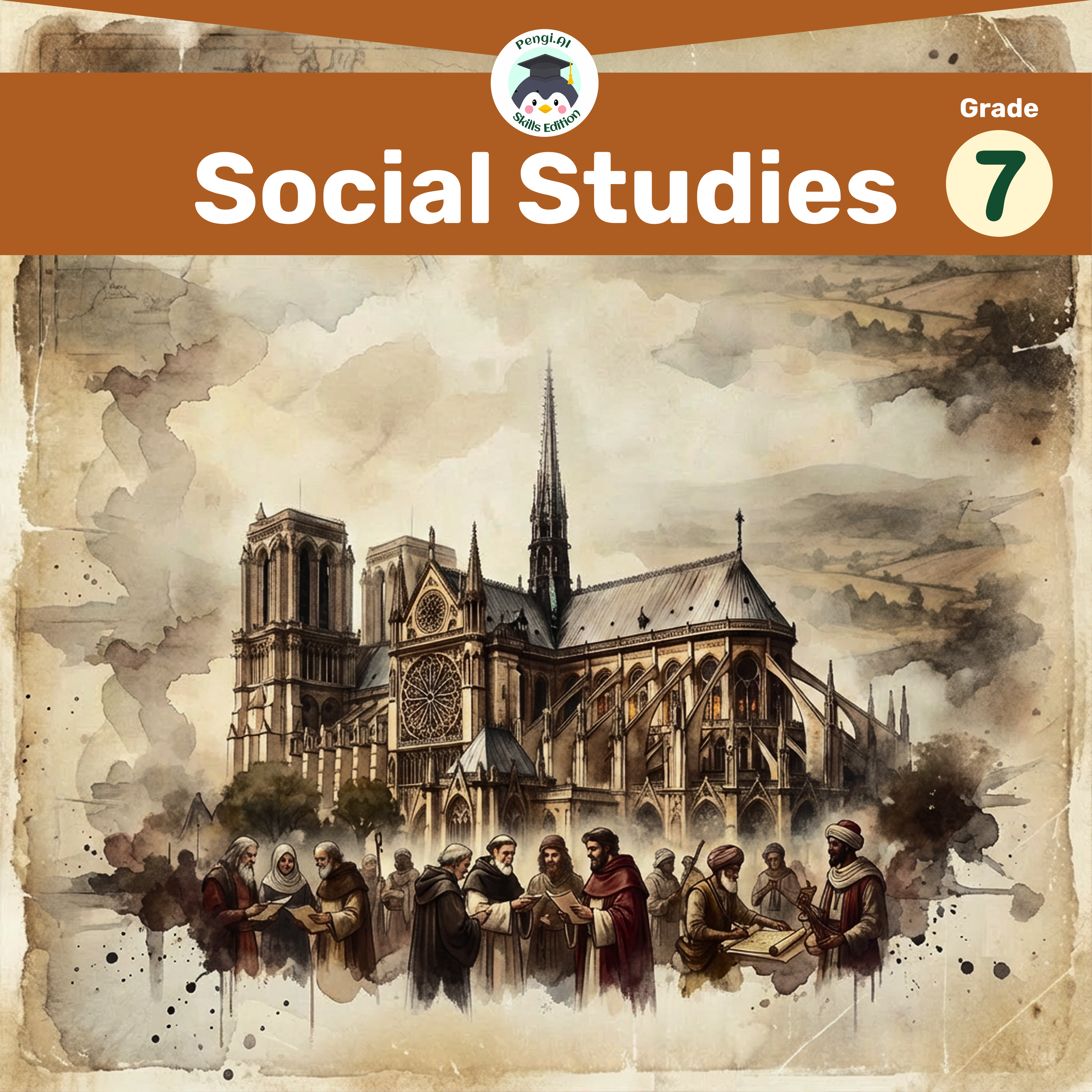
Pengi Social Studies (Grade 7)
Pengi Social Studies (Grade 7), published by Pengi, is a world history textbook designed for seventh-grade students. It covers a broad range of ancient and medieval civilizations and societies, including the Byzantine Empire, the Islamic World, South Asian trade routes, Imperial China, Feudal Japan, West African civilizations, the Americas, and Medieval Europe. The course concludes with an exploration of the Renaissance, the Reformation, and the dawn of the Early Modern World.
Chapters & Lessons
Chapter 1: The Byzantine Empire
3 lessonsIn this Grade 7 Pengi Social Studies lesson from Chapter 1: The Byzantine Empire, students examine why the Eastern Roman Empire survived after the fall of Western Rome by analyzing the strategic geography of Constantinople, including its peninsula location and control of the Bosporus Strait. Students also explore the military advantages that protected the East, such as the Theodosian Walls and Greek Fire, which helped defend against Germanic invasions.
In this Grade 7 Pengi Social Studies lesson from Chapter 1: The Byzantine Empire, students analyze the Justinian Code as a systematic preservation of Roman law and examine its lasting influence on modern Western legal systems. Students also explore the architectural features of the Hagia Sophia, including pendentives and domes, and evaluate Theodora's role in shaping imperial politics under Justinian's reign.
In this Grade 7 Pengi Social Studies lesson from Chapter 1: The Byzantine Empire, students explore the Great Schism of 1054 by contrasting the Roman Catholic and Eastern Orthodox churches across key differences in language, leadership, and practice — including the roles of the Pope and Patriarch, the use of icons, and the requirement of celibacy. Students also analyze the political and theological causes that led to the permanent division of the Christian Church into its two major branches.
Chapter 2: The Islamic World
3 lessonsIn this Grade 7 Pengi Social Studies lesson from Chapter 2: The Islamic World, students examine how the arid geography of the Arabian Peninsula influenced Bedouin trade networks and clan loyalty before exploring the life of Muhammad, including the Hijrah to Medina and the unification of Arab tribes. Students then define the Five Pillars of Islam and analyze the role of the Qur'an and Sunnah in shaping daily Muslim life.
In this Grade 7 Pengi Social Studies lesson from Chapter 2: The Islamic World, students explore how the Umayyad and Abbasid Caliphates rapidly expanded their territories through trade and military conquest. Students also examine how conquered peoples, particularly Jews and Christians designated as "People of the Book," were governed under pacts of religious tolerance.
In this Grade 7 lesson from Pengi Social Studies, students explore the Golden Age of Islam by analyzing the House of Wisdom in Baghdad as a hub for translating Greek philosophers such as Aristotle and Plato. Students identify key intellectual contributions from this era, including Al-Khwarizmi's development of algebra, Ibn Sina's advances in medicine, the founding of hospitals, and breakthroughs in optics.
Chapter 3: Civilizations of South Asia & Trade
3 lessonsIn this Grade 7 Pengi Social Studies lesson from Chapter 3, students explore the establishment of the Delhi Sultanate and the political shift from Hindu kingdoms to Muslim rule in medieval India. They also analyze the cultural synthesis that emerged from this transition, including the development of the Urdu language and distinctive Indo-Islamic architecture such as the Qutub Minar.
In this Grade 7 Pengi Social Studies lesson, students map the Indian Ocean trade network — known as the "Monsoon Marketplace" — tracing the interconnected routes linking the Swahili Coast, Arabia, India, and Southeast Asia. Students learn how seasonal monsoon winds regulated merchant trade schedules and drove the growth of cosmopolitan coastal cities along these routes. The lesson is part of Chapter 3: Civilizations of South Asia & Trade.
In this Grade 7 Pengi Social Studies lesson, students explore the founding of the Mughal Empire and examine Akbar the Great's policy of religious toleration as a key factor in its expansion across South Asia. The lesson also analyzes the Taj Mahal as a landmark example of architectural syncretism, tracing how Persian, Islamic, and Indian styles blended into a single iconic monument.
Chapter 4: Imperial China
4 lessonsIn this Grade 7 Pengi Social Studies lesson on Imperial China, students analyze how the Civil Service Examination applied Confucian ideals to establish a meritocratic Scholar-Official class in Tang and Song Dynasty China. Students also examine the agricultural revolution sparked by the introduction of Champa rice and its role in driving population growth and urbanization.
In this Grade 7 lesson from Pengi Social Studies, students explore China's Four Great Inventions — woodblock printing, gunpowder, the magnetic compass, and paper money — and examine how each transformed key areas of civilization. Students learn to identify and explain the lasting impact of these innovations on literacy, warfare, navigation, and the economy within the context of Imperial China.
In this Grade 7 lesson from Pengi Social Studies, students examine how Genghis Khan unified the steppe tribes and employed the military strategies that built the Mongol Empire. The lesson also analyzes the Pax Mongolica, exploring how this era of Mongol-enforced peace revitalized the Silk Road, enabled Marco Polo's travels, and contributed to the spread of the Black Death across Eurasia.
In this Grade 7 Pengi Social Studies lesson from Chapter 4: Imperial China, students examine the maritime voyages of Zheng He and how the Tribute System shaped China's relationships with neighboring regions. The lesson then analyzes the Ming Dynasty's shift toward isolationism and the large-scale restoration of the Great Wall as a defensive strategy.
Chapter 5: Feudal Japan
3 lessonsIn this Grade 7 Pengi Social Studies lesson from Chapter 5: Feudal Japan, students explore how Korea served as a cultural bridge transmitting Chinese writing (Kanji), Buddhism, and technology to Japan. The lesson also examines Prince Shotoku's Constitution and how Japan practiced selective borrowing from China to shape its own distinct civilization.
In this Grade 7 Pengi Social Studies lesson from Chapter 5: Feudal Japan, students explore the refined court culture of Heian-period Kyoto and examine why The Tale of Genji is recognized as the world's first novel. Learners analyze how aristocratic life, artistic expression, and literature defined this era of Japanese history.
In this Grade 7 lesson from Pengi Social Studies, students diagram the feudal hierarchy of medieval Japan, identifying the roles of the Emperor, Shogun, Daimyo, and Samurai. Students then contrast Zen Buddhism and Pure Land Buddhism, examining how Zen's emphasis on discipline and meditation shaped warrior culture. The lesson also analyzes Bushido, the samurai code of loyalty and honor, within the broader context of Chapter 5: Feudal Japan.
Chapter 6: Civilizations of West Africa
3 lessonsIn this Grade 7 lesson from Pengi Social Studies, students analyze the Gold-Salt Trade across the Sahara Desert and examine how this exchange network shaped early West African civilizations. Learners also explore the role of the Niger River as a critical geographic feature that supported trade and settlement in the region. This lesson is part of Chapter 6: Civilizations of West Africa.
In this Grade 7 Pengi Social Studies lesson from Chapter 6: Civilizations of West Africa, students trace the rise of the Ghana Empire through trade taxation and examine how control of gold-salt trade routes built its wealth. The lesson then explores Mansa Musa's famous pilgrimage to Mecca and the sweeping economic impact his journey had across North Africa and the Mediterranean world. Students also study Timbuktu's role as a thriving center of Islamic scholarship and its significance to Mali's cultural legacy.
In this Grade 7 lesson from Pengi Social Studies, students explore the vital role of griots in West African civilizations and how these oral historians preserved genealogy, laws, and history through storytelling and music. Part of Chapter 6 on Civilizations of West Africa, the lesson explains how oral tradition functioned as a primary method of transmitting cultural knowledge across generations.
Chapter 7: Medieval Europe
6 lessonsIn this Grade 7 lesson from Pengi Social Studies, students explore the feudal system of Medieval Europe, examining the decentralized political structure built around the lord and vassal relationship. They also learn how the manor functioned as an economically self-sufficient unit, with serfs providing agricultural labor in exchange for land and protection. This lesson builds foundational understanding of how political power and economic life were organized in the Middle Ages.
In this Grade 7 lesson from Pengi Social Studies, students analyze the Catholic Church as the dominant authority in medieval Europe, examining the ongoing power struggle between the Pope and secular kings. The lesson also explores the rise of Scholasticism through the work of Thomas Aquinas and the emergence of universities as centers of intellectual life.
In this Grade 7 Pengi Social Studies lesson from Chapter 7: Medieval Europe, students examine the Crusades by identifying their root causes, including conflict over the Holy Land. Students then analyze the lasting effects of the Crusades, such as increased trade with the East and the decline of the feudal nobility.
In this Grade 7 Social Studies lesson from Chapter 7: Medieval Europe, students map the spread of the Bubonic Plague and examine how the resulting labor shortages contributed to the end of serfdom in medieval Europe. Students also analyze the Hundred Years' War and explore the rise of nationalism through the story of Joan of Arc.
In this Grade 7 Pengi Social Studies lesson from Chapter 7: Medieval Europe, students analyze the Magna Carta of 1215 and examine its foundational principles of rule of law and due process. Students also trace the origins and development of Parliament as an early form of representative government.
In this Grade 7 Pengi Social Studies lesson from Chapter 7: Medieval Europe, students trace the Reconquista and the unification of Spain in 1492, including the expulsion of Jews and Muslims from the Iberian Peninsula. Students also examine the contributions of Jewish scholars such as Maimonides, who played a key role in translating and preserving classical knowledge during the medieval period.
Chapter 8: Civilizations of the Americas
3 lessonsIn this Grade 7 lesson from Pengi Social Studies, students explore how the ancient Maya adapted to rainforest environments and organized their society into city-states. The lesson covers key Maya achievements, including the mathematical concept of zero and the development of precise astronomical calendars. Part of Chapter 8: Civilizations of the Americas, this lesson builds foundational knowledge of pre-Columbian cultures in the Western Hemisphere.
In this Grade 7 Pengi Social Studies lesson from Chapter 8: Civilizations of the Americas, students explore the engineering achievements of the Aztec capital Tenochtitlán, including the construction of chinampas and causeways. Students also examine the Aztec social hierarchy and learn how warfare and tribute systems supported the empire's power and economy.
In this Grade 7 Pengi Social Studies lesson from Chapter 8: Civilizations of the Americas, students examine how the Inca Empire governed a vast mountain territory through an extensive road network, suspension bridges, and terrace farming. Students also learn how the Mita labor tax system and Quipu record-keeping method allowed the Incas to organize their society and economy without a written alphabet.
Chapter 9: The Renaissance and Reformation
4 lessonsIn this Grade 7 Pengi Social Studies lesson from Chapter 9, students explore the Renaissance by examining the revival of classical learning through Humanism, with a focus on how Italian city-states like Florence and the Medici family shaped this cultural movement. Students also contrast Medieval art with Renaissance art, learning how techniques such as perspective and realism transformed artistic expression.
In this Grade 7 Pengi Social Studies lesson from Chapter 9: The Renaissance and Reformation, students analyze how Gutenberg's printing press transformed literacy and accelerated the spread of ideas across Europe. The lesson also examines the shift from Latin to vernacular literature, exploring the works of writers like Dante and Shakespeare as key examples of this cultural change.
In this Grade 7 Pengi Social Studies lesson from Chapter 9, students examine Martin Luther's 95 Theses and the theological doctrine of Justification by Faith as key causes of the Protestant Reformation. Students also explore how Protestant self-governing congregations laid the groundwork for the later development of Federalism, connecting religious history to political thought.
In this Grade 7 lesson from Pengi Social Studies, students analyze the Catholic Church's response to the Protestant Reformation through two key developments: the Council of Trent and the founding of the Jesuits by Ignatius of Loyola. Part of Chapter 9 on the Renaissance and Reformation, the lesson helps students understand how the Catholic Church worked to reform itself and counter the spread of Protestantism.
Chapter 10: The Early Modern World
3 lessonsGrade 7 students explore the Scientific Revolution as part of Pengi Social Studies Chapter 10, learning how thinkers like Copernicus, Galileo, and Newton shifted the foundation of knowledge from traditional authority to observation and evidence. The lesson covers key developments including Copernicus's heliocentric model and the emergence of the Scientific Method. Students analyze how these breakthroughs reshaped understanding of the natural world during the Early Modern period.
In this Grade 7 Pengi Social Studies lesson from Chapter 10: The Early Modern World, students examine the motivations behind European exploration — God, Gold, and Glory — and the technologies that made it possible, including the caravel and astrolabe. Students also map the historic voyages of Columbus and Magellan to understand how these expeditions shaped the early modern world.
In this Grade 7 Pengi Social Studies lesson from Chapter 10: The Early Modern World, students analyze the Columbian Exchange — the global transfer of plants such as corn and potatoes, animals such as horses, and diseases such as smallpox between the Old and New Worlds. Students also examine the origins and brutality of the Atlantic Slave Trade and its role in shaping the early modern world.
Frequently Asked Questions
- Is Pengi Social Studies Grade 7 right for my child?
- Pengi Social Studies Grade 7 is aligned to California seventh-grade standards and covers medieval and early modern world history — from the Byzantine Empire through the Renaissance, Reformation, and early modern global connections. It spans ten chapters covering Islam, South Asia, China, Japan, West Africa, medieval Europe, the Americas, and the early modern world. This is a broad, ambitious curriculum ideal for seventh graders in California or any school covering this historical period. The writing is accessible and the scope is well-organized, though the breadth means students need strong study habits to keep track of so many civilizations.
- Which chapters are hardest in Pengi Social Studies Grade 7?
- Chapter 2 (The Islamic World) is often the most challenging for American students because it introduces religious, legal, and cultural concepts — the Five Pillars, the Quran, Islamic law — that require substantial background context. Chapter 9 (The Renaissance and Reformation) is content-dense and requires understanding how intellectual and religious movements transform societies, which is abstract for twelve-year-olds. Chapter 3 (Civilizations of South Asia and Trade) involves complex trade networks and religious diversity (Hinduism, Buddhism, Islam in one region) that are hard to sort out. Keeping the timelines of ten civilizations distinct is a consistent challenge throughout.
- My child is overwhelmed by so much world history. Where should they start?
- Start with Chapter 1 (The Byzantine Empire) because it directly connects to ancient Rome from sixth grade, giving your child a familiar anchor before jumping into new civilizations. Chapter 5 (Feudal Japan) is often a student favorite because the samurai culture is vivid and accessible — use it as a motivating entry point if engagement is low. Encourage your child to keep a running two-column note sheet for each chapter: key people/events on the left, significance on the right. This habit prevents information from blurring together across ten chapters and is a skill that pays off in eighth grade and high school.
- What should my child study after finishing Pengi Social Studies Grade 7?
- After Pengi Social Studies Grade 7, California eighth graders transition to US History from the colonial period through industrialism. Pengi Social Studies Grade 8 or History Alive! The United States Through Industrialism covers this period. The analytical skills from Grade 7 — comparing civilizations, tracing cause-and-effect across time, analyzing primary sources — transfer directly to US History. Students who particularly enjoyed the Renaissance and Reformation chapter may want to read supplemental books about Leonardo da Vinci, the printing press, or Martin Luther to deepen that interest before Grade 8.
- How can Pengi help my child with Pengi Social Studies Grade 7?
- With ten chapters spanning ten distinct world civilizations, seventh-grade social studies is one of the most content-heavy subjects students face. Pengi helps your child build strong mental organization — explaining what makes each civilization distinct, why it rose and fell, and how it connects to other civilizations in the book. Before a test on Chapter 6 (West Africa) or an essay comparing medieval European feudalism to Japanese feudalism, Pengi organizes the key comparisons clearly. Pengi also generates targeted quiz questions for any chapter so your child is reviewing actively rather than just re-reading dense paragraphs.
Ready to start learning?
Jump into your first lesson for Pengi Social Studies (Grade 7). Free, no account required.
Start Learning