
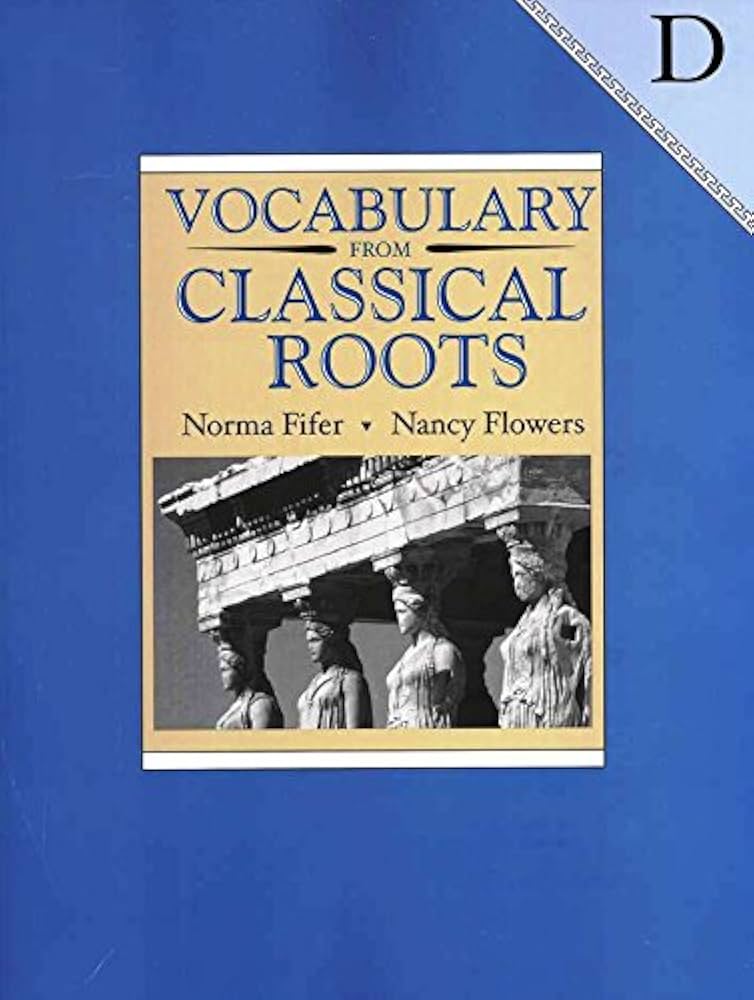
Vocabulary from Classical Roots (Book D)
Vocabulary from Classical Roots Book D is a Grade 6 vocabulary workbook that builds word knowledge by tracing English words back to their Greek and Latin origins. The book is organized into eight thematic units covering concepts such as believing, thinking and knowing, reading and writing, speaking, the natural world of earth, air, fire, and water, order and disorder in the universe, and time, with each unit pairing two lessons that explore related root words and their derivatives. Students develop a deeper understanding of word meaning and spelling patterns by studying classical roots in meaningful, interconnected contexts rather than memorizing isolated word lists.
Chapters & Lessons
Chapter 1: Believing (Lesson 1-2)
2 lessonsIn this Grade 6 vocabulary lesson from Vocabulary from Classical Roots Book D, students study 15 words rooted in the Latin cred (belief) and Greek the/theo (god), including terms such as credulous, apotheosis, theocracy, and pantheism. Exercises guide students in identifying synonyms and antonyms and recognizing correct usage in context. The lesson builds academic vocabulary tied to concepts of belief, religion, and divine authority.
In this Grade 6 lesson from Vocabulary from Classical Roots Book D, students learn 15 vocabulary words rooted in themes of belief and the sacred, including consecrate, sacrilege, sanctity, sanctuary, piety, and hieroglyphic. Students practice identifying synonyms and antonyms and distinguishing correct usage through contextual sentence exercises. The lesson builds familiarity with Latin and Greek roots related to holiness, reverence, and sacred structures as part of Chapter 1's focus on belief.
Chapter 2: Thinking and Knowing (Lesson 3-4)
2 lessonsIn this Grade 6 vocabulary lesson from Vocabulary from Classical Roots Book D, students learn 15 words rooted in concepts of thinking, knowing, and belief, including terms such as dogma, agnostic, mnemonic, prognosis, and rationalize. The lesson builds understanding of Greek and Latin roots through synonym, antonym, and sentence-usage exercises that reinforce precise word meanings and contextual application. Students develop academic vocabulary essential for reading and writing across subjects, with a focus on distinguishing closely related concepts like heterodox versus dogmatic and hypocrisy versus rationale.
In this Grade 6 lesson from Vocabulary from Classical Roots Book D, students master 15 vocabulary words rooted in concepts of thinking and knowing, including terms such as sapient, cognition, prescience, and putative. Drawing on Latin and classical origins, learners explore shades of meaning related to wisdom, awareness, reputation, and foresight through synonym, antonym, and usage exercises. The lesson builds precise word knowledge essential for reading comprehension and academic writing at the middle school level.
Chapter 3: Reading and Writing (Lesson 5-6)
2 lessonsGrade 6 students in Vocabulary from Classical Roots Book D explore the Latin roots lit (letter, reading) and scrib/script (write) alongside roots related to names and sounds, building vocabulary around words such as alliteration, obliterate, transcribe, proscribe, conscription, pseudonym, acronym, and onomatopoeia. The lesson develops skills in identifying synonyms and antonyms and recognizing correct and incorrect word usage in context. This chapter provides foundational vocabulary for understanding literary devices, writing terminology, and naming systems commonly encountered in academic reading and writing.
In Lesson 6 of Chapter 3 from Vocabulary from Classical Roots Book D, Grade 6 students study fifteen vocabulary words rooted in classical origins, including terms like epigram, choreography, topography, lexicon, eulogy, and logistics. Students practice distinguishing multiple meanings of words in context and identifying synonyms and antonyms through structured exercises. This lesson builds precise vocabulary skills essential for reading and writing at the middle school level.
Chapter 4: Speaking (Lesson 7-8)
2 lessonsIn this Grade 6 vocabulary lesson from Vocabulary from Classical Roots Book D, students study 15 words rooted in Latin stems related to speaking, saying, and language, including terms like diction, edict, malediction, valediction, jurisdiction, and polyglot. Exercises reinforce understanding through synonym and antonym identification and error-recognition activities that test precise usage of each word. The lesson builds academic vocabulary essential for reading comprehension and formal writing at the middle school level.
In Lesson 8 of Chapter 4 from Vocabulary from Classical Roots Book D, 6th graders study 16 vocabulary words rooted in Latin terms for speaking and language, including acclamation, circumlocution, lingua franca, loquacious, verbatim, and forensic. Students practice identifying synonyms and antonyms in context and interpreting multiple meanings of words like locution, clamor, and verbose. The lesson builds precise vocabulary for discussing speech, debate, and language through exercises drawn from real-world and academic contexts.
Chapter 5: Earth and Air (Lesson 9-10)
2 lessonsIn Lesson 9 of Vocabulary from Classical Roots Book D, sixth graders study fifteen words built around roots meaning earth, land, and country, including terms such as geocentric, terrestrial, apogee, perigee, humus, and terra cotta. Students practice distinguishing synonyms and antonyms and identifying correct usage in context for words like promontory, pastoral, rustic, and mountebank. This lesson builds the vocabulary foundation needed to discuss geography, ecology, and rural life with precision.
In this Grade 6 lesson from Vocabulary from Classical Roots Book D, students build word knowledge through Latin and Greek roots connected to themes of earth and air, learning terms such as animus, equanimity, ethereal, diaphanous, epiphany, phantasm, and hyperventilation. Students explore how roots like animus (spirit), aether (upper air), and hyper- (beyond) generate families of related words with nuanced meanings. The lesson develops vocabulary depth through contextual exercises that reinforce both definitions and real-world usage.
Chapter 6: Fire and Water (Lesson 11-12)
2 lessonsIn this Grade 6 vocabulary lesson from Vocabulary from Classical Roots Book D, students study 15 words rooted in themes of fire and burning, including terms like conflagration, pyromania, cauterize, scintillate, and flamboyant. Learners build precise understanding of each word's meaning and usage through synonym and antonym exercises that sharpen their ability to distinguish between closely related terms. This lesson strengthens academic vocabulary skills essential for reading comprehension and standardized test preparation.
In this Grade 6 lesson from Vocabulary from Classical Roots Book D, students master fifteen vocabulary words rooted in themes of fire and water, including terms like confluence, hydrology, inundate, flux, and pontificate. Learners practice identifying synonyms, understanding definitions, and applying words in context through structured exercises that reinforce both Latin and Greek root connections. This lesson builds academic vocabulary essential for reading comprehension and written expression across multiple subjects.
Chapter 7: Order and Disorder in the Universe (Lesson 13-14)
2 lessonsIn this Grade 6 lesson from Vocabulary from Classical Roots Book D, students build their vocabulary by studying 15 words drawn from Latin and Greek roots related to order, the cosmos, and moral conduct, including terms such as insubordinate, rectitude, cosmology, and epistolary. Exercises challenge students to identify synonyms and antonyms and recognize correct usage in context, sharpening both word knowledge and reading comprehension skills.
In this Grade 6 vocabulary lesson from Vocabulary from Classical Roots Book D, students learn fifteen Latin-rooted words centered on themes of change, disorder, and moderation, including terms such as immutable, transmute, permutation, turbid, and temperance. The lesson builds word knowledge through synonym and antonym exercises that sharpen students' ability to distinguish nuanced meanings, such as temerity versus confidence or imperturbable versus perturbed. Part of Chapter 7 on Order and Disorder in the Universe, Lesson 14 strengthens classical vocabulary skills essential for reading comprehension and academic writing at the middle school level.
Chapter 8: Time (Lesson 15-16)
2 lessonsIn this Grade 6 vocabulary lesson from Vocabulary from Classical Roots Book D, students study fifteen words rooted in concepts of time, including terms like anachronism, synchronous, millennium, diurnal, and equinox. The lesson builds understanding of Latin and Greek roots related to time, sequence, and duration through synonym, antonym, and usage exercises. It is part of Chapter 8's two-lesson unit on time-based vocabulary designed to strengthen academic and classical word knowledge.
In Grade 6 Vocabulary from Classical Roots (Book D), Lesson 16 introduces 15 vocabulary words rooted in concepts of time, newness, and memory, including terms such as novice, neologism, neophyte, immemorial, moratorium, and senescent. Students practice identifying synonyms and antonyms and analyzing correct word usage in context. This lesson builds precise vocabulary skills essential for reading comprehension and standardized test preparation.
Frequently Asked Questions
- Is Vocabulary from Classical Roots Book D right for my sixth grader?
- Vocabulary from Classical Roots Book D is an excellent choice if you want your child to build lasting vocabulary rather than memorize word lists that are forgotten after a test. By teaching Greek and Latin roots, it gives students a systematic way to decode unfamiliar words throughout their academic career. Book D is designed for Grade 6 and covers themes like believing, thinking, speaking, and the natural world. It works best as a supplemental vocabulary program alongside your child's main ELA curriculum. Students who are preparing for middle school reading or pre-SAT vocabulary building will benefit from its rigorous, root-based approach.
- Which parts of Vocabulary from Classical Roots Book D are hardest for sixth graders?
- The lessons on abstract concepts - like Chapter 1 on belief (credulous, theocracy, apotheosis) and Chapter 2 on thought and knowledge - are hardest because the vocabulary is genuinely sophisticated and the concepts are philosophical. Students who have not yet encountered words like sanctity, pantheism, or sacrilege have no mental hook to hang them on. The Chapter 7 unit on time and order can also be tricky because the words are less commonly heard in everyday speech. The synonym and antonym exercises catch students who try to guess rather than truly learn root meanings.
- My child is overwhelmed by the Greek and Latin roots. Where should they start?
- Start with Chapter 1, Lesson 1 and focus on just two roots: cred (believe) and the/theo (god). Have your child write down three words they already know that contain each root before looking at the textbook list - credible, credit, incredible, and athlete are all familiar. That prior knowledge connection is key. Do not try to learn all 15 words in one sitting. Three to five words per session, with the root meaning as the anchor, is the right pace. Vocabulary from Classical Roots rewards slow, methodical learning over cramming.
- My child just finished Vocabulary from Classical Roots Book D. What should they study next?
- Book E covers Grade 7 content and continues the Greek and Latin roots approach with new thematic units. If your child mastered Book D thoroughly, they are well-prepared. For additional challenge, introducing a dedicated SAT/PSAT vocabulary program that builds on root knowledge - like Vocabulary Workshop or Barron's Word Master - is a great complement. Students who enjoy etymology can also explore books on word origins like The Story of English or read widely in nonfiction, where academic vocabulary naturally reinforces what they learned from the roots.
- How can Pengi help my child with Vocabulary from Classical Roots Book D?
- Pengi can quiz your child on roots and words in a conversational way that is more engaging than flashcards. For example, it can give your child a sentence and ask them to identify the root and explain the word meaning, or ask them to generate an original sentence using a word like credulous or sanctity. Pengi can also explain why a specific word means what it means by tracing it back to its Greek or Latin root, which reinforces the root-based learning approach the textbook uses. It is especially helpful when your child encounters an unfamiliar derivative outside the book.
Ready to start learning?
Jump into your first lesson for Vocabulary from Classical Roots (Book D). Free, no account required.
Start Learning