
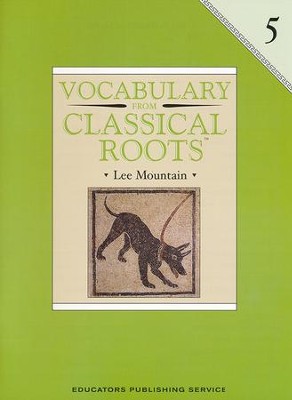
Vocabulary from Classical Roots (Book 5)
Vocabulary from Classical Roots, Book 5, published by Educators Publishing Service, is a Grade 3 vocabulary program designed to build word knowledge through the study of Greek and Latin roots, prefixes, and suffixes. Organized across four chapters with lessons covering a carefully selected set of classical roots and their English derivatives, the book helps students decode unfamiliar words and expand their academic vocabulary through etymology. This systematic approach supports reading comprehension and language development by connecting word origins to everyday and subject-area vocabulary.
Chapters & Lessons
Chapter 1: Lesson 1-3
3 lessonsGrade 3 students explore the Latin roots circ (around) and cycl (revolving) in this vocabulary lesson from Vocabulary from Classical Roots Book 5. Students learn eight words including circuit, circulate, semicircle, cycle, cyclone, recycle, and unicycle, building word meaning through root clues, synonyms, and context exercises. The lesson also introduces the number prefixes uni-, bi-, and tri- to extend understanding of word structure.
In this Grade 3 vocabulary lesson from Vocabulary from Classical Roots Book 5, students explore the Latin roots equ (same, even, equal) and pend (hanging, weighing in the balance) to build meaning for eight words including equality, equilateral, equidistant, pendulum, and dependent. Exercises guide students to use root clues, synonyms, and context passages to connect word meanings to real-world concepts like geometry and timekeeping. The lesson also introduces the prefix quadr- to extend understanding of number-based word parts.
In this Grade 3 lesson from Vocabulary from Classical Roots (Book 5), students learn the Latin prefixes trans- (across) and inter- (between) through ten vocabulary words including transmit, transfusion, interfere, intersect, and intermittent. The lesson also introduces the root sect (cut) with related words bisect, trisect, and section. Exercises guide students to apply prefix clues, identify synonyms, and use vocabulary in context to deepen word knowledge.
Chapter 2: Lesson 4-6
3 lessonsIn this Grade 3 vocabulary lesson from Vocabulary from Classical Roots Book 5, students explore the Latin roots aqua (water) and terr (land) to build understanding of eight key words, including aquatic, aquaculture, subterranean, terrain, and territory. Exercises guide students to use root clues, identify synonyms, and apply words in context through a passage about the Mediterranean Sea. The lesson also extends vocabulary by introducing the root marin through words like mariner, submarine, and marina.
In this Grade 3 vocabulary lesson from Vocabulary from Classical Roots Book 5, Chapter 2, students explore the Latin and Greek roots tele (far away) and astr (star; outer space) to build understanding of eight key words including telescope, astronaut, teleconference, and astronomy. Students practice using root clues, identifying synonyms, and applying words in context to strengthen their vocabulary skills. The lesson also extends learning by introducing related -scope words such as microscope, periscope, and kaleidoscope.
In this Grade 3 vocabulary lesson from Vocabulary from Classical Roots (Book 5), students learn how the prefixes in- and semi- change the meaning of base words, building words such as inactive, insignificant, semiannual, and semiconscious. Exercises guide students through matching prefix clues to meanings, identifying synonyms, and using context to fill in blanks with vocabulary words. The lesson also extends learning by exploring related negative prefixes — ig-, il-, im-, and ir- — and comparing them to un-, dis-, and non-.
Chapter 3: Lesson 7-9
3 lessonsIn this Grade 3 lesson from Vocabulary from Classical Roots Book 5, students learn eight vocabulary words built from the Latin roots civi (relating to citizens) and ord (regular), including civics, civil, civilian, civility, uncivilized, coordinate, extraordinary, and ordinarily. Through exercises using root clues, antonyms, and context-based fill-in-the-blank passages, students practice connecting word meanings to their classical origins. The lesson also extends learning by exploring the -ity suffix and its relationship to adjective forms.
In this Grade 3 vocabulary lesson from Vocabulary from Classical Roots Book 5, students explore the Latin roots metr/meter (measurement) and therm (heat) to understand words like diameter, perimeter, geometry, thermometer, and thermostat. Exercises guide students through synonyms, context clues, and vocabulary extension activities that connect these terms to real-world math and science concepts. The lesson builds word analysis skills by showing how shared roots link related words across subjects.
In Lesson 11 of Chapter 3 from Vocabulary from Classical Roots Book 5, Grade 3 students explore the Latin roots struct (build) and tract (pull) to understand words like construction, destructive, reconstruct, contraction, extract, protractor, retract, traction, and structure. Students practice identifying antonyms, using vocabulary in context, and expanding their knowledge of the prefix ex- and its variant e-, which both mean "out." This lesson builds word analysis skills by connecting root meanings to real-world concepts in grammar, math, and everyday language.
Chapter 4: Lesson 10-12
3 lessonsIn Lesson 13 of Chapter 4 in Vocabulary from Classical Roots Book 5, Grade 3 students explore the Latin roots frac/frag and rupt, both meaning "breaking," to build understanding of eight vocabulary words including fracture, fragility, fragment, abrupt, disrupt, interruption, and rupture. Students practice recognizing root clues, identifying synonyms, and using words in context through exercises drawn from real-world scenarios like archaeological digs. The lesson also introduces the suffix -ment and its role in forming nouns from base words.
In this Grade 3 lesson from Vocabulary from Classical Roots Book 5, students explore the Latin roots bas (foundation, low part) and pos (placement) to build understanding of eight vocabulary words including basement, basis, composition, dispose, exposure, and position. Exercises guide students to use root clues, identify synonyms, and apply words in context to sharpen both vocabulary and word-analysis skills.
In this Grade 3 vocabulary lesson from Vocabulary from Classical Roots Book 5, students learn the meanings of the Latin prefixes com-/con- (together; with) and re- (again; back) and apply them to eight vocabulary words including committee, conjunction, communicate, reflect, and reelect. Exercises guide students through identifying synonyms, using words in context, and sorting prefix spelling variations such as col-, co-, and cor- to understand how these prefixes change form depending on the root they join.
Frequently Asked Questions
- Is Vocabulary from Classical Roots Book 5 right for my 3rd grader?
- Vocabulary from Classical Roots Book 5 is a strong choice for 3rd graders who are already reading above grade level or who need enrichment beyond their classroom vocabulary program. It teaches Greek and Latin roots systematically — covering roots like circ, cycl, aqua, terr, struct, and tract — so students learn to decode unfamiliar words rather than just memorize lists. If your child is precocious with language, enjoys puzzles, or needs prep for gifted program assessments, this book delivers vocabulary that will serve them through high school.
- Which lessons in Vocabulary from Classical Roots Book 5 are hardest for students?
- Lesson 7 on the prefixes in- and semi- (Chapter 2) tends to be tricky because students have to learn that the same prefix changes form to ig-, il-, im-, or ir- depending on the root it attaches to. Lessons in Chapter 3 — particularly Lesson 10 on measurement roots (metr/meter, therm) and Lesson 11 on struct and tract — are harder because the vocabulary is dense with subject-area words. Taking these lessons one root family at a time rather than the whole lesson at once helps a lot.
- My child struggles with vocabulary in science and math class — where should they start in this book?
- Start with Chapter 3, Lesson 10 (Measuring in Math and Science), which teaches roots like metr/meter and therm — roots behind words your child already hears in class like perimeter, diameter, thermometer, and thermostat. Then try Chapter 1, Lesson 2 (Balancing Evenly) to build words like equilateral and equidistant, which show up in math class. Going root-by-root and connecting each new word to something familiar from class makes the learning feel useful rather than abstract.
- What should my child work on after Vocabulary from Classical Roots Book 5?
- The series continues with Book 6, which covers more complex roots and extends into academic vocabulary appropriate for upper elementary. Students who complete Book 5 in 3rd grade are typically well positioned to move to Book 6 in 4th grade. This root-based approach to vocabulary builds a strong foundation for middle school, where students encounter a dramatic spike in academic and subject-area vocabulary across science, history, and literature.
- How can Pengi help my child with Vocabulary from Classical Roots Book 5?
- Pengi can make root-based vocabulary learning interactive and fun. Instead of flash cards, your child can ask Pengi to quiz them on Chapter 1 circle and cycle words, or to explain how the trans- prefix changes the meaning of a root in Lesson 3. Pengi can also give sentences using words from any lesson so your child sees the vocabulary in real context. For 3rd graders especially, having a patient conversational partner who never rushes makes a big difference in how quickly the words stick.
Ready to start learning?
Jump into your first lesson for Vocabulary from Classical Roots (Book 5). Free, no account required.
Start Learning