
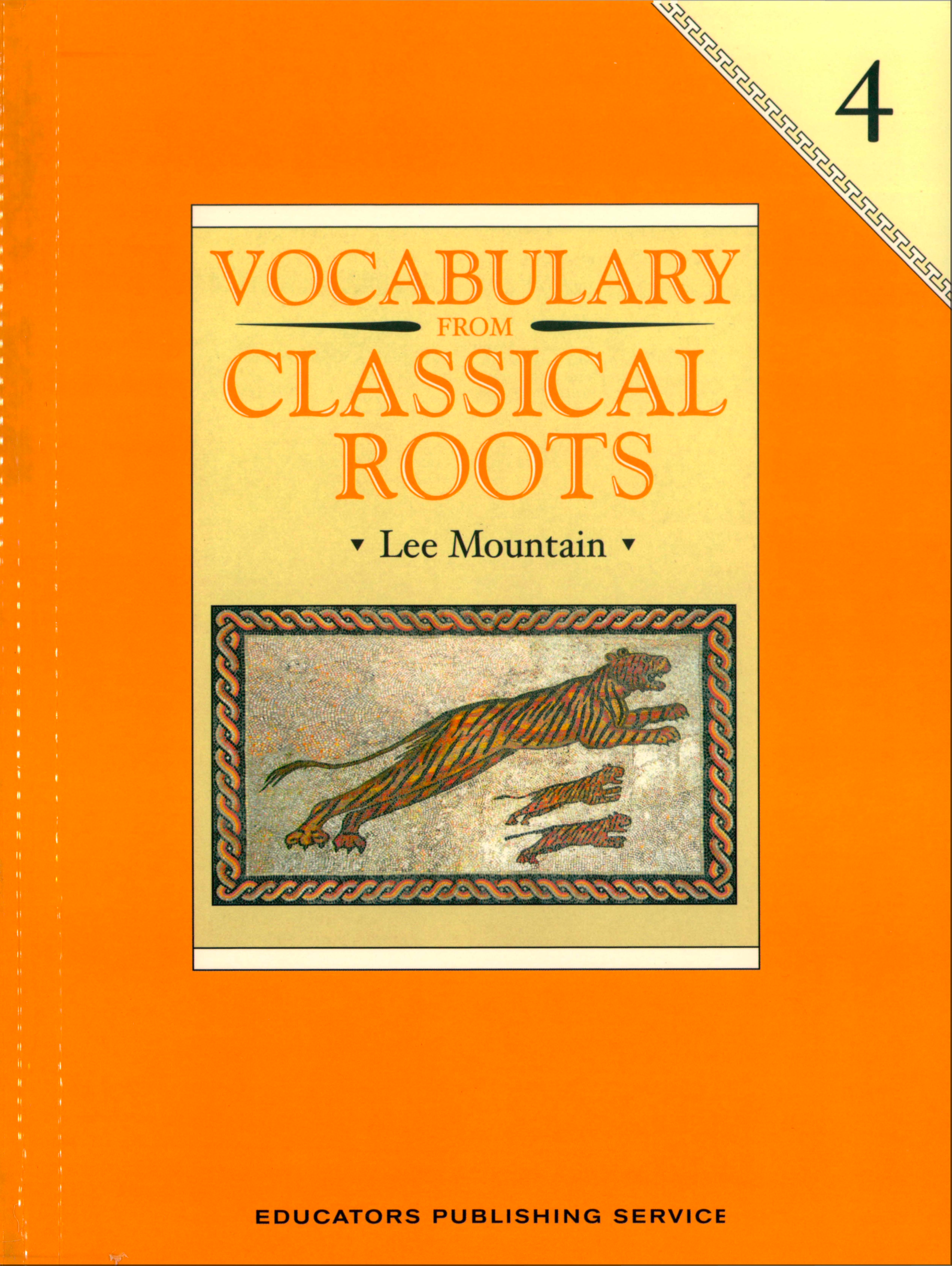
Vocabulary from Classical Roots (Book 4)
Vocabulary from Classical Roots (Book 4) is a Grade 3 vocabulary workbook from Educators Publishing Service that builds students' word knowledge through the systematic study of Greek and Latin roots, prefixes, and suffixes. Organized across four chapters and fifteen lessons, the book guides young learners through classical word origins, definitions, and contextual usage exercises designed to help them decode and retain unfamiliar vocabulary. By connecting modern English words to their ancient roots, students develop lasting vocabulary skills that support reading comprehension and writing across all subject areas.
Chapters & Lessons
Chapter 1: Lesson 1-3
3 lessonsIn this Grade 3 vocabulary lesson from Vocabulary from Classical Roots Book 4, students explore the Latin roots grad (step, grade level) and sens (feeling, sensing) to build understanding of words like gradually, graduation, sensation, sensible, and sensitive. Exercises guide students through identifying synonyms, using vocabulary in context, and recognizing how the adverb suffix -ly changes meaning. The lesson connects word origins to everyday language, helping students develop lasting vocabulary skills.
In this Grade 3 vocabulary lesson from Vocabulary from Classical Roots (Book 4), students explore the Latin roots mot (to move) and numer (number) to build understanding of eight words including motivate, motive, numerator, and numerous. Exercises guide students through synonyms, context-based fill-in-the-blank practice, and the adjective suffix -less using motionless as a model. By the end of the lesson, students can connect word meanings to their roots and apply new vocabulary in sentences.
In this Grade 3 vocabulary lesson from Vocabulary from Classical Roots Book 4, students explore eight words built from the Latin roots deli (pleasant) and ques (to ask or search), including delicacy, delicate, delicatessen, delicious, delightful, quest, questionable, and questionnaire. Exercises guide students to use root clues to decode word meanings, identify synonyms, and practice the adjective suffix -ful. The lesson builds foundational vocabulary skills by connecting word origins to everyday contexts.
Chapter 2: Lesson 4-6
3 lessonsIn this Grade 3 vocabulary lesson from Vocabulary from Classical Roots Book 4, students explore the Latin roots "part" (separate piece) and "studi" (to learn or study) to build understanding of eight related words, including partial, partition, partner, studio, and understudy. Exercises guide students through synonyms, meaning in context, and a word study of the noun suffix -ness using studiousness as the key example. The lesson helps students recognize how shared roots connect word meanings and how suffixes change a word's part of speech.
In this Grade 3 vocabulary lesson from Vocabulary from Classical Roots Book 4, students explore the Latin roots serv (to help, to serve) and vari (different, changing) to build understanding of eight related words including deserve, serviceable, variable, variation, and variety. Exercises guide students through identifying synonyms, using words in context, and applying the adjective suffix -ous to expand their word knowledge. This lesson is part of Chapter 2 and strengthens students' ability to decode and use academic vocabulary drawn from classical word roots.
In this Grade 3 vocabulary lesson from Vocabulary from Classical Roots Book 4, students explore the Latin roots eas (comfort) and fin (end) to understand eight words including ease, uneasy, finale, finalist, finite, and unfinished. Exercises guide students through identifying synonyms, using words in context, and applying the comparative suffixes -er and -est. The lesson builds word analysis skills by connecting root meanings to everyday English vocabulary.
Chapter 3: Lesson 7-9
3 lessonsIn this Grade 3 vocabulary lesson from Vocabulary from Classical Roots Book 4, students explore the Latin roots famil and speci to build understanding of eight key words including familiar, familiarity, familiarize, specialist, specialty, species, specific, and specify. Students practice using these words through synonym matching, fill-in-the-blank exercises, and a study of the verb suffix -fy/-ify with related words like clarify, satisfy, and unify. The lesson connects root meanings to word definitions, helping students recognize how shared origins link word families in English vocabulary.
In this Grade 3 vocabulary lesson from Vocabulary from Classical Roots Book 4, students explore the Latin roots act (to do) and offic (duty, work) to build understanding of eight related words including active, enact, officer, official, and officiate. Exercises guide students to use root clues, identify synonyms, and apply words in context. The lesson also introduces the adjective suffix -ive, showing how it transforms verbs like attract and invent into descriptive words.
In this Grade 3 vocabulary lesson from Vocabulary from Classical Roots Book 4, students explore the Latin roots capt (to take or catch) and stat (standing position) to build understanding of eight words including captivate, captivity, stationary, and understate. Exercises guide students through identifying synonyms, using words in context, and analyzing the verb suffix -ate to distinguish it from words where -ate is not a suffix.
Chapter 4: Lesson 10-12
3 lessonsIn this Grade 3 vocabulary lesson from Vocabulary from Classical Roots Book 4, students explore the Latin roots class (group) and grat (thankful) to build understanding of eight words including classify, classification, gratitude, and gratuity. Exercises guide learners to use root clues, identify synonyms, and apply words in context through a passage featuring Charlotte's Web. The lesson also introduces the noun suffix -tude, connecting vocabulary to geography terms like latitude and altitude.
In this Grade 3 vocabulary lesson from Vocabulary from Classical Roots Book 4, students explore words built from the roots organ (tool, instrument) and prob (to test or prove), learning terms such as organism, disorganized, organization, probability, probable, and probe. Exercises guide students to use root clues, identify synonyms, and apply words in context. The lesson also introduces the noun suffix -ist, helping students understand how words like organist, artist, and novelist are formed.
In this Grade 3 vocabulary lesson from Vocabulary from Classical Roots Book 4, students explore the Latin roots loc (place) and techn (practical skill) to build understanding of eight key words including local, locomotion, relocate, technician, technique, and technology. Exercises guide students through synonyms, context clues, and root analysis, including identifying that locomotion is formed from two roots. Students also practice applying the vocabulary through original sentences and personal writing prompts.
Frequently Asked Questions
- Is Vocabulary from Classical Roots Book 4 the right vocabulary program for my 3rd grader?
- Vocabulary from Classical Roots Book 4 is a great choice if your child is a strong 3rd grader who is ready to start building word knowledge through Latin and Greek roots. The book teaches roots like grad, sens, mot, numer, part, and serv in a gradual, lesson-by-lesson format with exercises that connect new words to everyday contexts. It is more structured and academically rigorous than typical Grade 3 vocabulary workbooks. If your child enjoys figuring out how words are connected rather than just memorizing lists, this program works very well. Students who struggle with reading fluency may need additional support alongside this program.
- Which lessons in Vocabulary from Classical Roots Book 4 are typically the hardest for 3rd graders?
- Chapter 4 Lesson 14 (roots organ and prob, covering words like organism, probability, and probe) tends to be challenging because the vocabulary is more scientific and abstract than the earlier lessons. Lesson 11 in Chapter 3 (roots capt and stat, covering words like captivate and stationary) can also be difficult because the suffix -ate rule requires students to distinguish it from non-suffix uses. Lesson 13 (roots class and grat) introduces concepts like gratitude and gratuity that require understanding social context. Generally, the Chapter 4 lessons are harder than Chapters 1 and 2, which deal with more concrete and familiar roots.
- My child is brand new to root-based vocabulary — where should they start in Book 4?
- Start with Chapter 1 Lesson 1 (roots grad and sens), which introduces accessible words like gradually and sensible through familiar contexts. Then move to Lesson 2 (roots mot and numer) with words like motivate and numerous. These two lessons teach the foundational skill of connecting root meaning to word meaning in a gentle way. Chapter 2 Lessons 5, 6, and 7 on part, serv, and fin are also very concrete and build confidence before the more abstract vocabulary in Chapters 3 and 4. The suffix exercises in each lesson (like -ly, -less, and -ful) are important to work through carefully as they build grammatical awareness alongside vocabulary.
- What should my child study after finishing Vocabulary from Classical Roots Book 4?
- After completing Book 4, your child is ready for Vocabulary from Classical Roots Book A (Grade 4), which continues the root-based program with a broader range of themes including numbers, opposites, creativity, travel, sports, and animals. The root-recognition skills built in Book 4 transfer directly to every academic subject — science vocabulary like locomotion and technical in Book 4's Lesson 15 previews the scientific terminology your child will encounter in Grade 4 and beyond. Continued independent reading at or above grade level will reinforce and extend the vocabulary from all 15 lessons.
- How can Pengi help my child with Vocabulary from Classical Roots Book 4?
- Pengi can make vocabulary review much more interactive and personalized for a 3rd grader. After your child completes Lesson 9 on roots famil and speci, Pengi can create a fun quiz where your child has to match words like specialist and specify to their root meanings rather than just filling in blanks from a familiar worksheet. For lessons where your child struggles with the suffix exercises — like applying -tude from Lesson 13 or -ist from Lesson 14 — Pengi can provide extra examples and guided practice using words the child already knows. Pengi adjusts to your child's pace, spending more time on tough vocabulary and moving quickly through what they already know well.
Ready to start learning?
Jump into your first lesson for Vocabulary from Classical Roots (Book 4). Free, no account required.
Start Learning