
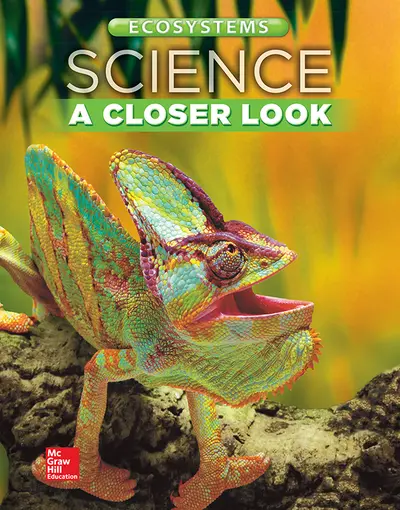
Science: A Closer Look (Grade 4)
Science: A Closer Look (Grade 4), published by McGraw-Hill, is a comprehensive science textbook designed for fourth-grade students. It covers a broad range of foundational topics including the kingdoms of life, ecosystems, Earth's physical processes, weather and climate, and the properties and changes of matter. The curriculum builds scientific literacy by connecting life science, earth science, and physical science concepts through hands-on inquiry and real-world examples.
Chapters & Lessons
Chapter 1: Kingdoms of Life
4 lessonsIn this Grade 4 lesson from Science: A Closer Look, students learn that cells are the basic building blocks of all living things and explore key vocabulary including cell, organism, oxygen, tissue, organ, and organ system. Students also discover the five life functions that define organisms — growing, using food, getting rid of wastes, reproducing, and reacting to changes in the environment. Hands-on microscope observations of onion skin and leaf slides help students connect these concepts to real plant structures.
In this Grade 4 lesson from Science: A Closer Look, students learn how scientists classify living things using traits such as cell structure, number of cells, presence of a nucleus, food source, and movement. Students explore the six kingdoms — ancient bacteria, bacteria, protists, fungi, plants, and animals — and discover how organisms are further grouped into phylum, class, order, family, genus, and species. Hands-on sorting activities help students understand how shared characteristics form the basis of biological classification.
In this Grade 4 lesson from Science: A Closer Look, Chapter 1, students explore how plants are classified by their structures and reproductive methods, learning key terms such as roots, stems, photosynthesis, stomata, transpiration, and spores. Students discover how roots, stems, and leaves work together to help plants obtain water and produce food through photosynthesis, and they compare plants that reproduce by seeds versus spores. Hands-on leaf observation activities reinforce scientific skills like making predictions, recording data, and drawing inferences.
In this Grade 4 lesson from Science: A Closer Look, Chapter 1, students learn how seed plants reproduce through key processes including pollination, fertilization, and germination, and explore how seeds are stored in flowers, fruits, and cones. Students also classify seed plants by comparing seed structures and discover the difference between flowering plants and conifers. A hands-on investigation tests whether seeds need water to germinate, reinforcing the concept of a plant's life cycle from seed to maturity.
Chapter 2: Exploring Ecosystems
4 lessonsIn this Grade 4 lesson from Science: A Closer Look, Chapter 2, students learn to distinguish between biotic factors (living things) and abiotic factors (nonliving things) and understand how these elements interact to form an ecosystem. Students also explore key vocabulary including habitat, population, and community while investigating how organisms depend on one another within an ecosystem. The lesson uses hands-on observation activities to help students classify and compare living and nonliving things in real-world environments.
In this Grade 4 lesson from Science: A Closer Look, Chapter 2, students explore how energy flows through an ecosystem by learning the roles of producers, consumers, and decomposers, along with key concepts like food chains, food webs, and energy pyramids. Students model how energy is transferred from the Sun through plants, herbivores, omnivores, and carnivores, discovering why less energy is available at each level. The lesson also covers how decomposers recycle nutrients and how competition shapes relationships among organisms in a community.
In this Grade 4 lesson from Science: A Closer Look, Chapter 2: Exploring Ecosystems, students learn how plants respond to environmental stimuli through a process called tropism. They discover how light, water, and gravity each trigger directional growth responses in plants, and explore how adaptations like those of mangrove trees help plants survive in challenging environments. A hands-on shoe box investigation gives students a firsthand look at how plants grow toward a light source when other directions are blocked.
In this Grade 4 lesson from Science: A Closer Look, Chapter 2: Exploring Ecosystems, students learn what fossils are and how different types form, including molds, casts, imprints, and petrified fossils. Students explore how scientists use fossil evidence to draw conclusions about ancient organisms and past environments on Earth. A hands-on modeling activity reinforces key vocabulary such as fossil, mold, cast, imprint, and nonrenewable resource.
Chapter 3: Shaping Earth
4 lessonsIn this Grade 4 lesson from Science: A Closer Look, Chapter 3, students explore Earth's major landforms — including mountains, plains, canyons, and sand dunes — and learn how water and wind shape Earth's surface over time. Students also discover Earth's internal layers (crust, mantle, outer core, and inner core) and examine features like river deltas and drainage basins where water meets land.
In this Grade 4 lesson from Science: A Closer Look, Chapter 3, students learn how the movement of Earth's tectonic plates shapes the crust through faults, folds, fault-block mountains, plateaus, and fold mountains. A hands-on clay model activity helps students explore how pressure on rock layers creates these landforms. The lesson also introduces key vocabulary including fault, plateau, fold, mountain, earthquake, seismic wave, seismograph, and volcano.
Grade 4 students learn how weathering, erosion, and deposition shape Earth's surface in this lesson from Chapter 3 of Science: A Closer Look. Students explore the difference between physical weathering and chemical weathering, discover how flowing water, wind, waves, and living things break rocks apart, and investigate how erosion transports weathered rock to new locations. A hands-on inquiry activity using soil, sand, and a spray bottle lets students model how rainfall moves land downhill.
In this Grade 4 lesson from Science: A Closer Look, Chapter 3, students explore how weather events such as floods, tornadoes, hurricanes, landslides, and avalanches cause rapid changes to Earth's surface. Students investigate how the steepness of a slope affects the movement of soil and rocks through a hands-on experiment, then apply inference skills to understand how erosion and deposition occur quickly during severe weather. The lesson builds core Earth science vocabulary and connects weather patterns to real-world land changes.
Chapter 4: Weather and Climate
4 lessonsIn this Grade 4 lesson from Science: A Closer Look, students explore Earth's atmosphere, learning how properties like temperature, humidity, and air pressure interact to create weather. Students investigate how air pressure affects wind movement through a hands-on bottle experiment, then read about the layers of the atmosphere, including the troposphere where all weather occurs. Key vocabulary such as atmosphere, humidity, wind vane, and barometer give students the scientific language to describe and measure weather conditions.
In this Grade 4 lesson from Science: A Closer Look, students explore the water cycle and learn how water changes state as it moves between Earth's surface and the atmosphere through the processes of evaporation, condensation, and precipitation. Students investigate the variables that affect how liquid water becomes water vapor, and discover how condensation forms clouds and dew. The lesson builds key vocabulary including water vapor, freezing, and precipitation within the context of Chapter 4: Weather and Climate.
In this Grade 4 lesson from Science: A Closer Look, Chapter 4, students learn how air masses and fronts — including warm fronts, cold fronts, and stationary fronts — cause weather patterns to form and change. Through a hands-on inquiry activity, students investigate how changes in air temperature affect water droplets, modeling how rain forms. Students also practice reading weather maps that display temperature, precipitation, and front locations to understand how scientists forecast weather.
In this Grade 4 lesson from Science: A Closer Look, Chapter 4, students learn the difference between weather and climate, exploring how climate is defined as the long-term pattern of temperature, humidity, precipitation, and wind in a region. Students investigate polar, tropical, and temperate climate regions and examine how factors like proximity to oceans and distance from the equator shape the climates of cities such as Chicago, Miami, Phoenix, and Seattle. The lesson builds skills in data interpretation and scientific classification using real-world weather data.
Chapter 5: Properties of Matter
3 lessonsIn this Grade 4 lesson from Science: A Closer Look, Chapter 5, students learn to identify and describe physical properties of matter, including mass, volume, buoyancy, magnetism, and the ability to dissolve. The lesson also introduces the three states of matter — solid, liquid, and gas — using hands-on exploration with cornstarch and water to compare and contrast how matter can behave. Students practice measuring mass with a balance and volume with graduated cylinders while building foundational vocabulary for understanding the physical world.
Grade 4 students explore how matter is measured using standard units in this lesson from Chapter 5 of Science: A Closer Look. Students learn key measurement concepts including length, area, density, and weight, as well as how the metric system uses prefixes like kilo-, centi-, and milli- to define units based on powers of ten. The lesson also covers how to calculate area by multiplying length by width and how to compare irregular shapes using unit squares.
In Grade 4 Science: A Closer Look, Chapter 5 Lesson 3, students learn to classify matter by identifying elements, atoms, metals, nonmetals, and metalloids using the periodic table. The lesson teaches students how to distinguish metals from nonmetals based on properties such as luster, ability to bend, and heat conductivity. Students also explore chemical symbols for elements and conduct hands-on investigations to test and classify unknown materials.
Chapter 6: Matter and Its Changes
4 lessonsIn Grade 4 Science: A Closer Look, Chapter 6 Lesson 1, students learn to distinguish between physical changes and chemical changes in matter. The lesson covers key concepts including change of state, evaporation, rust, and tarnish, while students investigate how altering the shape of clay affects its mass and volume. Through hands-on inquiry and real-world examples, fourth graders build understanding of how matter behaves differently depending on the type of change it undergoes.
In this Grade 4 lesson from Science: A Closer Look, Chapter 6, students learn what a mixture is and how to distinguish between mixtures, solutions, and alloys using real-world examples like salt water and bronze. Students also explore how physical properties such as density, filtration, and distillation can be used to separate the parts of a mixture. Hands-on experiments with salt, sand, sugar, and gelatin help students observe how different solids interact with water.
In this Grade 4 lesson from Science: A Closer Look, Chapter 6, students explore thermal energy and learn how heat flows from warmer objects to cooler objects through three processes: conduction, convection, and radiation. Students also discover the difference between thermal energy and temperature, and how thermometers measure temperature using both the Fahrenheit and Celsius scales. The lesson introduces key vocabulary including insulators and conductors to explain why some materials transfer thermal energy more effectively than others.
Frequently Asked Questions
- Is Science: A Closer Look Grade 4 the right textbook for my child?
- Science: A Closer Look (Grade 4) by McGraw-Hill is a widely used, standards-aligned textbook that covers all three main branches of science — life, earth, and physical — in a single volume. It is appropriate for most 4th graders in public school and is especially well-suited if your child is naturally curious and enjoys hands-on activities. The book covers the kingdoms of life, ecosystems, Earth processes, weather, and properties of matter, making it a solid foundation for 5th-grade science and beyond. It pairs well with NGSS-aligned supplemental activities.
- Which chapters or topics are hardest in Science: A Closer Look Grade 4?
- Chapter 5 on properties and changes of matter is where many 4th graders hit a wall — concepts like physical versus chemical changes, atoms, and the differences between elements and compounds can feel very abstract at this age. Chapter 3 on Earth processes is also challenging because students need to visualize tectonic plate movement and distinguish between weathering, erosion, and deposition (Lessons 3.2 and 3.3). Hands-on demonstrations or YouTube videos of these processes help a lot alongside the textbook reading.
- My child is weak in life science concepts — where should they start?
- Start with Chapter 1, Lesson 1 on cells, which introduces the vocabulary and big picture of what makes something alive. From there, Lesson 2 on classifying living things gives your child a framework to organize everything else. Lesson 3 on the plant kingdom and Lesson 4 on seed plant reproduction build naturally on each other. If your child is coming in weak, doing the hands-on microscope and seed germination activities alongside the reading will make the concepts stick much better.
- What does my child study after Science: A Closer Look Grade 4?
- The Grade 4 content serves as direct preparation for 5th-grade science, which typically covers more advanced physical science (matter at the molecular level, forces and motion), deeper Earth science (rock cycle, ecosystems at scale), and life science (human body systems). McGraw-Hill publishes Grade 5 in the same A Closer Look series, so the vocabulary and format will already be familiar to your child. Building strong science vocabulary in 4th grade pays dividends throughout middle and high school science.
- How can Pengi help my child with Science: A Closer Look Grade 4?
- Pengi can help your 4th grader review vocabulary, work through reading comprehension questions, and understand tricky concepts like the water cycle or food webs at a level that is easy to grasp. If your child is preparing for a chapter test on Chapter 2 ecosystems or Chapter 4 weather and climate, Pengi can quiz them on key terms like biotic, abiotic, condensation, and precipitation in a conversational way that keeps them engaged. It also helps explain the why behind concepts rather than just the what.
Ready to start learning?
Jump into your first lesson for Science: A Closer Look (Grade 4). Free, no account required.
Start Learning